
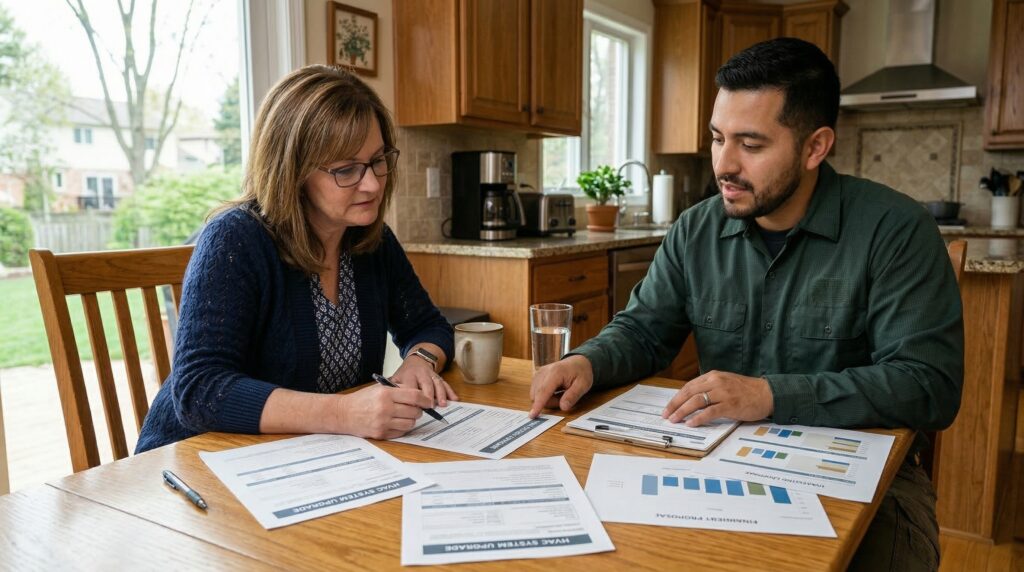
Most HVAC replacements run between $7,000 and $13,000. Homeowners replacing with a York system can access York dealer financing through York Certified Comfort Expert dealers, with typical 12 to 18 month 0% promotional periods available. Few homeowners keep that kind of cash on hand when the system fails in August. The good news is that financing options are widely available. In cities like Las Vegas, NV where full system replacements regularly run $10,000 to $16,000, financing is a common choice. The frustrating part is that the terms vary enormously, and the paperwork your contractor hands you often glosses over the details that matter most. Before finalizing financing, it helps to know how long HVAC replacement takes so you can plan around the installation timeline. Sellers financing a replacement before or after closing have specific options: see HVAC Replacement and Home Sale for how to structure the negotiation.
This guide walks through every HVAC financing path available in 2026: contractor programs, home equity options, government programs, and personal loans. Before financing, check what incentives you qualify for. The federal 25C heat pump tax credit expired December 31, 2025, but state rebates and utility rebates remain. See our heat pump tax credit 2026 guide to understand what is still available. Massachusetts homeowners can also stack MassSave rebates with the 0% HEAT Loan: see the Massachusetts HVAC replacement cost guide for details. For each one, you’ll see real monthly payment numbers, the total interest cost, and the questions to ask before you sign anything.
What HVAC Financing Options Are Available to Homeowners?
Homeowners replacing an HVAC system have five main financing paths. Each has different approval requirements, interest costs, and risk profiles. The right choice depends on your credit score, how much equity you have in your home, and whether you can pay off a promotional balance before it expires.
| Financing Type | Typical APR | Typical Term | Credit Required | Best For |
|---|---|---|---|---|
| Contractor financing (deferred interest) | 0% promo, then 26–29% | 12–18 months promo | 620+ | Homeowners who can pay it off in full before the promo ends |
| Contractor financing (true installment) | 9–15% APR | 36–84 months | 640+ | Homeowners who need predictable monthly payments long-term |
| HELOC or home equity loan | 8.5–10.5% APR | 5–15 years | 660+ / 20% equity | Homeowners with significant equity staying put 5+ years |
| Personal loan (unsecured) | 10–25% APR | 24–84 months | 580–700+ | Renters or homeowners without equity |
| PACE loan / on-bill financing | 5–9% APR | 5–25 years | No credit check | Income-qualified homeowners or those with poor credit |
Two lenders, GreenSky and Synchrony Bank, handle the large majority of contractor-offered HVAC financing in the United States. Wells Fargo Home Projects is a third significant player. This concentration matters in ways most homeowners don’t realize, which we’ll cover in the next section.
How Does Contractor HVAC Financing Work — and What Is the Catch?
When a contractor offers you “0% financing for 18 months,” that offer almost certainly comes from GreenSky, Synchrony, or Wells Fargo Home Projects. The contractor has a relationship with one of these lenders and earns a fee for each approved loan they originate. The financing product you’re signing up for is not a loan from the contractor. It is a credit card or installment loan from a national lender, with the contractor as the origination point.
Here is where the catch lives: most promotional 0% offers are deferred interest, not true 0%. The difference is significant.
With true 0% financing, no interest accrues during the promotional period. You owe exactly what you borrowed at the end.
With deferred interest, interest accrues at the full APR (typically 26.99% on Synchrony products) from day one, but the lender waits to collect it. If you pay off the full balance before the promotional period ends, the deferred interest is forgiven. If even one dollar remains unpaid at the end of month 18, the entire 18 months of backdated interest becomes immediately due.
The math is unforgiving. On an $8,000 balance at 26.99% APR, 18 months of backdated interest equals approximately $3,220. (A mid-efficiency 4-ton AC replacement falls squarely in this price range.) That is in addition to the $8,000 you still owe. Homeowners who make minimum payments and expect to pay the rest at month 18 often discover they owe far more than anticipated.
Before signing any contractor financing offer, ask directly: “Is this deferred interest or true 0% APR?” Get the answer in writing. Look for the words “deferred interest” or “waived if paid in full” in the cardholder agreement. If you see either phrase, you are dealing with a deferred interest product.
Additional red flags to watch for in contractor financing agreements: if a contractor pressures you to sign the financing agreement on the same day they quote the job, or won’t provide equipment model numbers in the written quote, these are warning signs beyond the financing terms. See the full guide to HVAC quote red flags before committing to any contractor.
- A penalty for paying off the balance early (some installment products charge 1–2% of the remaining balance)
- A “balloon payment” clause that accelerates the full balance if you miss a single payment
- A financing surcharge added to the project price (some contractors charge 3–5% more for financed jobs to offset their origination fee)
Does It Matter Which Brand’s Financing Program You Choose?
Carrier, Trane, Lennox, Goodman, and Rheem all market branded financing programs. The Carrier Comfort Pay program, Trane Comfort Credit, and Lennox financing all sound like proprietary products. They are not. Nearly every major manufacturer’s financing routes through one of the same two or three national lenders: GreenSky, Synchrony, or Wells Fargo Home Projects.
What this means in practice: the terms you get from “Carrier financing” are functionally identical to the terms you’d get from your local independent contractor’s financing, because both products originate from the same lender pools. The brand name on the financing brochure does not change the APR, the deferred interest mechanics, or the credit approval process.
The practical implication: don’t let the manufacturer’s financing program be a reason to favor one brand over another. Carrier systems and Trane systems both offer financing, but that financing comes from the same financial infrastructure. Shop the equipment and contractor quality instead. The financing terms will be nearly identical regardless of which brand is on the outdoor unit.
One exception worth noting: some regional utilities and state programs have partnerships with specific equipment brands for their rebate programs. In those cases, the brand matters for the rebate, not the financing. Check DSIRE.org for state-specific incentive programs available in your area.
Income-qualified homeowners should also check whether their state has an active IRA rebate program. HEEHRA provides point-of-sale discounts of up to $8,000 on qualifying heat pump installations, which can dramatically reduce the amount you need to finance. See the full IRA HVAC rebates guide for state availability and eligibility requirements.
When Does a HELOC or Home Equity Loan Make Sense for HVAC?
Home equity lines of credit (HELOCs) are currently running at roughly 8.5–10.5% APR as of early 2026, according to Bankrate’s weekly rate survey. That sounds higher than a 0% promotional rate from a contractor. But run the numbers over a realistic scenario, and home equity often wins on total cost.
Before financing a full replacement, consider whether a smaller repair could solve the problem. A failed capacitor, for example, looks like total system failure but costs just $150–$400 to fix. See the AC capacitor replacement guide for warning signs and pricing before committing to a full system purchase. When budgeting your total financing amount, also factor in the cost of an extended warranty. An extended parts-and-labor warranty typically adds $300–$800 to the project cost upfront, but covers major repair bills for 5–10 years. See our HVAC extended warranty cost guide to decide whether it makes sense for your situation.
Consider two homeowners, both financing an $8,000 HVAC replacement. The first takes a contractor’s 18-month deferred interest offer and makes the minimum payment each month ($120). They plan to pay the balance at month 17. Life intervenes. They carry $1,400 into month 19. The lender applies 18 months of backdated interest at 26.99%: roughly $3,220 added to their remaining balance. Total cost: over $11,000.
The second homeowner draws $8,000 from a HELOC at 9.5% APR and pays it down over 5 years at $167 per month. Total interest paid: approximately $2,000. Total cost: $10,000. And the HELOC has no deferred interest trap, no promotional period to manage, and no balloon-payment risk.
The HELOC wins in total cost for any homeowner who realistically can’t pay off a large promotional balance within 12–18 months. It also wins for any homeowner who values predictability. HELOC rates are variable, but they don’t suddenly jump to 27% if you miss a payment.
When a HELOC is not the right call:
- You plan to sell the home within 2–3 years (HELOC balance must be paid off at closing)
- Your home equity is below 20% after the draw (you risk going underwater)
- You’re already carrying a high-balance HELOC for other purposes
- You can genuinely pay off the contractor financing within the promotional window
A home equity loan (fixed-rate, lump sum) is a solid alternative to a HELOC if current rates have you concerned about rising variable payments. Rates on home equity loans currently run slightly higher than HELOCs (9–11% range) but offer payment certainty for the full term.
What Are PACE Loans and On-Bill Financing?
Property Assessed Clean Energy (PACE) loans are a government-backed financing mechanism available in about 35 states. Unlike traditional loans, PACE financing is attached to your property tax bill, not to your credit profile. Approval is based on home equity, not your FICO score.
How PACE works in practice: a PACE lender pays your HVAC contractor directly. You repay the loan through an annual addition to your property tax bill, typically over 5–25 years at rates between 5–9% APR. Because it’s a lien on the property, it transfers with the home when you sell. This is the most important thing to know about PACE: you must disclose the lien to any buyer, and it can complicate mortgage refinancing.
On-bill financing works differently. Some utilities, including Duke Energy and certain Georgia Power programs, allow customers to repay energy efficiency upgrades through their monthly utility bill. The loan is tied to the meter, not the borrower. If you sell, the new owner takes over the payments. Evergy’s FastTrack HVAC PAYS in Kansas City is one example of this model. Rates are typically low (3–7% APR), and some programs are income-qualified with reduced rates for lower-income households.
The Weatherization Assistance Program (WAP) is worth mentioning for income-qualified homeowners. WAP provides free or heavily subsidized HVAC replacements through a federal program administered by your state. Eligibility is based on income (generally at or below 200% of the federal poverty level). Visit the Department of Energy’s weatherization program page or contact your state energy office to check availability.
For a comprehensive list of state-level incentive programs, including PACE availability, on-bill financing, and weatherization assistance, DSIRE.org is the authoritative database maintained by North Carolina State University.
How Much Will Your HVAC Monthly Payment Be?
Talking about financing in the abstract doesn’t help you budget. Here are real monthly payment numbers across common system costs and financing terms. The 0% rows assume deferred interest: the balance must be paid in full by the end of the term or backdated interest applies.
| System Cost | 12 mo (0%*) | 24 mo (0%*) | 60 mo (9.99% APR) | 84 mo (12.99% APR) |
|---|---|---|---|---|
| $6,000 | $500/mo | $250/mo | $127/mo | $99/mo |
| $8,000 | $667/mo | $333/mo | $170/mo | $132/mo |
| $10,000 | $833/mo | $417/mo | $212/mo | $165/mo |
| $12,000 | $1,000/mo | $500/mo | $255/mo | $198/mo |
*Deferred interest: must pay full balance by end of promotional term or backdated interest applies at 26–29% APR.
A few observations from this table. The 12-month 0% payment on an $8,000 system ($667/month) is aggressive. Many homeowners budget for the promotional rate and then miss it. The 60-month installment at 9.99% is more forgiving at $170/month, but you’ll pay roughly $2,200 in total interest over the life of the loan. The 84-month option at 12.99% brings the monthly payment to $132, but total interest climbs to about $3,088.
Not sure what your system will cost? Use the HVAC replacement cost estimator to get a realistic project budget before your first contractor conversation. Knowing your number before you walk into a financing discussion gives you a significant advantage.
Does HVAC Financing Hurt Your Credit Score?
Applying for HVAC financing typically triggers a hard credit inquiry, which can lower your score by 5–15 points temporarily. That’s normal and expected. The inquiry drops off most scoring models within 12–24 months. More importantly, FICO’s scoring model counts multiple loan inquiries within a 14–45 day window as a single inquiry, which means you can shop multiple lenders without multiplying the damage.
General minimum credit score thresholds for common HVAC financing paths:
- GreenSky contractor programs: approximately 640
- Synchrony financing: approximately 620
- Personal loans from online lenders: 580–640 depending on lender
- HELOC or home equity loan: 660 minimum, with most approvals at 700+
- PACE loans: no credit score minimum (property equity determines eligibility)
“No credit check HVAC financing” is a phrase that appears in contractor advertising, but it usually refers to lease-to-own or rent-to-own arrangements rather than traditional loans. These products allow you to lease the equipment with an option to purchase. The effective APR on rent-to-own arrangements is often 40–80%, making them the most expensive financing option available. They work as a last resort for homeowners who genuinely cannot qualify for any other product.
Pre-qualification with a soft pull is available through most major financing programs and doesn’t affect your credit score. Ask your contractor or the lender about pre-qualifying before submitting a full application.
What Should You Ask Before Signing HVAC Financing Paperwork?
The financing conversation with a contractor typically happens at the end of a sales presentation, when you’re already committed emotionally to solving a problem. That’s the worst time to carefully read a lending agreement. Go in with these six questions ready, and get answers before the contractor leaves your home.
- Is this true 0% APR, or is this deferred interest? (Ask to see the specific language in the cardholder agreement.)
- What is the APR if I carry any balance past the promotional period?
- Is there an early payoff penalty on this loan?
- What happens to my interest rate if I miss a single payment?
- Is the price you quoted me the same price I’d pay if I paid cash? (Some contractors charge more for financed jobs.)
- Can I pay additional principal at any time without penalty?
A contractor who can’t answer these questions clearly, or who deflects when you ask to see the financing agreement before signing, is a signal to slow down. The financing terms are as important as the equipment terms. A great Carrier or Trane system financed at 26.99% deferred interest ends up costing far more than a comparable system financed through a HELOC or a pre-arranged personal loan.
One more thing worth knowing: you can often arrange your own financing before calling a contractor. If you pre-qualify for a personal loan or open a HELOC before getting quotes, you have the option to pay the contractor in cash, which sometimes earns a small discount (2–5%) and removes any confusion about deferred interest entirely. Your local costs matter too: in Albuquerque, NM, for example, homeowners pay $5,800 to $14,500 before rebates, with PNM offering up to $860 off at the point of install.
Can You Use a Federal Tax Credit to Reduce 2026 Financing?
No. The federal Section 25C credit expired for equipment placed in service after December 31, 2025. A homeowner financing an $8,000 heat pump in 2026 should budget the full financed amount unless a current utility or state program has approved a rebate for the project.
If your qualifying equipment was placed in service in 2025, review the IRS Energy Efficient Home Improvement Credit guidance and Form 5695 for the 2025 return. For a 2026 installation, see our HVAC efficiency ratings guide and ask the utility or state program administrator which current efficiency thresholds apply.
The practical financing strategy is to size payments around money you have, not an expired federal credit or an unapproved rebate. If a current rebate is paid after installation, confirm its amount and timing in writing before deciding whether to use it as a lump-sum principal payment. Your timing your replacement for maximum savings matters too. See our guide to HVAC tax credits and rebates for current program sources.
Frequently Asked Questions About HVAC Financing
What credit score do you need for HVAC financing?
Most contractor financing programs through GreenSky or Synchrony approve borrowers with scores of 620–640 or above. HELOC and home equity loans generally require 660–700 minimum. If your score is below 620, PACE loans and on-bill financing programs don’t use credit scores at all, though they require home ownership and available equity.
Is HVAC financing worth it, or is paying cash better?
Cash is the cheapest option if you have it available and no better use for the funds. Financing makes sense in two scenarios: you can secure true 0% financing and are certain you’ll pay it off within the promotional window, or the opportunity cost of the cash (what else you’d earn by keeping it invested) is higher than the financing rate. For most homeowners, a deferred interest plan paid off within 12 months is financially competitive with cash. If the cost of central air is what holds you back, you may want to compare window AC vs central air costs to see if a lower-cost option fits your situation first.
What is the typical term for HVAC financing?
Terms vary significantly by financing type:
- Deferred interest promotional offers: 12–18 months
- Contractor installment loans: 36–84 months at 9–15% APR
- HELOC or home equity loans: 10–15 years
- PACE loans: 5–25 years depending on the program and state
Will HVAC contractors do payment plans directly?
Most established HVAC contractors don’t offer in-house payment plans. What they call a “payment plan” is almost always a loan originated through a third-party lender like GreenSky or Synchrony, with the contractor acting as the origination point. A small number of family-owned contractors offer informal payment arrangements for longtime customers, but these are the exception.
What is the $5,000 rule for HVAC?
The $5,000 rule is a contractor-used heuristic for the repair vs. replace decision. If the repair cost exceeds $5,000, or if the repair cost in dollars exceeds the system’s age in years multiplied by $100, replacement typically pencils out better long-term. It’s a rough guide, not a precise threshold. For a more detailed analysis, see our guide to deciding whether to repair or replace your HVAC system.
Can you get HVAC financing with bad credit?
Yes, options exist for borrowers with low credit scores. PACE loans are based on home equity rather than credit scores. On-bill financing through utilities often has minimal credit requirements. Rent-to-own or lease-to-own programs are available with no credit check, though the effective rates are significantly higher (40–80% APR equivalent in many cases). Income-qualified homeowners may be eligible for the federal Weatherization Assistance Program, which provides free or heavily subsidized equipment.
The Bottom Line on HVAC Financing
HVAC financing is manageable if you go in with the right information. For most homeowners, the best sequence is: know your project cost before the conversation starts, pre-qualify for financing through your bank or credit union if possible, and ask the six questions above before signing anything from a contractor.
If you can pay off a deferred interest balance within 12 months, the contractor’s promotional offer is often the most convenient path. If you can’t, a HELOC or home equity loan almost always costs less over the full repayment period. PACE and on-bill programs are valuable for homeowners who don’t qualify for traditional financing.
Start with what the project actually costs. Use the HVAC replacement cost estimator to get a realistic number before your first contractor quote. Going into that conversation knowing your budget gives you a significant advantage at the financing table. Memphis homeowners can check the Memphis HVAC replacement cost guide for local pricing and available TVA EnergyRight rebates.
Before comparing financing options, make sure you know exactly what your quote should cover. See what HVAC replacement includes for a complete scope breakdown so you can verify your total before borrowing. Kansas homeowners can also check the Kansas HVAC replacement cost guide for Evergy on-bill financing details and local pricing.
Rhode Island homeowners can combine these financing options with Rhode Island Energy EnergyWise rebates. See our Rhode Island HVAC replacement cost guide for rebate details.