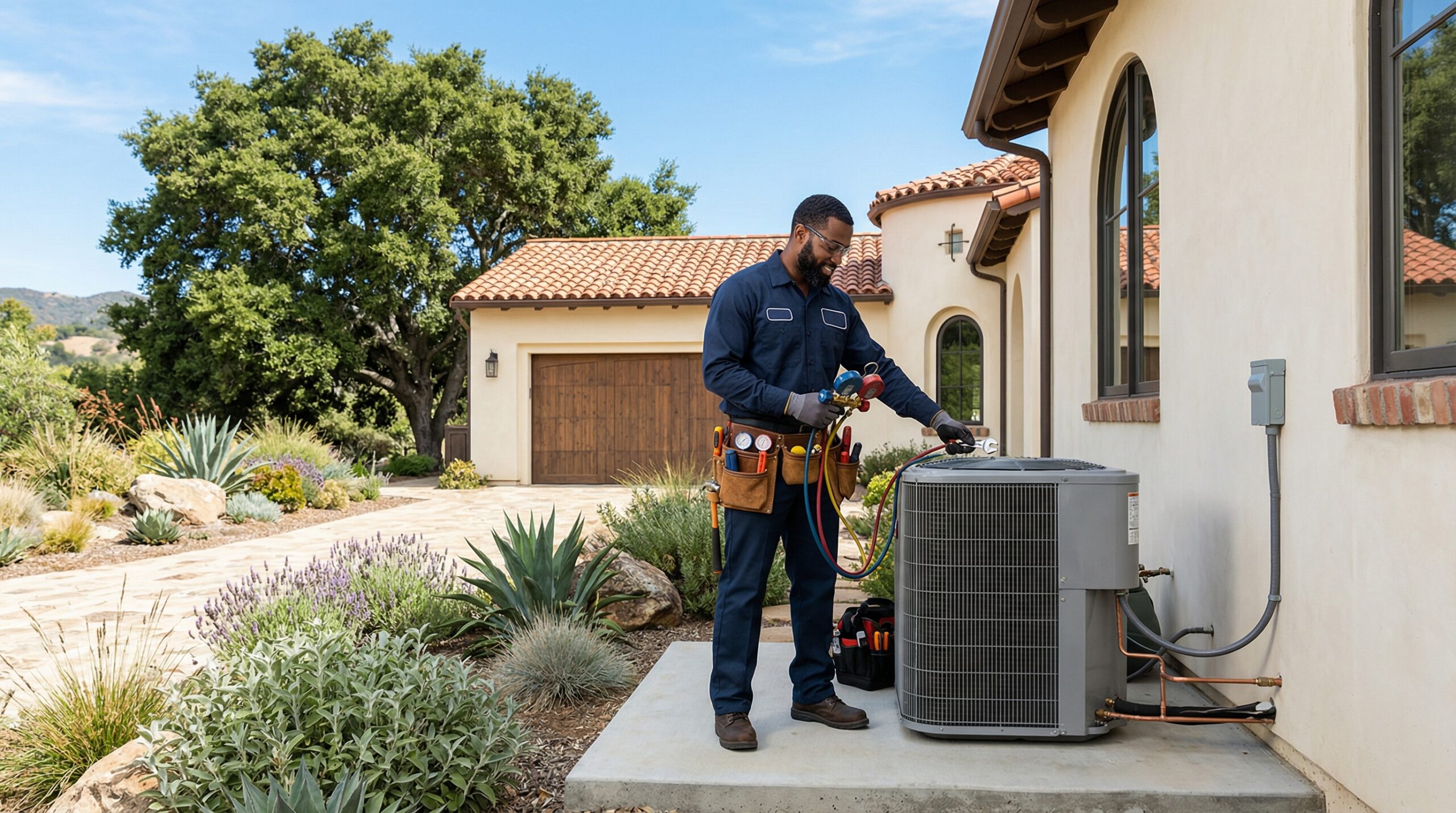
California homeowners pay $6,500 to $16,000 to replace an HVAC system in 2026, running 20 to 30% above the national average. Three things drive that premium: Title 24 efficiency standards that require higher-SEER2 equipment, labor rates that rank among the highest in the country, and a climate that spans coastal fog to Central Valley heat exceeding 110°F. This guide covers statewide pricing by system type, how California’s 16 climate zones affect your equipment choice, rebates from PG&E, SoCal Edison, LADWP, SMUD, and SDG&E, and what to expect from the permit process before your contractor arrives.
How Much Does HVAC Replacement Cost in California?
The table below shows 2026 replacement cost ranges across the most common system types for California homes. Prices include equipment, labor, permits, and disposal by a licensed C-20 contractor. See our full HVAC replacement cost guide for national comparison ranges.
| System Type | California Cost Range | Typical Home Size |
|---|---|---|
| Central AC only (replacement) | $4,800–$10,500 | 1,200–2,500 sq ft |
| Heat pump system (ducted) | $7,000–$16,000 | 1,200–3,000 sq ft |
| Gas furnace + central AC | $7,500–$16,500 | 1,500–3,500 sq ft |
| Full HVAC replacement (any type) | $6,500–$16,000 | Any size |
| Ductless mini-split (single zone) | $3,800–$8,500 | Single room or addition |
California costs consistently run above national averages, but the gap narrows for simpler jobs (AC-only swap in a well-maintained system) and widens for full system replacements in older homes with ductwork issues. The Central Valley and Inland Empire tend toward the higher end of these ranges because of larger system sizes required for extreme summer heat. The Bay Area and San Diego Coast tend toward the middle range because of milder design temperatures.
Why Does HVAC Cost More in California Than in Other States?
California HVAC replacement runs 20 to 30% above the national average in 2026, driven by four structural factors that affect every installation in the state. Understanding these factors helps you evaluate contractor bids and know when a quote is reasonable versus when it’s out of range.
- Title 24 efficiency minimums: California’s Building Energy Efficiency Standards require a minimum of 15 SEER2 for split-system cooling equipment. That’s above the federal minimum in many regions and pushes equipment costs higher. HERS (Home Energy Rating System) verification is required for many projects, adding $150 to $400 to the total.
- High labor costs: California contractor labor rates rank among the highest in the country. A licensed HVAC installer in Los Angeles or San Francisco earns significantly more per hour than the national median, and that premium shows up in installation quotes.
- Climate zone complexity: California’s 16 CEC climate zones range from mild coastal to extreme desert heat exceeding 110°F. Homes in hotter inland zones need larger equipment (3 to 5 ton systems versus 2 to 3 ton in moderate climates), which drives up both equipment and labor costs.
- Peak season compression: California’s busiest HVAC season runs June through September. Statewide search volume for HVAC replacement triples in June compared to winter months. That demand spike creates installation backlogs and pushes prices up 10 to 15% compared to fall or winter replacements. If your system isn’t failing, scheduling a fall replacement can save money.
For a comparison with another high-demand Western market, see our Arizona HVAC replacement cost guide. Arizona faces similar peak-season demand and large-system-size dynamics, though its regulatory framework differs from California’s Title 24 requirements.
California Climate Zones and What They Mean for Your HVAC
California uses 16 California Energy Commission (CEC) climate zones, not the 8 federal IECC zones used in most other states. The distinction matters because your climate zone determines the system type your contractor will recommend, the minimum efficiency required under Title 24, and which rebate programs apply. Here are the zones most relevant to homeowners making HVAC decisions.
| CEC Zone | Region | Summer Design Temp | System Recommendation |
|---|---|---|---|
| Zone 3 | San Francisco Bay Area | 78–85°F | Heat pump (cooling minimal), high-efficiency furnace |
| Zone 5 | Coastal/Inland San Diego North | 83–88°F | Heat pump, dual-zone mini-split |
| Zone 6 | Los Angeles Basin, SoCal Coast | 88–95°F | Central AC or heat pump, 3–4 ton standard |
| Zone 9 | West San Gabriel Valley, Inland | 98–104°F | High-SEER2 central AC, 4–5 ton sizing |
| Zones 11–14 | Central Valley (Fresno, Bakersfield) | 100–112°F | High-SEER2 central AC or heat pump, oversized |
| Zone 16 | High Desert, Mountain Communities | 85–95°F summers, cold winters | Dual-fuel heat pump or high-efficiency gas furnace |
The practical takeaway: if you live in the Bay Area or San Diego Coast, a heat pump is often the most cost-effective choice for both heating and cooling. If you live in the Central Valley or Inland Empire, a high-SEER2 central AC with efficient gas or electric heat is often more practical given extreme summer loads. Mountain communities like Lake Tahoe, Mammoth, and Big Bear need robust heating capacity, where a dual-fuel system (heat pump above 35°F, gas below) often makes sense.
California Title 24 Efficiency Requirements for HVAC
Title 24 Part 6, California’s Building Energy Efficiency Standards, sets the minimum efficiency levels for HVAC equipment installed in the state. These standards are enforced at the permit level, which is why understanding them before you call contractors matters. California’s efficiency minimums are stricter than the federal baseline in most regions.
- Minimum cooling efficiency: 15 SEER2 for split-system central air conditioners and heat pumps, statewide. This is enforced for any equipment replacement that requires a mechanical permit.
- Minimum heating efficiency: 80% AFUE for gas furnaces in most climate zones. High-efficiency furnaces (95%+ AFUE) are available and may qualify for utility rebates.
- HERS verification: Projects involving ductwork replacement, system type changes, or new installations often require a HERS (Home Energy Rating System) field verification by a certified HERS rater. Budget $150 to $400 for this step if your project triggers it.
- Duct leakage testing: If you replace more than 40 linear feet of ductwork, California requires a duct leakage test. A system with excessive duct leakage will fail inspection and require sealing before final approval.
- Thermostat requirements: New HVAC installations in California generally require a programmable or smart thermostat. Most equipment packages include a qualifying thermostat.
Your licensed C-20 contractor is responsible for ensuring compliance with Title 24 and should handle permit applications, HERS coordination, and final inspections as part of the installation quote. Ask specifically whether HERS verification is required for your project before signing a contract. The California Energy Commission publishes the current Title 24 standards and a database of certified HERS raters.
What HVAC Rebates Are Available in California?
California offers more HVAC rebate opportunities than almost any other state, with programs from multiple utilities and the state-funded TECH Clean California initiative. The federal Section 25C credit expired December 31, 2025 and is not available for equipment placed in service in 2026. The key is knowing which programs apply to your utility territory and stacking them correctly. A well-structured rebate claim can reduce your out-of-pocket cost by $3,000 or more on a qualifying heat pump installation.
TECH Clean California
TECH Clean California is a statewide initiative funded through utility programs to accelerate heat pump adoption. It provides rebates for replacing gas heating systems with qualifying heat pump equipment. BayREN administers the program in the Bay Area. SoCal Gas and SoCalREN administer it in Southern California. Rebates reach up to $1,000 for qualifying heat pump systems, with higher amounts available for income-qualified households. Check eligibility through your utility or at techcleanCA.com before committing to a system type.
PG&E Rebates
Pacific Gas and Electric serves Northern and Central California. PG&E’s current rebate program offers $50 to $1,000 depending on equipment type and efficiency level. Heat pumps and high-efficiency AC units qualify for the higher end. Smart thermostats qualify for smaller rebates. PG&E rebates are submitted by your contractor within 60 days of installation. Verify current amounts at pge.com/rebates before signing a contract, as programs update annually.
SoCal Edison (SCE) Rebates
Southern California Edison serves most of Southern California outside of LADWP territory. SCE offers $100 to $1,500 for qualifying central air conditioners and heat pumps. The higher rebate amounts go to higher-efficiency units with SEER2 ratings of 18 or above. Verify current SCE rebates at sce.com/residential/rebates. SCE and TECH Clean California rebates can often be combined for the same installation.
LADWP (Los Angeles Department of Water and Power)
LADWP serves the City of Los Angeles (note: not all of LA County). LADWP offers rebates for qualifying heat pumps and high-efficiency AC equipment. Programs and amounts update frequently. Los Angeles homeowners should verify current offers at ladwp.com/residential-rebates before installation. Our Los Angeles HVAC replacement cost guide covers LADWP rebates in detail for LA-area homeowners.
SMUD (Sacramento Municipal Utility District)
SMUD serves the Sacramento area and offers some of the most competitive rebates in the state for qualifying heat pump systems. Sacramento-area homeowners should check smud.org/en/residential/rebates for current amounts. Our Sacramento HVAC replacement cost guide covers SMUD rebate programs in detail.
SDG&E (San Diego Gas and Electric)
San Diego Gas and Electric serves the San Diego area. SDG&E offers rebates for qualifying high-efficiency cooling and heating equipment. Verify current SDG&E rebates at sdge.com/rebates.
Federal Section 25C Status for 2026
The federal Section 25C credit expired December 31, 2025 and is not available for equipment placed in service in 2026.
| Federal Program | Amount | Eligibility |
|---|---|---|
| Federal Section 25C | Not available for 2026 installations | Expired after December 31, 2025 |
| HEAR Program (IRA income-qualified) | Up to $8,000 | Household income below 150% of area median income; administered by California’s state energy office |
See our HVAC rebates and tax credits guide for a current breakdown of which available programs may be combined.
California HVAC Costs by City
California’s wide geography means HVAC costs vary substantially by city. Inland cities with extreme summer heat (Fresno, Bakersfield, Riverside) tend toward the higher end of the range because larger equipment is required. Coastal cities (San Diego, Santa Barbara) tend toward the middle. Labor market differences also affect final quotes, with San Francisco and Los Angeles among the most expensive labor markets in the state.
- Los Angeles HVAC Replacement Cost: LA homeowners typically pay $6,800 to $15,500 for full HVAC replacement. LADWP and SoCal Edison service territories overlap in the broader LA metro. High contractor density in LA keeps pricing competitive despite strong labor market wages.
- Sacramento HVAC Replacement Cost: Sacramento homeowners typically pay $6,500 to $14,500 for full HVAC replacement. SMUD serves the city proper with competitive rebates for heat pump upgrades. The Central Valley heat load means most Sacramento homes need 3 to 4 ton systems for reliable summer cooling.
- San Francisco HVAC Replacement Cost (coming soon): The Bay Area’s mild climate (Zone 3) means many SF homes can meet heating and cooling needs with a single heat pump system. Expect higher labor costs offset by smaller equipment sizing requirements.
- San Diego HVAC Replacement Cost (coming soon): San Diego’s Mediterranean climate is one of the mildest for HVAC purposes in California. Many San Diego homes use smaller systems (2 to 3 ton), which keeps replacement costs toward the lower end of the CA range.
- San Jose HVAC Replacement Cost (coming soon): San Jose sits at the intersection of Bay Area labor costs and inland heat in summer. Costs typically fall in the mid-range for California markets.
For a full list of California cities with dedicated pricing guides, visit the HVAC cost by city hub. If your city isn’t yet listed, the statewide ranges on this page are your best baseline. Use our free HVAC cost estimator to get a range tailored to your home size and zip code.
Do You Need a Permit for HVAC Replacement in California?
Yes. California requires a mechanical permit for HVAC equipment replacement in virtually every city and county in the state. Permits are pulled by your licensed contractor at the city or county building department level. Most reputable contractors include permit fees in their quoted price and handle all paperwork. Here’s what to expect.
- Who pulls the permit: Your licensed C-20 (Warm-Air Heating and Air Conditioning) contractor is responsible for obtaining the mechanical permit before beginning work. Verify your contractor’s C-20 license at the California Contractors State License Board (CSLB) website before signing any contract.
- Permit fees: Typically $75 to $400 depending on the city or county and the declared value of the project. Major cities (Los Angeles, San Francisco, San Jose) tend toward the higher end. Smaller cities and unincorporated county areas tend toward the lower end.
- Inspection process: Most jurisdictions require a rough inspection (after equipment is installed but before access is closed) and a final inspection. Your contractor coordinates both. The inspection verifies code compliance, proper refrigerant handling, and electrical connections.
- HERS verification trigger: A like-for-like equipment swap in the same location typically does not require HERS verification. Adding ductwork, changing system type, or relocating equipment often triggers HERS requirements. Ask your contractor which scenario applies to your project before getting quotes.
- Why you should never skip the permit: Unpermitted HVAC work can void your manufacturer’s warranty, create issues during home sale inspections, and leave you liable if equipment problems cause property damage. The permit process exists to protect you, not just to generate fee revenue for the city.
See our AC replacement cost guide for more detail on what’s included in a standard California replacement quote, including how permit costs are typically billed by contractors in different metro areas. For a full comparison of what drives system cost differences across California, see our heat pump replacement cost guide.
Frequently Asked Questions About California HVAC Costs
How much does HVAC replacement cost in California?
California homeowners typically pay $6,500 to $16,000 for a full HVAC system replacement in 2026. Central AC-only replacement runs $4,800 to $10,500. Heat pump systems run $7,000 to $16,000. Gas furnace plus central AC configurations run $7,500 to $16,500. California prices run 20 to 30% above the national average due to Title 24 efficiency standards, high labor rates, and climate zone diversity that drives larger or specialized equipment in hotter inland areas.
What HVAC rebates are available in California in 2026?
California offers rebates through TECH Clean California (up to $1,000 for qualifying heat pumps), PG&E ($50 to $1,000), SoCal Edison ($100 to $1,500), plus programs from LADWP, SMUD, and SDG&E. The federal Section 25C credit expired December 31, 2025 and is not available for equipment placed in service in 2026. Income-qualified households can access up to $8,000 through the IRA-funded HEAR program. Available utility, TECH Clean California, and income-qualified HEAR programs may be combined when their current rules allow.
What is California’s SEER2 requirement for HVAC?
California Title 24 Part 6 requires a minimum of 15 SEER2 for split-system cooling equipment statewide. Most HVAC professionals recommend 16 to 20 SEER2 for California homes given electricity rates of $0.27 to $0.35 per kWh with PG&E and SoCal Edison. Higher-efficiency equipment qualifies for larger utility rebates and can pay back the premium cost in 3 to 6 years through lower monthly bills, depending on climate zone and usage patterns.
Is a heat pump worth it in California?
For most California homeowners, yes. Coastal and valley regions have mild enough winters for a heat pump to handle both heating and cooling efficiently year-round. Available programs include TECH Clean California rebates (up to $1,000) and utility rebates from SoCal Edison (up to $1,500) or PG&E. Mountain and high-desert areas with temperatures regularly below 20°F may benefit from a dual-fuel heat pump with gas backup heating for the coldest nights.
Do I need a HERS rating for HVAC replacement in California?
Not always. A simple like-for-like equipment replacement typically does not require HERS verification. Projects that modify ductwork, change system type, or relocate equipment often trigger HERS requirements under Title 24. Budget $150 to $400 if HERS verification is required for your project. Your licensed C-20 contractor should confirm whether your specific replacement triggers HERS requirements based on the scope of work and your local building department’s current requirements.
What is TECH Clean California?
TECH Clean California is a statewide initiative funded through utility programs to accelerate heat pump adoption by replacing gas heating systems. It offers rebates up to $1,000 for qualifying heat pump systems, with higher amounts available for income-qualified households. BayREN administers the program in the Bay Area. SoCal Gas and SoCalREN administer it in Southern California. The program runs through participating utilities, so eligibility depends on your service territory and the equipment your contractor installs.
Do I need a permit for HVAC replacement in California?
Yes. California requires a mechanical permit for HVAC replacement in virtually every jurisdiction statewide. Your contractor must hold a valid C-20 license and will pull the permit as part of the installation. Permit fees typically run $75 to $400. Skipping the permit can void manufacturer warranties and cause problems during home sale inspections. Verify your contractor’s C-20 license at the California Contractors State License Board (CSLB) website before signing a contract.
Ready to see what HVAC replacement would cost for your specific California home? Use our free HVAC cost estimator to get an instant range based on your home size, climate zone, and system type.
Put the numbers in context
What would it cost for your home?
Get a planning range based on your home, system and region. Free, with no email required.
Get my cost estimate