
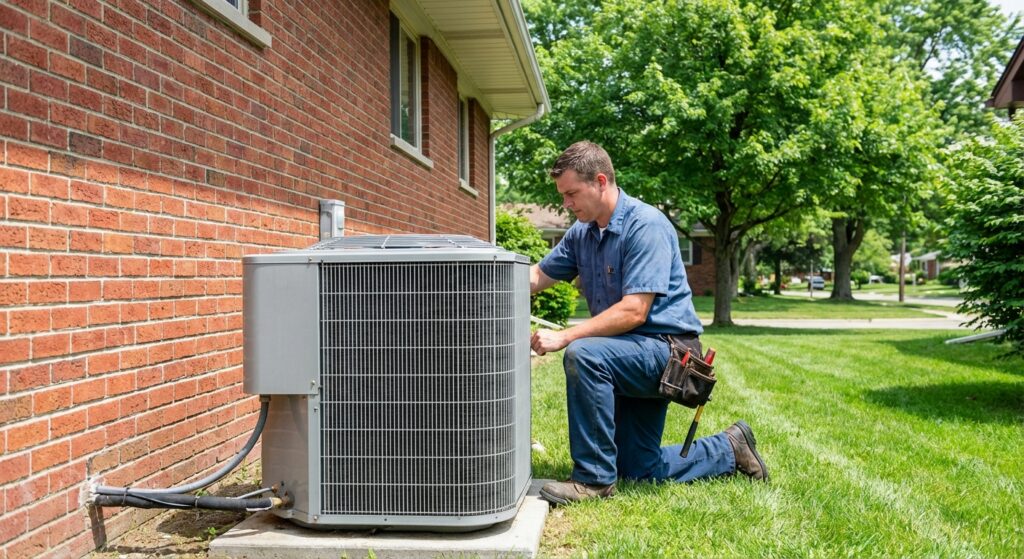
Michigan homeowners pay $5,200 to $14,500 to replace a full HVAC system (gas furnace plus central AC) in 2026. The state’s cold winters and high natural gas dependency make furnace replacement the most common HVAC project in Michigan, with the Upper Peninsula facing some of the harshest conditions in the continental US. DTE Energy and Consumers Energy both offer rebates that reduce your out-of-pocket cost, particularly for heat pump installations.
How Much Does HVAC Replacement Cost in Michigan?
The table below shows 2026 Michigan replacement costs across the most common system types. Prices include equipment and installation by a licensed Michigan HVAC contractor. Detroit metro pricing reflects the unionized trades market; secondary markets like Flint and Lansing run below the Detroit average.
| System Type | Michigan Range | Detroit Metro | Secondary Markets |
|---|---|---|---|
| Central AC only | $3,800–$9,000 | $4,800–$10,500 | $3,500–$8,000 |
| Gas furnace only | $3,000–$9,500 | $4,000–$11,000 | $2,800–$8,500 |
| Heat pump system | $5,500–$13,000 | $6,500–$15,000 | $5,000–$11,500 |
| Gas furnace + central AC | $5,200–$14,500 | $6,500–$17,000 | $4,800–$13,000 |
| Dual-fuel (heat pump + gas backup) | $7,000–$15,500 | $8,500–$18,000 | $6,500–$14,000 |
Michigan’s gas furnace market dominates because over 80% of Michigan homes use natural gas for heat, one of the highest rates in the country. Replacing a furnace mid-life (before it fails completely) typically costs less than emergency replacement in peak winter demand. Use the free HVAC cost estimator to benchmark quotes against your home size and system type.
Michigan City-by-City HVAC Cost Breakdown
Labor costs, permit structures, and contractor market density all vary significantly across Michigan. The table below reflects full system (gas furnace plus central AC) replacement costs by metro area.
| City / Metro | Full System Range | Key Market Factor |
|---|---|---|
| Detroit (Wayne County core) | $6,500–$17,000 | Unionized trades; BSEED permit process; large contractor base |
| Ann Arbor (Washtenaw County) | $5,800–$15,000 | University market; above-average labor costs; strong contractor competition |
| Grand Rapids (Kent County) | $5,500–$14,000 | Mixed union/non-union market; faster permit process than Detroit |
| Lansing / East Lansing | $5,200–$13,000 | State capital market; MSU anchor; mid-range labor costs |
| Flint (Genesee County) | $4,800–$12,000 | Below statewide average; reduced contractor demand |
| Kalamazoo / Battle Creek | $5,000–$13,000 | SW Michigan market; approaching Zone 4A fringe; stronger heat pump adoption |
| Upper Peninsula (Marquette, Sault Ste. Marie) | $5,500–$13,500 | Limited contractors, higher mobilization costs; extreme cold design temps |
The Upper Peninsula presents a unique cost dynamic: labor rates are not exceptionally high, but the limited number of licensed contractors in rural UP areas creates capacity constraints that push per-job costs up. Emergency furnace replacement in the UP during a January cold snap can run significantly above normal replacement pricing due to demand and travel costs.
What DTE Energy and Consumers Energy HVAC Rebates Are Available?
Michigan homeowners can access rebates through their electric and gas utilities. Most Michigan households are served by either DTE Energy or Consumers Energy, though some areas have municipal or co-op utilities with their own programs.
| Utility | Rebate Program | Amount | Notes |
|---|---|---|---|
| DTE Energy (electric) | Heat pump installation (15 SEER2+) | $200–$500 | DTE electric territory (SE Michigan) |
| DTE Energy (electric) | Smart thermostat | Up to $150 | DTE electric territory |
| DTE Energy (gas) | High-efficiency furnace (AFUE 95%+) | $50–$100 | DTE gas territory |
| Consumers Energy (electric) | Heat pump installation (qualifying) | $200–$400 | Consumers electric territory (central/west MI) |
| Consumers Energy (electric) | Smart thermostat | $50–$100 | Consumers electric territory |
| Consumers Energy (gas) | High-efficiency furnace (AFUE 95%+) | $50–$100 | Consumers gas territory |
Two additional programs can stack on top of utility rebates:
- Michigan HOMES and HEAR Programs (EGLE): Michigan was approved for IRA (Inflation Reduction Act) funds under the Home Efficiency Rebates (HOMES) and Home Electrification and Appliance Rebates (HEAR) programs administered through the Michigan Department of Environment, Great Lakes, and Energy. As of April 2026, disbursement timelines are pending state rollout. Check egle.michigan.gov for updated program availability.
- Federal Section 25C: Expired December 31, 2025; unavailable for 2026 installations.
The federal Section 25C credit expired December 31, 2025 and is not available for equipment placed in service in 2026. See the full heat pump cost guide.
How Does Michigan’s Climate Affect Your HVAC Choice?
Michigan spans three ASHRAE climate zones, which directly shapes what equipment is appropriate for your home and what the federal efficiency minimums are for new installations.
The federal minimum efficiency for new central AC in Zone 5A is SEER2 13.4. The Zone 6A portion of the state (parts of the Upper Peninsula) has additional cold-climate considerations that affect heat pump minimum performance requirements. The heating season is the dominant cost driver statewide: most Michigan homes heat for 7 to 9 months per year.
Key climate factors by region:
- Lower Peninsula (Detroit, Grand Rapids, Lansing, Ann Arbor): ASHRAE Climate Zone 5A. Winter design temperatures of 4 to 6 degrees Fahrenheit. Gas furnace plus central AC is the standard system. Heat pump adoption is growing, particularly dual-fuel setups with DTE and Consumers rebates. Standard heat pump efficiency drops significantly below 35 degrees; standalone heat pumps are not recommended without cold-climate rated equipment.
- Southwest Michigan (Kalamazoo, Battle Creek, Benton Harbor): Southernmost portion of Zone 5A, approaching Zone 4A fringe. Milder winters relative to the rest of Michigan. Best area in the state for standalone heat pump consideration, though dual-fuel is still the safer bet.
- Upper Peninsula (Marquette, Houghton, Sault Ste. Marie): Climate Zone 6A and 7. Winter design temperatures as low as -15 degrees Fahrenheit. Furnace with high-AFUE rating is essential. Heat pumps are not practical as primary heat source without cold-climate equipment and propane or natural gas backup. Many UP homes use propane rather than natural gas due to limited pipeline coverage.
- Northern Lower Peninsula (Traverse City, Petoskey, Gaylord): Upper Zone 5A conditions with significant lake-effect snow from Lake Michigan. Heating loads are higher than metro Detroit. Furnace sizing for cold winters is critical; undersized furnaces fail to maintain comfort during polar vortex events.
Upgrading from an 80% AFUE furnace to a 95% AFUE furnace saves approximately $200 to $400 per year in natural gas costs at current Michigan rates. At that savings rate, the efficiency premium typically pays back in 6 to 10 years depending on your home size and heating load.
Do You Need a Permit for HVAC Replacement in Michigan?
Yes. Michigan requires a mechanical permit for HVAC replacement in all jurisdictions. Michigan does not have a single statewide permit fee; permits are issued and priced at the city or township level. All contractors performing HVAC work must hold a Michigan HVAC contractor license issued through LARA (Licensing and Regulatory Affairs).
Typical Michigan permit fees and processing by city:
- Detroit (BSEED): Bureau of Buildings, Safety Engineering and Environmental Dept. Mechanical permit fees run $75 to $300 for residential work. Detroit city proper requires a city contractor registration in addition to the state HVAC license. Processing typically takes 1 to 2 weeks.
- Grand Rapids: Building Safety Department. Mechanical permit fees run $60 to $200. Processing is typically 3 to 7 business days. State HVAC license required; city registration not separately required.
- Lansing: Department of Planning, Permits and Neighborhood Development. Fees run $50 to $175. Processing 3 to 5 business days.
- Ann Arbor: Community Services / Building Services. Fees run $65 to $200. Processing 3 to 7 business days.
- Flint: Community and Economic Development Department. Fees run $50 to $150. Processing 3 to 5 business days.
- Township and rural jurisdictions: Fees generally $50 to $150. Some rural townships use county building departments. Always confirm which jurisdiction issues permits for your specific address.
Most licensed HVAC contractors pull the mechanical permit as part of their installation quote. If a contractor offers to skip the permit to reduce your price, treat it as a serious red flag. An unpermitted HVAC system can void your homeowner’s insurance coverage and create problems when you sell the home. Verify Michigan HVAC contractor licenses at michigan.gov/lara.
What HVAC Brands Are Most Common in Michigan?
Michigan contractors carry a mix of premium, mid-range, and budget brands. The Detroit metro union market favors established brands with strong local dealer networks, particularly Carrier and Trane. Cold-climate furnace reliability is a key brand differentiator in Michigan given the extreme winter conditions.
- Carrier: Premium tier. Factory Authorized Dealer (FAD) network strong in the Detroit and Grand Rapids metros. 10-year parts warranty requires licensed FAD installer. Installed cost: $5,500–$15,000+. See the Carrier HVAC cost guide for model-level pricing.
- Trane: Premium tier. Respected for cold-climate durability; stainless steel heat exchangers in the XV and XR furnace series are well-suited to Michigan’s freeze-thaw cycling. Installed cost: $5,500–$16,000+. See the Trane HVAC cost guide.
- Lennox: Premium tier. Highest SEER2 ratings (up to 28) and top AFUE options (up to 98.7%). Installed cost: $5,500–$15,500+.
- Rheem: Mid-range. Balance of cost and performance; widely available through Michigan distributors. Installed cost: $4,000–$10,500.
- Goodman: Budget tier. Made in Houston, TX; owned by Daikin. Popular with landlords and price-sensitive buyers. Installed cost: $3,500–$9,000.
- Daikin: Mid-range to premium. 12-year parts and unit replacement warranty. Growing contractor share in the Grand Rapids market. Installed cost: $4,000–$11,500.
- Mitsubishi / Bosch (heat pump): Cold-climate heat pump specialists. Mitsubishi Hyper-Heat and Bosch IDS 2.0 series maintain efficiency at temperatures as low as -13 degrees Fahrenheit. Installed cost for mini-split or full system: $6,000–$18,000+.
For a complete brand comparison including reliability data and warranty terms, see the best HVAC brands guide. In Michigan’s cold climate, heat exchanger quality and furnace reliability matter as much as efficiency ratings. Always ask your contractor specifically about heat exchanger warranty terms.
How to Get Accurate Michigan HVAC Quotes
Getting at least three quotes is standard practice in any state, but Michigan has several market-specific factors worth knowing before you start:
- Verify your contractor’s Michigan license through LARA. Michigan requires HVAC contractors to be licensed through the Licensing and Regulatory Affairs agency. You can verify licenses at michigan.gov/lara. In Detroit, additionally confirm the contractor holds a city contractor registration through BSEED.
- Ask about DTE and Consumers rebate enrollment upfront. Not all contractors handle rebate paperwork for DTE Energy or Consumers Energy programs. For heat pump rebates in particular, confirm the contractor is enrolled in the applicable utility rebate program before signing anything.
- Request a Manual J load calculation. Michigan homes with older construction, varying insulation, finished basements, and lake-effect climate zones need accurate sizing. An oversized furnace short-cycles and wastes energy; an undersized furnace fails to maintain comfort during polar vortex conditions. Always get sizing verified in writing as part of your quote.
- Ask about dual-fuel as an alternative to furnace-only. With DTE and Consumers heat pump rebates available, a dual-fuel system that uses an electric heat pump above 35 degrees and switches to gas below that point can reduce heating costs in shoulder seasons. Run the payback math with your contractor, factoring in current gas and electric rates.
- Plan for UP or northern Lower Peninsula surcharges. Contractors serving the Upper Peninsula or rural northern Michigan often add travel charges or mobilization fees for remote locations. Get this in writing before signing.
See the complete HVAC cost breakdown guide for itemized cost categories. Use the cost by home size tool to benchmark contractor quotes against your square footage and system type. If you are comparing costs across the Great Lakes region, see our Pennsylvania HVAC cost guide for eastern state pricing context.
Frequently Asked Questions: Michigan HVAC Replacement
How much does HVAC replacement cost in Michigan?
Michigan homeowners typically pay $5,200 to $14,500 for a full HVAC system replacement (gas furnace plus central AC) in 2026. Central AC-only replacement runs $3,800 to $9,000. Gas furnace replacement runs $3,000 to $9,500. Heat pump systems run $5,500 to $13,000. Detroit metro pricing runs 10 to 20% above the statewide average due to union contractor markets; secondary markets like Flint and Lansing typically run 5 to 15% below Detroit.
What HVAC rebates are available in Michigan?
DTE Energy offers $200 to $500 for qualifying heat pump installation (15 SEER2 or higher). Consumers Energy offers $200 to $400 for qualifying heat pump installation. Both utilities offer $50 to $100 for a 95% AFUE furnace and up to $150 for a qualifying smart thermostat. The Michigan HOMES and HEAR programs through EGLE are pending 2026 disbursement. The federal Section 25C credit expired December 31, 2025 and is not available for equipment placed in service in 2026.
Do I need a permit for HVAC replacement in Michigan?
Yes. Every Michigan jurisdiction requires a mechanical permit for HVAC replacement. Detroit permit fees run $75 to $300 for residential work through BSEED. Grand Rapids charges $60 to $200. Lansing charges $50 to $175. Ann Arbor charges $65 to $200. Flint charges $50 to $150. All contractors must hold a Michigan HVAC license through LARA. Most licensed contractors pull the permit as part of the installation quote. An unpermitted HVAC system can void your homeowner’s insurance and create problems at resale.
Should I get a heat pump or a gas furnace in Michigan?
For most of Michigan, a gas furnace plus central AC combination or a dual-fuel system (heat pump with gas furnace backup) is the practical choice. Michigan winters regularly hit single digits across the Lower Peninsula and well below zero in the Upper Peninsula, which reduces standard heat pump efficiency significantly. Dual-fuel systems use the heat pump above 35 degrees and switch to gas below that threshold for reliable cold-weather heating. Southwest Michigan counties closest to Zone 4A are the best candidates for standalone heat pump consideration. Cold-climate rated heat pumps from Mitsubishi and Bosch can operate at lower temperatures but carry a meaningful upfront premium.
How does Michigan’s climate affect HVAC sizing and cost?
Michigan’s Lower Peninsula is in ASHRAE Climate Zone 5A (cool-humid). The Upper Peninsula reaches Climate Zone 6A and 7 with design temperatures as low as -15 degrees Fahrenheit. Michigan averages 6,000 to 9,000 heating degree days depending on location, placing it among the most heating-intensive states in the continental US. The federal minimum efficiency for central AC is SEER2 13.4 in Zone 5A. The long heating season means gas furnace AFUE is the dominant cost driver for most Michigan homeowners. Upgrading from 80% to 95% AFUE saves approximately $200 to $400 per year in natural gas costs, with a typical payback of 6 to 10 years.
Is HVAC more expensive in Detroit than in other Michigan cities?
Yes. Detroit metro HVAC installation typically runs 10 to 20% above the Michigan statewide average. The main driver is the unionized contractor market; Detroit’s Sheet Metal Workers and Pipefitters locals operate at rates above the state average. The BSEED permit process in Detroit city proper also adds time and cost versus suburban jurisdictions. Markets like Flint, Lansing, and Saginaw run 5 to 15% below Detroit metro for equivalent equipment and system types.
If you are in southeast Michigan, use the Detroit HVAC replacement cost guide for city permit details and metro labor pricing.
What HVAC brands do Michigan contractors typically install?
Michigan contractors most commonly install Carrier, Trane, Lennox, Rheem, Goodman, and Daikin. Carrier and Trane have strong Factory Authorized Dealer networks in the Detroit and Grand Rapids metros. Trane’s stainless steel heat exchanger furnace lines are well-regarded for Michigan’s cold winters. For heat pump applications, Mitsubishi Hyper-Heat and Bosch IDS cold-climate systems are the leading options in the Lower Peninsula. Goodman and Rheem are the most common budget-to-mid options for landlords and price-sensitive buyers.
Michigan City HVAC Cost Guides
For city-specific pricing, rebate details, and permit requirements, see the individual Michigan city guides as they are published. Use the free HVAC cost estimator for a personalized estimate based on your home size, system type, and region.