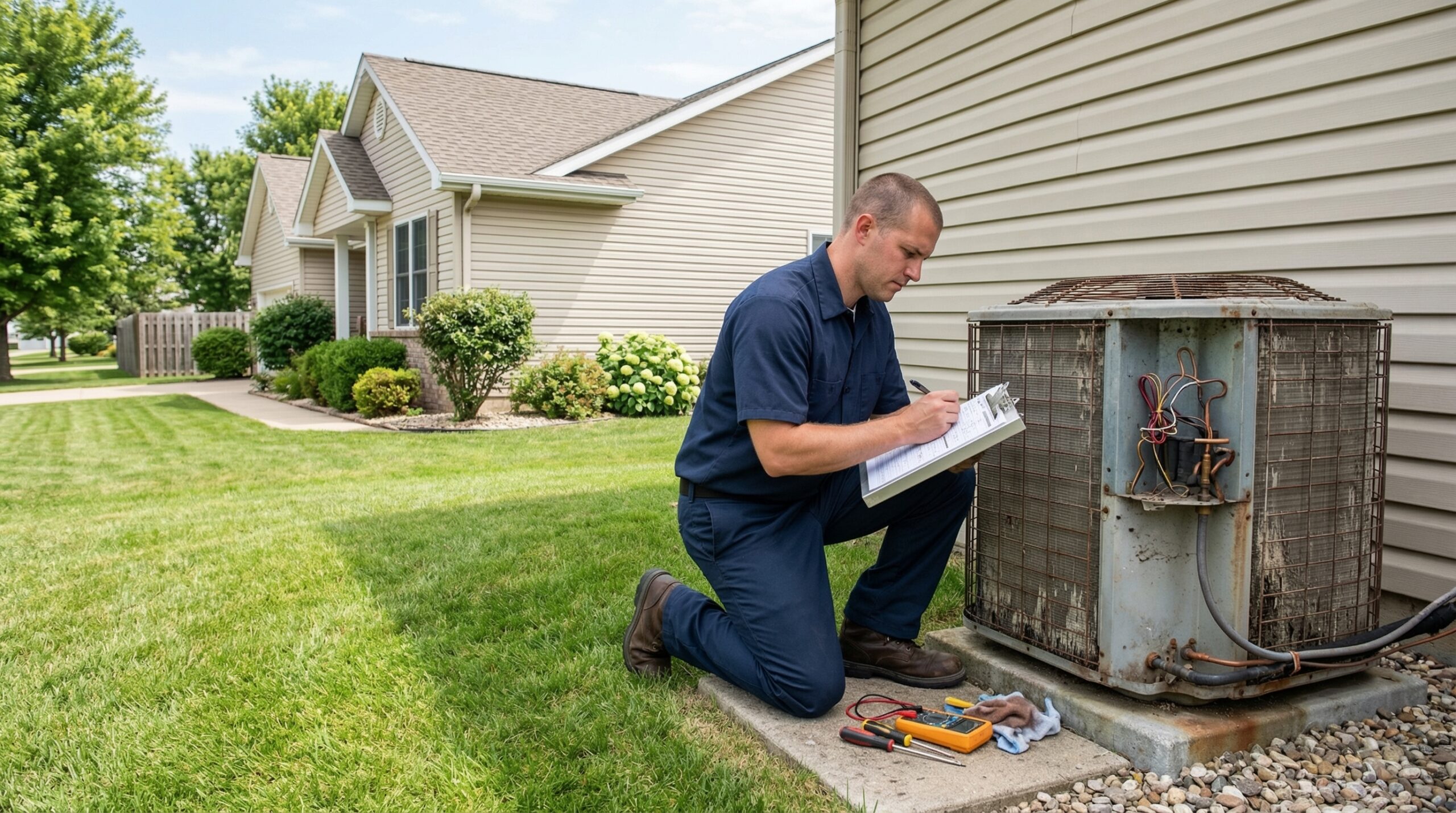
Your HVAC system just broke down. The repair quote is $1,400. Your system is 13 years old. You’re under pressure: it’s the middle of summer, the house is 85 degrees, and your contractor is standing in your living room waiting for an answer. Do you repair it or replace it?
Most homeowners in this position don’t have a framework. They’re guessing based on gut feel and whatever the contractor recommends. This page gives you the actual decision logic: a formula, a decision matrix, and the gray-zone factors that can tip the answer either way. No contractor affiliation. No gated results. Just the math. When you do move forward with replacement, our HVAC overcharge prevention guide covers how to verify that your replacement quote reflects fair pricing before you sign.
TL;DR: The industry standard is the $5,000 rule: multiply your system’s age by the repair cost. Above $5,000: lean toward replacement. Below $5,000: repair is usually defensible. But that’s a starting point. R-22 refrigerant now costs $90–$150/lb installed (Angi, 2026), and replacing a 10+ year old system can cut cooling costs 20–40% (Energy Star). Use the decision matrix below to map your exact situation, then run your replacement cost estimate to make the math concrete.
What Is the $5,000 Rule — and When Does It Actually Work?
The $5,000 rule is a tiebreaker formula used by HVAC contractors and manufacturers including Lennox, Trane, and Energy Star: multiply your system’s age in years by the cost of the repair in dollars. If the result exceeds $5,000, replacement is generally the better financial choice. Below $5,000, repair is usually defensible.
Two worked examples:
- Repair territory: 7-year-old system + $400 capacitor repair = 7 × $400 = $2,800. Well below $5,000: repair it.
- Replace territory: 14-year-old system + $600 compressor repair = 14 × $600 = $8,400. Above $5,000: replacement is the better long-term bet.
The rule works because it captures two risks simultaneously: the remaining useful life of the system (proxied by age) and the severity of the current failure (proxied by repair cost). A big repair on an old system is doubly bad: you’re spending significant money on a system that’s likely to fail again soon anyway.
The $5,000 rule was designed for R-22-era systems with 15–20 year lifespans and pre-2020 repair costs. It doesn’t automatically account for two factors that now change the calculus: the collapse of R-22 refrigerant availability (see gray zone section below) and the much larger efficiency gap between a 12-year-old SEER 10 system and a modern SEER2 17+ replacement. On those two fronts, the $5,000 rule actually understates the case for replacement.
The rule also has a known limitation: it doesn’t account for repair history. A system that has already needed two repairs in the past 24 months is a worse candidate for another repair than a system with a clean history, even if the math is technically in repair territory. Two or more unscheduled repairs in 24 months is an independent signal that the system is in general decline.
How Does the Decision Matrix Work by Age and Repair Cost?
The decision matrix maps your system’s age against the repair cost as a percentage of your replacement cost baseline, giving you a clear repair, gray zone, or replace recommendation. Expressing repair cost as a percentage (rather than a raw dollar amount) normalizes the decision across different system types and sizes. Here’s the matrix:
| System Age | Repair Cost < 15% of Replacement | Repair Cost 15–30% | Repair Cost 30–50% | Repair Cost > 50% |
|---|---|---|---|---|
| 0–5 years | Repair | Repair | Repair (check warranty first) | Gray Zone (may be covered under warranty) |
| 6–10 years | Repair | Repair | Gray Zone | Replace |
| 11–15 years | Repair | Gray Zone | Replace | Replace |
| 16+ years | Gray Zone | Replace | Replace | Replace |
Replacement cost baseline: $5,000–$7,500 for a central AC unit; $7,500–$12,000 for a full AC + furnace system, installed. Regional labor rates vary 15–25%. Use the HVAC Replacement Cost Estimator to calculate your specific baseline. It takes 60 seconds and requires no email.
How to use the matrix: find your system’s age band in the left column, then find your repair cost as a percentage of the replacement cost baseline in the top row. The intersecting cell gives your starting recommendation. “Gray Zone” means neither option is clearly wrong. That’s where the R-22, efficiency, and financing factors in the sections below become decisive.
When Does Repair Clearly Make Sense?
Repair clearly makes sense when your system is under 8 years old, the repair cost is under 15% of replacement cost, and this is the first unscheduled breakdown. At that age and cost level, you still have 7–12 years of useful life remaining on a system that has not shown a pattern of failure. HVAC systems last 15–20 years on average (Energy Star, 2025), so a well-maintained young system is recovering real value from an asset with significant runway. All of the following conditions should be true to feel confident in a repair call:
- The system is under 8 years old
- The repair cost is under 15% of replacement cost (typically under $750–$1,200 depending on system type)
- This is the first unscheduled repair (no pattern of breakdowns)
- The system uses R-410A or R-454B refrigerant (not R-22)
- The system has been reasonably maintained (annual tune-ups, filter changes)
- The failure is a discrete component (capacitor, contactor, thermostat), not core infrastructure (compressor, heat exchanger, evaporator coil)
Component repair costs worth understanding: a capacitor replacement typically runs $90–$480 installed and is a straightforward repair on any system age. A refrigerant recharge runs $200–$600 on a modern R-410A system. These are the repairs where the $5,000 math is almost always in repair territory on systems under 10 years old.
The components that change the calculus are compressor replacement ($900–$2,900) and evaporator coil replacement ($1,000–$5,000+) (Trane, 2025). At those price points, even a moderately-aged system starts scoring in replace territory on the $5,000 rule. An 8-year-old system needing a $2,500 compressor scores 8 × $2,500 = $20,000, well above the threshold, even though the system isn’t old. Compressor failure on a system under warranty is a different matter: always check manufacturer warranty coverage before authorizing any compressor replacement.
When Does Replacement Clearly Make Sense?
Replacement is the clear call when your system is 15+ years old (furnace) or 12+ years old (central AC), or when any single major warning signal appears alongside the age: a failed compressor, R-22 refrigerant, or a second repair within 24 months. At that combination of age and severity, the math almost always favors a new system. Replacing a 10+ year old AC with a modern high-efficiency unit can reduce cooling costs 20–40% (Energy Star, 2025), and that savings compounds over the new system’s 15–20 year lifespan.
Replacement clearly makes sense when any of the following are true:
- The system is 15+ years old (furnace) or 12+ years old (central AC or heat pump)
- The $5,000 rule threshold is exceeded (age × repair cost > $5,000)
- The system uses R-22 refrigerant and the repair requires refrigerant addition (see gray zone for R-22 pricing)
- Two or more unscheduled repairs have occurred in the past 24 months
- Energy bills have risen year-over-year with no change in usage or occupancy
- The compressor or heat exchanger has failed (these are the heart of the system, and replacement is almost always more cost-effective than repair on a system past 10 years)
The efficiency argument deserves specific numbers. A central AC running at SEER 10 (common in systems installed before 2006) versus a modern SEER2 17 replacement generates real annual savings. In a typical 2,000 sq ft home, that efficiency gap translates to $200–$400 per year in reduced cooling costs. Over a 12-year new system lifespan, that’s $2,400–$4,800 in cumulative savings, in addition to avoiding future repair costs on the aging system.
For detailed cost ranges by system type, see: AC replacement cost, furnace replacement cost, and heat pump replacement cost, including whether a heat pump is worth considering as an alternative to a straight AC replacement. If replacement is likely but your system still runs, compare the best time to replace HVAC before scheduling, then review what happens on installation day.
What About the Gray Zone — R-22, Efficiency, and Financing?
In the gray zone, the $5,000 rule gives you an ambiguous answer: neither repair nor replace is obviously wrong. Three factors most commonly break that tie, and any one of them can flip the recommendation decisively toward replacement:
R-22 refrigerant. The EPA banned production and importation of R-22 refrigerant effective January 1, 2020 (US EPA). The only R-22 now available is recovered or stockpiled, and prices reflect it. R-22 now costs $90–$150 per pound installed, with a full recharge running $660–$2,400 depending on system size (Angi, 2026). R-22 prices are up 53% since 2021 and will continue rising through the 2030 final phaseout deadline.
What this means in practice: if your system uses R-22 and the repair requires adding refrigerant, the effective repair cost is the parts and labor plus $660–$2,400 for the refrigerant recharge. Run that through the $5,000 rule and many repairs that look viable on labor cost alone tip into replacement territory once R-22 recharge cost is included. A 12-year-old system with a $400 repair that also needs a 6-lb refrigerant recharge at $130/lb = $400 + $780 = $1,180 effective repair cost × 12 years = $14,160. That’s not a close call.
Efficiency losses in aging systems. An HVAC system can run (compressor starts, air circulates, house cools) while operating at 70% or less of its rated efficiency due to component degradation, refrigerant loss, or coil fouling. You won’t see a warning light. You’ll see a slowly rising electric bill. A system that was SEER 13 when new may be effectively running at SEER 9 or 10 in year 14. Replacing it with a SEER2 17 unit recovers that efficiency gap immediately.
Financing. 0% or low-APR financing over 24–60 months changes the monthly math significantly. A $7,000 system replacement at 0% for 36 months is $194/month. Compare that to a $2,500 repair that may not solve the underlying problem, plus continued higher operating costs on an aging system. Many manufacturers (Carrier, Trane, Lennox, Goodman) and HVAC distributors offer promotional financing. Ask explicitly: contractors don’t always volunteer it.
Federal Section 25C cutoff. The credit applied only to qualifying property placed in service through December 31, 2025. It is not available for a new 2026 central AC or heat pump. For current replacement savings, check utility and state programs before choosing equipment.
How Do You Evaluate a Repair Quote?
Get the itemized breakdown, the exact part numbers, and a written warranty before authorizing any HVAC repair over $500. Those three requirements filter out the majority of inflated quotes and symptom-only patches before you’ve committed to anything. There are five specific questions to ask, and a contractor who can’t or won’t answer them is a reason to get a second opinion.
- What is the itemized breakdown? Parts cost separately from labor cost. A $1,200 repair quote that’s a single line item doesn’t let you verify whether the part itself is $200 (reasonable) or $800 (marked up significantly). Ask for parts and labor as separate line items.
- What are the exact part model numbers? A compressor or evaporator coil replacement involves specific OEM or aftermarket components. The model number lets you verify pricing independently and confirm the part is the right fit for your system, not a generic substitute.
- Does this repair fix the root cause or the symptom? A failed capacitor is often a standalone failure. A repeatedly failing compressor may signal voltage problems, refrigerant issues, or a dirty condenser coil that caused the compressor to overheat. Ask: “What caused this failure, and will the repair prevent it from happening again?”
- What is the repair warranty? Most legitimate HVAC contractors warrant labor for 30–90 days and parts per the manufacturer’s warranty (typically 1 year on most components). Ask for the warranty terms in writing before authorizing the repair.
- Given my system’s age, is repair the right call? Ask your contractor directly: “If this were your house, would you repair this or replace the system?” A contractor who recommends repair on a 16-year-old system with a $2,000 quote should be able to explain why, and the explanation should be specific to your system’s condition, not a generic “it still has life in it.”
The most useful diagnostic question isn’t about the repair itself. It’s about what else they found. Ask: “What is the overall condition of the rest of the system?” A good technician will note coil condition, refrigerant level, electrical connections, and heat exchanger integrity as a matter of course. A cracked heat exchanger is the one finding that ends the repair conversation, because it is a carbon monoxide risk and heat exchanger replacement is labor-heavy enough to rival the price of a new furnace. If a technician quotes the repair but can’t describe the condition of the surrounding components, they may not have done a thorough inspection.
For how we evaluate contractor pricing and what goes into cost estimates, see our cost methodology page.
How Do You Use the Estimator for Repair-vs-Replace Math?
Use the estimator to get your replacement cost baseline, then divide your repair quote by that number to find your repair cost percentage for the decision matrix. The $5,000 rule and matrix tell you which zone you’re in conceptually; the estimator gives you the specific dollar baseline you need to apply them to your actual situation. Without that baseline, you’re estimating a percentage against a number you don’t have.
Here’s how to use it for repair-vs-replace math:
- Enter your home size, system type (AC only, furnace only, or full system), and region
- The estimator returns a cost range; use the low end of that range as your replacement baseline for a conservative comparison
- Divide your repair quote by that baseline: $1,400 repair ÷ $7,000 replacement = 20%, which puts you in the second column of the decision matrix above
- Find your system age band and read the recommendation
Run your replacement cost baseline now. The HVAC Replacement Cost Estimator factors in system type, home size, and region. It takes 60 seconds and requires no email. Get the number you need to make this decision with the actual math, not a guess.
For additional context on replacement cost by system type: full HVAC replacement cost guide, AC replacement cost, furnace replacement cost, heat pump replacement cost. For how long you can reasonably expect your current system to last before this decision recurs, see our guide on how long HVAC systems last.
Frequently Asked Questions
What is the $5,000 rule for HVAC?
The $5,000 rule is an industry-standard tiebreaker: multiply your system’s age in years by the repair cost in dollars. If the result exceeds $5,000, replacement is generally the better financial choice. The formula captures two risks at once: remaining useful life (age) and failure severity (repair cost). To apply it:
- Find your system’s age: check the data plate on the outdoor unit or the service records
- Get the repair cost as a specific dollar figure, not a range
- Multiply: age × repair cost
- Above $5,000: lean toward replacement. Below $5,000: repair is usually defensible.
Note: the rule is a starting point, not a final answer. R-22 refrigerant cost, repair history, and system efficiency all modify the recommendation. See the decision matrix above for a fuller picture.
How do I know if my HVAC system uses R-22 refrigerant?
Check the data plate on your outdoor AC unit or the service panel inside: the refrigerant type is printed directly on the label. Systems manufactured before 2010 almost certainly use R-22 (also labeled HCFC-22 or Freon). If yours does, any repair requiring refrigerant addition now costs $90–$150 per pound installed; a full recharge runs $660–$2,400 (Angi, 2026). That cost should be included in your repair-vs-replace math. The EPA banned R-22 production and importation on January 1, 2020. Only recycled stockpiles remain, and prices will continue rising through the 2030 phaseout deadline.
Is it worth repairing a 15-year-old HVAC system?
In most cases, no. At 15 years, most HVAC systems are at or near the end of their 15–20 year expected lifespan (Energy Star). The $5,000 rule almost always tips toward replacement: even a $400 repair scores 15 × $400 = $6,000. The efficiency gap is also significant: a 15-year-old system running at degraded SEER efficiency costs $200–$400 more per year to operate than a modern replacement. The exception: a minor repair (under $300) on a system with a clean repair history and verified good condition that is NOT using R-22. In that case, it may still be worth extending the life by 1–2 years.
What questions should I ask before authorizing an HVAC repair?
Five questions to ask before authorizing any HVAC repair over $500:
- What is the itemized breakdown: parts cost vs. labor cost separately?
- What are the exact part model numbers for everything being replaced?
- What caused this failure, and will this repair prevent it from recurring?
- What is the warranty on both parts and labor, in writing?
- Given my system’s age, would you repair or replace if this were your house?
A contractor who can answer all five specifically and in writing is worth more than one who can’t. For major repairs ($1,500+), always get a second opinion.
How does financing change the repair vs. replace math?
Financing makes replacement cost-competitive with large repairs more often than homeowners realize. A $7,000 system replacement at 0% APR over 36 months is about $194/month. A $2,500 repair bill paid upfront (plus continued higher operating costs on an aging system) can easily exceed that over the same period. Many HVAC manufacturers (Carrier, Trane, Lennox, Goodman) offer promotional financing through their contractor networks: 12–60 month terms at 0% or low APR. Ask specifically: contractors don’t always mention it unless prompted. Check current utility and state rebates, but do not include the expired federal Section 25C credit in a 2026 comparison.
Ready to put real numbers to the decision? Use the HVAC Replacement Cost Estimator to get a personalized replacement cost range for your home size, system type, and region: free, no email required. That’s the baseline you need to apply the decision matrix and make this call with confidence.
Related reading: Full HVAC Replacement Cost Guide · AC Replacement Cost · Furnace Replacement Cost · Heat Pump Replacement Cost · How Long Does HVAC Last?
Put the numbers in context
What would it cost for your home?
Get a planning range based on your home, system and region. Free, with no email required.
Get my cost estimate