
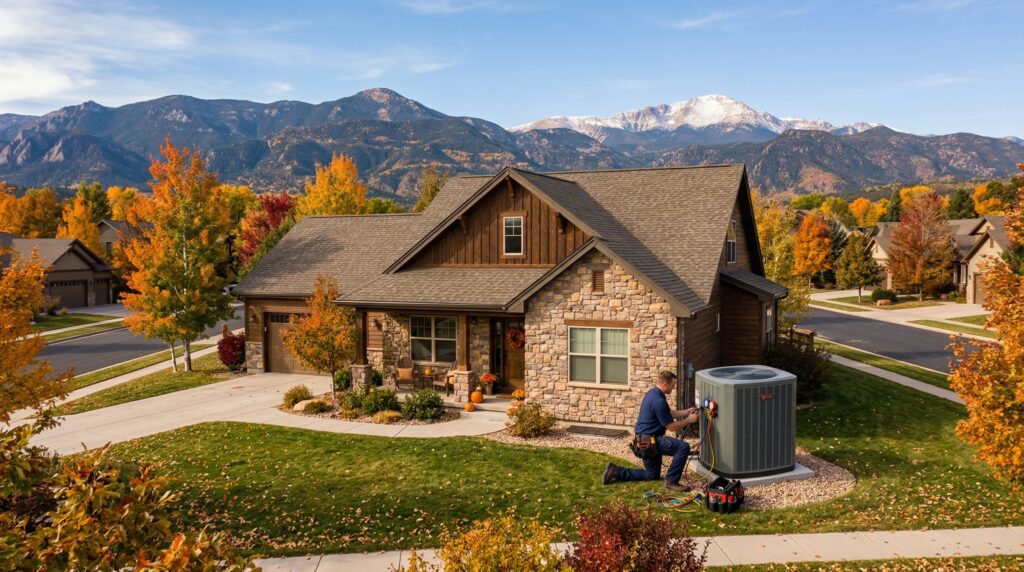
How Much Does HVAC Replacement Cost in Colorado?
Colorado homeowners replacing an HVAC system in 2026 pay $8,200 to $14,500 for most Front Range installations, with the most common full heating and cooling combo landing between $10,000 and $12,400 (UniColorado, 2026). That range covers a standard 2,000 square foot home with existing ductwork in decent condition. High-altitude sizing requirements, cold-climate heat pump specs, and Xcel Energy’s robust rebate program make Colorado one of the more nuanced states for HVAC replacement planning. Denver homeowners in particular face the classic 5,280-foot challenge: see our dedicated Denver HVAC replacement cost guide for altitude-specific sizing rules, Xcel rebate details, and permit requirements.
The table below shows 2026 cost ranges for the most common system types across Colorado. Prices include equipment, labor, permits, and basic installation with existing ductwork.
| System Type | Colorado Low | Colorado Typical | Colorado High |
|---|---|---|---|
| Central AC only | $3,800 | $6,200 | $9,500 |
| Gas furnace only | $2,500 | $4,200 | $7,000 |
| Gas furnace + central AC (combo) | $6,400 | $10,800 | $14,500 |
| Cold-climate heat pump (ducted) | $10,200 | $16,000 | $23,200 |
| Dual-fuel system (heat pump + gas backup) | $12,000 | $18,500 | $25,000 |
| Ductless mini-split (per zone) | $3,200 | $5,500 | $14,500 |
Denver metro pricing runs 8 to 12 percent above the Colorado statewide average. Pueblo and eastern plains markets run 10 to 15 percent below Denver. Mountain resort communities (Aspen, Vail, Telluride) can run 20 to 35 percent above Denver due to limited contractor availability and difficult access. For national comparison ranges, see our HVAC replacement cost guide.
Colorado City-by-City Cost Comparison
Colorado is not a single market. The Front Range corridor from Fort Collins to Pueblo covers five distinct local economies with different labor costs, contractor density, and permit requirements. Boulder commands the highest prices in the state outside of mountain resort communities. Pueblo runs the lowest of the major markets.
| City | Typical Full System Cost | Primary Equipment | Key Local Factor |
|---|---|---|---|
| Denver metro | $10,000–$14,500 | Cold-climate heat pump, gas furnace + AC | Xcel rebates up to $6,750; highest labor rates on Front Range |
| Boulder | $11,000–$16,000 | Cold-climate heat pump, high-efficiency furnace | 10–15% premium over Denver; contractor scarcity; strong heat pump adoption |
| Fort Collins | $8,500–$13,000 | Gas furnace + AC, cold-climate heat pump | Competitive contractor market; Xcel service area; typical AC $4,880–$6,693 |
| Colorado Springs | $5,000–$12,000 | Gas furnace + AC, heat pump | $500–$1,500 below Denver; 6,035 ft elevation; altitude sizing critical |
| Pueblo | $4,500–$10,500 | Central AC, gas furnace | Black Hills Energy territory (not Xcel); lowest labor costs in major CO markets |
Boulder’s pricing premium reflects a combination of progressive energy code requirements, high contractor wages, and a local market that has adopted heat pumps faster than anywhere else in the state. Fort Collins is generally the most price-competitive major market on the Front Range. For detailed Colorado Springs data including permit fees, utility programs, and contractor guidance, see the Colorado Springs HVAC pricing guide.
How Does Colorado’s High Altitude Affect HVAC Sizing?
At Denver’s 5,280-foot elevation, air is roughly 82 percent as dense as at sea level, which means standard HVAC sizing calculations built for sea-level conditions will underperform in Colorado (MoJo Home Services, 2026). Colorado Springs sits at 6,035 feet, and many mountain communities reach 7,000 to 9,000 feet. The thinner air carries less heat per cubic foot, so systems must move more air to achieve the same thermal transfer as a lower-altitude installation.
Altitude adjustment guidelines used by Colorado contractors:
- Denver metro (5,000–5,500 ft): Add 10–12% capacity to standard Manual J calculations. A home that would need a 3-ton system at sea level typically needs 3.3–3.4 tons in Denver.
- Colorado Springs (6,000–6,500 ft): Add 15–20% capacity. The Colorado Springs contractor community has specific experience with this adjustment and an established standard practice.
- Mountain communities above 7,000 ft: Add 20–25% or more, depending on solar exposure and local climate. Custom Manual J calculations are essential at this elevation.
Gas furnaces require altitude kit adjustments at high elevation. Without proper orifice resizing, furnaces burn rich, produce excess carbon monoxide, and cycle off on safety limits. This is not optional: all major manufacturers require altitude adjustments above 2,000 feet, and most Colorado homes sit well above that threshold. The altitude adjustment typically adds $200 to $500 to a furnace installation quote. Ask which model is on the quote before you compare Colorado furnace prices, because staging and AFUE move the number far more than the altitude kit does: our Daikin furnace cost guide shows a $3,200 to $4,300 spread between an 80 percent single-stage unit and a modulating 97 percent unit from the same manufacturer.
For heat pumps, altitude matters differently. Cold-climate heat pumps actually move air more easily in thinner conditions (lower fan resistance) but extract heat less efficiently from the cold, thin air during winter. This is why standard (non-cold-climate) heat pumps are a poor fit for most Colorado homes: their capacity drops significantly below 25°F at altitude, leaving the home undersized for Colorado’s cold snaps. Use our HVAC sizing calculator to get a Colorado-adjusted estimate for your home.
Colorado Climate Zones and Equipment Recommendations
Colorado spans four distinct climate environments. The right equipment choice depends on where you live in the state, not just on national guidelines.
Front Range — Denver, Colorado Springs, Fort Collins, Boulder
The Front Range is a true four-season climate. Denver records highs above 95°F in summer and lows below 0°F in winter. Colorado Springs sees similar temperature ranges at higher elevation. This means you need a system sized for genuine heating and cooling loads, not just one or the other.
Cold-climate heat pumps from Mitsubishi (H2i series), Bosch (Climate 5000), and Daikin (Aurora series) are rated to operate effectively at negative 13°F. These units handle both heating and cooling in a single system and qualify for Xcel Energy’s $2,250-per-ton rebate. Dual-fuel systems (cold-climate heat pump paired with a gas furnace backup) are also popular in Denver and Colorado Springs for homeowners who want a gas backup for the coldest nights. Trane also fields a cold-climate line, running $7,983 to $17,012 installed nationally; see our Trane heat pump cost guide for tier-by-tier pricing before you apply the Xcel per-ton rebate. For a full cost breakdown comparing heat pumps to central AC and furnace combinations, including break-even analysis and climate zone guidance, see our heat pump vs. central air cost comparison.
Mountain Communities — Aspen, Vail, Steamboat Springs, Telluride
Mountain communities above 7,000 feet have extended heating seasons and mild summers. Heating is the dominant load by a wide margin. Gas furnaces remain common here, especially in communities with established natural gas infrastructure. Cold-climate heat pumps are viable but require careful contractor selection: not all Front Range contractors have experience with high-altitude heat pump installations above 7,000 feet.
Expect to pay 20 to 35 percent above Denver metro rates in resort communities. Contractor scarcity, access challenges, and higher equipment costs for properly altitude-adjusted systems all contribute. Off-season scheduling (September through November before ski season, April through May after) can reduce wait times and sometimes costs.
Eastern Plains and Pueblo Area
The eastern plains and Pueblo have hot dry summers and moderate winters, the most straightforward climate profile in the state for HVAC selection. Central AC plus a gas furnace is the standard choice and remains cost-effective. Pueblo is in Black Hills Energy territory, not Xcel territory, so the large Xcel heat pump rebates are not available. Homeowners in Black Hills Energy service areas should check the DSIRE Colorado program index at programs.dsireusa.org for current utility and state programs.
Xcel Energy Rebates and Colorado Heat Pump Incentives
Xcel Energy’s Efficiency+ program offers the largest utility HVAC rebates in Colorado, with cold-climate heat pump rebates reaching $2,250 per ton for qualifying equipment. A 3-ton cold-climate heat pump earns $6,750 from Xcel alone, with no income requirement (Xcel Energy Efficiency+ program, 2026). This rebate applies to all Xcel gas account holders across the Front Range.
| Equipment Type | Xcel Rebate | Requirements |
|---|---|---|
| Cold-climate ducted heat pump (ccASHP) | $2,250 per heating ton | 1.75 COP at 5°F; 70% cold heat capacity |
| Standard ducted heat pump (ASHP) | $900 per cooling ton | ENERGY STAR certified; 15.2 SEER2 |
| Cold-climate mini-split (ccMSHP) | $2,250 per heating ton | 16 SEER2; 1.75 COP at 5°F |
| Standard mini-split (MSHP) | $900 per cooling ton | ENERGY STAR certified; 15.2 SEER2 |
| Heat pump water heater | $750 flat | ENERGY STAR certified |
| Smart thermostat | $50 instant + $100 AC Rewards enrollment | Qualifying model required |
| Panel upgrade (for heat pump or EV) | $1,500 | Installed concurrent with heat pump |
Two additional programs can layer on top of the Xcel rebate:
- Colorado HEAR Program (income-qualified): Administered by the Colorado Energy Office, this IRA-funded program offers up to $8,000 for qualifying cold-climate heat pump installation for households at or below 80% of area median income, or 50% of installation cost for households between 80% and 150% AMI. Denver County AMI for a family of four is approximately $99,100 (2025 estimate). As of the current Colorado Energy Office program update, the HEAR single-family program for Region 1 (Front Range counties including Denver, Boulder, Jefferson, El Paso, Larimer, and Weld) is closed for household applications and project proposals submitted after April 27, 2026. Region 2 remains open until remaining funding is fully reserved.
- Federal 25C tax credit: This credit expired December 31, 2025 under the One Big Beautiful Bill Act. It is no longer available for HVAC systems installed in 2026 or later. Homeowners who installed qualifying equipment before December 31, 2025 can still claim it on their 2025 tax return.
Homeowners outside Xcel territory (Black Hills Energy, Atmos Energy, rural electric cooperatives) have fewer utility rebate options. Check the DSIRE Colorado program index for current state and utility programs by ZIP code. For a full breakdown of available programs including the HEAR income-qualified pathway, see the HVAC rebates and tax credits guide.
Gas Furnace vs. Heat Pump in Colorado’s Cold Climate
Modern cold-climate heat pumps rated to negative 13°F are now a viable primary heating source across the Front Range and most lower-elevation Colorado communities (Xcel Energy contractor data, 2026). Cold-climate heat pumps are taking the same share in the Northeast for the same reasons: homeowners in Providence, Rhode Island tap stacked Clean Heat RI plus Rhode Island Energy rebates to offset the premium on cold-climate equipment. The performance gap between a cold-climate heat pump and a gas furnace has narrowed significantly over the past five years. That said, the right choice still depends on your elevation, existing gas infrastructure, and how you weigh upfront cost against long-term operating cost.
- Cold-climate heat pump advantages: Single system handles both heating and cooling. Qualifies for Xcel’s $2,250-per-ton rebate. Lower operating cost in moderate cold (above 20°F). No combustion products or carbon monoxide risk in the living space.
- Gas furnace advantages: Lower upfront cost (no altitude efficiency penalty). Performs at any temperature without efficiency reduction. Familiar technology with a wide contractor network. Better fit for mountain communities above 8,000 feet where heat pump performance at extreme low temperatures is less predictable.
- Dual-fuel systems: The heat pump handles heating above roughly 20°F efficiently. The gas furnace kicks in below that threshold. This approach maximizes the Xcel rebate (because you’re installing a qualifying heat pump) while maintaining the full comfort of a gas backup. Dual-fuel is popular in Denver, Colorado Springs, and Fort Collins for homeowners who want heat pump rebates without giving up gas backup.
A heat pump water heater is a separate product that adds a $750 Xcel rebate on top of any HVAC rebate. These are worth considering alongside any HVAC replacement project if your water heater is also aging. See our guide to heat pump vs. gas furnace cost comparison for a full side-by-side analysis.
What Drives HVAC Costs Higher in Colorado?
Several Colorado-specific factors push HVAC costs above national averages, particularly in the Front Range and mountain markets.
- Altitude sizing premium: Upsizing from a 3-ton to a 3.3-ton system adds $400 to $1,200 in equipment cost depending on the system type and brand tier. Cold-climate heat pumps feel this more than furnaces because larger-tonnage heat pump units are disproportionately more expensive.
- Altitude kit adjustment: Proper furnace orifice resizing and blower adjustment for Colorado elevations adds $200 to $500 to a furnace installation. Some contractors include this; confirm it is in the quote before signing.
- Mountain contractor scarcity: In Aspen, Vail, and Telluride, HVAC labor runs 20 to 35 percent above Denver metro rates. The short shoulder season between ski season and summer makes scheduling difficult.
- Seasonal demand spikes: May through June and October through November are peak booking periods across the Front Range. Scheduling 8 to 10 weeks in advance during shoulder seasons (March through April or August through September) can save $300 to $600 compared to emergency summer or winter calls.
- Permit requirements: Denver, Colorado Springs, Fort Collins, and Boulder all require mechanical permits for HVAC replacement. Permit fees typically run $100 to $400 depending on jurisdiction. Colorado does not have a statewide permit exemption; requirements are set by each local Authority Having Jurisdiction (AHJ).
Frequently Asked Questions: Colorado HVAC Replacement
How much does HVAC replacement cost in Denver?
Denver homeowners pay $10,000 to $14,500 for a full HVAC replacement (AC plus furnace or heat pump) for a standard 2,000 square foot home in 2026. High-efficiency cold-climate heat pump systems reach $18,000 to $23,200 before Xcel Energy rebates. After a $6,750 Xcel rebate on a 3-ton cold-climate system, net cost drops into the $11,000 to $16,500 range depending on efficiency tier.
Does Colorado’s altitude affect what HVAC system size I need?
Yes. At Denver’s 5,280-foot elevation, air density is about 82 percent of sea level. Standard load calculations undersize the system for Colorado conditions. Colorado HVAC contractors add 10 to 15 percent capacity for Front Range homes and 15 to 20 percent for Colorado Springs and higher elevations. Gas furnaces require altitude kit adjustments for safe combustion. Ask any contractor bidding your job whether their quote includes a Colorado-adjusted Manual J calculation.
What is the Xcel Energy heat pump rebate in 2026?
Xcel Energy offers $2,250 per ton for qualifying cold-climate heat pumps through its Efficiency+ program. A 3-ton system earns $6,750 with no income requirement. Qualifying brands include Mitsubishi H2i, Bosch Climate 5000, Daikin Aurora, and Fujitsu XLTH. Available to all Xcel gas account holders in Colorado. Standard (non-cold-climate) heat pumps qualify for $900 per ton. Rebates are applied after installation by a licensed contractor.
Is a heat pump a good choice for Colorado winters?
Modern cold-climate heat pumps rated to negative 13°F work well across the Front Range and most Colorado communities below 7,000 feet. Above 7,000 feet, contractors generally recommend a dual-fuel setup (heat pump plus gas backup) for reliable heating during extreme cold. The Xcel rebate of up to $6,750 makes cold-climate heat pumps one of the best-rebated upgrade options available to Colorado homeowners in 2026. When you compare specific cold-climate equipment, note that Carrier’s Infinity 21 Ultimate Cold Climate is rated for heating down to minus 23 degrees Fahrenheit, well below the negative 13 degree threshold above; our Carrier heat pump cost guide prices it against the rest of the Carrier lineup. For another cold-climate Midwest market comparison, see our Wisconsin HVAC replacement cost guide.
Is HVAC cheaper in Colorado Springs than Denver?
Generally yes. Colorado Springs runs $500 to $1,500 below Denver metro pricing for comparable systems, reflecting lower labor costs and a Regional Price Parity close to the national average. A full system in Colorado Springs typically runs $5,000 to $12,000 installed. The higher elevation (6,035 feet) means altitude sizing is even more critical in Colorado Springs than in Denver. See our Colorado Springs HVAC pricing guide for local permit, utility, and contractor details.
Does Colorado have state-level HVAC rebates beyond Xcel?
Yes, but availability changed in 2026. The HEAR (Home Electrification and Appliance Rebates) program through the Colorado Energy Office provides income-qualified rebates up to $8,000 for qualifying cold-climate heat pumps, but the Region 1 Front Range single-family program is closed for household applications and project proposals submitted after April 27, 2026. Region 2 remains open until remaining funding is fully reserved. The federal 25C tax credit expired December 31, 2025 and is no longer available for new installs. Homeowners outside Xcel territory should check the Colorado Energy Office and DSIRE Colorado program index for current utility programs by ZIP code.
Colorado City HVAC Cost Guides
For city-specific pricing, Xcel rebate details, permit requirements, and local contractor guidance, see the individual Colorado city guides:
- Colorado Springs HVAC Replacement Cost: Local pricing at 6,035 ft elevation, altitude sizing requirements, permit fees, and contractor recommendations
Use the free HVAC replacement cost estimator to get a personalized range for your Colorado home in under 2 minutes. Or compare Colorado costs to neighboring states with the HVAC cost by city and state guide.