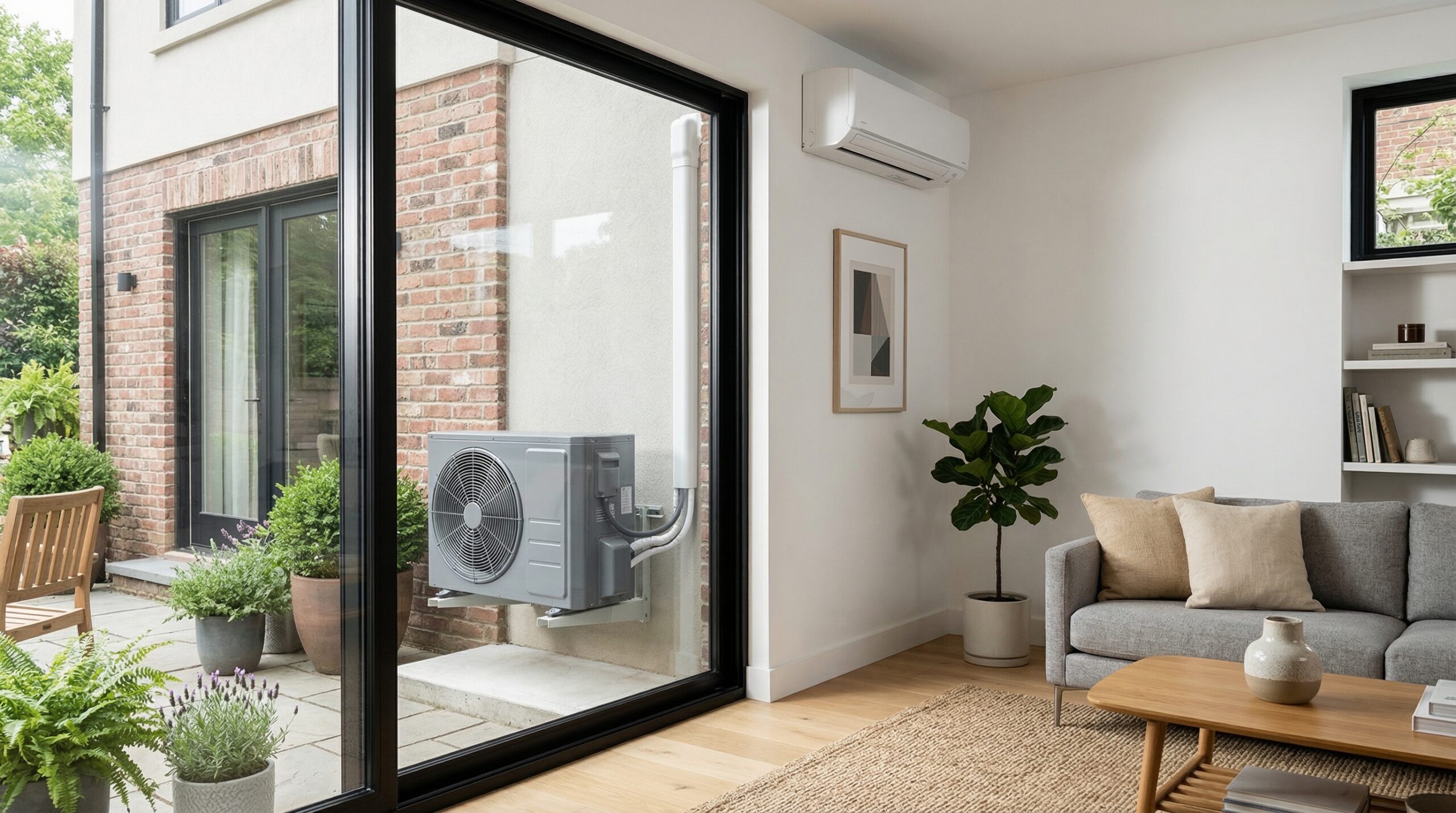
When you’re adding cooling to a room addition, garage, finished basement, or older home without ductwork, the question isn’t just about price: whether a ductless mini split or extending central air makes more sense for your situation matters just as much. Mini splits cost more per ton of cooling than central AC, but they skip the $3,000–$8,000 ductwork installation bill entirely. Central AC is usually cheaper per square foot when you already have ducts, though not always when you don’t.
This guide compares installed costs by zone count, efficiency ratings, and installation complexity so you can make a data-backed decision. Use our free HVAC cost estimator to get a personalized range for your home size and region.
How Much Does a Mini Split Cost vs. Central AC?
All costs below are fully installed: equipment plus labor. Central AC pricing assumes existing ductwork unless noted.
| System | Installed Cost | SEER Rating | Best For |
|---|---|---|---|
| Single-zone mini split | $2,000–$5,000 | SEER 18–30+ | One room or zone |
| 2-zone mini split | $4,000–$8,000 | SEER 18–25 | Two areas, no ductwork |
| 3–4 zone mini split | $7,000–$14,000 | SEER 16–22 | Full home without ducts |
| Central AC (existing ducts) | $3,500–$7,500 | SEER 14–21 | Whole home with existing ducts |
| Central AC (new ductwork) | $8,000–$16,000 | SEER 14–21 | Whole home, no existing ducts |
The comparison shifts dramatically based on your existing ductwork. If you have serviceable ducts, central AC is almost always cheaper for whole-home cooling. If you don’t, a 3–4 zone mini split often costs the same or less than central AC plus new ductwork installation.
Mini Split Cost by Number of Zones
Multi-zone mini split systems use one outdoor compressor connected to multiple indoor air handlers. Cost scales with the number of zones:
| Zones | Installed Cost | Typical Coverage |
|---|---|---|
| 1 zone | $2,000–$5,000 | 400–600 sq ft |
| 2 zones | $4,000–$8,000 | 800–1,200 sq ft |
| 3 zones | $6,500–$11,000 | 1,200–1,800 sq ft |
| 4 zones | $8,500–$14,000 | 1,600–2,400 sq ft |
These costs reflect professional installation including the outdoor unit, indoor air handlers, line sets, electrical connections, and refrigerant charging. DIY-friendly models (MrCool DIY, Cooper & Hunter) can reduce installed cost by 25–30% by eliminating most labor, though proper refrigerant line flare connections still require careful work.
Practical comparison: a 3-zone mini split at $6,500–$11,000 installed is often competitive with central AC plus new ductwork at $8,000–$16,000 for a 1,200–1,800 sq ft home, and the mini split delivers better zone control and higher SEER ratings.
When Does a Mini Split Make More Sense?
A mini split is usually the better choice in these situations:
- No existing ductwork: New duct installation for central AC typically costs $3,000–$8,000 on top of the AC unit itself, bringing total project cost to $8,000–$16,000. A comparable mini split system can deliver similar coverage for less.
- Room additions, garages, or converted spaces: Extending existing ductwork into a new addition is often impractical or structurally disruptive. A single-zone mini split handles these spaces cleanly with a two-inch line-set penetration through the wall.
- Supplemental cooling for a problem room: A hot attic office, sunroom, or bonus room that existing central air can’t adequately serve is a natural fit for a single-zone mini split ($2,000–$5,000).
- Historic homes or renovations where duct installation would require major structural work: Older homes with plaster walls, no attic access, or finished ceilings make duct installation extremely expensive. Mini splits avoid this entirely.
- Accessory Dwelling Units (ADUs) or detached structures: Garages, guest houses, and workshops are ideal mini split candidates: one outdoor unit, one indoor handler, clean and self-contained.
When Does Central AC Make More Sense?
One clarification before the list: central AC here covers both split systems and package units. If your home has no attic, basement, or utility closet for an indoor air handler, the central option available to you is a single outdoor cabinet, priced in our HVAC package unit cost guide.
Central AC paired with existing ductwork is the better call when:
- You have ductwork in good condition: The biggest cost advantage of central AC is the sunk investment in existing ducts. If your ducts are serviceable, a central AC swap at $3,500–$7,500 is hard to beat.
- Whole-home cooling for 2,000+ sq ft: A 4-zone mini split for a larger home gets expensive fast ($10,000–$14,000 or more). Central AC covers the full home from a single outdoor unit at a lower installed cost.
- You prefer a single thermostat: Mini split multi-zone systems require each zone to be controlled independently (each indoor head has its own remote or wall control). Central AC with a single thermostat is simpler for many homeowners.
- Simpler maintenance preference: One outdoor unit and one air handler (central AC) is mechanically simpler than a multi-zone mini split with multiple indoor heads requiring filter cleaning and coil maintenance.
Installation Complexity: How Does Mini Split Installation Compare?
The installation process differs significantly between the two systems:
- Single-zone mini split: 1–2 days. Requires a 2–3 inch wall penetration for the line set, electrical connection for the outdoor unit (usually 240V), and mounting the indoor head. No duct modification. Minimal structural work.
- Central AC (existing ducts): 6–8 hours. Swap outdoor condenser, connect to existing air handler, recharge refrigerant. Straightforward for a licensed HVAC tech.
- Central AC (new ductwork): 3–5 days. Duct design, fabrication, installation through walls/attic/crawlspace, then AC installation. Major construction project with drywall patching and finishing.
For ductwork replacement cost context, see our ductwork replacement cost guide; the numbers make the mini split comparison clearer when you see what new duct systems actually cost.
SEER Ratings and Efficiency: Do Mini Splits Save You Money on Bills?
Mini splits typically run SEER 18–30+ thanks to variable-speed compressors that modulate output rather than cycling on/off. Central AC systems typically achieve SEER 14–21. The 2025 federal minimum for ductless mini splits is SEER2 15 (roughly equivalent to SEER 16–17 under the old rating).
The efficiency comparison has a hidden dimension: duct losses. Older central AC ductwork typically loses 10–30% of conditioned air through leaks, poor insulation, and thermal transfer, especially in unconditioned attics. A SEER 16 mini split delivering all its output directly to the room can outperform a SEER 21 central AC system losing 20% through leaky attic ducts.
If your existing ductwork is poorly sealed or runs through a hot attic, the efficiency advantage of a mini split is larger than the SEER numbers alone suggest. For a broader look at how efficiency ratings affect total cost, see our HVAC cost by efficiency tier guide.
For homeowners also evaluating a full heat pump vs. standard AC comparison, see our heat pump vs. AC cost guide; many mini split systems also function as heat pumps for year-round climate control. If a ducted heat pump is still on the table, our Lennox heat pump cost guide compares installed pricing across the Lennox lineup.
How We Calculate These Costs: Our cost data is sourced from contractor invoices, manufacturer pricing, and regional labor surveys across 12 U.S. metro areas. All prices reflect fully installed costs including equipment, labor, and standard materials. SEER rating data reflects 2025 AHRI standards. See our Methodology page for data sources and update frequency.
Frequently Asked Questions
Is a mini split cheaper than central AC?
It depends on whether you have existing ductwork. For a single room, a mini split at $2,000–$5,000 installed is often cheaper than extending central AC ductwork. For whole-home cooling without existing ductwork, mini splits are often comparable or cheaper than central AC plus new ductwork ($8,000–$16,000). For homes with existing ductwork in good condition, central AC is usually $3,000–$6,000 cheaper upfront.
How much does a mini split cost per room?
A single-zone mini split covering one room costs $2,000–$5,000 installed. Multi-zone systems cost $1,500–$3,500 per additional zone after the first, depending on brand, SEER rating, and distance from the outdoor unit. Higher-SEER models (SEER 25+) carry a $500–$1,500 premium over baseline SEER 18 units.
Do mini splits work in winter?
Yes. Mini split heat pumps provide both cooling and heating. Standard models work efficiently down to 25–30°F. Cold-climate models from Mitsubishi, Bosch, and Daikin operate down to -13°F, making them a viable year-round system in most U.S. climates. They replace both AC and heating in one unit. See our heat pump replacement cost guide for full pricing on heat pump mini splits.
What SEER rating should I look for in a mini split?
Look for SEER 20 or higher for meaningful energy savings over baseline. The federal minimum for ductless systems in 2025 is SEER2 15 (roughly SEER 16–17 equivalent). Higher SEER ratings cost more upfront but reduce monthly operating costs. A SEER 25 mini split typically pays back the premium over a SEER 16 model in 3–7 years depending on local electricity rates and annual runtime hours.
Can I install a mini split myself?
DIY-friendly mini split models such as MrCool DIY and Cooper & Hunter allow self-installation without an HVAC license, saving $500–$1,500 in labor costs. However, proper refrigerant line flare connections require careful technique to avoid leaks, and DIY installation may void the manufacturer warranty on some models. Professional installation is recommended for multi-zone systems due to the complexity of refrigerant line sizing and balancing.
For a broader comparison of HVAC system replacement costs, see our central AC replacement cost guide and full HVAC replacement cost overview.
Get a Personalized Cost Estimate
Use our free estimator to get a low/mid/high cost range for your specific home size, system type, and region, no email required.
Put the numbers in context
What would it cost for your home?
Get a planning range based on your home, system and region. Free, with no email required.
Get my cost estimate