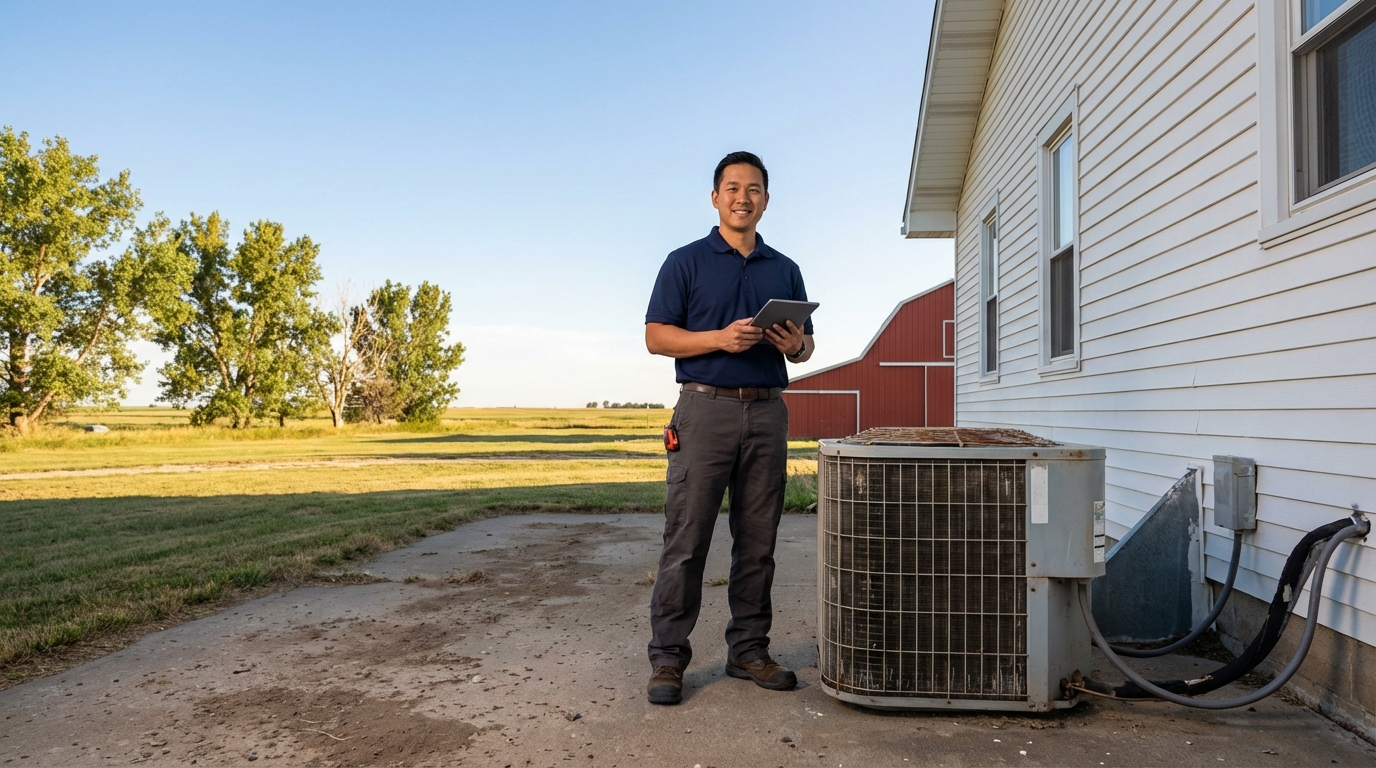
Nebraska homeowners face a heating-dominant HVAC environment: continental winters that regularly push below 0°F across most of the state, hot and humid summers along the Missouri River corridor, and a geography that ranges from dense Omaha suburbs to rural high plains where contractor travel time adds to every quote. Climate Zone 5A covers northern and western Nebraska, while the Omaha-Lincoln corridor sits on the Zone 4A-5A boundary. This guide covers what HVAC replacement actually costs across Nebraska in 2026, which OPPD, LES, and NPPD rebates you can claim, and how to evaluate the heat pump vs. high-efficiency furnace decision for Nebraska conditions.
What Does HVAC Replacement Cost in Nebraska?
HVAC replacement in Nebraska runs $3,200 to $14,500 installed, depending on system type, equipment tier, and location. The table below shows 2026 installed cost ranges for the most common replacement scenarios.
| System Type | Low End | High End | Most Common |
|---|---|---|---|
| Gas furnace only | $3,200 | $9,500 | $4,800–$7,000 |
| Central AC only | $3,500 | $8,500 | $4,200–$7,000 |
| Full HVAC system (AC + furnace) | $5,800 | $14,500 | $8,500–$12,000 |
| Cold-climate heat pump | $5,500 | $13,500 | $7,000–$11,500 |
| Mini-split (per zone) | $2,800 | $8,000 | $3,500–$6,000 |
These ranges reflect installed cost including equipment, refrigerant, electrical work, and labor. Permit fees ($75–$200 in most Nebraska cities) are not included and should be added to any contractor quote.
Why Is Nebraska HVAC Priced the Way It Is?
Nebraska HVAC costs track near the national average in Omaha and Lincoln but run higher in rural areas and for heating-focused installations. Three factors shape Nebraska pricing.
Long heating season drives equipment upgrades. Omaha averages 6,000–6,500 heating degree days per year. Grand Island and Norfolk in central and northeast Nebraska push 7,000–7,500 HDD. That heating load means a 2,000 sq ft Nebraska home typically needs an 80,000–100,000 BTU furnace, and the long season makes the efficiency upgrade from 80% to 96%+ AFUE pay back faster than in warmer states. Contractors here routinely recommend high-efficiency equipment because it produces real savings for Nebraska homeowners.
Labor market by region. BLS data for the Omaha-Council Bluffs MSA puts HVAC technician wages (SOC 49-9021) at approximately $52,000–$56,000 per year, near the national mean. Lincoln runs comparably. That keeps metro Nebraska pricing in line with national averages. Rural Nebraska has lower base wages but contractor travel costs often offset the difference.
Rural service geography. Nebraska covers 77,000 square miles, much of it agricultural. Contractors serving farms and small towns outside the major metros often travel 30–60 miles per job, adding $50–$150 to installation quotes as a travel surcharge or higher hourly rates. Homeowners in communities outside Omaha, Lincoln, Grand Island, and Kearney should expect a rural premium of 10–20% compared to metro pricing.
What Does Furnace Replacement Cost in Nebraska?
Furnace replacement is the most common HVAC job in Nebraska. Most homes in Omaha and Lincoln run natural gas, and the primary decision is efficiency tier. Nebraska’s long heating season makes the upgrade from 80% AFUE to 96%+ AFUE worth serious consideration.
| Furnace Type | AFUE | Installed Cost | Notes |
|---|---|---|---|
| Entry-level single-stage | 80% | $3,200–$5,000 | Lower upfront; not rebate-eligible in most programs |
| Mid-range two-stage | 96% | $4,800–$7,000 | Qualifies for OPPD, LES, and Black Hills rebates |
| Premium variable-speed | 97–98% | $6,500–$9,500 | Best humidity control; quietest operation |
In Zone 5A Nebraska (Omaha, Grand Island, Norfolk), the upgrade from 80% to 96%+ AFUE typically pays back in 4–7 years. A household burning 900 therms per year at $1.10/therm saves approximately $155–$195 annually with a 96% AFUE furnace compared to an 80% model. OPPD and LES each offer rebates on qualifying high-efficiency furnaces. The federal Section 25C credit expired December 31, 2025 and is not available for equipment placed in service in 2026.
What Does Central AC Replacement Cost in Nebraska?
Central AC replacement in Nebraska runs $3,500–$8,500 installed. Nebraska’s ~1,200–1,400 cooling degree days in the Omaha-Lincoln corridor are lower than in Southern states, which affects the payback calculation on premium efficiency equipment. The SEER2 16 tier typically offers the best value for Nebraska homeowners: rebate-eligible without the cost premium of 20 SEER2 equipment.
| AC Tier | SEER2 Rating | Installed Cost | Rebate Eligible? |
|---|---|---|---|
| Standard efficiency | 14–15 SEER2 | $3,500–$5,500 | No |
| High efficiency | 16–17 SEER2 | $4,500–$7,000 | OPPD/LES: $50–$200 |
| Premium efficiency | 18–20+ SEER2 | $6,000–$8,500 | Federal Section 25C expired December 31, 2025; unavailable for 2026 installations |
Nebraska summers in Omaha and Lincoln are hot and humid, making proper AC sizing and refrigerant charge critical for both temperature control and dehumidification. For a full breakdown of efficiency ratings and cost impact, see our SEER rating cost comparison guide.
Heat Pump Cost in Nebraska — Is It Worth It?
Cold-climate heat pumps are a growing option for Nebraska homeowners, particularly with OPPD and LES rebates. Nebraska’s Zone 5A winters require careful equipment selection and, for most of the state, a dual-fuel configuration.
Installed cost for a cold-climate heat pump in Nebraska ranges from $5,500 to $13,500, depending on configuration and home size.
| Configuration | Installed Cost | Best For |
|---|---|---|
| Heat pump only (all-electric) | $7,500–$13,500 | Homes with electric backup; milder Zone 4A locations |
| Dual-fuel (heat pump + gas backup) | $9,000–$14,500 | Existing gas homes; Zone 5A and northern Nebraska |
| Single-zone mini-split heat pump | $2,800–$8,000 | Additions, sunrooms, supplemental zones |
Rebates make heat pumps financially competitive in Nebraska. OPPD offers rebates on qualifying cold-climate heat pumps for Omaha metro customers. LES offers comparable programs for Lincoln customers.
The Nebraska-specific consideration: Omaha and Lincoln heat pumps work well as primary heat through most of the winter with NEEP-listed cold-climate models rated to -13°F. Grand Island, Norfolk, and western Nebraska see harder winters with more sustained extreme cold; dual-fuel configurations (heat pump plus gas backup) are the most reliable approach in those regions. For most Nebraska homeowners with natural gas already available, a dual-fuel setup captures heat pump efficiency for 80–90% of the heating season while the gas furnace handles the coldest weeks.
Nebraska HVAC Rebates — OPPD, LES, NPPD, and Federal Section 25C Status for 2026
Nebraska rebate availability is utility-specific. Which programs you can access depends on your electric and gas provider. Here is what is available from each major Nebraska utility in 2026.
OPPD Rebates — Omaha Metro
Omaha Public Power District serves the Omaha metro including Bellevue, Papillion, La Vista, Millard, and surrounding areas. OPPD’s energy efficiency program includes rebates on qualifying HVAC equipment:
- Cold-climate heat pump: rebates available on qualifying ENERGY STAR certified models
- Central AC (high efficiency): rebates available on SEER2 16+ equipment
- Smart thermostat: rebates on ENERGY STAR certified thermostats
- Verify current amounts at oppd.com before committing to equipment selection
LES Rebates — Lincoln Area
Lincoln Electric System serves Lincoln and immediate surrounding communities. LES has an active residential energy efficiency program covering the most common HVAC upgrades:
- Cold-climate heat pump: $150–$400 depending on efficiency tier
- Central AC (SEER2 16+): $50–$200
- High-efficiency furnace (96%+ AFUE): $50–$100
- Smart thermostat (ENERGY STAR): up to $50
LES rebates require licensed contractor installation and documentation submitted within 60 days of install. Verify current amounts at les.com before purchase as amounts may change annually.
NPPD Rebates — Rural Nebraska
Nebraska Public Power District is the largest utility by geography, serving much of rural Nebraska outside the Omaha and Lincoln metro areas. NPPD’s energy efficiency programs have varied over time; homeowners in NPPD territory should verify current rebate availability directly at nppd.com. Some rural Nebraska homeowners are served by electric cooperatives affiliated with NPPD, which may have their own separate programs.
Black Hills Energy — Natural Gas Rebates
Black Hills Energy provides natural gas service to many Nebraska communities including Lincoln, Omaha (partial coverage), Grand Island, Kearney, and Hastings. Black Hills Energy periodically offers rebates on high-efficiency gas furnaces (96%+ AFUE) and smart thermostats. Check the Black Hills Nebraska HEAT program for current programs before selecting equipment.
Federal Section 25C Status for 2026
The federal Section 25C credit expired December 31, 2025 and is not available for equipment placed in service in 2026.
Do You Need a Permit for HVAC Replacement in Nebraska?
Nebraska requires a mechanical permit for all HVAC replacements. Permits are issued by the local Authority Having Jurisdiction, typically the city or county building or development services department. There is no single statewide permit; requirements and fees vary by municipality.
Typical permit costs by Nebraska city:
- Omaha: $75–$200
- Lincoln: $75–$175
- Grand Island: $50–$150
- Kearney: $50–$125
- Bellevue: $60–$150
- Norfolk: $50–$125
Nebraska requires HVAC contractors to hold a valid mechanical contractor license before pulling permits. Verify your contractor’s license status before signing any contract. Reputable contractors include the permit fee in their quote and handle inspection scheduling. If a contractor tells you a permit is not required for HVAC replacement in Nebraska, that is a serious warning sign. Unpermitted work creates problems with homeowners insurance claims and real estate transactions.
Nebraska City Cost Comparison — Omaha vs. Lincoln vs. Rural Nebraska
HVAC costs vary across Nebraska. Omaha has the most contractor competition and a wide price range. Lincoln is comparable, often slightly lower. Rural Nebraska has lower base labor costs offset by travel premiums and, in some areas, propane dependency.
| City/Region | Full System Cost Range | Notes |
|---|---|---|
| Omaha metro (including Bellevue) | $9,000–$14,500 | Most competition; OPPD rebates available |
| Lincoln | $8,500–$13,500 | LES service area; competitive market |
| Grand Island | $7,500–$12,500 | Central Nebraska hub; NPPD territory |
| Kearney | $7,000–$12,000 | South-central market; moderate contractor availability |
| Norfolk | $7,000–$12,000 | Northeast Nebraska; colder Zone 5A winters |
| Hastings | $7,000–$11,500 | South-central Nebraska; NPPD area |
| Rural Nebraska | $6,500–$13,000 | 10–20% rural premium; propane common outside gas mains |
Rural Nebraska homeowners outside natural gas service areas face higher operating costs with propane systems. Propane furnaces and heat pumps are both viable, but propane price volatility means annual fuel costs can vary significantly. Heat pumps reduce propane dependency and often make financial sense for rural Nebraska homeowners who want to stabilize heating costs.
How to Get Accurate Nebraska HVAC Quotes
Getting three quotes is standard advice, but what separates a useful quote from a confusing one is line-item detail. Ask every Nebraska contractor to provide a written quote that includes the following before you sign anything.
- Equipment manufacturer, model number, and efficiency rating (AFUE, SEER2, or HSPF2)
- Labor cost listed separately from equipment cost
- Permit fee included (or explicitly excluded with cost stated)
- Warranty terms: equipment manufacturer warranty and contractor labor warranty (minimum 1 year on labor)
- Refrigerant type (R-410A systems are being phased out; R-454B or R-32 is 2025+ standard)
- OPPD, LES, or NPPD rebate paperwork handling: confirm whether the contractor processes rebate claims or you handle them directly
Use our free HVAC cost estimator to get a personalized estimate based on your home size, system type, and Nebraska region before you start collecting contractor bids. For a full breakdown of what drives replacement costs nationally, see our national HVAC replacement cost guide. If you are timing your replacement to maximize savings, see our best time to replace HVAC guide for seasonal pricing patterns.
Frequently Asked Questions
How much does HVAC replacement cost in Nebraska?
Nebraska homeowners typically pay $5,800 to $14,500 for a full HVAC system replacement (central AC plus gas furnace) in 2026. Furnace-only replacement runs $4,800 to $7,000. Central AC only runs $4,200 to $7,000. A cold-climate heat pump costs $7,000 to $11,500 before rebates. Omaha and Lincoln metro costs are near the statewide average; rural Nebraska varies based on contractor travel distance and fuel availability.
What HVAC rebates are available in Nebraska?
Nebraska rebate availability depends on your electric and gas utilities. OPPD customers in the Omaha metro area can receive rebates on qualifying heat pumps and high-efficiency AC. LES customers in Lincoln can receive rebates of $50 to $400 depending on equipment type. NPPD customers in rural Nebraska should check nppd.com for current programs. The federal Section 25C credit expired December 31, 2025 and is not available for equipment placed in service in 2026.
Is a heat pump a good choice for Nebraska winters?
Cold-climate heat pumps work in Nebraska with the right equipment and configuration. Omaha and Lincoln sit in Climate Zone 4A to 5A, where temperatures regularly reach 0°F to -10°F in winter. NEEP-listed cold-climate models rated to -13°F handle the majority of Nebraska winter days efficiently. Most Nebraska contractors recommend a dual-fuel setup pairing a heat pump with a gas backup furnace that activates below approximately 35°F. This captures heat pump efficiency for most of the season while gas handles the coldest stretches. All-electric heat pump systems are viable in Omaha and Lincoln; northern and western Nebraska benefits most from dual-fuel.
Do I need a permit for HVAC replacement in Nebraska?
Yes. Nebraska requires mechanical permits for HVAC replacement statewide. Permits are issued by the local jurisdiction (city or county). Fees typically run $75 to $200 in Omaha and Lincoln, and $50 to $150 in smaller cities. A licensed mechanical contractor must pull the permit, and an inspection is required after installation. If a contractor tells you no permit is needed for an HVAC replacement in Nebraska, treat that as a serious warning sign.
Why do HVAC costs run higher in Nebraska than in warmer states?
Nebraska’s long heating season (6,000 to 7,500 heating degree days) drives demand for higher-BTU furnaces and 96%+ AFUE efficiency tiers, both of which cost more than lower-efficiency equipment. Rural Nebraska’s large service territories add contractor travel costs to installations in communities outside the major metros. Propane dependence in areas without natural gas access also raises equipment and operating costs compared to natural gas systems.
What efficiency furnace should I buy in Nebraska?
Nebraska’s Climate Zone 5A and 6,000 to 7,500 heating degree days make a 96%+ AFUE furnace the standard recommendation for most of the state. The payback period for upgrading from 80% to 96%+ AFUE in Nebraska is typically 4 to 7 years. A household burning 900 therms per year at $1.10 per therm saves approximately $155 to $195 annually with a 96% AFUE furnace. High-efficiency furnaces qualify for OPPD, LES, and Black Hills Energy rebates.
Put the numbers in context
What would it cost for your home?
Get a planning range based on your home, system and region. Free, with no email required.
Get my cost estimate