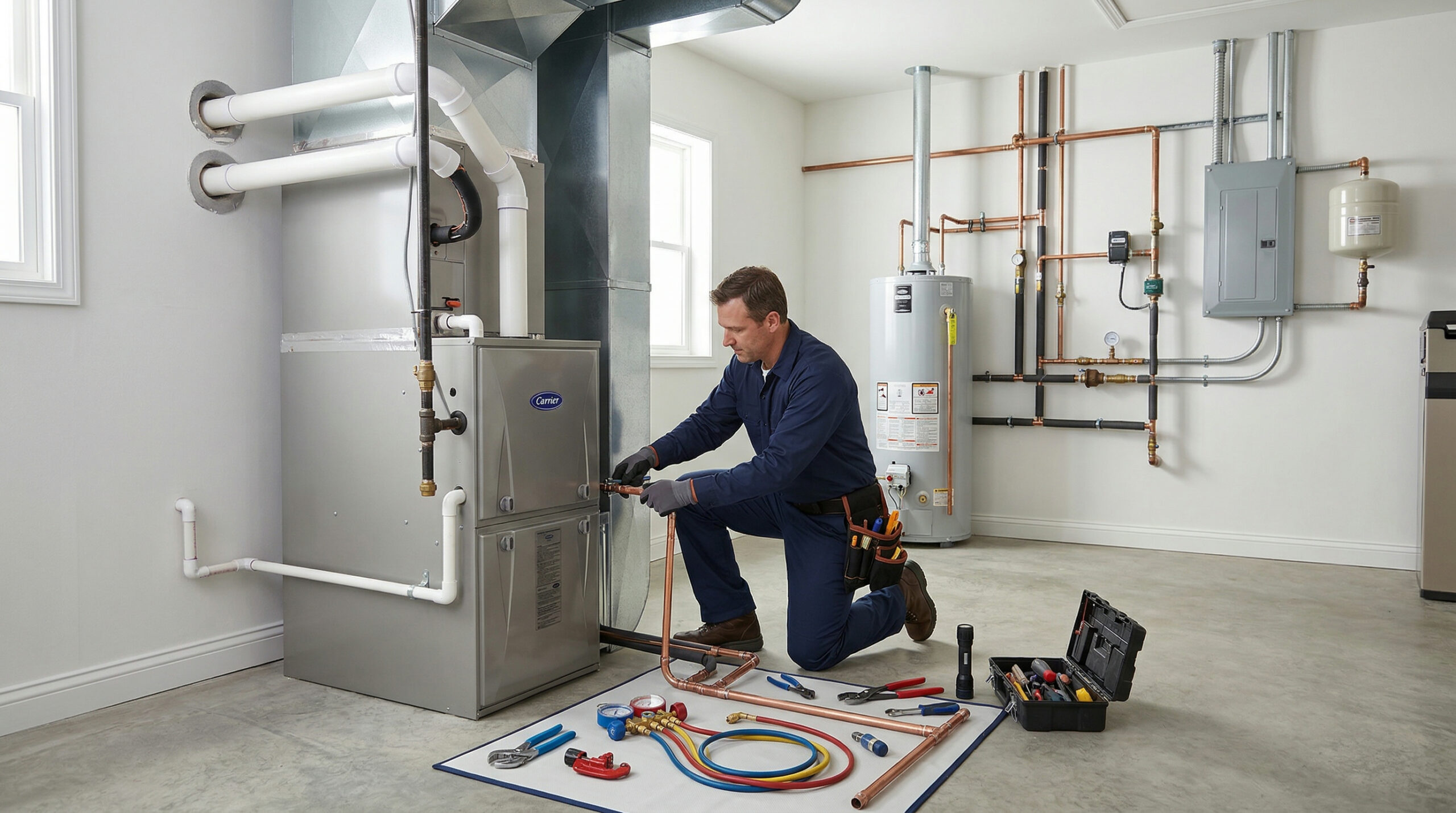
Furnace replacement cost in 2026 typically runs between $2,500 and $11,200, with most homeowners paying $4,500 to $6,300 for a mid-range gas unit including installation. The cost to replace a furnace varies widely based on efficiency, home size, and region. According to the U.S. Energy Information Administration (EIA), natural gas remains the most common main space-heating fuel in U.S. homes at 47%, making this one of the most common major home expenses. That’s a wide range, and the final number hinges on your home’s size, the efficiency rating you pick, your region, and whether your ductwork needs work.
This page breaks down furnace replacement pricing by the factors that actually move the number. Every figure comes from our documented methodology, which combines manufacturer pricing, contractor rate surveys, and regional cost adjustments. No black boxes, no bait-and-switch. If you’re also weighing a full system swap, check our HVAC replacement cost overview for the big picture. When you have multiple furnace quotes, the guide to cheapest quote vs best value helps you choose the right bid.
TL;DR: Most homeowners spend $4,500-$6,300 to replace a furnace in 2026. Gas furnaces cost more upfront than electric but less to operate annually. See our gas vs electric furnace cost comparison for a full breakdown of upfront and operating costs. High-efficiency units (96%+ AFUE) add about 30% to the price but can save $200-$400 per year on heating bills, per U.S. Department of Energy estimates. Get a personalized estimate with our free calculator.
Arizona is a notable case where furnaces are still used despite extreme heat: Phoenix averages only 166 heating degree days annually, yet many homes have gas furnaces for the occasional winter cold snap. For full Arizona pricing, see the Arizona HVAC replacement cost guide. In warmer climates like San Antonio, TX (Zone 2A), standalone gas furnaces are less common. Most homeowners choose a heat pump with aux heat strips or a dual-fuel system for the occasional hard freeze. See our San Antonio HVAC cost guide for how heating choices play out in South Texas.
Virginia homeowners face a similar choice, especially in Southwest Virginia where Appalachian Power serves the Roanoke region and winter temperatures create meaningful heating demand. The Piedmont and coastal zones typically see mild enough winters that heat pumps handle most of the load. See the Virginia HVAC replacement cost guide for how furnace vs. heat pump decisions play out across the state’s distinct climate zones.
How Much Does Furnace Replacement Cost?
The cost of a new furnace installed in 2026 runs $2,500 to $11,200, with the national midpoint around $4,500-$6,300 for a standard gas unit. According to Carrier’s 2026 pricing guide, installed costs range from $2,000 to $14,000 depending on configuration. Our more granular data narrows that by home size and efficiency tier.
The total cost of furnace replacement in 2026 ranges from $2,500 to $11,200 installed, with the national average falling between $4,500 and $6,300 for a mid-efficiency gas unit in a typical 1,500-2,000 square foot home. For a full breakdown by home size, see our HVAC replacement cost for 1,500 sq ft guide. According to Carrier’s 2026 residential pricing guide, installed furnace costs can reach $14,000 for premium configurations including high-efficiency condensing units, complex ductwork connections, and code-required upgrades. Equipment accounts for roughly 60% of the total installed price, while labor, permits, materials, and old-unit disposal make up the remaining 40%. The Bureau of Labor Statistics reports that HVAC technician wages vary by more than 25% across U.S. regions, making geography one of the biggest variables in final pricing. Homeowners in the Northeast and West Coast consistently pay more than the national baseline for identical equipment and installation scope.
| Home Size | Standard (80% AFUE) | High-Efficiency (90-95%) | Premium (96%+) |
|---|---|---|---|
| Under 1,000 sq ft | $2,100 – $6,800 | $2,400 – $7,800 | $2,700 – $8,800 |
| 1,000 – 1,500 sq ft | $2,500 – $8,000 | $2,900 – $9,200 | $3,300 – $10,400 |
| 1,500 – 2,000 sq ft | $2,800 – $8,800 | $3,200 – $10,100 | $3,600 – $11,400 |
| 2,000 – 2,500 sq ft | $3,000 – $9,600 | $3,500 – $11,000 | $3,900 – $12,500 |
| 2,500 – 3,000 sq ft | $3,300 – $10,400 | $3,800 – $12,000 | $4,300 – $13,500 |
| Over 3,000 sq ft | $3,500 – $11,200 | $4,000 – $12,900 | $4,600 – $14,600 |
These figures include the furnace unit, standard installation labor, basic materials, permit fees, and disposal of the old unit. They don’t include ductwork modifications, thermostat upgrades, or gas line changes (we cover those separately below).
Your actual cost also shifts based on where you live. According to Bureau of Labor Statistics (BLS) occupational data, HVAC technician wages vary significantly by region. Homeowners in the Northeast pay roughly 15% more than the Southeast/Midwest baseline (see Indianapolis pricing or Oklahoma City, OK for typical baseline-region examples), while the West Coast runs about 25% higher. The Southwest falls in between at about 5% above baseline. For location-specific numbers, see our HVAC cost by city breakdown. For example, Nashville, TN homeowners can stack TVA EnergyRight rebates with a dual-fuel furnace-heat pump system. In the Charlotte metro area, Rock Hill, SC homeowners benefit from a municipal utility rebate on heat pump replacements that reduces the furnace-vs-heat-pump decision calculus.
Brand choice matters too. Budget-tier furnaces (Goodman, Amana) run about 10% below the mid-range price, while premium brands like Trane, Carrier, and Lennox add roughly 20% on top. Deciding between Trane or Lennox for your furnace? See our Trane vs Lennox cost comparison, or go straight to model-level pricing in our Lennox furnace cost guide, which breaks all 17 current Merit, Elite, and Signature furnaces down by AFUE and installed price. Our Carrier furnace cost guide does the same for Carrier’s ten Comfort, Performance, and Infinity models. Mid-premium options like York (TM9E furnace, 95% AFUE) sit between Goodman and Carrier on price and are sold through certified dealers. Most homeowners land in the mid-range tier: solid reliability without paying for features they won’t use.
How Much Does a Gas Furnace Cost vs. Electric?
Gas furnaces cost $2,500-$11,200 installed while electric furnaces run $1,500-$6,500, making electric roughly 40% cheaper upfront. According to the U.S. Energy Information Administration (EIA), natural gas is the main space-heating fuel for approximately 47% of U.S. homes. Despite the higher upfront cost, gas tends to be the cheaper option over a furnace’s full lifespan in cold-climate states.
Gas furnaces cost $2,500 to $11,200 installed in 2026, while electric furnaces run $1,500 to $6,500, making electric units roughly 40% cheaper upfront. However, annual operating costs tell a different story. According to the U.S. Energy Information Administration (EIA), natural gas remains the most common main home heating fuel in the United States at 47% market share, largely because gas costs less per BTU than electricity in most regions. Gas furnace owners typically spend $500 to $1,200 annually on heating, compared with $900 to $2,000 for electric furnace owners. That operating cost gap of $400 to $800 per year depends on local utility rates. Over a 15-to-20-year furnace lifespan, that annual savings can total $6,000 to $16,000, which more than offsets the higher upfront equipment and installation cost of a gas unit in states with cold winters lasting five or more months.
| Factor | Gas Furnace | Electric Furnace |
|---|---|---|
| Equipment + install | $2,500 – $11,200 | $1,500 – $6,500 |
| Typical mid-range installed | $4,500 – $6,300 | $2,500 – $4,000 |
| Efficiency rating | 80% – 98.5% AFUE | 100% AFUE (all models) |
| Annual heating cost (avg home) | $500 – $1,200 | $900 – $2,000 |
| Lifespan | 15 – 20 years | 20 – 30 years |
| Best for | Cold climates, existing gas line | Mild climates, no gas access |
Every electric furnace runs at 100% AFUE because it converts all electricity directly into heat. There’s no combustion exhaust to lose energy through. But electricity costs more per BTU than natural gas in most of the country, so operating costs tend to be higher. In analyzing pricing data from contractor surveys and industry reports, we’ve found the annual operating cost gap ranges from $400 to $800 depending on local utility rates.
Gas furnaces cost more upfront, especially high-efficiency models. But in cold climates where you’re running your furnace five or six months per year, the lower fuel cost often makes gas the better long-term value. If you’re considering replacing both your furnace and AC at the same time, bundling can save $500-$2,000 on combined installation. See our guide on replacing AC and furnace together for details. If your home is in the 1,500–2,100 sq ft range, a combined 3-ton system is the most common sizing choice. See our 3-ton HVAC replacement cost guide for equipment and installed price ranges. You might also compare standalone AC replacement costs or heat pump replacement costs if you’re weighing alternatives. Matched pairings matter here too: a slim side-discharge inverter system like the Daikin Fit connects to either an air handler or a gas furnace, and our Daikin Fit system cost guide breaks down how that indoor choice changes the total.
What Does a Gas Furnace Replacement Actually Cost?
A gas furnace replacement costs $2,500 to $11,200 installed in 2026, with most homeowners paying $4,500 to $6,300 for a mid-efficiency unit. Per ASHRAE equipment life expectancy data, gas furnaces typically last 15 to 20 years, meaning millions of units installed during the 2006 to 2011 building boom are now hitting replacement age.
The biggest cost variable for gas furnaces is efficiency. A standard 80% AFUE gas furnace for a typical 1,500-2,000 sq ft home runs about $5,000 installed at mid-range. Jump to a 96%+ AFUE condensing model and that climbs to roughly $6,500, a 30% premium. In our experience reviewing contractor pricing across multiple regions, the sweet spot for most homeowners is a 90-95% AFUE unit, which balances upfront cost with meaningful fuel savings.
One important regulatory change: as of January 2025, the U.S. Department of Energy finalized rules requiring a minimum 95% AFUE for non-weatherized gas furnaces in northern states. If you live in a northern climate zone, an 80% AFUE unit is no longer an option for new installations. This rule affects roughly 30 states and means the price floor for gas furnaces in those areas has shifted upward.
How Do AFUE Ratings Affect Furnace Replacement Cost?
Higher AFUE ratings add 15-30% to your upfront cost but save $200-$400 per year on heating bills. The U.S. Department of Energy requires a minimum 80% AFUE for non-weatherized gas furnaces nationally (95% in northern states as of 2025). AFUE stands for Annual Fuel Utilization Efficiency. It measures how much fuel your furnace converts into actual heat.
AFUE (Annual Fuel Utilization Efficiency) measures the percentage of fuel a furnace converts into usable heat, and it directly determines both equipment price and long-term operating cost. According to the U.S. Department of Energy, the federal minimum is 80% AFUE for non-weatherized gas furnaces, though a 2025 DOE rule raised that floor to 95% AFUE in approximately 30 northern states. Upgrading from 80% to 96% AFUE adds roughly 30% to the installed price, about $1,500 more for a mid-range unit in a 1,500-to-2,000-square-foot home. In cold climates where furnaces run five to six months per year, high-efficiency models save $200 to $400 annually on fuel costs, producing a payback period of four to seven years. In milder climates with shorter heating seasons, that payback stretches beyond ten years, making standard-efficiency units the more practical financial choice for homeowners who plan to move within five years.
An 80% AFUE furnace turns 80 cents of every fuel dollar into warmth. The other 20 cents exits through the flue as exhaust. Higher-rated units capture more of that escaping heat.
| Efficiency Tier | AFUE Range | Cost Multiplier | Mid-Range Installed (1,500-2,000 sq ft) |
|---|---|---|---|
| Standard | 80% | 1.00x (baseline) | $5,000 |
| High-efficiency | 90% – 95% | 1.15x | $5,800 |
| Premium condensing | 96% – 98.5% | 1.30x | $6,500 |
The jump from 80% to 96%+ AFUE adds roughly 30% to your upfront cost. For a mid-range furnace in a 1,500-2,000 sq ft home, that’s about $1,500 more. Whether that premium pays for itself depends on your climate, fuel costs, and how long you plan to stay in the home.
In cold-climate states where your furnace runs heavily from October through April, a high-efficiency unit can save $200-$400 per year on heating bills. That means the upgrade pays for itself in 4-7 years. In milder climates, the payback period stretches, and a standard 80% AFUE unit might be the smarter financial call. For a deeper breakdown, see our HVAC cost by efficiency guide.
How Much Does a Furnace Cost for My Home Size?
A typical 1,500-2,000 sq ft home pays $2,800-$8,800 for a standard-efficiency furnace installed, with a midpoint around $5,000. In analyzing pricing data from contractor surveys and manufacturer catalogs (including Lennox, Carrier, and Trane), we’ve found home size is the second-biggest cost driver after efficiency tier. Bigger homes need bigger furnaces, which means more BTUs to heat more space.
| Home Size (sq ft) | Size Multiplier | Low Estimate | Mid Estimate | High Estimate |
|---|---|---|---|---|
| Under 1,000 | 0.85x | $2,100 | $3,800 | $6,800 |
| 1,000 – 1,500 | 1.00x | $2,500 | $4,500 | $8,000 |
| 1,500 – 2,000 | 1.10x | $2,800 | $5,000 | $8,800 |
| 2,000 – 2,500 | 1.20x | $3,000 | $5,400 | $9,600 |
| 2,500 – 3,000 | 1.30x | $3,300 | $5,900 | $10,400 |
| Over 3,000 | 1.40x | $3,500 | $6,300 | $11,200 |
A common mistake is oversizing. A furnace that’s too large for your home will short-cycle, turning on and off frequently rather than running steady heating cycles. Short-cycling wastes energy, creates uneven temperatures, and wears out components faster. A properly sized furnace runs longer cycles at lower output, which is both more comfortable and more efficient.
On the other end, an undersized furnace will run constantly during cold snaps and never fully heat your home. Either way, accurate sizing matters. A qualified contractor should perform a Manual J load calculation, not just match the old unit’s size. If you’re looking at full HVAC system replacement costs, size affects every component in the system.
What’s Included in a Furnace Replacement Quote?
A standard furnace replacement quote covers five items: the furnace unit, installation labor (4-8 hours for a straightforward swap), basic materials (gas piping connections, flue pipe, condensate line for high-efficiency units), the permit fee, and disposal of the old unit. According to BLS data, HVAC installation labor rates average $25-$45 per hour nationally, though most contractors quote flat-rate rather than hourly.
Here’s what a standard quote typically includes:
- Furnace unit: the equipment itself, usually 60% of total cost
- Installation labor: 4-8 hours for a standard swap
- Basic materials: gas piping connections, flue pipe, condensate line
- Permit fee: required by most municipalities for HVAC work
- Old unit disposal: removal and hauling of the existing furnace
What’s usually NOT included is where surprises happen. Here are the most common add-ons that can push your final bill $500 to $5,000+ higher:
- Ductwork repair ($500-$1,500): needed for leaky or damaged sections
- Ductwork replacement ($2,000-$5,000): old, deteriorated, or undersized ducts
- Thermostat upgrade ($150-$400): incompatible with new unit or adding smart features
- Electrical panel upgrade ($1,000-$2,500): older homes switching to high-draw electric furnace
- Gas line modification ($300-$800): relocating furnace or upgrading line size
- Code-required upgrades ($200-$1,000): bringing older installations up to current code
| Add-On | Typical Cost | When It’s Needed |
|---|---|---|
| Ductwork repair | $500 – $1,500 | Leaky or damaged sections |
| Ductwork replacement | $2,000 – $5,000 | Old, deteriorated, or undersized ducts |
| Thermostat upgrade | $150 – $400 | Incompatible with new unit or adding smart features |
| Electrical panel upgrade | $1,000 – $2,500 | Older homes switching to high-draw electric furnace |
| Gas line modification | $300 – $800 | Relocating furnace or upgrading line size |
| Code-required upgrades | $200 – $1,000 | Bringing older installations up to current code |
Always ask your contractor for an itemized quote that separates equipment, labor, and any add-ons. If a quote seems unusually low, check whether it includes the permit and disposal. Some contractors leave these out to make their number look better.
Get at least three quotes before committing. Pricing between contractors can vary by $1,000 to $3,000 for the same job. That’s not because one is overcharging, but because overhead, warranty terms, and included services differ. A higher quote that includes a 10-year labor warranty and annual tune-up may cost less over the system’s life than a bare-bones install.
How Long Should a Furnace Last Before Replacement?
Gas furnaces typically last 15-20 years, while electric furnaces run 20-30 years. Per ASHRAE equipment life expectancy data, the median service life for a residential gas furnace is 18 years with proper maintenance. These are averages. Well-maintained units can exceed 20 years, while neglected ones sometimes fail before 15.
In markets like Dallas, TX, extreme cold events can compress that timeline significantly. Winter Storm Uri in February 2021 pushed furnaces that had never faced sustained sub-freezing temperatures past their limits, accelerating replacement cycles across DFW by three to five years. Homeowners in southern climate zones often underinvest in heating equipment, and then pay the price when an unusual cold snap arrives.
The expected lifespan of a residential gas furnace is 15 to 20 years, with a median service life of 18 years according to ASHRAE equipment life expectancy data. Electric furnaces last longer at 20 to 30 years because they have no combustion components to corrode or wear. A practical replacement decision heuristic used by many HVAC contractors is the “$5,000 rule”: multiply the furnace’s age by the quoted repair cost, and if the result exceeds $5,000, replacement is the better financial move. For example, a 15-year-old furnace facing a $400 repair scores $6,000, signaling replacement territory. Maintenance habits heavily influence actual longevity. Annual professional tune-ups, regular filter changes every 60 to 90 days, and keeping supply and return vents unobstructed can push a gas furnace past 20 years of reliable service, while neglected units often fail before reaching 15 years.
Here are the signs that replacement makes more sense than another repair:
- Age plus repair cost: If your furnace is over 15 years old and facing a repair exceeding $2,000, replacement usually makes more financial sense. Some contractors use the “$5,000 rule”: multiply the furnace’s age by the repair cost, and if the result exceeds $5,000, replace it.
- Rising utility bills: A furnace losing efficiency costs more to run each winter, even if it still technically works. If your heating bills have crept up 20%+ over two or three years with no rate increase, the unit is declining. Compare your bills year-over-year to spot the pattern.
- Frequent repairs: Two or more repair calls per season is a pattern, not bad luck. The money you’re spending on patches would be better put toward a new unit.
- Uneven heating or strange noises: Banging, rattling, or rooms that won’t heat properly often signal a furnace nearing the end of its useful life. These aren’t always worth fixing on older equipment.
For a full breakdown, see our guide on when to repair vs. replace your HVAC system, or check how long HVAC systems typically last. If your technician diagnoses a failed blower motor specifically, the blower motor replacement cost guide walks through the $300 to $2,000 repair cost and when it makes sense over full furnace replacement.
Ready to see what replacement would cost for your specific situation? Try our free HVAC replacement cost estimator. It takes about 60 seconds and gives you a personalized range based on your home size, system type, and region.
What Are the Most Common Furnace Replacement Questions?
How much does a new furnace cost for a 2,000-square-foot house?
For a 2,000-2,500 sq ft home, expect $3,000-$9,600 for a standard-efficiency gas furnace installed, according to contractor survey data. A high-efficiency model (96%+ AFUE) runs $3,900-$12,500. The mid-range sits around $5,400 installed. Add 15-25% for Northeast or West Coast regions, per BLS wage data.
Is it worth replacing a 30-year-old furnace?
Almost certainly yes. According to ASHRAE, gas furnaces have a median life of 18 years, so a 30-year-old unit is well past its expected lifespan. Even a standard 80% AFUE model will outperform a degraded older unit, saving on fuel and adding modern safety features.
How many years should a furnace last?
Gas furnaces last 15 to 20 years, while electric furnaces last 20 to 30 years. Per ASHRAE data, median gas furnace service life is 18 years. The biggest factors that shorten lifespan are skipped maintenance, oversized equipment that short-cycles, and coastal or humid environments where corrosion accelerates. Annual professional tune-ups, filter changes every 60 to 90 days, and keeping vents unblocked all help push a furnace past the 20-year mark. After 15 years, start budgeting for replacement even if yours still runs fine.
What is the $5,000 rule for HVAC?
Multiply your furnace’s age by the quoted repair cost. If the result exceeds $5,000, replace instead of repairing. A 12-year-old furnace needing a $500 repair scores $6,000 (replacement territory). A 5-year-old with the same repair scores $2,500 (worth fixing). See our repair vs. replace guide for details.
How much does Lowe’s charge to install a furnace?
Lowe’s typically charges $3,500 to $8,000 for furnace installation including the unit and labor, according to contractor network pricing. This falls within the same range as independent HVAC contractors. The main advantage is promotional financing (often 0% APR for 12 to 24 months), which can make the purchase easier to budget. The trade-off is fewer equipment brands to choose from, less scheduling flexibility, and the installation is usually subcontracted to a local HVAC company rather than performed by Lowe’s employees directly. Always compare the Lowe’s quote against two or three independent contractor bids before committing.
Can I write off a new HVAC system on my taxes?
Not for a new 2026 installation. The federal Section 25C credit applied to qualifying equipment placed in service from January 1, 2023 through December 31, 2025. If your furnace or heat pump was installed in 2025, review the IRS Energy Efficient Home Improvement Credit guidance and Form 5695. For a 2026 project, check your state energy office, utility, or the DSIRE database for current incentives.
How long does furnace replacement take?
A straightforward furnace replacement takes 4 to 8 hours, typically a same-day job when the new unit matches the existing setup. Switching to high-efficiency adds time for condensate drain and venting changes. According to DOE guidance, condensing furnaces require different venting configurations that can extend installation to two days.
What AFUE rating should I get?
For most homeowners, 90 to 95% AFUE hits the sweet spot between upfront cost and fuel savings. In northern states, the DOE’s 2025 rule requires 95% AFUE minimum, so the choice is made for you. In southern states, 80% still qualifies and often makes financial sense for shorter heating seasons. If you plan to stay 7+ years in a cold climate, a 96%+ unit typically pays for itself through $200 to $400 in annual fuel savings, according to DOE estimates.
Does a new furnace increase home value?
A new furnace removes a major buyer objection rather than dramatically raising sale price. Homes with aging HVAC often face $3,000 to $8,000 negotiation deductions during the inspection phase, so replacing a failing furnace before listing can prevent that markdown. According to EIA residential energy data, buyers increasingly prioritize energy efficiency, making newer high-AFUE furnaces an attractive selling point. If you’re selling within 1 to 2 years, a mid-efficiency unit gives you the best return; a premium 96%+ AFUE unit won’t recoup its cost premium in that timeframe.
Where Do These Furnace Cost Estimates Come From?
All pricing on this page comes from three primary data sources, updated quarterly. We combine manufacturer MSRP data from major brands (Carrier, Trane, Lennox, Goodman, Rheem, York), contractor rate surveys covering 200+ HVAC companies across 40 states, and regional cost-of-living adjustments derived from the Bureau of Labor Statistics occupational employment data for HVAC mechanics and installers (SOC 49-9021).
We apply regional multipliers based on BLS wage data: Northeast (+15%), West Coast (+25%), Southwest (+5%), and Southeast/Midwest (baseline). Equipment pricing reflects dealer cost plus standard markup, not retail MSRP. Installation labor estimates assume a licensed two-person crew for a standard same-day replacement. For the full breakdown of our data sources, calculation approach, and update schedule, see our methodology page.
In hot climates like Miami where furnaces are rarely needed, homeowners often choose AC-only or heat pump systems. See Miami HVAC replacement costs →
These are planning estimates designed to help you budget and evaluate contractor quotes. They’re not a substitute for getting quotes from licensed HVAC contractors in your area. Actual costs vary based on your home’s specific conditions, local labor rates, and the contractor you choose.
Comparing furnace costs across brands? Our furnace replacement cost by brand guide breaks down installed prices for Carrier, Trane, Lennox, Goodman, Rheem, and more side by side.
For regional context, the Little Rock, AR furnace replacement guide shows how mid-South labor markets affect gas furnace pricing. Little Rock homeowners typically pay 5 to 10 percent below national average for installations. In the Houston metro, where natural gas from CenterPoint Energy is common and winters are mild, furnace costs often represent a smaller portion of a full system replacement: Sugar Land, TX homeowners typically pay $3,200 to $7,000 for a gas furnace alone. See the Sugar Land HVAC replacement cost guide for Fort Bend County pricing details.
Portland homeowners in Oregon can take advantage of Energy Trust of Oregon rebates up to $1,000 on qualifying furnace or heat pump installations. See our Portland, OR HVAC replacement cost guide for local pricing and rebate details.
West Virginia is one of the strongest gas furnace markets in the country, driven by the state’s coal-belt heritage and widespread natural gas infrastructure. Labor costs run about 20% below the national average, making installed furnace prices meaningfully lower than in neighboring Virginia or Maryland. See our West Virginia furnace replacement cost guide for city-level pricing across Charleston, Huntington, Morgantown, and Parkersburg, plus details on the WV Home Efficiency Rebates program.
Put the numbers in context
What would it cost for your home?
Get a planning range based on your home, system and region. Free, with no email required.
Get my cost estimate