
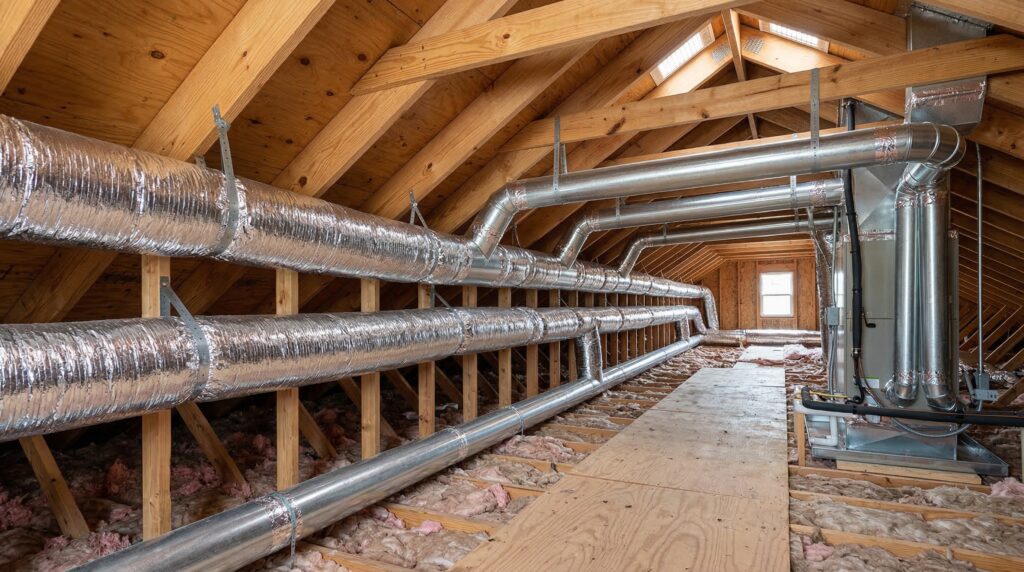
Your HVAC contractor handed you a quote, and there’s a ductwork line item bigger than you expected. Before you sign off on it, or push back, you need to understand what actually drives ductwork costs, when full replacement makes financial sense, and how to read what you’re being charged.
This guide breaks down the numbers by home size and scope: full replacement costs, partial repair options, what contractors actually price into that per-foot rate, and how timing replacement with a new HVAC system changes the math. If you are replacing the full HVAC system at the same time, see our guide to combined HVAC and ductwork replacement costs.
TL;DR: Full ductwork replacement costs $20–$60 per linear foot installed, which works out to $3,200–$14,400 for a typical 1,500–2,000 sq ft home. Partial repairs run $500–$3,000. Replacing ductwork simultaneously with your HVAC system typically saves $500–$2,000 in shared labor. If you have flex ductwork over 15 years old, replacement is almost always justified because flex degrades significantly past that point (Angi, 2025).
How Much Does Ductwork Replacement Cost by Home Size?
Full ductwork replacement costs $20–$60 per linear foot installed, covering materials, labor, and removal of old ducts (AllTemp Solutions, 2025). Most residential homes have 150–350 linear feet of ductwork, so the total project cost scales significantly with home size. Here’s what both full replacement and partial repair typically run:
Full Replacement Cost by Home Size
| Home Size | Est. Linear Feet | Low | Typical | High |
|---|---|---|---|---|
| Under 1,000 sq ft | 80–120 LF | $1,600 | $4,000 | $7,200 |
| 1,000–1,500 sq ft | 120–180 LF | $2,400 | $6,000 | $10,800 |
| 1,500–2,000 sq ft | 160–240 LF | $3,200 | $8,000 | $14,400 |
| 2,000–2,500 sq ft | 200–300 LF | $4,000 | $10,000 | $18,000 |
| 2,500–3,000 sq ft | 240–360 LF | $4,800 | $12,000 | $21,600 |
Low = flex duct, open basement access. High = sheet metal or tight attic/crawlspace work.
Partial Repair and Sealing Cost
| Scope | Typical Cost |
|---|---|
| Duct sealing only (no removal) | $300–$1,000 |
| Single section patch or seal | $150–$500 |
| Small partial replacement (1–2 runs) | $500–$1,500 |
| Moderate partial replacement (3–5 runs) | $1,200–$3,000 |
The national average duct replacement project costs $1,251, with most homeowners paying $453–$2,185 (Angi, 2025). That average reflects partial replacements and smaller homes; whole-home replacement consistently runs higher.
One thing worth knowing before you compare quotes: attic and crawlspace ductwork typically costs 20–40% more than the same job in a basement, because contractors work in tighter conditions with limited range of motion. If your quote is at the high end and most of your ductwork runs through the attic, that premium is likely legitimate, not a padding move.
Want to see how ductwork adds to your total HVAC bill? Run a full project estimate with our HVAC Replacement Cost Estimator. Then review the HVAC replacement cost breakdown to understand each line item in your quote.
When Does Ductwork Actually Need Replacement?
Flex ductwork (the most common residential type) lasts 10 to 15 years before deterioration causes measurable efficiency loss (Engineer Fix, 2025). Sheet metal systems can last 30 to 50 years or more. Age is the first filter. It’s not the only one.
Here are the clearest signs your ductwork needs attention:
- Flex duct over 15 years old: especially runs in attics or crawlspaces, where temperature swings and humidity accelerate breakdown
- Energy bills rising without an obvious cause: leaking ducts waste 20–30% of conditioned air per EPA estimates, forcing the system to work harder for the same result
- Persistently uneven temperatures: some rooms always hot or cold despite the HVAC running normally
- Musty smells or excess dust from vents: a breach pulls unconditioned attic or crawlspace air directly into your living space
- Visible damage: tears, disconnected sections, collapsed flex runs
- Rattling or whistling when the system kicks on: loose connections or blockages moving under pressure
Here’s what surprises most homeowners: ducts can fail without any visible damage. If your HVAC system tests fine but the home never quite gets comfortable, duct leakage is one of the first things an HVAC tech should rule out, and it often requires a pressure test to find.
Should You Repair or Replace Ductwork?
Localized damage costs $150–$500 to patch or seal; widespread deterioration requiring full whole-home replacement runs $1,600–$21,600 depending on home size (Angi, 2025). The right call depends on how much of the system is compromised and how old it is.
| Scenario | Best Move | Estimated Cost |
|---|---|---|
| Ducts under 10 years, isolated breach | Seal or patch | $150–$500 |
| Ducts 10–15 years, 20–30% damaged | Partial replacement | $500–$3,000 |
| Flex over 15 years, widespread leaks | Full replacement | Per home-size table above |
| Installing a new HVAC system | Replace simultaneously | Combined labor savings |
Repair makes sense when the damage is in one or two accessible runs, the rest of the system is in good shape, and the ductwork isn’t more than 10 years old. Duct sealing with mastic or foil tape across the whole home ($300–$1,000) is often the right first step when leaks are minor and distributed throughout the system.
Replacement makes sense when the ductwork is old flex that’s failing system-wide, you’re already having your HVAC unit replaced (ductwork upsizing is especially common with 5-ton HVAC replacements that need larger trunk lines), or energy bills have climbed steadily for years despite the system testing correctly.
There’s a harder middle ground: ductwork that’s 12–14 years old, showing some wear, but not completely failed. A targeted partial replacement of the worst sections can extend life 5–8 more years. But you’ll spend again when those remaining runs follow. Full replacement at a system changeout avoids that second project cost entirely.
Old homes add unique complexity to ductwork decisions. See our guide to old home ductwork compatibility and HVAC costs for a full breakdown by home era. For the full decision framework, see our repair vs. replace HVAC guide.
How Is Ductwork Replacement Cost Actually Calculated?
HVAC contractors typically charge $50–$150 per hour for ductwork labor (Angi, 2025), but you won’t see an hourly rate on your quote because they price by linear foot of duct installed. Here’s what goes into that number:
1. Linear footage: The primary driver. Estimate 1 linear foot of ductwork per 8–10 sq ft of conditioned space for a single-story home; add 20–30% for multi-story layouts.
2. Material type: Three main options, each with a different cost and lifespan:
| Material | Material Cost | Installed Cost | Lifespan |
|---|---|---|---|
| Flexible duct | $8–$18/LF | $20–$35/LF | 10–15 years |
| Fiberglass duct board | $12–$25/LF | $30–$45/LF | 15–25 years |
| Sheet metal | $20–$40/LF | $45–$60/LF | 30–50+ years |
3. Accessibility: Attic and crawlspace work costs 20–40% more than basement access. If your ducts run through tight, unconditioned spaces, expect the high end of the range.
4. Removal and disposal: Old duct removal adds $200–$800 to most projects. Always confirm it’s included in your quote as a line item.
Line items to verify before signing:
- Permit fees: $50–$400 depending on municipality (required for most ductwork jobs)
- Registers and boots: $10–$40 each (often replaced during installation)
- Insulation wrap for attic runs: $0.50–$1.50/LF additional
How Does Replacing Ductwork With Your HVAC System Save Money?
Replacing ductwork at the same time as a furnace or AC unit typically saves $500–$2,000 compared to scheduling the work separately (AllTemp Solutions, 2025). The savings come from shared costs that you’d pay twice if you ran two separate projects.
Here’s where the savings actually come from:
- One mobilization: Contractors set up once, work both jobs
- Coordinated access: Drywall or ceiling penetrations opened once and closed once
- System sizing alignment: New ductwork designed for the new equipment from day one (mismatched duct size causes efficiency loss starting immediately)
- Single permit: Many municipalities charge per permit; one project, one fee
The cost of waiting: A homeowner who replaces their AC now with aging flex ductwork still in place, then returns two years later to address the failing ducts, pays two mobilization costs, two permit fees, and often patches drywall twice. The combined bill is nearly always higher than doing both at once. If your ductwork is over 12 years old when your HVAC system needs replacing, get a ductwork quote alongside the system quote before deciding.
When separate replacement still makes sense: the ductwork is under 8 years old and in good condition, or budget constraints require a phased approach. Phasing is legitimate, but go in knowing it costs more over time.
See full combined replacement costs at our replace AC and furnace at the same time guide.
Is Ductwork Replacement Actually Worth the Money?
Yes, when the ductwork is old or significantly leaking. The U.S. Department of Energy estimates that leaky ducts in a typical home waste 20–30% of the air a heating or cooling system moves, meaning your system runs harder and longer for the same result. New, properly sealed ductwork can recover most of that loss, and replacement projects typically show a 50–70% return on investment over time (Angi, 2025).
On the $5,000 rule: You may see this in HVAC discussions online. The rule says: if a repair quote exceeds $5,000, full system replacement is usually the better financial move. That threshold applies to the combined HVAC system, not ductwork alone. For ductwork specifically: if yours is over 15 years old and the repair scope covers more than 30% of the system, full replacement almost always costs less than repeated partial repairs over the next 5–10 years.
What homeowners insurance covers: Standard policies don’t cover ductwork replacement from age or general wear. Coverage may apply only for sudden, accidental damage, such as a storm, fire, or burst pipe. Check with your insurer before assuming you’re covered.
In cities like Salt Lake City, UT, attic ductwork in older homes often runs through tight, poorly insulated spaces that require additional labor for access, sealing, and insulation upgrades to meet Zone 5B energy code minimums.
Ready to see how ductwork affects your total project cost? Use our HVAC Replacement Cost Estimator to see a full system estimate with ductwork included.
Frequently Asked Questions
Is it worth it to replace ductwork?
Yes, when ducts are over 15 years old or leaking significantly. The EPA estimates leaky ducts waste 20–30% of conditioned air, and new ductwork typically reduces annual HVAC energy costs by 20–30%. Replacement projects have a 50–70% ROI on average (Angi, 2025). Use our HVAC Replacement Cost Estimator to run the full project math for your home.
How much does it cost to replace ductwork in a 2,000 sq ft house?
Full replacement in a 2,000 sq ft home typically costs $3,200–$14,400 at $20–$60 per linear foot installed. That home has roughly 160–240 linear feet of ductwork. The low end reflects flex duct in accessible spaces; the high end reflects sheet metal or attic/crawlspace work where access is limited. Larger homes cost proportionally more: a 2,500 sq ft home with 200–300 linear feet of ductwork typically runs $4,000–$18,000. See sizing considerations in the HVAC cost guide for 2,500 sq ft homes.
Should I replace 20-year-old ductwork?
If it’s flex duct, almost certainly yes. Flex has a 10–15 year lifespan, and 20-year-old flex duct is well past its efficient life. Sheet metal at 20 years may still have decades of service remaining if well-maintained. Ask a contractor to inspect joint seals and check for airflow imbalance before committing, but flex that old rarely passes that inspection.
Does homeowners insurance cover duct replacement?
Generally no. Standard policies exclude wear, age, and gradual deterioration. Coverage may apply only for sudden, accidental damage, such as a storm, fire, or burst pipe causing direct harm to ductwork. Verify with your insurer; don’t assume coverage exists before filing.
How long does ductwork replacement take?
Most whole-home ductwork replacements take 1–3 days depending on home size and access conditions. Partial replacements covering 1–3 runs are typically completed in a single day. Tight-access homes (crawlspaces or multi-story homes with in-wall runs) take longer and carry higher labor costs.
The ranges on this page come from published cost data from Angi, This Old House, and AllTemp Solutions, plus HVAC industry pricing surveys. Labor and material costs vary by region. Urban markets typically run 15–25% above the national averages shown here. For your actual number, get quotes from at least two licensed HVAC contractors in your area. See our cost methodology page for full sourcing details.
Historic homes in coastal markets like Savannah, GA present some of the most challenging ductwork replacement scenarios: original 1920s–1950s supply trunks, limited attic clearance in Craftsman bungalows, and coastal humidity that accelerates duct liner degradation. Our Savannah HVAC replacement cost guide covers what to expect for full system and ductwork projects in the Georgia coastal market.
In South Florida markets like Fort Lauderdale, ductwork replacement often pairs with AC upgrades because salt-air humidity degrades flex duct liner faster than in northern climates. See Fort Lauderdale HVAC replacement costs →
Fort Worth ranch-style homes with attic ductwork face similar challenges when aging flex ducts meet Zone 3A heat. Post-2021 freeze, many Tarrant County homeowners discovered their ductwork needed replacement alongside the main system. See Fort Worth HVAC replacement costs →
One important note on warranties: ductwork is almost never covered by your HVAC system manufacturer warranty. Parts warranties from Carrier, Trane, Amana, and Goodman cover the system itself. Duct replacement is a separate project and expense. If you are replacing both the system and ductwork, review our HVAC warranty costs guide to understand exactly what your manufacturer warranty does and does not protect.
Related reading: Full HVAC Replacement Cost Guide · Repair vs. Replace HVAC · Replace AC and Furnace at the Same Time · Mini-Split Installation Cost (ductless option when ductwork replacement isn’t worth it)
See also: Tennessee HVAC replacement cost guide.
Arkansas homeowners face a particular ductwork challenge: high summer humidity and wide attic temperature swings (often 130 to 150 degrees Fahrenheit in an unconditioned attic) accelerate flex duct breakdown faster than in many other states. If your Arkansas home has flex duct over 12 years old and your HVAC system is also aging, replacing both at the same time can save $500 to $2,000 in labor overlap. See our full Arkansas HVAC replacement cost guide for statewide pricing context.
Washington state homeowners replacing ductwork alongside an HVAC system face some of the highest labor rates in the country due to strong Puget Sound construction unions. See our Washington state HVAC replacement cost guide for full regional pricing and utility rebate details.