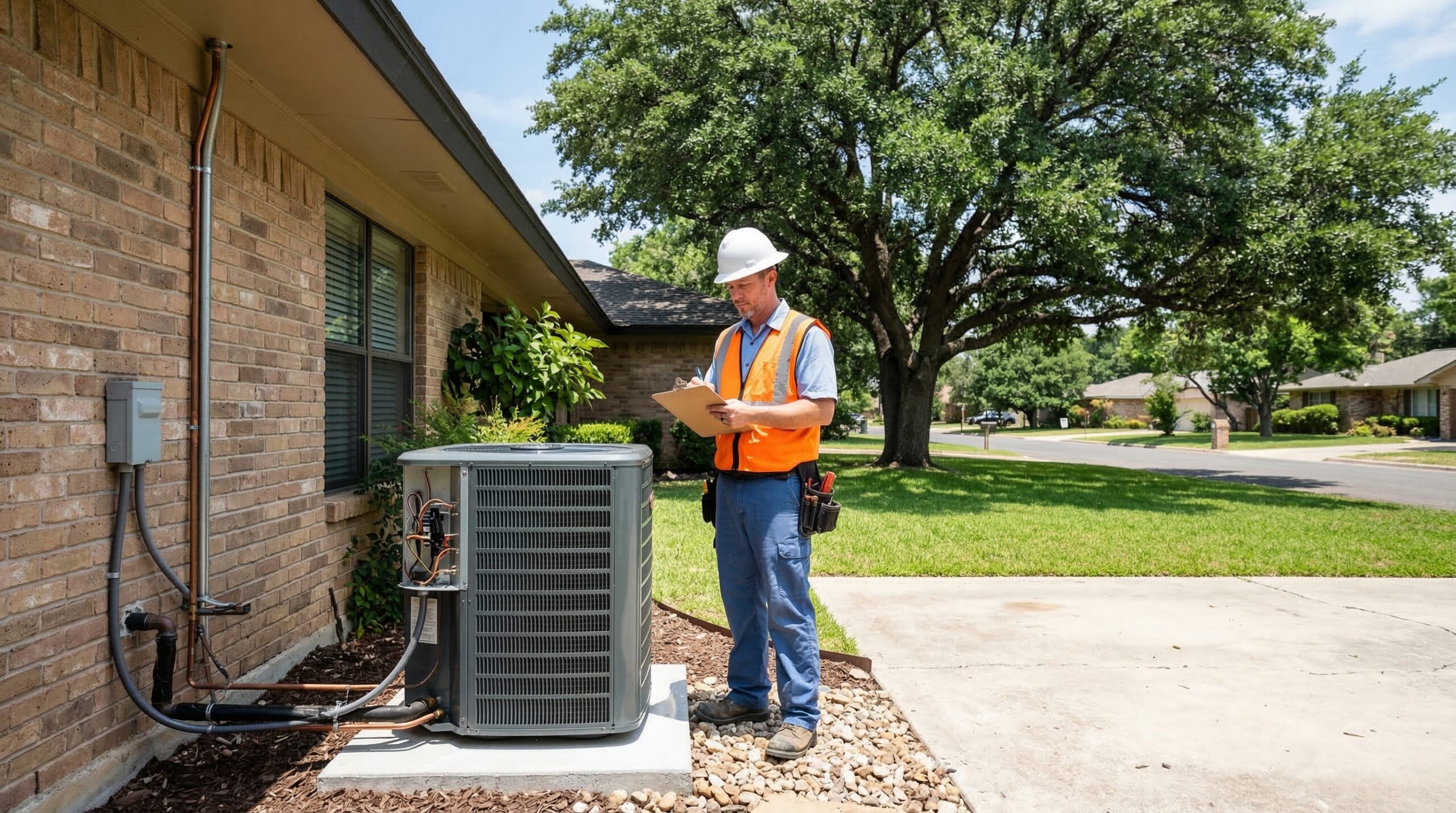
San Antonio’s HVAC market combines two things that shape every replacement decision: a hot-humid Zone 2A climate that demands reliable cooling for 8 to 9 months a year, and CPS Energy’s tiered rebate program that can put $500 to $1,000+ back in your pocket on a high-efficiency install. Whether you’re recovering from a system failure or planning a proactive upgrade, this guide covers 2026 pricing, CPS Energy rebate tiers, City of San Antonio permit requirements, and what the post-Uri freeze experience means for heating choices in Bexar County.
TL;DR: HVAC replacement in San Antonio, TX typically costs $5,000–$14,500 depending on system type and home size. San Antonio sits in ASHRAE Climate Zone 2A (hot-humid subtropical), with 8–9 months of cooling demand. CPS Energy offers tiered rebates up to $310/ton for high-efficiency systems (a 4-ton, 17+ SEER2 early replacement earns $1,000 in bill credits). A City of San Antonio mechanical permit (roughly $75–$150) is required. Get your free cost estimate.
How Much Does HVAC Replacement Cost in San Antonio?
Most San Antonio homeowners pay $5,000 to $14,500 for a complete HVAC replacement, with the range driven by system type, home size, and efficiency tier. Here are typical ranges by system type for Bexar County (2026):
| System Type | Typical San Antonio Range |
|---|---|
| Central AC split system (3–4 ton) | $5,000 – $12,500 |
| Heat pump system (3–4 ton) | $6,000 – $14,500 |
| Full system (outdoor unit + air handler) | $8,000 – $16,000+ |
| Gas furnace (standalone or dual-fuel) | $3,500 – $7,500 |
| Add: ductwork replacement | +$2,500 – $5,000 |
These ranges include equipment, installation labor, the required City of San Antonio mechanical permit, and disposal of the old system. Most mid-range replacements for a 1,500 to 2,200 sq ft home in Bexar County land between $7,500 and $11,000 for a complete system before CPS Energy rebates. Use our HVAC replacement cost estimator for a range adjusted to your home’s specifics, or compare options at our AC replacement cost guide and cost by home size guide.
What Drives HVAC Costs in San Antonio?
Several factors shape San Antonio pricing that don’t show up in national averages:
- Zone 2A cooling load: San Antonio averages roughly 2,800 cooling degree days annually. Your AC runs 8 to 9 months per year, and summers hit 98 to 104°F routinely. Systems sized for milder climates are undersized here. Larger-capacity equipment (3.5 to 5 ton) is common, and that drives up base cost.
- Military and suburban demand: Joint Base San Antonio (JBSA) is the largest military installation in the US by personnel. Combined with fast-growing suburbs (Converse, Schertz, New Braunfels, Cibolo), contractor demand stays high year-round. This keeps labor competitive but limits availability during summer crunch.
- Post-Uri heating upgrades: Winter Storm Uri in February 2021 exposed San Antonio homes that relied solely on heat strips or had no heating system at all. Since then, demand for dual-fuel systems (heat pump plus gas furnace backup) and properly sized auxiliary heat has increased. Adding a gas furnace to an all-electric system adds $3,500 to $7,500 to the project.
- Older housing stock in inner neighborhoods: Established areas like Alamo Heights, Olmos Park, King William, and Southside have homes with aging ductwork that may need replacement alongside the mechanical system. Duct replacement adds $2,500 to $5,000 to the project but is often the right investment in a 40+ year old home.
- Competitive market vs. Austin: San Antonio contractor rates typically run 5 to 10 percent below Austin, reflecting lower labor costs in the local market. This makes San Antonio one of the more affordable major Texas metros for HVAC work.
For HVAC labor context: BLS wage data for the San Antonio-New Braunfels MSA (May 2023 release) shows overall construction and installation wages at approximately $27.74/hr mean across all occupations. HVAC-specific data for this MSA tracks near $23 to $25/hr median for mechanics, slightly below the national median. That modest labor cost advantage is one reason San Antonio HVAC pricing tends to undercut Austin. See our national HVAC replacement cost guide for broader benchmarks.
What CPS Energy Rebates Are Available for HVAC Replacement in San Antonio?
All of San Antonio and most of Bexar County is served by CPS Energy (City Public Service Energy), a municipally owned utility. CPS Energy’s HVAC rebate program offers tiered per-ton rebates based on your new system’s SEER2 efficiency rating and whether your existing system is still operational. This structure rewards high-efficiency choices more generously than the flat-rate rebates offered by some other Texas utilities.
Early Replacement Rebates (existing system still operational, under 25 years old for central systems):
| Efficiency Tier | SEER2 Rating | Rebate Per Cooling Ton | Example: 3-ton system |
|---|---|---|---|
| Tier 1 | 13.8–15.1 SEER2 | $115/ton | $345 |
| Tier 2 | 15.2–16.1 SEER2 | $130/ton | $390 |
| Tier 3 | 16.2–17.0 SEER2 | $175/ton | $525 |
| Tier 4 | 17.1–19.9 SEER2 | $250/ton | $750 |
| Tier 5 | 20.0+ SEER2 | $310/ton | $930 |
Replace on Burnout Rebates (existing system failed or beyond usable life) follow the same tiers but at lower amounts: $90, $120, $150, $225, and $275 per ton respectively. A 4-ton, Tier 4 (17+ SEER2) Replace on Burnout earns $900 in CPS Energy bill credits.
Key requirements verified March 2026:
- Must use a Texas-licensed HVAC contractor
- A City of San Antonio mechanical permit number is required for all installations within city limits
- Application must be submitted within 30 days of installation
- Applies to central AC, central heat pumps, and ductless mini-split systems
- Rebate paid as a bill credit (2–3 weeks) or check (8–12 weeks)
Texas does not participate in the federal HOMES or HEEHRA state rebate programs (as of March 2026), so CPS Energy’s program is the primary rebate source for most San Antonio homeowners. The federal Section 25C energy efficiency tax credit expired December 31, 2025 and is no longer available. Verify current program terms at cpsenergy.com/residentialrebates before scheduling your installation. Program details confirmed via the CPS Energy STEP (Sustainable Tomorrow Energy Plan) PY4 rebate application, dated September 2025.
Does a San Antonio Home Need a Furnace or Will a Heat Pump Work?
This is the most consequential equipment decision for San Antonio homeowners, and the answer shifted after February 2021. Here’s how to think through it:
Normal San Antonio winters: Zone 2A winters are mild. Average January lows are in the upper 30s to low 40s°F. A standard air-source heat pump handles these temperatures efficiently, often running at a coefficient of performance (COP) of 2.5 to 3.5, meaning it delivers $2.50 to $3.50 of heat for every $1.00 of electricity. A gas furnace cannot match that efficiency in moderate cold. For most San Antonio winters, a heat pump alone is the right choice.
The Uri problem: Winter Storm Uri (February 2021) dropped San Antonio to -2°F. Standard air-source heat pumps lose efficiency below 30°F and switch to auxiliary electric heat strips below about 20°F. In Uri conditions, even aux heat strips struggled against the extreme load. Homes with gas furnaces fared significantly better. Cold-climate heat pumps (rated to -13°F, like certain Mitsubishi, Bosch, and Trane XV series units) can handle Uri-level events without switching to backup, but they cost more upfront.
The practical guidance:
- If your home has gas service: Consider a dual-fuel system (heat pump for cooling and mild heating + gas furnace for extreme cold). CPS Energy’s rebate applies to heat pumps in dual-fuel setups. Gas furnace backup adds $3,500–$7,500 to project cost but provides a margin of safety for once-a-decade freeze events.
- If your home is all-electric: Choose a heat pump with properly sized electric aux heat strips. Ensure the aux heat capacity is sized for your home’s heat loss, not just the default minimum. A sizing conversation with your contractor about winterization is worth having before signing.
- If budget is the primary constraint: A standard central AC split system with separate electric heat strips handles 95% of San Antonio winters fine. The tradeoff is efficiency during mild-cold weather.
Our repair vs. replace HVAC guide covers when to invest in a full system upgrade versus a targeted repair, which matters particularly after a stress event like a freeze. Our furnace replacement cost guide covers gas furnace pricing in detail if you’re adding heating capacity.
What Permits Are Required for HVAC Replacement in San Antonio?
A mechanical permit from the City of San Antonio Development Services Department (DSD) is required for all HVAC system replacements within San Antonio city limits. Your licensed HVAC contractor applies for this permit, typically through the BuildSA online portal (sa.gov/DSD). The fee structure is straightforward: a $50 base mechanical permit fee, plus $6.25 per major component installed (condensing unit, air handler, heat pump, gas furnace), plus a 6% surcharge. A typical full system replacement (condenser + air handler + furnace = 3 components) costs roughly $75 to $100 in base permit fees, plus the surcharge.
The City also operates a Limited Service and Repair (LSR) permit program that allows licensed HVAC contractors to complete eligible AC replacements on existing electric systems in 1 to 2 family homes and obtain the permit within 3 working days after completing work, rather than before. This reduces scheduling friction for straightforward swap-outs. Gas system replacements are not covered under LSR and require standard permit-first procedure.
Work done without a permit in San Antonio can create issues with homeowner insurance, title disclosure at sale, and disqualify you from CPS Energy rebates (which require permit number submission). Always confirm your contractor is pulling the permit before work begins.
San Antonio HVAC Replacement FAQs
How much does HVAC replacement cost in San Antonio, TX?
Most San Antonio homeowners pay $5,000 to $14,500 for a full HVAC replacement. A central AC split system (3 to 4 ton) typically runs $5,000 to $12,500 installed; a heat pump system runs $6,000 to $14,500. For a typical 1,500 to 2,200 sq ft home, expect $7,500 to $11,000 before CPS Energy rebates. Use our free estimator for a range specific to your home.
What CPS Energy rebates are available for HVAC replacement in San Antonio?
CPS Energy offers tiered per-ton rebates based on your new system’s SEER2 efficiency rating. For Early Replacement (existing unit still works), rebates run $115 to $310 per cooling ton. For Replace on Burnout (failed unit), rebates run $90 to $275 per ton. A 3-ton, 16 SEER2 Early Replacement earns $525; a 4-ton, 17+ SEER2 system earns $1,000. You must use a Texas-licensed contractor and submit a City of San Antonio permit number with the application. Apply within 30 days at cpsenergy.com.
Do San Antonio homes need a gas furnace or will a heat pump work for winter?
For most San Antonio winters, a heat pump works well without a gas furnace. Normal winter lows are in the upper 30s to low 40s°F, within standard heat pump range. However, Winter Storm Uri (February 2021) brought -2°F temperatures, and homes with only heat strips or inadequate heating struggled. Your options:
- Heat pump with aux electric heat strips (all-electric, most common new install)
- Dual-fuel system (heat pump + gas furnace for extreme cold, best if you have gas service)
- Cold-climate heat pump (rated to -13°F, handles Uri conditions without backup, higher upfront cost)
What permits are required for HVAC replacement in San Antonio?
A City of San Antonio DSD mechanical permit is required for all HVAC replacements within city limits. Your licensed contractor applies through the BuildSA portal. Typical permit fees run $75 to $150 for a full system swap (base $50 fee + $6.25 per component + 6% surcharge). For straightforward electric AC replacements in existing 1 to 2 family homes, the Limited Service and Repair (LSR) program allows the contractor to complete work first and pull the permit within 3 business days. CPS Energy requires a permit number on all rebate applications for San Antonio installations.
When is the best time to replace an HVAC system in San Antonio?
The best replacement windows are March through May and October through November. San Antonio summers (June through September) are brutally hot, contractors are fully booked, and emergency same-week replacements command a premium. Spring and fall offer better contractor availability and typically shorter lead times. If your system is showing signs of failure, do not wait for summer. The CPS Energy rebate is available year-round and is not tied to a seasonal window.
How does San Antonio’s HVAC market compare to other Texas cities?
San Antonio typically runs 5 to 10 percent less expensive than Austin for HVAC replacement. Dallas and Houston are broadly comparable in labor cost, though Dallas has a longer heating season (Zone 3A) that can add furnace complexity. San Antonio’s large contractor base, partly driven by Joint Base San Antonio and fast-growing suburbs, keeps competition healthy. CPS Energy’s per-ton rebate structure is more favorable for high-efficiency, larger-capacity systems than flat-rate rebate programs elsewhere in Texas. For another warm-climate market with strong utility rebates, see Los Angeles HVAC replacement costs, where LADWP offers up to $2,500/ton on qualifying heat pumps. See our Houston HVAC cost guide and Dallas HVAC cost guide for direct Texas comparisons.
For a full look at Texas HVAC pricing across all major cities, see our Texas HVAC replacement cost guide. If you plan to add a smart thermostat during your San Antonio HVAC replacement, see how much it adds to your total in our smart thermostat cost guide.
Put the numbers in context
What would it cost for your home?
Get a planning range based on your home, system and region. Free, with no email required.
Get my cost estimate