
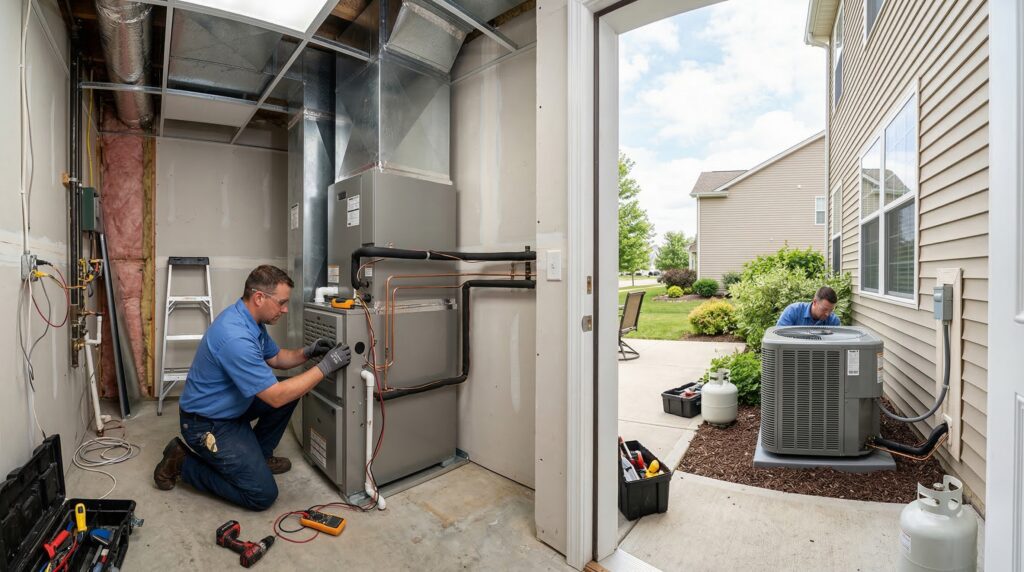
Your contractor just told you both your AC and furnace are on their last legs. Now you’re looking at two big-ticket replacements at once (see what this costs in Missouri) and wondering: is there actually a financial reason to do both at the same time, or are they just trying to upsell you?
There is a real financial case for simultaneous replacement, but it’s not automatic. The answer depends on the age gap between your two systems, what your contractor actually includes in a “full system” quote, and how you verify you’re not paying for bundled convenience at an inflated price.
TL;DR: A standard-efficiency AC and furnace replacement costs about $6,300–$11,600 when installed together, compared with $6,800–$12,100 across two separate visits. The savings come from shared labor, a single permit, and one service visit. Bundling also improves equipment compatibility and aligns warranty start dates. If one system is significantly newer, separate replacement usually wins.
Combined vs. Separate: What You Actually Save
The core question is whether the labor savings from doing both at once offset any added cost of bundling. Here’s how the math typically breaks down (Angi, 2025; HomeAdvisor, 2025):
| Replacement Approach | Typical Cost Range | Notes |
|---|---|---|
| Central air installation only | $4,000–$7,500 | 3-ton central unit, standard efficiency, installed |
| Furnace replacement only | $2,800–$4,600 | 80% AFUE gas furnace, installed (see gas vs electric furnace cost comparison) |
| Both replaced separately (2 visits) | $6,800–$12,100 | Two mobilizations, two permits, two service windows |
| Both replaced together (1 visit) | $6,300–$11,600 | Shared labor, one permit, matched equipment |
| Typical savings from bundling | $500 | Difference between the displayed range endpoints; contractor discounts vary |
Cost ranges are national averages for a 2,000 sq ft home. Regional labor rates vary 15–25%. High-efficiency upgrades add $1,000–$3,000. See our full HVAC replacement cost guide for detailed breakdowns by system type and region. For a larger home, see the HVAC cost guide for 2,500 sq ft homes.
Use our HVAC Replacement Cost Estimator to get a personalized cost range for a full system replacement based on your home size, region, and system type. No email required. NC homeowners can also see the Concord, NC HVAC pricing guide for local cost data.
Why Replacing Together Often Makes Financial Sense
The labor savings are the most visible reason to bundle, but there are four additional factors that compound the financial case. If you plan to finance both units together, see our guide to HVAC financing options and payment plans:
1. Shared labor creates the $500 baseline difference. Installing a furnace and AC on the same day eliminates duplicate mobilization costs: one crew, one truck, one service window. The refrigerant line connections, electrical hookups, and final commissioning all happen in a single visit. Contractor discounts vary, so compare itemized together and separate bids rather than assuming a larger discount (HVAC.com, 2025).
2. Single permit. Most jurisdictions require a mechanical permit for HVAC replacement. Two separate jobs typically mean two permit fees ($150–$400 each). One combined installation means one fee and one inspection.
3. Matched equipment guarantees compatibility. Your AC’s indoor coil (evaporator) and outdoor condenser are rated for a specific furnace air handler configuration. Mismatched components can reduce efficiency by 5–15% and may void manufacturer warranties (Carrier, 2025). Replacing both together means your contractor selects matched, tested equipment from the start.
4. Unified warranty terms. When both systems are installed simultaneously, their parts and labor warranties start on the same date. This simplifies warranty claims and means you’re not staggering replacement cycles by 3–5 years in the future.
There’s a less-discussed fifth factor: negotiating power. A $10,000+ combined job gives you more leverage on price, equipment tier, and warranty terms than two smaller jobs. Birmingham homeowners can compare a bundle quote with the local HVAC replacement cost guide. Contractors may compete harder for a single large contract, especially in off-peak seasons (fall and spring), so ask whether an itemized quote includes any discount beyond the displayed $500 baseline.
When Replacing Separately Still Makes Sense
Bundling is not the right call in every situation. The financial logic breaks down in three specific scenarios:
Significant age disparity. If your AC is 3 years old and your furnace is 17 years old, replacing the AC just because the furnace failed makes no financial sense. The AC likely has 12+ years of useful life remaining. Replace the furnace now and plan the AC replacement in a decade. The break-even point for bundling is typically when both systems are within 5 years of end of life (furnace: 15–20 years; AC: 15–20 years).
One system has a known, low-cost repair. A furnace with a cracked heat exchanger needs replacement. But if your AC is working fine and has a refrigerant recharge as its only recent issue, that’s not a signal the AC is failing. Don’t let a contractor bundle in a replacement for a system with years of life remaining based on a speculative future failure.
Budget constraints that would force a lower-quality choice. If bundling means you can only afford builder-grade equipment on both systems instead of a quality mid-tier furnace, you may be better served by replacing the critical system now with a good unit and replacing the second system in 2–3 years when budget allows. A quality single replacement usually beats two mediocre replacements bundled for the discount.
For the full breakdown on AC replacement cost and furnace replacement cost separately, those guides walk through what drives cost on each system independently. If you are bundling on a budget, our Goodman furnace cost guide prices the value brand most often quoted for combined jobs.
What a Full System Replacement Includes (and What It Doesn’t)
When a contractor quotes a “full system replacement,” the scope varies more than most homeowners realize. Here’s what a complete quote should cover, and what requires a separate line item:
| Component | Typically Included | Watch For |
|---|---|---|
| Gas furnace (or air handler) | Yes | Confirm BTU size is correct for your home |
| Outdoor AC condenser unit | Yes | Confirm SEER2 rating and brand tier |
| Evaporator coil (indoor AC coil) | Usually (confirm) | Some quotes exclude coil; add $400–$900 if separate |
| Refrigerant line set (if reused) | Sometimes | Old line sets may need flush or replacement ($200–$600) |
| Thermostat | Sometimes | Smart thermostat upgrades add $150–$400 |
| Mechanical permit | Usually | Confirm permit is pulled in your name, not just “included” |
| Equipment disposal | Usually | Confirm old equipment hauling is in scope |
| Ductwork modifications | No (separate) | See ductwork replacement cost or our full HVAC and ductwork guide for typical ranges |
| Electrical upgrades (new circuit or panel work) | No (separate) | Heat pump upgrades often require electrical work ($500–$2,000) |
The most common omission in contractor quotes is the evaporator coil. Some contractors price the outdoor condenser and furnace separately from the indoor coil. Always ask explicitly: “Does this quote include the evaporator coil?”
How to Evaluate a “Full System” Contractor Quote
Getting the right quote means asking the right questions before you sign. Here’s a practical checklist for evaluating any full system replacement proposal:
- Ask for itemized pricing. Request a quote that breaks out equipment cost vs. labor vs. permits separately. A contractor unwilling to itemize is hiding something: either margin on the equipment or unusually high labor rates.
- Confirm the equipment model numbers. Look up the efficiency ratings (SEER2, AFUE) for the specific models quoted. This lets you cross-check pricing against what comparable equipment sells for and verify the quoted efficiency claims.
- Ask about the load calculation. A legitimate contractor will perform a Manual J load calculation to confirm your home’s heating and cooling load before recommending system size. If they size by “same as existing” without any measurement, that’s a red flag: an oversized or undersized system is a more expensive long-term problem than the cost savings from bundling.
- Verify the warranty terms in writing. Get the parts warranty (typically 5–10 years) and labor warranty (typically 1–2 years) in the written quote. Extended labor warranties (5 years) are sometimes available and worth asking about.
- Get at least two quotes. Combined replacement jobs above $8,000 are worth the effort of a second quote. Price variance on the same scope of work can run 15–25% between contractors.
When reviewing contractor quotes, one of the most telling questions is: “What happens if ductwork issues are found during installation?” A good contractor gives you a clear answer about how they handle scope changes and what the cost would be. Vague answers like “we’ll deal with it then” on a four-figure scope change risk are a signal of poor project management, not just a pricing question.
In Reno and Northern Nevada, where homes need both full heating and cooling capacity for a four-season high desert climate, replacing the AC and furnace together is especially common. The Nevada HVAC replacement cost guide covers when the combined replacement math makes sense for Reno homeowners.
How we calculate these estimates: Our cost ranges are built from national pricing data, HVAC contractor surveys, and manufacturer list prices, reviewed quarterly and adjusted for regional labor differences. See our full cost methodology for sources and calculation approach.
Frequently Asked Questions
For homeowners in North Carolina deciding whether to bundle both systems, the state’s four-season piedmont climate makes the case even stronger. Oregon homeowners replacing both systems should also review the Oregon HVAC replacement cost guide for Energy Trust of Oregon rebates that can offset the cost of a combined heat pump replacement. Replacing both an aging AC and furnace together with a heat pump system can be done for $7,500-$14,000, with Duke Energy Smart $aver rebates (up to $500) and Energy Saver NC (up to $8,000 income-qualified) offsetting costs. See the North Carolina HVAC replacement cost guide for complete statewide pricing and rebate details.
In Kentucky, bundling AC and furnace replacement makes similar sense given the four-season climate with hot humid summers and cold winters. Louisville and Lexington homeowners should verify current LG&E or KU rebate amounts before purchase. The federal Section 25C credit expired for equipment placed in service after December 31, 2025. See the Kentucky HVAC replacement cost guide for current pricing and rebate details.
How much does it cost to replace both AC and furnace at the same time?
At the displayed 2,000 sq ft standard-efficiency baseline, replacing both together costs $6,300–$11,600 installed, compared with $6,800–$12,100 across two separate visits. Larger homes, high-labor markets, and high-efficiency upgrades can run higher; upgrading to 16+ SEER2 AC and a 96% AFUE furnace can add $1,000–$3,000. In cold-climate cities like Minneapolis, combined system replacement can reach $8,000–$16,000 due to larger equipment sizing and higher labor costs. See our Minneapolis HVAC replacement cost guide for local pricing and available Xcel Energy rebates, or use our HVAC Replacement Cost Estimator for a tailored range.
Is it cheaper to replace AC and furnace together or separately?
At the displayed national baseline, replacing both together is $500 cheaper at both ends of the range. The savings come from shared labor (one crew mobilization instead of two), a single mechanical permit, and reduced disposal costs. Actual contractor discounts vary, so compare itemized bids. If only one system is truly at end of life, replace only that system. Replacing a functional 6-year-old AC alongside a failing furnace just to capture the labor discount is rarely cost-effective.
Can I replace just the AC without replacing the furnace?
Yes. AC and furnace can be replaced independently. The practical constraint is equipment compatibility: your AC’s indoor evaporator coil must be rated to work with your furnace’s air handler. If you keep an older furnace while replacing the AC, your contractor needs to verify that the new AC coil fits the existing furnace cabinet and that airflow specs are compatible. See AC replacement cost for typical pricing if replacing AC only.
What questions should I ask before signing a full system replacement quote?
The five most important questions: (1) Does this quote include the evaporator coil? (2) What are the exact model numbers for both systems? (3) Did you perform a Manual J load calculation to confirm system sizing? (4) What is the labor warranty, and is it in writing? (5) What happens if ductwork modifications are needed and how will scope changes be priced? A contractor who answers all five confidently and in writing is worth considerably more than one who hesitates on any of them.
Does replacing AC and furnace together affect the warranty?
Replacing both systems at the same time generally simplifies warranty coverage: both units start their warranty period simultaneously, they’re certified as a matched system by the manufacturer, and future claims go through a single installation date. Most major manufacturers (Carrier, Trane, Lennox, Goodman, and Bryant) offer 5–10 year parts warranties on equipment installed as a matched pair, sometimes with extended terms when registered within 60–90 days of installation. Ask your contractor to confirm warranty registration is part of their post-installation process. If you are choosing between Goodman or Carrier for the bundle, the Goodman vs Carrier cost comparison covers warranty differences and pricing by model line.
How These Cost Estimates Are Built
The ranges on this page are drawn from national HVAC contractor cost surveys, manufacturer pricing (Carrier, Trane, Lennox, Goodman), and published installation data, reviewed quarterly to reflect current material and labor conditions. Combined replacement pricing is based on typical labor overlap rates reported by licensed HVAC contractors across major U.S. markets.
Regional costs vary. Urban markets and peak-demand seasons typically run 15–25% above national averages. Always get at least two quotes from licensed local HVAC contractors. For full methodology details, see how we calculate HVAC cost estimates.
Ready to see what a full system replacement costs for your home? The HVAC Replacement Cost Estimator factors in system type, home size, and region to show you a personalized cost range: free, no email required.
Related reading: Full HVAC Replacement Cost Guide · AC Replacement Cost · Furnace Replacement Cost · Ductwork Replacement Cost · Fort Worth HVAC Cost · Wisconsin HVAC Cost
If your contractor writes the proposal as a matched split system, compare it against the AC and furnace replacement cost guide to confirm the bundle savings are real.