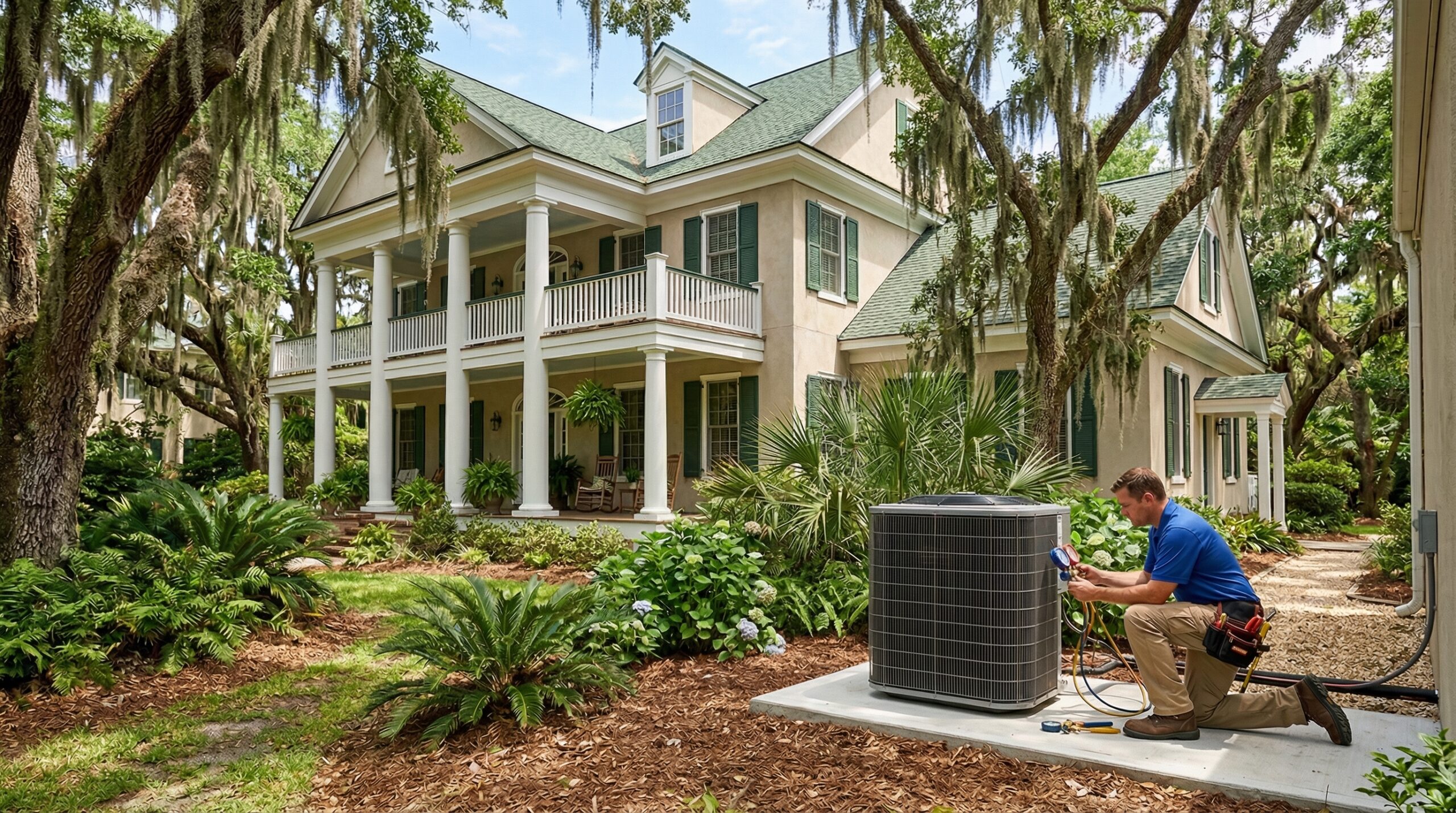
If you are pricing an HVAC replacement in Savannah, national cost ranges will not tell you what you actually need to know. Savannah’s Zone 2A coastal climate, salt air that shortens system lifespan, historic district homes with challenging ductwork, and Georgia Power’s HEIP rebate program all shape what you will pay and what system you need. This guide covers HVAC replacement cost in Savannah, GA with actual local pricing data, Georgia Power rebates, permit fees, and the coastal factors that make Savannah different from Atlanta, Jacksonville, or any inland market.
TL;DR: HVAC replacement in Savannah runs $6,500–$12,000 for most homeowners, with historic-home projects reaching $14,000+. Zone 2A coastal climate makes cooling a primary load. Georgia Power HEIP may cover 50% of cost, up to $1,500, only for an eligible air source heat pump replacing an electric furnace. Georgia HEAR is paused and has no current standalone heat pump rebate. Salt air shortens equipment life; City of Savannah lists a $60 permit for stand-alone AC replacement. Use our free estimator for a range adjusted to your home.
How Much Does HVAC Replacement Cost in Savannah?
Most Savannah homeowners pay between $6,500 and $12,000 for a full HVAC system replacement. Here are the typical ranges by system type based on local contractor data and recent Savannah-area projects:
| System Type | Typical Savannah Cost Range |
|---|---|
| Central AC only (2.5–3 ton) | $5,000 – $9,500 |
| Heat pump system (2.5–3 ton) | $7,000 – $13,000 |
| Gas furnace only | $3,500 – $6,500 |
| Full system (heat pump or AC + air handler) | $6,500 – $12,000 |
| Historic home with ductwork replacement | $10,000 – $16,000 |
| Add: ductwork replacement | +$2,000 – $5,000 |
Prices include equipment, installation labor, City of Savannah mechanical permit ($60 for stand-alone AC), and removal of the old system. The wide ranges reflect differences in system size, efficiency tier, home age, and installation complexity. For most 1,500–2,500 sq ft Savannah homes, a mid-range heat pump replacement lands in the $8,000–$11,000 range. Use our HVAC replacement cost estimator to get a range adjusted for your home’s specifics. If your home has multiple floors with uneven temperatures, see our HVAC zoning system cost guide for what zone control adds to the project.
Why Savannah HVAC Prices Are Shaped by the Coast
Several factors make Savannah’s HVAC pricing and equipment decisions different from inland Georgia cities:
- Coastal corrosion: Salt particles from the Atlantic and coastal marshes settle on HVAC metal components (coils, compressors, capacitors), accelerating failure. Savannah HVAC contractors with decades of local experience report system lifespans of 10–15 years vs. the national 15–20 year average. Closer to tidal marshes or the Savannah River means faster degradation. Budget for it.
- Historic district complexity: Pre-1960 homes in Ardsley Park, Thomas Square, Starland, and the Historic District often have undersized, leaking, or improperly routed ductwork. Full duct replacement in a 1920s Savannah Craftsman can add $3,000–$5,000 to the project, plus the challenge of working around original architectural features.
- Extreme humidity: Savannah’s summer dew points regularly hit 73–76°F, among the highest in the continental U.S. Proper dehumidification is as important as cooling. An oversized single-speed system will cool air quickly but not remove humidity, leaving you with a clammy 72°F house. Always request a Manual J load calculation.
- Salt-air equipment: Look for condensers with epoxy-coated or UV-coated coils when getting quotes in Savannah. They cost $200–$500 more upfront but significantly extend equipment life in the coastal environment.
- Labor market: Savannah MSA HVAC installer median wage is $50,510/yr (BLS 2024), below Atlanta’s $56,830 and below the Georgia statewide median. The smaller contractor market (compared to Atlanta or Charlotte) means fewer options but generally competitive pricing.
How Savannah’s Climate Drives Your HVAC Decision
Savannah sits in ASHRAE Climate Zone 2A (Hot/Humid), the same as Jacksonville, FL. This is critical context for system selection. Unlike Zone 3A Atlanta, where you need both meaningful cooling and meaningful heating capacity, Savannah’s climate is overwhelmingly cooling-dominant:
- Cooling degree days: ~3,200 annually, significantly higher than Atlanta’s ~2,036. Savannah’s cooling season runs from roughly March through November.
- Heating degree days: ~1,200 annually, far lower than Atlanta’s ~2,505. Savannah winters are mild: January average high is ~62°F, low ~40°F. Temperatures below 25°F are rare.
- Implication: Heat pumps are the default recommendation for most Savannah replacements. They handle Savannah’s mild winters efficiently while providing maximum cooling performance. Dual-fuel or cold-climate heat pump setups are generally overkill here. Standard heat pumps work well for Zone 2A temperatures.
The humidity piece is crucial. Savannah’s July average relative humidity runs 75–80%, with dew points regularly at 73–76°F. Conditions are oppressively humid. A system sized or operating incorrectly will cool the air but fail to pull adequate moisture. The result is a sticky, uncomfortable home even at the target temperature setpoint. Any contractor you hire should perform a Manual J load calculation and select a system with proper dehumidification performance for Zone 2A conditions. See our AC replacement cost guide for full cooling system pricing.
Georgia Power Rebates for Savannah Homeowners
Savannah is served by Georgia Power (a Southern Company subsidiary), which offers the same Home Energy Improvement Program (HEIP) available to all Georgia Power residential customers statewide. Key rebates for HVAC replacement:
| Upgrade Type | Rebate Amount | Requirements |
|---|---|---|
| Air source heat pump replacing electric furnace | 50% of cost, up to $1,500 | Georgia Power residential customer; licensed HVAC installer; AHRI-listed indoor/outdoor combination; installer attestation |
| Ground source heat pump conversion | 50% of cost, up to $300 | Licensed HVAC installer; AHRI-listed geothermal heat pump |
| Duct repair and sealing | 50% of cost, up to $600 electric / $500 gas | Qualifying duct location and system testing |
| Air sealing | 50% of cost, up to $400 electric / $300 gas | Program installer and testing |
| Home Comfort Bundle | 50% of cost, up to $1,700 electric / $1,400 gas | Program installer; attic insulation, air sealing, duct repair and sealing |
| ENERGY STAR smart thermostat | 50% of cost, up to $150 | Ducted central heating and air system |
Replacing an aging AC alone does not qualify for Georgia Power’s air source heat pump conversion rebate. The requirements effective August 1, 2026 limit it to an eligible heat pump replacing an electric furnace, with licensed installation, AHRI-listed matched equipment, and installer attestation. Apply within 60 days of purchase or installation and verify the complete terms before budgeting the rebate.
Georgia HEAR has been paused since August 14, 2026 and is not accepting new applications. The state plans a limited October reopening only for single-family wiring and panel upgrades tied to an eligible HER project, not standalone heat pump installation. See the official HEAR update.
What HVAC Systems Work Best in Savannah Homes?
Savannah’s housing stock is diverse, and each type has different HVAC considerations:
- Historic district homes (pre-1960): Often have original gravity-fed duct systems or improperly adapted ductwork. These homes are candidates for ductless mini-splits in sections that cannot be adequately served by central ducted systems, or full duct replacement as part of an HVAC upgrade. See our ductwork replacement cost guide for what to expect.
- Mid-century Southside homes (1960s–1980s): Typically already converted to central air; systems from the 1990s–early 2000s are now at or past replacement age. Standard heat pump or AC replacement is straightforward.
- Newer suburbs (Pooler, Rincon, Richmond Hill, Georgetown): 2000s–2010s construction. Systems are approaching the 15–20 year mark (or 10–15 years if on the coast and experiencing accelerated corrosion). Heat pumps dominate newer construction in these zip codes.
- Waterfront and marsh-adjacent properties: Highest corrosion risk. Consider coated coils, annual coil cleaning, and budgeting for a shorter replacement cycle.
For many Savannah homes, a high-efficiency heat pump can handle the cooling-dominant climate and mild winters. Compare corrosion protection, sizing, and operating costs. Budget a Georgia Power HEIP conversion rebate only if the project replaces an electric furnace and meets the program’s equipment and installer rules. See our repair vs. replace HVAC guide if you are deciding whether full replacement is warranted.
Tips for Getting the Best HVAC Price in Savannah
- Time it right: November through February is a useful window for planned replacements in Savannah.
- Get three itemized quotes: Ask for equipment model number, SEER2 rating, warranty terms, permit fee, and labor cost separately.
- Ask about coastal equipment options: Request pricing for corrosion-resistant coils and maintenance.
- Verify HEIP eligibility: If replacing an electric furnace, confirm Georgia Power residential service, licensed installation, AHRI-listed matched equipment, and installer attestation before budgeting a rebate.
- Budget for ductwork: If your home is pre-1980, request a duct assessment with each quote.
- Check hurricane season timing: A named storm can delay summer installations.
Get a Savannah-Specific HVAC Cost Estimate
Our free estimator applies Zone 2A coastal Georgia pricing to your home’s specific inputs: square footage, system type, efficiency tier, and ductwork condition. You get a low, mid, and high cost range with an explanation of what is driving your number. No email required, no lead capture, takes under two minutes.
Savannah’s coastal factors (salt air, humidity, historic housing stock) make it one of the more nuanced HVAC markets in the Southeast. Starting with an independent estimate means you walk into every contractor conversation knowing what a fair number looks like for your home and neighborhood. Compare Savannah pricing with other Southeast markets in our HVAC cost by city guide.
Savannah HVAC Replacement FAQs
How much does HVAC replacement cost in Savannah, GA?
Most Savannah homeowners pay $6,500 to $12,000 for a full HVAC system replacement. AC-only replacements for smaller homes start around $5,000–$7,500. Historic homes with complex duct routing or full ductwork replacement can reach $14,000–$16,000. A local Reddit user paid $7,200 for a 2.5-ton air handler and compressor in 2024; a Home Depot project in Savannah (Oct 2025, zip 31419) came to $15,954, likely a larger system or complex install. Use our free estimator to get a range for your specific home.
Does Georgia Power offer HVAC rebates in Savannah?
Yes. For a Georgia Power residential customer, HEIP may rebate 50% of cost, up to $1,500, when an eligible air source heat pump replaces an electric furnace. A licensed HVAC installer, AHRI-listed indoor/outdoor combination, and installer attestation are required. Other conditional measures include duct repair and sealing (up to $600 electric / $500 gas), air sealing (up to $400 electric / $300 gas), and ENERGY STAR smart thermostats (up to $150). Check the 2026 HEIP terms before scheduling.
Does coastal air really shorten HVAC lifespan in Savannah?
Yes, this is a documented, well-known issue in the Savannah market. Salt particles from the Atlantic coast and tidal marshes settle on HVAC metal components and accelerate corrosion. Local Savannah HVAC companies with decades of experience report average system lifespans of 10–15 years in coastal Georgia versus the national 15–20 year average. Mitigation options include:
- Equipment with epoxy-coated or UV-coated condenser and evaporator coils (ask for this when getting quotes)
- Annual professional coil cleaning to remove salt buildup
- Keeping the condenser area clear of salt-spray vegetation
- Rinsing the condenser with fresh water after salt events (storms, heavy wind off the water)
Homes within a mile of tidal marshes or the Savannah River face the highest corrosion risk. Westside Savannah, Pooler, and inland suburbs experience less salt exposure and typically see closer-to-normal system lifespans.
Do I need a permit to replace HVAC in Savannah?
Yes. Within City of Savannah limits, a mechanical permit is required for HVAC replacement. The City of Savannah Development Services Fee Schedule (effective January 1, 2025) sets the fee for a New AC Unit (stand-alone mechanical permit) at $60. Full system replacements valued at $75,000 or more are charged at $8.00 per $1,000 of construction value. Properties in unincorporated Chatham County fall under Chatham County Building Safety & Regulatory Services (912-201-4300) with separate fee requirements. Any reputable contractor will include the permit fee in their written quote and pull the permit on your behalf. If a contractor suggests skipping the permit, find a different contractor.
Should Savannah homeowners budget for extra humidity control?
Yes. Savannah humidity often makes comfort worse than the thermostat temperature suggests. If your home feels damp, ask contractors about variable-speed equipment, correct tonnage, duct sealing, and thermostat humidity settings before adding a standalone dehumidifier.
See our full HVAC cost by city guide to compare Savannah pricing with Atlanta, Jacksonville, and other Southeast markets. Atlanta-area homeowners in Marietta (Cobb County) operate in a different Zone 3A climate than Savannah and face different pricing and rebate dynamics. For statewide Georgia pricing, rebates, and regional breakdowns, see the Georgia HVAC replacement cost guide. Savannah is also close to the Alabama HVAC market, where Alabama Power rebates and lower labor costs create different pricing dynamics.
Put the numbers in context
What would it cost for your home?
Get a planning range based on your home, system and region. Free, with no email required.
Get my cost estimate