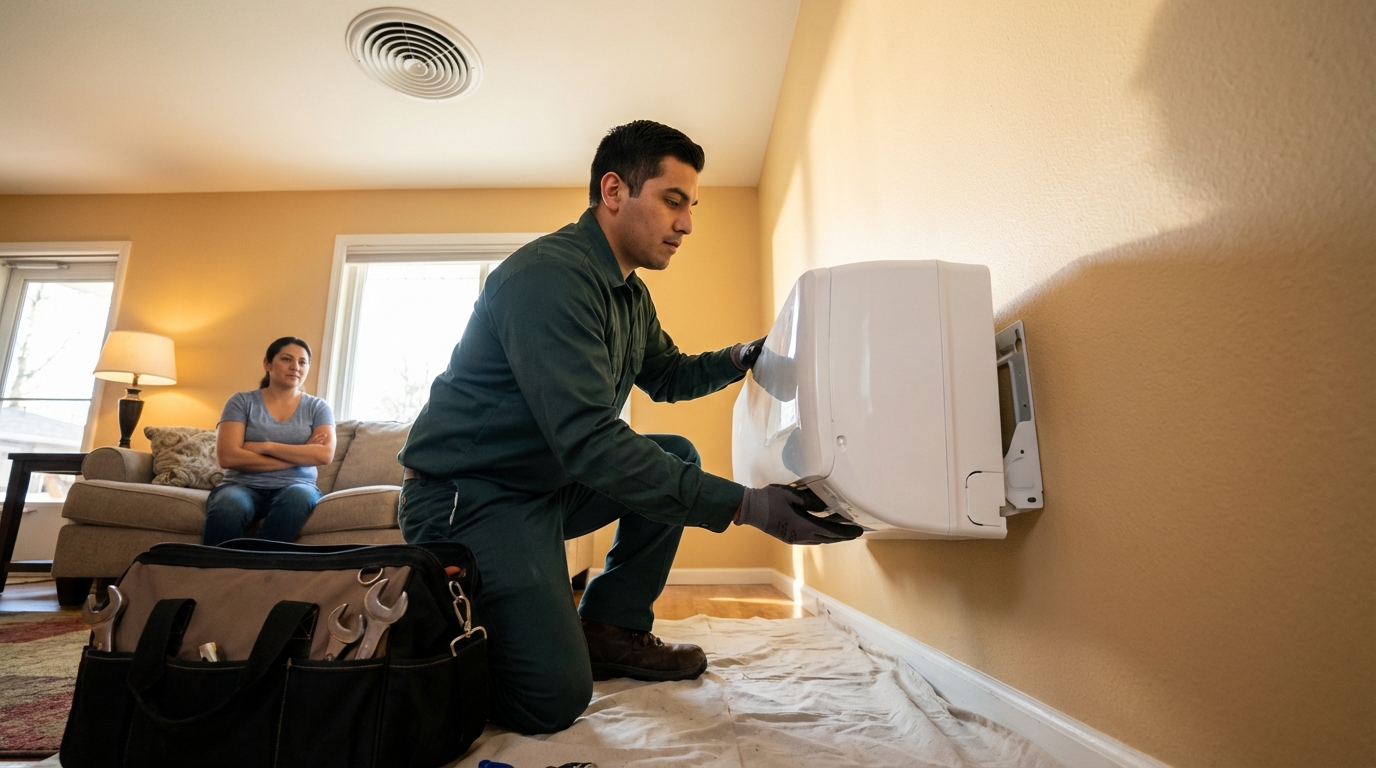
Mini-split installation costs $2,000–$5,500 for a single zone and $4,500–$14,000 for multi-zone systems with professional installation included. The final number depends on how many indoor heads you need, the brand you choose, line set length, and whether your electrical panel needs an upgrade. This guide breaks down every cost factor so you know what to budget before calling a contractor.
How Much Does Mini-Split Installation Cost by Zone Count?
Zone count is the single biggest driver of total cost. Each additional indoor air handler adds equipment cost plus another $500–$2,500 in labor for the extra line set run and refrigerant charge.
| Configuration | Installed Cost Range | Best For |
|---|---|---|
| Single-zone (9,000–12,000 BTU) | $2,000–$4,500 | Bedroom, home office, sunroom addition |
| Single-zone (18,000–24,000 BTU) | $2,500–$5,500 | Open-plan living area, garage, studio |
| 2-zone multi-split | $4,500–$8,000 | Two bedrooms or one floor |
| 3-zone multi-split | $6,500–$10,500 | Small to mid-size home (1,200–1,800 sq ft) |
| 4-zone multi-split | $8,500–$14,000 | Full home zoning (1,800–2,500 sq ft) |
| 5-zone whole-home | $12,000–$18,000+ | Large home or high-end builds |
Note on multi-zone pricing: Multi-zone systems use one outdoor compressor connected to multiple indoor units. The compressor is sized to handle all zones simultaneously, which costs more upfront than multiple single-zone systems, but saves on equipment footprint and electrical connections.
What Does Labor Cost for Mini-Split Installation?
Labor runs $500–$2,500 per zone for standard installations. Simple single-zone installs in accessible interior walls typically land at $500–$900. Complex multi-zone jobs with long line set runs, attic routing, or second-story work can reach $1,500–$2,500 per zone.
Labor Cost Breakdown — Per Zone
- Indoor head mounting and wiring: $200–$600 per unit
- Outdoor compressor placement and wiring: $150–$400
- Line set installation (per linear foot): $3–$8
- Refrigerant charge and system startup: $100–$250
- Electrical circuit (dedicated 20–30A line): $200–$500 per zone
- Permit (varies by city/county): $75–$300
Line set length matters more than most homeowners expect. A 15-foot run through an interior wall costs a fraction of a 60-foot run routed through an attic and down an exterior wall. Per ACCA Manual J installation guidelines, proper refrigerant line sizing and minimizing line set length are critical to system efficiency. Always ask contractors to specify line set length in their bids.
Which Mini-Split Brand Offers the Best Value for the Price?
Brand choice can shift your installed cost by $1,000–$4,000 or more on a single-zone system. Budget brands like Pioneer and Gree deliver reliable performance for most residential applications. Premium brands like Mitsubishi carry longer warranties, quieter operation, and better cold-climate performance but at a meaningful premium.
| Brand | Single-Zone Installed | Warranty | Notes |
|---|---|---|---|
| Pioneer / Gree | $1,800–$3,500 | 5 years | Best value; widely available; good for mild climates |
| Friedrich | $2,200–$4,200 | 5–7 years | U.S.-based support; solid mid-range quality |
| LG | $2,500–$5,500 | 7–10 years | Art Cool gallery units; strong SEER2 ratings |
| Daikin | $2,800–$6,000 | 12 years (parts) | Contractor-only distribution; variable-speed compressor |
| Mitsubishi | $3,200–$9,000+ | 12 years | Best cold-climate performance; Hyper Heat line to -13°F |
For most homeowners adding a zone to a room without existing ductwork, Pioneer, Friedrich, or LG deliver excellent value. If you live in a cold climate where the mini-split serves as your primary heat source, Mitsubishi Hyper Heat or Daikin Aurora justifies the higher price tag with rated heating capacity down to -13°F. For a ducted alternative that keeps the inverter benefits in a slim outdoor cabinet, compare Daikin Fit system costs.
What Factors Raise or Lower the Installed Price?
Factors That Increase Cost
- Long line set runs: Every extra foot adds $3–$8 in labor and materials
- Electrical panel upgrade: If your panel is near capacity or uses older 60-amp service, expect $500–$2,500 to add circuits
- Second-story or attic routing: Adds 2–6 hours of labor per zone
- Concrete pad for outdoor unit: $150–$300 if one doesn’t exist
- Line set covers (for aesthetics): $100–$400 depending on linear footage
- Drain pan or condensate pump: Required in some locations; adds $150–$400
Factors That Lower Cost
- Short, accessible line set run: Through an exterior wall in a single story for the lowest labor cost
- Existing dedicated circuit: Saves $200–$500 if a 240V circuit is already nearby
- Budget brand selection: Pioneer or Gree vs. Mitsubishi saves $800–$2,500 on a single zone
- Off-peak installation timing: Late fall and winter installations sometimes come in 5–10% lower due to lower contractor demand
DIY vs. Professional Mini-Split Installation
DIY mini-split kits (pre-charged line sets, no-vacuum installations) cost $800–$2,500 for the equipment alone, saving $500–$2,000 in labor. However, there are real tradeoffs to consider.
DIY Pros and Cons
- Pro: Saves $500–$2,000 in labor per zone
- Pro: Brands like Mr. Cool and Pioneer DIY offer pre-charged line sets that don’t require EPA 608 certification for refrigerant handling
- Con: Manufacturer warranty often voided if not installed by a licensed HVAC contractor
- Con: DIY work may not qualify for utility or state rebates that require an approved contractor
- Con: Permit requirements apply regardless; unpermitted work can create issues at resale
- Con: Pre-charged kits are limited to specific line set lengths; custom runs require a certified technician
For most homeowners, professional installation is the right call when warranty coverage, permits, and current rebate eligibility matter. DIY makes more sense for secondary rooms, garages, or vacation properties where those requirements are less important.
Did the IRA 25C Tax Credit Apply to Mini-Splits?
Only qualifying heat pump mini-splits placed in service through December 31, 2025 could use the former Section 25C credit of up to $2,000. For a 2025 claim, the system had to meet requirements such as:
- The mini-split had to function as a heat pump (both heating and cooling)
- The system had to meet the applicable 2025 efficiency thresholds
- The system and property had to meet the IRS residence rules
- The homeowner had to retain the required manufacturer and installation records
- The former credit equaled 30% of eligible cost, up to $2,000 for the qualifying tax year
For a qualifying 2025 installation, use the IRS Energy Efficient Home Improvement Credit guidance and Form 5695 when filing the 2025 return. The credit is not available for a mini-split placed in service in 2026. Check current utility and state rebates instead.
When Does a Mini-Split Make More Sense Than Central HVAC?
Mini-splits deliver strong value in specific scenarios. They’re rarely the cheapest option for whole-home cooling in a home that already has ductwork, but they’re often the best option in these situations:
- Home additions and sunrooms: Extending existing ductwork to a new room costs $1,500–$4,000. A single-zone mini-split ($2,000–$4,500 installed) is often comparable and avoids duct modifications
- Homes without existing ductwork: Installing new ductwork for central air costs $8,000–$18,000. A multi-zone mini-split system delivers whole-home comfort for $6,000–$14,000 without the duct disruption
- Older homes with radiator or baseboard heat: Adding cooling without a duct system makes mini-splits an obvious fit
- Multi-tenant properties or ADUs: Independent zone control lets you condition only occupied spaces, reducing operating costs
- Garage, workshop, or detached structure: A single-zone mini-split at $2,000–$3,500 is typically the most cost-effective option for a detached space
If your home already has functional ductwork and needs a full system replacement, a traditional central HVAC replacement is usually more economical. For a side-by-side comparison, see our mini-split vs. central AC cost guide.
How Do You Get an Accurate Mini-Split Installation Quote?
Online cost estimates give you a useful baseline, but the installed price varies significantly based on your home’s specific layout, electrical situation, and local labor market. To get a number you can rely on:
- Get at least three quotes from licensed HVAC contractors; price variation of 20–40% between contractors is common
- Ask each contractor to specify BTU size, line set length, brand model number, and whether electrical work is included
- Confirm whether the permit is included in the bid; some contractors bill it separately
- Ask which current utility or state rebate programs apply and whether pre-approval is required
Use our free HVAC cost estimator to get a ballpark range before reaching out to contractors. For a broader look at heat pump costs including ducted systems, see our heat pump replacement cost guide.
Frequently Asked Questions
How much does it cost to install a mini-split in one room?
A single-zone mini-split installation for one room typically costs $2,000–$5,500 fully installed. The low end applies to smaller 9,000–12,000 BTU units with a straightforward line set run. Larger 18,000–24,000 BTU units for open-plan spaces or premium brands like Mitsubishi push toward the higher end. Labor alone is $500–$1,500 for a standard single-zone install.
What is included in mini-split installation cost?
Standard mini-split installation includes the indoor air handler, outdoor compressor, refrigerant line set, electrical connections, and startup commissioning. Common add-ons that may or may not be included in contractor bids:
- Dedicated electrical circuit ($200–$500)
- Concrete pad for outdoor unit ($150–$300)
- Line set cover/chase for aesthetics ($100–$400)
- Drain pan or condensate pump ($150–$400)
- Permits ($75–$300 depending on jurisdiction)
Always ask contractors to itemize these separately so you’re comparing bids on an equal basis.
Is a mini-split cheaper than central AC?
For a home that already has ductwork, a central AC replacement is typically cheaper than converting to mini-splits for whole-home coverage. Central AC replacement runs $3,800–$7,500 installed for a typical home, while equipping the same home with mini-splits would cost $8,000–$18,000. However, if your home has no existing ductwork, mini-splits are often the more economical whole-home solution since new ductwork installation alone costs $8,000–$18,000. See our full mini-split vs. central AC comparison for a detailed breakdown.
Do mini-splits qualify for tax credits in 2026?
No. The federal Section 25C credit is not available for mini-splits placed in service in 2026. The IRS says the credit applied only to qualifying property placed in service through December 31, 2025. For a 2026 installation, check current utility and state programs before selecting equipment.
How long does mini-split installation take?
A single-zone installation typically takes 4–8 hours for an experienced HVAC crew. Multi-zone systems take longer: a 3-zone system may require a full day (8–12 hours), and a 5-zone whole-home installation can take 2 days. Installation time extends when electrical panel work is needed or when line sets must be routed through finished walls, attic spaces, or exterior masonry.
What size mini-split do I need?
Mini-split sizing is measured in BTUs (British Thermal Units). General sizing guidelines for residential spaces:
- 150–250 sq ft: 6,000–9,000 BTU
- 250–400 sq ft: 9,000–12,000 BTU
- 400–650 sq ft: 12,000–18,000 BTU (1–1.5 ton)
- 650–1,000 sq ft: 18,000–24,000 BTU (1.5–2 ton)
- 1,000–1,500 sq ft: 24,000–36,000 BTU (2–3 ton)
These are rough baselines. Actual sizing requires accounting for ceiling height, insulation quality, window area, local climate, and sun exposure. An oversized mini-split short-cycles and fails to dehumidify properly; undersized units run continuously and fail to reach setpoint. A proper Manual J load calculation from a licensed contractor ensures the right size.
Put the numbers in context
What would it cost for your home?
Get a planning range based on your home, system and region. Free, with no email required.
Get my cost estimate