
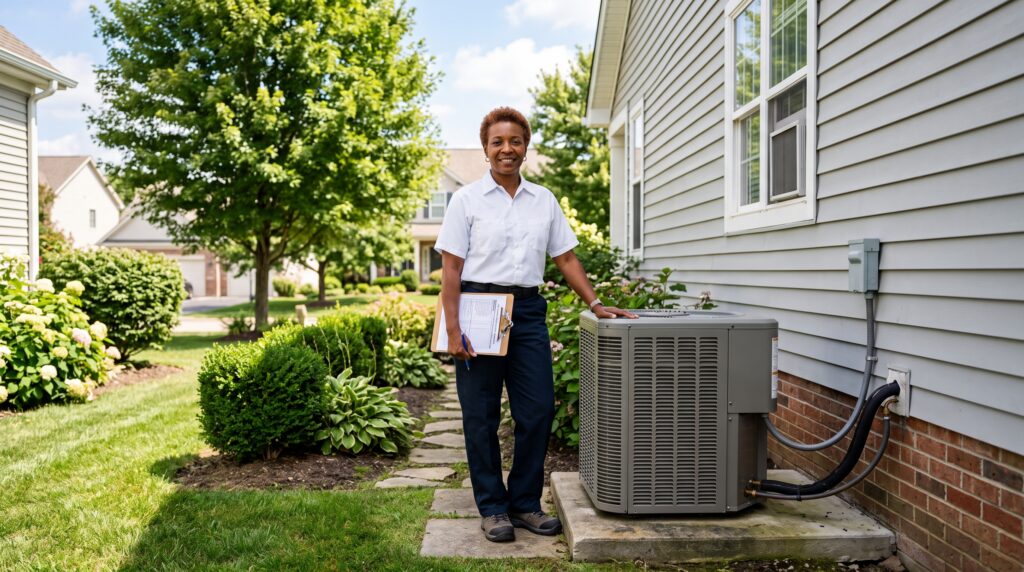
A ducted air-source heat pump costs $4,500 to $14,600 installed across the 2 to 5 ton range that covers almost every American home. Size is the single biggest driver inside that spread: each half-ton step up adds roughly $500 at the low end of the market and $900 at the high end. But heat pump sizing does not work the way air conditioner sizing does, and that difference is worth understanding before you sign anything.
TL;DR: Installed heat pump cost by size runs $4,500–$8,200 for a 2-ton system up to $9,200–$14,600 for a 5-ton high-efficiency system. A 3-ton unit (36,000 BTU/hr) covers about 1,500–2,000 sq ft in a mixed climate at $5,500–$10,000 installed. Unlike an air conditioner, a heat pump is sized for your heating load as well as your cooling load, which is why two identical-sized homes in different climates land on different tonnage. The federal 25C credit expired for 2026 installs, but per-ton utility rebates like Mass Save’s $2,650 per ton are still live. Get a size-specific estimate for your home.
How Much Does a Heat Pump Cost by Size in 2026?
Heat pump prices scale with capacity, measured in tons. One ton equals 12,000 BTU per hour of cooling capacity, so a 3-ton system moves 36,000 BTU/hr. The table below shows fully installed cost for a ducted air-source heat pump at each residential capacity, split by efficiency tier.
Heat Pump Installed Cost by Tonnage (2026)
| Capacity | Cooling Output | Home Size (Mixed Climate) | Standard 14.3–17 SEER2 | High-Efficiency 18+ SEER2 |
|---|---|---|---|---|
| 2 ton | 24,000 BTU/hr | 900–1,200 sq ft | $4,500–$8,200 | $6,200–$9,200 |
| 2.5 ton | 30,000 BTU/hr | 1,200–1,500 sq ft | $5,000–$9,100 | $6,700–$10,100 |
| 3 ton | 36,000 BTU/hr | 1,500–2,000 sq ft | $5,500–$10,000 | $7,200–$11,000 |
| 3.5 ton | 42,000 BTU/hr | 2,000–2,500 sq ft | $6,000–$10,900 | $7,700–$11,900 |
| 4 ton | 48,000 BTU/hr | 2,500–3,000 sq ft | $6,500–$11,800 | $8,200–$12,800 |
| 5 ton | 60,000 BTU/hr | 3,000–3,600 sq ft | $7,500–$13,600 | $9,200–$14,600 |
The full span across the table is $4,500 to $14,600, from a 2-ton standard-efficiency install at the bottom of the market to a 5-ton high-efficiency install at the top. That is slightly wider than the $4,500–$14,000 band on our main heat pump replacement cost guide, because this table runs the full capacity range rather than the typical install.
These ranges come from our analysis of manufacturer list pricing and contractor rate surveys across the six residential capacities, reviewed August 2026 and cross-checked against the published figures on our own tonnage guides. Everything above is capacity cost. Whether a new air handler, backup heat, or duct repair lands on your invoice depends on what is already in your house, and those items are covered further down.
Want a figure built around your actual square footage, climate zone, and existing equipment? Run the heat pump cost estimator.
What Size Heat Pump Does Your Home Actually Need?
The mixed-climate column above is a starting point, not a specification. The conventional cooling rule of thumb is one ton per 400 to 600 sq ft, and the table uses roughly one ton per 600 sq ft, which is where most well-insulated homes in Climate Zones 3 to 5 land. Climate shifts it in both directions.
- Hot, humid climates (Zones 1–2). The cooling load dominates. A 2,000 sq ft home in the Gulf Coast or south Florida commonly needs 3.5 tons where the same house in Ohio needs 3. Expect to move up a half-ton from the table.
- Mixed climates (Zones 3–5). Heating and cooling loads are close enough that the table’s figures usually hold without adjustment. This is where heat pumps are simplest to size.
- Cold climates (Zones 6–7). Cooling load drops, but the heating load rises sharply, and the heating load is what governs. This is where heat pump sizing stops resembling air conditioner sizing entirely.
Two other variables matter more than most homeowners expect. Ceiling height above nine feet raises the load 10 to 15 percent per additional foot, and insulation below current code can add 15 to 25 percent. Our HVAC sizing guide works through the full adjustment list, and HVAC cost by home size covers the same brackets for conventional AC and furnace systems.
Why Is a Heat Pump Sized Differently Than an Air Conditioner?
An air conditioner has one job, so it gets sized to one number: the cooling load. A heat pump has to satisfy the cooling load in July and deliver enough heating capacity in January, and those two numbers rarely point at the same tonnage. That is the genuine difference between this page and our AC tonnage guides, and it is where most sizing mistakes happen.
Heating Capacity Falls as It Gets Colder
A heat pump moves heat from outdoor air into your house. The colder that air gets, the less heat there is to move, so output drops exactly when you need it most. The nominal tonnage on the label is a cooling rating measured at 95°F. It tells you very little about what the unit delivers at 5°F.
ENERGY STAR quantifies this. To carry the Cold Climate designation, a heat pump must deliver at least 70 percent of its 47°F heating capacity when the outdoor temperature falls to 5°F, and hit a coefficient of performance of at least 1.75 at that temperature (ENERGY STAR heat pump key product criteria, verified August 1, 2026). A 3-ton cold-climate unit rated at 36,000 BTU/hr therefore still puts out at least 25,200 BTU/hr at 5°F. A conventional heat pump with no cold-climate certification can fall well below that.
Two Ways Contractors Resolve the Conflict
When the heating load exceeds what the cooling-sized unit can deliver at your design temperature, a contractor has two legitimate options, and they price out differently.
- Size to cooling, add backup heat. Pick the tonnage the cooling load calls for, then cover the winter shortfall with electric resistance strips or an existing gas furnace in a dual-fuel setup. Cheapest upfront, but the backup heat is expensive to run on the coldest days.
- Size to heating with a variable-speed unit. Specify a larger, inverter-driven cold-climate model that meets the heating load outright. It costs more, but an inverter compressor modulates down in summer, so the extra capacity does not cause the short-cycling and humidity problems that oversizing a single-stage air conditioner would.
- The tolerance is the point. A single-stage AC that is one ton oversized short-cycles, leaves the house clammy, and wears out early. A variable-speed heat pump that is one ton oversized simply runs at a lower speed. That tolerance is why heat pump sizing is allowed to lean toward the heating load at all.
Mass Save encodes this in program rules: its $500 sizing bonus requires equipment sized to meet 90 to 120 percent of the total heating load at the outdoor design temperature, calculated per ACCA Manual J (Mass Save air source heat pump rebates, verified August 1, 2026). A utility paying homeowners to size off the heating load is a fair signal of where the industry has landed.
Ask any contractor for the Manual J output showing both the cooling load and the heating load at your design temperature, plus the manufacturer’s capacity table at 17°F and 5°F. If a quote arrives with a tonnage and no load calculation behind it, that is a sizing guess.
How Much Does Each Half-Ton Step Actually Add?
Capacity pricing is close to linear across the residential range. Reading straight down the table, each half-ton step up adds about $500 at the low end and $900 at the high end of the standard-efficiency tier. A full ton is roughly $1,000 to $1,800.
Across the whole span, going from a 2-ton to a 5-ton standard-efficiency system adds $3,000 at the low end ($4,500 up to $7,500) and $5,400 at the high end ($8,200 up to $13,600). The high end climbs faster because larger systems bring heavier line sets, bigger air handlers, higher electrical demand, and more labor hours, and those costs compound.
Moving from standard to high efficiency adds about $1,700 at the low end and about $1,000 at the high end, at every capacity. The two tiers converge at the top because a difficult install costs what it costs regardless of which box you hang: attic access, long duct runs, and panel work do not get cheaper on a 15.2 SEER2 unit. The practical read is that the efficiency premium is most visible on straightforward installs and largely disappears on complicated ones.
Brand tier stacks on top of capacity. Premium brands carry a real markup at the same tonnage, which our heat pump cost by brand guide breaks out, along with model-level pricing on the Trane and Lennox pages.
What Does Your System Size Do to Your Rebate?
Size changes your rebate in some programs and not in others, and the difference is worth several thousand dollars. Start with what is gone: the federal Section 25C Energy Efficient Home Improvement Credit applies only to improvements made through December 31, 2025 (IRS, verified August 1, 2026). A heat pump placed in service in 2026 does not qualify. If a salesperson deducts $2,000 from your quote for the federal credit, that number is wrong. Our 2026 heat pump tax credit page covers the details.
State and utility programs are a different story, and several are still generous. They fall into two structures.
Per-Ton Programs, Where Size Directly Sets the Payment
Massachusetts pays by capacity. For equipment installed between January 1 and December 31, 2026, Mass Save pays $2,650 per ton for a whole-home air source heat pump, $1,125 per ton for a partial-home system, and $250 per ton on a basic rebate. Tons are calculated as AHRI cooling capacity divided by 12,000 BTU. The whole-home and partial-home rebates cap at $8,500; the basic rebate caps at $2,500 (Mass Save, verified August 1, 2026).
That cap does something specific to the sizing decision. At $2,650 per ton, the $8,500 ceiling is reached at 3.2 tons. A 2-ton system earns $5,300 and a 3-ton earns $7,950, but a 3.5-ton, a 4-ton, and a 5-ton system all earn the same $8,500. Upsizing past 3.5 tons in Massachusetts costs you more equipment with no additional rebate to offset it, which is exactly the kind of detail that changes a net-cost comparison.
Flat-Amount Programs, Where Size Does Not Matter
Maine pays a fixed figure. Efficiency Maine’s ducted whole-home heat pump rebate is $3,000 for any income, $6,000 for moderate income, and $9,000 for low income, plus a $500 bonus for projects completed and rebate claims postmarked between March 1 and December 31, 2026 (Efficiency Maine, verified August 1, 2026). A 2-ton and a 5-ton system collect the identical amount, so the rebate has no bearing on which capacity you choose.
Before you assume anything about your own utility, look up the current program terms directly. Rebate amounts, caps, and structures change annually, and both programs above carry 2026-specific installation windows and submission deadlines.
What Costs Get Added on Top of the Heat Pump Itself?
The tonnage table covers the outdoor unit, matched indoor coil, labor, and permits. These items are quoted separately and are the most common reason a real invoice lands above the table.
| Add-On | Added Cost | When You Need It |
|---|---|---|
| New air handler (all-electric) | +$1,800–$3,500 | No gas furnace to pair with, or the existing blower is too old to match |
| Electric backup heat strips | +$300–$900 | Any cold-climate install where the heat pump alone will not cover design-day heating |
| Cold-climate certified model | +$1,000–$3,000 | Climate Zones 5 to 7, or anywhere design temperature drops below about 15°F |
| Dedicated circuit or panel upgrade | +$400–$3,000 | Switching off gas or oil heat, especially in homes with 100-amp service |
| Ductwork repair or replacement | +$3,000–$10,000 | Leaky, undersized, or absent ducts; heat pumps move more air than furnaces at the same output |
The ductwork item deserves special attention on a heat pump project. Heat pumps deliver heated air at a lower temperature than a gas furnace does, so they need higher airflow to move the same heat. Ducts that were adequate for a furnace can be undersized for a heat pump at the same nominal capacity, and undersized ducts cost you comfort and efficiency for the life of the system.
Which Heat Pump Size Fits Your Home?
Here is what each capacity looks like in practice, with the tonnage-specific cost guides where we have them.
2 Ton (24,000 BTU/hr)
Condos, townhomes, small ranches, and additions at 900 to 1,200 sq ft. Installed cost is $4,500 to $8,200 standard, $6,200 to $9,200 high efficiency. At this size a ductless mini-split system is often price-competitive and worth quoting alongside a ducted unit, particularly if there is no existing duct system. Compare against the same capacity in cooling-only equipment on our 2-ton AC replacement cost guide.
2.5 Ton (30,000 BTU/hr)
Starter homes at 1,200 to 1,500 sq ft. Installed cost is $5,000 to $9,100 standard, $6,700 to $10,100 high efficiency. This capacity sits on a common boundary: a well-insulated 1,500 sq ft home in a mild climate may only need 2 tons, while the same footprint in Houston or Phoenix needs 3. The half-ton either way is a $500 to $900 decision on equipment and a comfort decision for the next 15 years, so it is worth the Manual J.
3 Ton (36,000 BTU/hr)
The most common residential heat pump size, covering roughly 1,500 to 2,000 sq ft in a mixed climate. Installed cost is $5,500 to $10,000 standard, $7,200 to $11,000 high efficiency. Because this is the volume size, it also has the deepest inventory and the most competitive contractor pricing. Our 3-ton HVAC replacement cost guide compares this capacity against AC and furnace equivalents.
3.5 Ton (42,000 BTU/hr)
Homes at 2,000 to 2,500 sq ft, and the size that a 2,000 sq ft house in a hot climate frequently steps up into. Installed cost is $6,000 to $10,900 standard, $7,700 to $11,900 high efficiency. In Massachusetts this is the first capacity that hits the $8,500 Mass Save rebate ceiling. See our 3.5-ton AC replacement cost guide for cooling-only pricing at the same capacity.
4 Ton (48,000 BTU/hr)
Larger two-story homes at 2,500 to 3,000 sq ft. Installed cost is $6,500 to $11,800 standard, $8,200 to $12,800 high efficiency. At this size, zoning starts paying for itself: upstairs and downstairs loads diverge enough that a single thermostat leaves one floor uncomfortable. Budget $1,500 to $3,000 for zoning controls if you go that route. Our 4-ton HVAC replacement cost guide covers the equivalent conventional system.
5 Ton (60,000 BTU/hr)
The largest standard residential capacity, serving 3,000 to 3,600 sq ft in a mixed climate. Installed cost is $7,500 to $13,600 standard, $9,200 to $14,600 high efficiency. Above roughly 3,500 sq ft, two smaller systems usually outperform one 5-ton unit, because a single system that large runs into duct static pressure limits and cannot balance distant rooms. Two systems cost more upfront but give you redundancy and independent zone control. See our 5-ton HVAC replacement cost guide for the conventional comparison.
Still weighing a heat pump against a conventional system at the same capacity? Our heat pump vs central air cost comparison runs the upfront and operating math side by side. Get a size-specific heat pump estimate →
Frequently Asked Questions About Heat Pump Cost by Size
What size heat pump do I need for a 2,000 sq ft house?
A 2,000 sq ft home in a mixed climate usually lands on a 3-ton heat pump (36,000 BTU/hr), which costs $5,500 to $10,000 installed at standard efficiency. In a hot, humid climate the cooling load can push the same house to 3.5 tons. In a cold climate the heating load often governs instead, and a contractor may specify 3.5 tons with a cold-climate compressor rather than 3 tons plus electric backup. Only a Manual J load calculation settles it for your specific house.
How much does a 3-ton heat pump cost installed?
A 3-ton (36,000 BTU/hr) ducted air-source heat pump costs $5,500 to $10,000 installed at 14.3 to 17 SEER2, and $7,200 to $11,000 installed at 18+ SEER2. Those figures include equipment, labor, permits, and a standard refrigerant line set, and assume your existing ductwork is reused. A new air handler, backup heat strips, or duct replacement are separate line items on top.
Why does a heat pump cost more than an air conditioner of the same tonnage?
A heat pump carries hardware an air conditioner does not, because it has to run in reverse all winter:
- A reversing valve to switch between heating and cooling modes
- A defrost control board and sensors to clear ice off the outdoor coil
- A compressor and outdoor coil rated for low-ambient heating operation
- A longer commissioning visit: the contractor tests heating mode, sets the backup heat lockout temperature, and configures the thermostat for staged or dual-fuel operation
At the same tonnage, the heat pump typically runs $800 to $2,000 more installed than a comparable air conditioner. That premium buys you heating too, which is why the operating-cost comparison usually favors the heat pump in electricity-priced markets.
Does a bigger heat pump get a bigger rebate?
Only up to a point, and only in programs that pay by capacity. Mass Save pays $2,650 per ton for a whole-home air source heat pump in 2026 but caps the payment at $8,500, so a 2-ton system earns $5,300, a 3-ton earns $7,950, and every system at 3.5 tons or larger earns the same $8,500. Flat-amount programs such as Efficiency Maine’s ducted whole-home rebate pay the same figure regardless of tonnage. Check your own utility’s current terms before assuming either structure applies.
Is there still a federal tax credit for a heat pump in 2026?
No. The IRS states that the Section 25C Energy Efficient Home Improvement Credit applies to improvements made through December 31, 2025. A heat pump placed in service in 2026 does not qualify, so do not subtract 30 percent or $2,000 from any quote you receive this year. State and utility rebates are separate programs and many of them are still running, including the two covered above.
How many square feet does a 5-ton heat pump cover?
A 5-ton heat pump delivers 60,000 BTU/hr and typically serves 3,000 to 3,600 sq ft in a mixed climate, less in a hot, humid climate and more in a cool one. Installed cost runs $7,500 to $13,600 at standard efficiency and $9,200 to $14,600 at 18+ SEER2. Homes above roughly 3,500 sq ft are often better served by two smaller systems than one 5-ton unit, because zoning and duct static pressure become limiting factors.
Related reading: Heat Pump Replacement Cost Guide · Heat Pump Cost by Brand · Heat Pump vs Central Air Cost · What Size HVAC Do I Need? · Full HVAC Replacement Cost Guide