
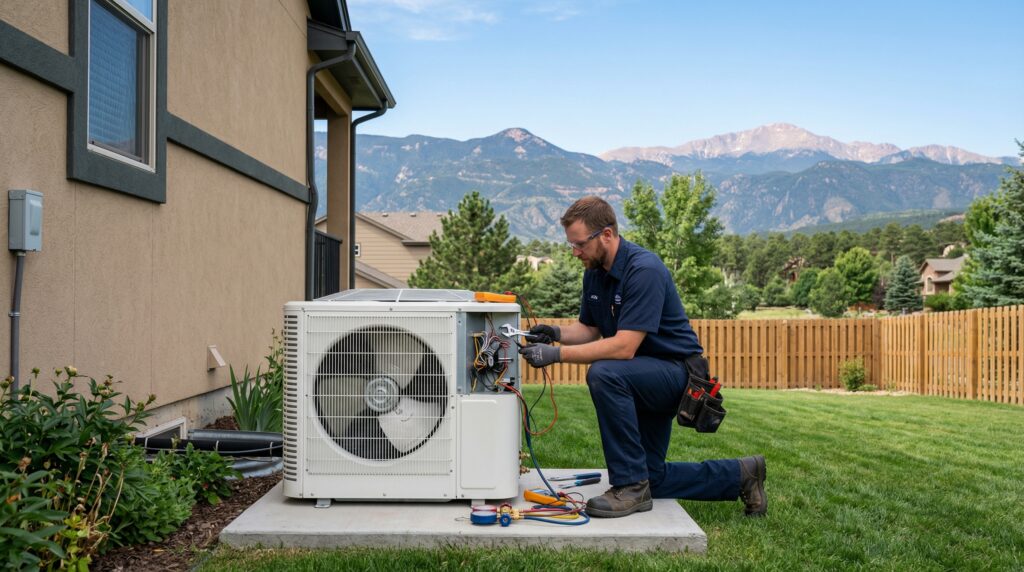
Colorado Springs homeowners face a unique HVAC challenge that most online cost guides ignore: at 6,035 feet above sea level, standard equipment sizing doesn’t apply, and the city’s cold winters require systems built for real cold. This guide covers what you’ll actually pay in 2026, how Colorado Springs Utilities rebates change the math, and what altitude means for your equipment choice.
Colorado Springs TL;DR: Full HVAC replacement costs $4,800-$14,500 in 2026 depending on system type. The city sits in ASHRAE Climate Zone 5B (cold, dry), meaning heating demand dominates and cold-climate heat pump ratings matter. Colorado Springs Utilities offers up to $1,500 back on qualifying heat pump installs plus a new $1,500 electric bill credit (2026). A mechanical permit is required through the Pikes Peak Regional Building Department ($100-$200). Get your free Colorado Springs HVAC estimate here.
How Much Does HVAC Replacement Cost in Colorado Springs?
Colorado Springs HVAC replacement costs run 10-20% above national averages, primarily because altitude-related sizing requirements push homeowners into larger equipment. At 6,035 feet, the thin air forces HVAC systems to work harder to move heat, which means you need more capacity than a home of the same square footage at lower elevations would require.
| System Type | Colorado Springs Cost Range | After CSU Rebate |
|---|---|---|
| Central AC replacement only | $4,800-$9,500 | No direct AC rebate (see heat pump row) |
| Cold-climate heat pump (full system) | $6,500-$14,000 | $3,500-$11,000 (with $1,500 rebate + $1,500 bill credit) |
| Gas furnace + central AC split system | $6,800-$14,500 | $5,900-$13,600 (with $900 furnace rebate) |
| Dual-fuel (heat pump + gas backup) | $8,000-$16,000 | $5,000-$13,000 (with $1,500 heat pump rebate + $1,500 bill credit) |
| Ductless mini-split (1 zone) | $3,800-$9,500 | $2,300-$8,000 (with $1,500 rebate for qualifying outdoor unit) |
| Furnace only (with altitude kit) | $4,200-$9,500 | $3,300-$8,600 (with $900 ENERGY STAR furnace rebate) |
These ranges include equipment, altitude-rated installation, refrigerant charge, permit, and removal of your old system. Ductwork repairs or replacement add $1,500-$8,000 depending on scope and age of existing ducts. See national HVAC replacement cost averages for direct comparison.
How Does Colorado Springs Altitude Affect HVAC Sizing and Cost?
This is the question most homeowners don’t know to ask until they’re comparing quotes and notice Colorado Springs contractors recommending larger equipment than expected. The science is straightforward: at 6,035 feet, air pressure is approximately 81% of sea level. HVAC systems move heat by moving air, and thinner air means less heat transfer per unit of airflow.
Sizing Adjustments
The industry rule of thumb for homes above 5,000 feet is to add 15-20% to calculated capacity. A home that would need a 3-ton central AC at sea level typically needs 3.5 tons in Colorado Springs. Standard sizing calculators designed for sea-level conditions undersize systems for this market, which leads to systems that run constantly in peak summer heat and can’t keep up during heat waves.
Gas Furnace Derating
Gas furnaces add a layer of complexity. The National Fuel Gas Code requires altitude derating for furnaces operating above 2,000 feet. At Colorado Springs’ elevation, a standard furnace must have its gas input reduced to maintain proper air-to-fuel ratios in thinner air. Without this adjustment, burners run “rich” (too much fuel, not enough oxygen), causing incomplete combustion, higher carbon monoxide production, and accelerated wear.
Reputable Colorado Springs HVAC contractors include altitude kits and combustion testing in their installation quotes. If a quote doesn’t mention altitude commissioning or combustion analysis, ask specifically. This is not an optional step at 6,035 feet.
Cost Impact
- Equipment cost: Larger tonnage means higher equipment price, typically $400-$1,200 more than a same-efficiency system at lower elevation
- Labor time: Altitude commissioning and combustion testing adds 1-2 hours of technician time
- Altitude kits: Required for most gas appliances, typically $50-$200 for the kit itself
- Total altitude premium: Plan for 10-20% above what the same job would cost in Denver or Boulder
What HVAC Rebates Are Available in Colorado Springs?
Colorado Springs homeowners have access to layered rebates from their municipal utility, the state of Colorado, and (until recently) the federal government. Here’s what’s currently available (verified March 2026):
Colorado Springs Utilities (CSU) Rebates
CSU increased its HVAC rebates substantially in 2025, with further changes in 2026. These apply to CSU natural gas and electric customers:
| Equipment | CSU Rebate Amount | Notes |
|---|---|---|
| ENERGY STAR furnace | $900 | Increased from $500 in 2024. Also applies to qualifying boilers ($1,200). |
| ENERGY STAR heat pump (under 3 tons) | $1,500 | Plus: $1,500 electric bill credit starting Jan. 1, 2026 |
| Cold Climate ASHP (NEEP, 3 tons+) | $3,000 | Requires NEEP-listed cold climate rating |
| Ductless mini-split | Based on outdoor units | Number of indoor cassettes does not affect rebate |
| Heat pump water heater | $750 | Separate program; stacks with HVAC rebates |
Work must be installed by a licensed contractor through an approved permit from the Pikes Peak Regional Building Department. Applications go through CSU’s online portal, by email (products@csu.org), or by mail. Receipts must clearly show equipment make/model, purchase price, and installation date. Postmark deadline is January 31 of the following year. View current CSU HVAC rebate details.
Colorado State Heat Pump Tax Credit
Colorado residents who install a qualifying heat pump through a registered contractor receive a $1,000 state income tax credit in 2026 (reduced from $1,500 in 2024 and $1,250 in 2025). The heat pump must cover at least 80% of the home’s annual heating needs. This credit stacks with CSU rebates, so a homeowner installing a qualifying cold-climate heat pump could see a $3,000 CSU rebate plus $1,500 bill credit plus $1,000 state tax credit for a total of $5,500 in combined savings.
Federal Tax Credit Status (2026)
The federal Section 25C tax credit (up to $2,000 on qualifying heat pumps) expired on December 31, 2025 under the One Big Beautiful Bill Act. As of March 2026, there is no federal tax credit available for HVAC replacements. Check DSIRE for any new state or federal programs that may emerge. The CSU and Colorado state credits remain the primary financial incentives for Colorado Springs homeowners.
Do You Need a Permit for HVAC Replacement in Colorado Springs?
Yes. All HVAC replacements in Colorado Springs and El Paso County require a mechanical permit through the Pikes Peak Regional Building Department (PPRBD). This applies to like-for-like replacements, system upgrades, and new installations.
Key facts about Colorado Springs HVAC permits:
- Issuing authority: Pikes Peak Regional Building Department (PPRBD), serving Colorado Springs, El Paso County, Fountain, Manitou Springs, Monument, and other jurisdictions
- Cost: Typically $100-$200 for residential mechanical permits based on PPRBD’s 2025 fee schedule (Table A, based on project valuation)
- Fee schedule: Available at pprbd.org/Information/FeeSchedule to estimate your specific fee
- Who applies: Your licensed HVAC contractor pulls the permit as part of the installation. Most reputable contractors include this in their quoted price.
- Inspection: A post-installation mechanical inspection is required. Schedule through pprbd.org or by calling 719-327-2880.
- CSU requirement: CSU’s rebate program requires installation through an approved permit from PPRBD. If you skip the permit, you lose the rebate eligibility.
Any contractor who suggests skipping the permit to reduce cost should be treated as a red flag. Unpermitted work can void your equipment warranty, create insurance complications, and create problems when selling your home.
Should Colorado Springs Homeowners Choose a Heat Pump or a Gas System?
Colorado Springs sits in ASHRAE Climate Zone 5B (cold, dry), which is among the colder zones where heat pumps are practical for year-round use. The key is selecting the right type of heat pump for the climate.
Standard Heat Pumps: Not Recommended Alone
Standard heat pumps typically lose meaningful efficiency below 25-30 degrees Fahrenheit and may not produce sufficient heat when temperatures drop to the single digits that Colorado Springs sees during cold snaps. Colorado Springs has a 99th percentile design temperature of 7 degrees Fahrenheit, meaning a standard heat pump would struggle during the coldest days of the year.
Cold-Climate Heat Pumps: The Right Option for Zone 5B
Cold-climate air source heat pumps (ccASHPs), rated to -13 degrees Fahrenheit or lower on the NEEP list, are specifically designed for Zone 5B conditions. These systems maintain efficiency well below freezing and can serve as the primary heat source even on Colorado Springs’ coldest days. CSU offers its highest rebate tier ($3,000) for NEEP-rated systems at 3 tons and above, making cold-climate units financially attractive despite their higher upfront cost.
Dual-Fuel Systems: Best of Both Worlds
Many Colorado Springs homeowners choose a dual-fuel system: a cold-climate heat pump for primary heating and cooling paired with a gas furnace that activates only during extreme cold. This maximizes efficiency during the 95% of the heating season when temperatures are above 20 degrees while providing gas backup reliability for the coldest days. Dual-fuel systems cost more upfront ($8,000-$16,000) but qualify for both the heat pump rebates and (if the furnace is ENERGY STAR-rated) the $900 furnace rebate.
Gas Furnace Only: Still Practical in Colorado Springs
Natural gas remains widely available in Colorado Springs and gas furnaces work well at altitude when properly derated. A high-efficiency condensing furnace (95+ AFUE) with proper altitude commissioning is a reliable and lower-upfront-cost option. The $900 CSU rebate on ENERGY STAR furnaces applies here. Homeowners with existing gas service who prioritize lower equipment cost and proven cold-weather performance often choose this route.
What Does HVAC Cost by Neighborhood in Colorado Springs?
Pricing varies somewhat by neighborhood based on housing stock age, home size, and ductwork condition:
- Briargate and Northgate: Newer construction (1990s-2010s), typically 2,500-4,000 sq ft homes with accessible equipment pads and newer ductwork. Average system replacement $7,500-$13,500 for a full system.
- Old Colorado City and Manitou Springs: Older homes (1920s-1970s), potentially challenging ductwork, smaller homes but more complex installs. Budget for ductwork inspection and possible sealing or replacement.
- Broadmoor and Cheyenne Mountain: Larger luxury homes, often requiring larger system capacity and premium equipment. Full system replacement ranges $10,000-$18,000+.
- Black Forest: Rural-adjacent area, homes on well/septic, sometimes propane instead of natural gas. Verify fuel type before sizing system.
- Fountain and Widefield: Military housing adjacent to Fort Carson, mix of newer and older homes. Average pricing close to Colorado Springs standard ranges.
How Should Colorado Springs Homeowners Get HVAC Quotes?
Getting three quotes remains the best practice in any market, and Colorado Springs has enough licensed HVAC contractors to make comparison shopping worthwhile. Here’s what to look for specifically in this market:
- Altitude sizing confirmation: Ask each contractor how they calculated the required tonnage. They should mention elevation adjustment or Manual J calculation. Any contractor using rule-of-thumb square footage tables without mentioning altitude should be asked to explain further.
- Altitude kit and combustion testing: For gas systems, ask if the quote includes an altitude kit and post-installation combustion analysis (CO2/CO testing). This should be standard in Colorado Springs.
- CSU rebate registration: Ask if the contractor is familiar with CSU’s rebate program and whether they’ll help with the application. Some contractors complete the paperwork as part of service.
- Permit inclusion: Verify the PPRBD mechanical permit is included in the quoted price. Most reputable contractors include it; if it’s listed separately, that’s fine as long as it’s listed.
- Cold-climate rating: If considering a heat pump, confirm the outdoor unit has a NEEP cold-climate rating and ask for the minimum operating temperature specification.
Use the free HVAC cost estimator to get a Colorado Springs-specific baseline before calling contractors. See how home size affects HVAC cost for Colorado Springs-sized homes in the 2,000-3,500 sq ft range.
Colorado Springs HVAC Replacement: Frequently Asked Questions
How much does HVAC replacement cost in Colorado Springs, CO?
Colorado Springs homeowners typically pay $4,800 to $14,500 for a full HVAC replacement in 2026. The city’s 6,035-foot elevation adds a 10-20% sizing premium over national averages. A central AC-only replacement runs $4,800-$9,500. A cold-climate heat pump system costs $6,500-$14,000 before rebates and potentially $3,500-$11,000 after CSU rebates and bill credits. A gas furnace plus central AC split system runs $6,800-$14,500 including altitude commissioning.
What HVAC rebates does Colorado Springs Utilities offer?
Colorado Springs Utilities (CSU) offers several residential HVAC rebates, verified March 2026:
- ENERGY STAR furnace: $900 rebate (80% increase from 2024)
- ENERGY STAR heat pump under 3 tons: $1,500 rebate plus $1,500 electric bill credit (new in 2026)
- Cold Climate ASHP (NEEP-rated, 3 tons and over): $3,000 rebate
- ENERGY STAR boiler: $1,200 rebate
- Heat pump water heater: $750 rebate
Work must be done by a licensed contractor through an approved PPRBD permit. Applications submitted through My Account at csu.org, by email, or mail. Postmark deadline is January 31 of the following year. Colorado residents also qualify for a $1,000 state income tax credit on qualifying heat pumps (2026 rate).
Does Colorado Springs altitude affect HVAC sizing and cost?
Yes, significantly. At 6,035 feet, air is about 20% less dense than at sea level. HVAC systems typically need 15-20% more capacity than a same-size home at lower elevation. Gas furnaces require altitude derating per the National Fuel Gas Code to prevent incomplete combustion and carbon monoxide risk. Expect to pay 10-20% more than what national cost guides suggest, and always ask contractors specifically about altitude sizing and combustion testing.
Do I need a permit for HVAC replacement in Colorado Springs?
Yes. The Pikes Peak Regional Building Department (PPRBD) requires a mechanical permit for all HVAC replacements in Colorado Springs and El Paso County. Fees run $100-$200 for typical residential replacements based on the 2025 PPRBD fee schedule. Licensed contractors handle permitting as part of the job. The permit is also a prerequisite for CSU rebate eligibility, so skipping it means losing rebate access in addition to creating compliance issues.
Should Colorado Springs homeowners choose a heat pump or a gas furnace?
Colorado Springs is in ASHRAE Climate Zone 5B (cold, dry), with winter design temperatures reaching 7 degrees Fahrenheit at the 99th percentile. Standard heat pumps are not recommended as the sole heating source for this climate. Options that work well here include:
- Cold-climate heat pumps (NEEP-rated, effective to -13 degrees Fahrenheit or lower): Best for all-electric homes; CSU offers up to $3,000 rebate plus $1,500 bill credit
- Dual-fuel systems (cold-climate heat pump plus gas backup): Maximizes efficiency while providing cold-snap reliability; qualifies for both heat pump and furnace rebates
- Gas furnace with central AC: Lower upfront cost, proven cold-weather performance, $900 CSU rebate on ENERGY STAR models
When is the best time to replace HVAC in Colorado Springs?
September through October and April through May offer the best combination of contractor availability and pricing. HVAC contractors in Colorado Springs are under the most pressure during June-August (AC demand) and November-February (furnace emergencies). Shoulder season scheduling typically saves 5-10% and reduces wait times significantly. With Fort Carson driving consistent year-round demand, booking at least 2-4 weeks in advance is recommended even in shoulder seasons.