
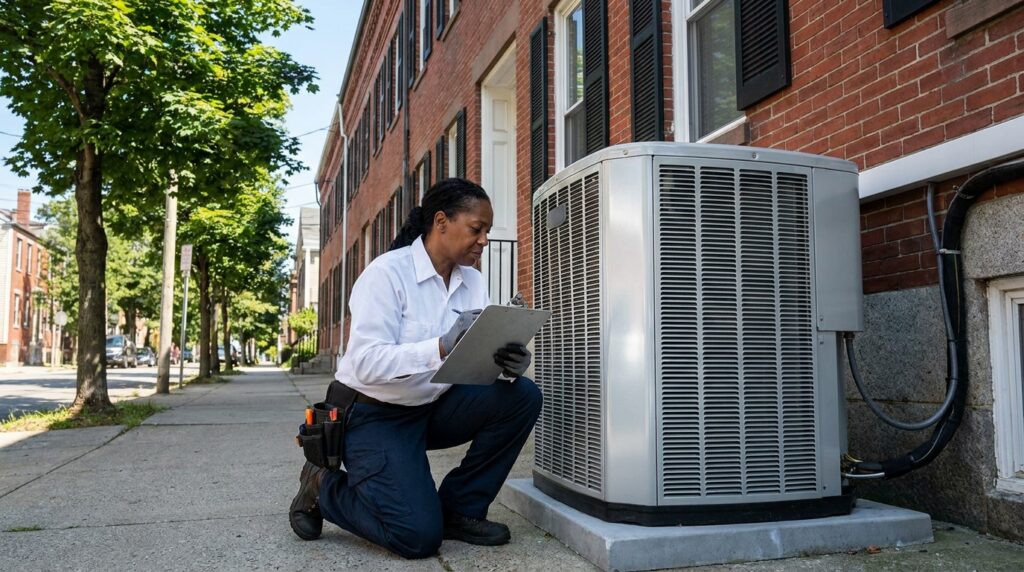
Providence homeowners face a distinct HVAC math problem: the country’s oldest housing stock sits on a coastal climate that demands real heating capacity, and Rhode Island’s utility rebate program is one of the most generous in the nation. This guide covers what a full HVAC replacement actually costs across the Providence metro, how to stack Clean Heat Rhode Island with Rhode Island Energy rebates, and what the permit process looks like through the city’s Department of Inspection and Standards.
TL;DR: A full HVAC replacement in Providence runs $7,500 to $15,000 for most homes. Climate Zone 5A means cold winters (design-day 0°F) and humid summers that favor variable-capacity equipment. Clean Heat Rhode Island pays 60% of a heat pump install, capped at $11,500, and stacks with Rhode Island Energy rebates of $150 to $1,000 per ton. A mechanical permit is required; gas work needs a separate gas permit through the Department of Inspection and Standards. Get your Providence estimate here.
How Much Does HVAC Replacement Cost in Providence?
For most Providence-area homes, a full HVAC system replacement runs between $7,500 and $15,000 before rebates. That range covers the common scenario: replacing both a central air conditioner and a gas furnace in a single-family home or a triple-decker unit with existing ductwork. The spread reflects real differences in home size, equipment tier, and whether the job requires ductwork repair, a panel upgrade, or a boiler-to-forced-air conversion.
| System Type | Typical Installed Cost (Providence Metro) |
|---|---|
| Central AC only (replacement) | $4,800–$9,000 |
| Gas furnace only (replacement) | $4,200–$9,500 |
| Full system: AC + gas furnace | $7,500–$15,000 |
| Air-source heat pump (whole home) | $9,000–$18,000 before rebates |
| Heat pump after Clean Heat RI + RI Energy stack | $0–$6,500 effective cost |
| Ductless mini-split (2–3 zone) | $6,000–$13,000 |
| Boiler-to-forced-air conversion | $13,000–$22,000 (includes ductwork) |
| Add ductwork replacement | $2,500–$5,500 additional |
Providence runs 5% to 10% above the national average on HVAC labor costs, which is real money on a $12,000 install, but meaningfully less than neighboring Boston’s union-driven rates. For a broader view of how full system replacement pricing varies nationally, see the HVAC replacement cost guide.
What Drives HVAC Costs Higher in Providence?
Three factors consistently push Providence HVAC replacement quotes above what national calculators show. Understanding each one helps you read a quote and decide whether it is reasonable for the local market.
Labor Rates and Licensing
Rhode Island HVAC technicians earn roughly $63,000 to $68,000 annually at the state mean, compared to the national mean of $59,810 (BLS OEWS May 2024). That puts Providence labor roughly 7% to 14% above the national baseline. Every mechanical contractor pulling a permit in Providence must hold an active Rhode Island mechanical contractor license. Gas work additionally requires a separately licensed gasfitter. Heat pump installations frequently involve both a mechanical permit and an electrical permit, which may bring a second licensed trade onto the job. Plan for labor to account for 40% to 50% of a typical replacement quote.
Old Housing Stock and Ductwork Challenges
Providence has one of the oldest median home ages of any major US city, approximately 1939 per Census data. Walk through College Hill, Federal Hill, Fox Point, or Elmwood and you see pre-1940 Federal-style brick rowhouses, Victorian triple-deckers, and single-family homes that have passed through coal, oil, and gas heating eras. These homes commonly present one or more cost drivers that newer suburban construction avoids:
- Original steam or hot-water boiler systems with no existing ductwork (forced-air conversion adds $13,000 to $22,000)
- Knob-and-tube wiring in attics or walls that requires remediation before a heat pump can be installed
- Narrow balloon-frame wall cavities that limit duct routing options
- Shared chimneys or mechanical rooms in triple-deckers that complicate equipment access and zoning
- Asbestos-wrapped steam pipes that require certified abatement before removal
If your home has existing ductwork, a technician should inspect it before quoting. Providence homes with original duct systems commonly leak 20% to 30% of conditioned air into unconditioned attic or basement spaces. Duct sealing runs $400 to $900, full duct replacement adds $2,500 to $5,500.
Equipment Tier and Cold-Climate Ratings
Providence sits in Climate Zone 5A (cold, humid), with a winter design temperature of 0°F in Providence County. Standard-efficiency heat pumps lose heating capacity rapidly below 35°F, and a standard unit at 5°F may deliver only 50% to 60% of rated heating output. Cold-climate heat pumps, rated down to -13°F, cost $1,500 to $3,000 more than standard units but maintain 75% to 100% of rated capacity through Providence’s coldest stretches. Clean Heat Rhode Island’s incentive is structured around cold-climate equipment listed on the Northeast Energy Efficiency Partnerships (NEEP) product list, so the larger rebate frequently offsets the equipment premium.
What HVAC Rebates Are Available in Providence in 2026?
Providence homeowners have access to one of the richest heat pump incentive stacks in the country. Two programs run side by side: Clean Heat Rhode Island (state-administered) and Rhode Island Energy utility rebates. Both can apply to the same project.
Clean Heat Rhode Island — 2026
Clean Heat Rhode Island covers 60% of eligible heat pump project costs, capped at $11,500 per address. The program has a strict equipment list (Rhode Island NEEP list), an HPIN-certified installer requirement, and a weatherization prerequisite: your home must have been built after 2000, have completed weatherization recommendations, or need less than $1,000 in weatherization work.
| Project Type | Incentive | Cap |
|---|---|---|
| Air-source heat pump (whole home) | 60% of project cost | $11,500 |
| Heat pump water heater | $2,500 flat | $2,500 |
| Lifetime per-property cap (all categories) | Combined | $18,000 |
Income-qualified households (up to 150% of State Median Income, which is $124,950 for a 1-person household and $178,500 for a 4-person household in 2026) may qualify for enhanced incentives. Verification runs through SNAP, LIHEAP, the Rhode Island Energy Discount Rate, or iVerify. Amounts and eligibility verified 2026-04-16 at cleanheatri.com.
Rhode Island Energy Utility Rebates
Rhode Island Energy (the utility formerly known as National Grid Rhode Island before PPL’s 2022 acquisition) offers its own residential heating and cooling rebates through rienergy.com/heatpumps that stack on top of Clean Heat RI. Amounts vary by the fuel being displaced:
- Air-source heat pump: $150 to $1,000 per ton of equipment capacity, depending on current heating fuel (larger rebates for oil or propane displacement)
- Heat pump water heater: up to $600
- Smart thermostats and weatherization offers available alongside equipment rebates
For a 3-ton whole-home heat pump replacing an oil system, a homeowner can realistically see $1,500 to $3,000 from Rhode Island Energy on top of the Clean Heat RI payment. On a $14,000 installation, stacked incentives frequently land the net homeowner cost under $4,000.
Stacking Rules and Federal Tax Credits
Clean Heat Rhode Island and Rhode Island Energy rebates are stackable on the same project. The Clean Heat RI 60% calculation applies to eligible project cost before the RI Energy rebate is subtracted. The federal Section 25C Energy Efficient Home Improvement Credit, which previously covered up to $2,000 for qualifying heat pumps, expired December 31, 2025. Installations completed in 2026 are not eligible for Section 25C. If you completed a qualifying install in 2025, you can still claim it on your 2025 federal tax return.
What HVAC System Works Best for Providence’s Climate?
Providence’s Zone 5A climate demands equipment that handles both humid Atlantic summers and cold, windy winters. Here is how the three main system categories compare for the local conditions.
Cold-Climate Heat Pumps — Best for Most New Installs
Cold-climate heat pumps from Mitsubishi (Hyper Heat), Bosch IDS, Carrier Infinity, and Daikin Aurora are rated down to -13°F, which comfortably covers Providence winters. They handle both heating and cooling from a single unit, cut or eliminate fossil fuel use, and qualify for the full Clean Heat RI rebate. For homes with existing ductwork, a ducted central heat pump replaces the furnace and AC as one system. For homes without ductwork (most pre-1940 Providence housing), ductless mini-splits heat and cool zone by zone without the cost of new duct installation.
Gas Furnace Plus Central AC — Still Viable
A high-efficiency gas furnace (90% to 98% AFUE) paired with a central air conditioner remains common for Providence homeowners not ready to electrify. Installed cost typically runs $7,500 to $13,500. Rhode Island Energy gas service reaches most of the city. The downside: no Clean Heat RI rebate applies, and you remain exposed to gas price volatility. The upside: lower equipment cost and simpler retrofit in homes with existing forced-air systems. Some homeowners choose this path when a dying AC forces replacement before they can plan a full electrification project.
Ductless Mini-Splits for Older Homes
For Providence’s pre-1940 triple-deckers and Federal rowhouses without ductwork, ductless mini-splits are often the best fit. A 2-to-3-zone ductless system runs $6,000 to $13,000 before rebates and sidesteps the $15,000-plus cost of installing new ducts through plaster walls and balloon-frame cavities. Each indoor head can be zoned independently, so a bedroom and a living room run on different schedules. Clean Heat RI covers ductless systems on the same 60% / $11,500 basis as ducted units. The main trade-off: visible wall cassettes, which some owners of historic homes find disruptive to period interiors.
What Permits Do You Need for HVAC Replacement in Providence?
Providence requires permits for HVAC replacement work. Skipping permits creates real problems: insurance claims can be denied for unpermitted work, and unpermitted mechanical changes can complicate a future home sale. Here is what the city requires for the most common scenarios. For a cross-state comparison, see the HVAC replacement permit cost guide.
Mechanical Permits (AC, Furnace, Heat Pump)
The Providence Department of Inspection and Standards issues mechanical permits for HVAC replacement. Providence uses a value-based permit fee calculator, meaning the fee scales with the declared project value. For a typical residential HVAC replacement, expect:
- Furnace or AC replacement permit: $75 to $300 depending on project value
- Heat pump installation permit: $100 to $350
- Ductless mini-split permit: $75 to $250
- New ductwork permit: $100 to $400
Permits must be pulled by a licensed Rhode Island mechanical contractor. If a contractor offers to skip the permit to save you money, walk away. That is a red flag in every Providence permit post-mortem.
Gas and Electrical Permits
Any work involving a gas appliance (furnace replacement, gas line extension, gas-fired water heater) requires a separate gas permit, pulled by a licensed Rhode Island gasfitter. Typical gas permit runs $50 to $200. Heat pump installations that require new 240V circuits or a panel upgrade also need an electrical permit, pulled by a licensed Rhode Island electrician. Fees run $50 to $200. Your mechanical contractor typically coordinates all three trades and pulls the associated permits as part of the project scope.
Providence HVAC Cost by Home Type and Neighborhood
Providence’s housing varies substantially by neighborhood, and that variation shows up in HVAC replacement costs. Here is what to expect for the most common home types across the metro.
Triple-Deckers (Elmwood, Olneyville, Smith Hill, West End)
Victorian-era triple-deckers are a Providence signature: 3-unit wooden multi-family buildings, typically built between 1880 and 1930. Many were originally heated by a shared steam or hot-water boiler serving all three units. Converting these to unit-by-unit forced air or ductless heat pumps is the most complex HVAC work in the Providence market. Cost factors by unit:
- Per-unit forced-air replacement (if ductwork already exists): $7,000 to $12,000
- Per-unit boiler-to-forced-air conversion: $13,000 to $18,000 (includes new ductwork)
- Per-unit ductless mini-split (2-3 zones): $4,500 to $9,000 before rebates
- Shared mechanical room improvements may require separate permits per unit
Federal-Style Rowhouses and Historic Single-Family (College Hill, Fox Point, Benefit Street)
Federal-style brick rowhouses and early-19th-century single-family homes in College Hill and along Benefit Street are among the oldest residential buildings in continuous use in the United States. Many are in Providence’s Local Historic Districts, which restrict exterior equipment placement. Expect:
- Historic District review required for visible exterior condenser placement
- Interior equipment (air handlers, ducted heat pumps) often routed through closets and attics due to narrow floor plans
- Full replacement typically $10,000 to $17,000 before rebates
- Boiler-to-heat-pump conversion frequently paired with weatherization to meet Clean Heat RI eligibility
Post-1950 Single-Family (Cranston, Warwick, East Providence, Johnston)
Post-war single-family homes in the inner suburbs typically have existing ductwork installed during 1970s or 1980s renovations. These are the most straightforward Providence-metro replacement scenarios. A 2,000 to 2,600 sq ft colonial, ranch, or cape usually needs a 3-ton system. Expect:
- Central AC replacement: $5,500 to $9,000
- Gas furnace replacement: $5,000 to $8,500
- Full system replacement: $9,000 to $14,500
- Cold-climate heat pump (whole home): $11,000 to $17,000 before rebates, $0 to $6,500 after stacked rebates
How to Get the Best Price on HVAC Replacement in Providence
Providence’s HVAC market is competitive, but quotes on the same job routinely vary by $3,000 to $5,000 between contractors. Here are the steps that consistently lead to better outcomes.
- Start at cleanheatri.com to confirm you qualify. If your home needs more than $1,000 in weatherization work, schedule that first, because the rebate requires weatherization eligibility.
- Ask every contractor whether they are an HPIN (Heat Pump Installer Network) certified installer. Only HPIN contractors can process Clean Heat RI rebates on your behalf. Non-HPIN contractors mean you file the rebate paperwork yourself or lose access entirely.
- Get at least three quotes. Providence has dozens of licensed mechanical contractors. Quotes on the same job commonly vary by $3,000 to $5,000. Do not accept the first quote.
- Compare quotes on equipment model, tonnage, and efficiency ratings, not just total price. A lower quote on a standard-efficiency system may cost you more in foregone rebates than you save on install cost.
- Time the project strategically. September and October are peak pre-heating demand. Mid-summer and late-winter windows often offer better contractor availability and occasionally better pricing.
For a structured comparison framework, see the HVAC planning guide. And for broader context on Rhode Island pricing, see the Rhode Island state HVAC guide.
Frequently Asked Questions — Providence HVAC Replacement Cost
How does the Clean Heat Rhode Island rebate work for Providence homeowners?
Clean Heat Rhode Island covers 60% of an eligible heat pump installation, capped at $11,500 per address. The program has four main steps:
- Confirm weatherization eligibility. Your home must be post-2000 construction, have completed weatherization recommendations, or need less than $1,000 in weatherization work. A free Rhode Island Energy home energy assessment documents your starting point.
- Select an HPIN-certified installer from the Clean Heat RI approved list. Non-HPIN contractors cannot submit the rebate on your behalf.
- Install an approved cold-climate heat pump listed on the Rhode Island NEEP product list. Your installer handles equipment specification and paperwork.
- The installer submits the rebate application. You receive the incentive check from the program administrator, typically within 6 to 12 weeks of installation.
Income-qualified households (up to 150% of State Median Income) qualify for enhanced incentives. The full program cap per property is $18,000 lifetime, including any past Clean Heat RI payments. Verified 2026-04-16.
Do cold-climate heat pumps actually work in Providence winters?
Yes. Providence’s winter design temperature is 0°F (per the Rhode Island Energy Code), and cold-climate heat pumps from Mitsubishi (Hyper Heat), Bosch IDS, Carrier Infinity, and Daikin Aurora are rated to operate down to -13°F. At Providence’s typical cold snaps of 5°F to 15°F, properly specified cold-climate units maintain 75% to 100% of rated heating capacity. The key specifications to confirm before installation: HSPF2 rating of 8.5 or higher, documented low-temperature heating capacity in the AHRI certificate, and equipment listed on the Rhode Island NEEP product list. A standard heat pump (non-cold-climate) will struggle in Providence; a properly sized cold-climate unit will not.
How much does HVAC replacement cost in a Providence triple-decker or Federal rowhouse?
Triple-decker and Federal rowhouse replacement costs depend heavily on what was originally installed. Three scenarios dominate:
- If the unit has existing forced-air HVAC, per-unit replacement runs $7,000 to $12,000, similar to a comparable single-family home
- Boiler-to-forced-air conversion per unit: $13,000 to $18,000, because ductwork must be installed through balloon-frame walls and historic plaster
- Ductless mini-split system per unit (2 to 3 zones): $4,500 to $9,000 before rebates, and usually the best fit for pre-1940 housing with no ductwork
Multi-unit projects may qualify for separate Clean Heat Rhode Island rebates per unit, since each unit is an independent dwelling. A triple-decker can, in principle, capture three $11,500 rebates if each unit converts separately and each unit meets weatherization requirements. Historic District homes on College Hill or Benefit Street may require Historic District review for exterior condenser placement.
Does HVAC replacement require a permit in Providence?
Yes. HVAC replacement in Providence requires a mechanical permit from the Department of Inspection and Standards. Gas furnace or gas-fired boiler replacement additionally requires a gas permit pulled by a licensed Rhode Island gasfitter. Heat pump installations that require new 240V circuits or a panel upgrade also need an electrical permit. Permit fees use a value-based calculator: typical residential HVAC permits run $75 to $350, and gas or electrical permits run $50 to $200 each. Your licensed contractor pulls the permits before work begins. Unpermitted HVAC work is illegal in Providence and can affect insurance claims and property sales. Inspections happen at job completion before the permit closes out.
Is Rhode Island Energy the same utility as National Grid for rebate purposes?
Functionally, yes. PPL Corporation acquired National Grid’s Rhode Island gas and electric businesses in May 2022 and rebranded the combined utility as Rhode Island Energy. The service territory, customer accounts, and rebate infrastructure carried over from National Grid. If you search for “National Grid Rhode Island rebates” today, every active residential program redirects to Rhode Island Energy (rienergy.com). Rebate amounts are unchanged for most programs, and Rhode Island Energy continues to coordinate with Clean Heat Rhode Island to process stacked incentives. Massachusetts homeowners still deal with National Grid as a separate utility, which is where the confusion originates. If you moved from Massachusetts to Rhode Island or vice versa, you are dealing with two different companies despite the historical connection.