
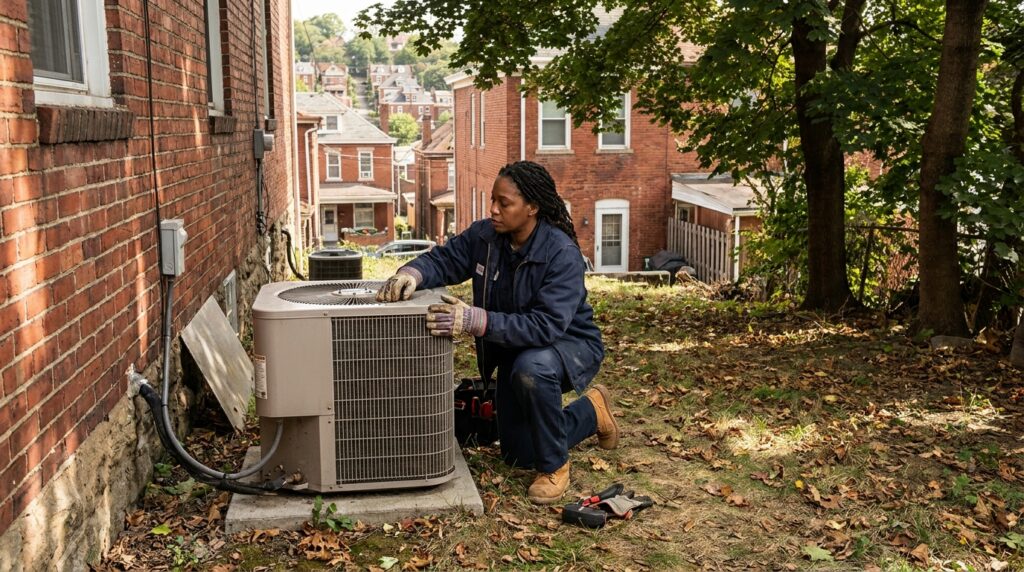
Pittsburgh’s older housing stock, long heating season, and Zone 5A cold winters make HVAC replacement more involved here than in warmer markets. Many city neighborhoods have rowhouses and narrow homes with steam boilers instead of forced-air systems, which changes the replacement options available. Knowing what Pittsburgh homeowners typically pay, which rebates apply, and what the permit process requires puts you ahead of the process before a contractor arrives.
Pittsburgh TL;DR: Full HVAC system replacement costs $6,500–$14,500 in Pittsburgh in 2026. The city sits in ASHRAE Climate Zone 5A (cold-humid), with winters that average 21°F lows in January. Peoples Natural Gas offers up to $225 back on a 97%+ AFUE furnace; Duquesne Light standard HVAC rebate purchases ended May 31, 2026, with final applications due June 6, 2026 for eligible prior installs. A mechanical permit from the City of Pittsburgh PLI is required ($125 minimum). Get a free Pittsburgh HVAC estimate here.
How Much Does HVAC Replacement Cost in Pittsburgh?
Pittsburgh HVAC replacement costs run slightly above the national average, reflecting Zone 5A sizing requirements (systems must handle genuine cold) and the labor involved when older homes need ductwork attention. Contractors in the Pittsburgh metro are experienced with both traditional forced-air systems and the duct-free options common in older city neighborhoods.
| System Type | Pittsburgh Cost Range | After Current Rebates |
|---|---|---|
| Central AC replacement only | $4,500–$8,200 | Check DLC before assuming a new-install rebate |
| Gas furnace replacement only | $3,200–$6,500 | $2,975–$6,300 (with $225 Peoples Gas rebate) |
| Gas furnace + central AC (full system) | $6,500–$14,000 | $6,075–$13,575 (with Peoples Gas rebate on furnace) |
| Heat pump (full system) | $6,000–$13,500 | Check DLC before assuming a new-install rebate |
| Dual-fuel (heat pump + gas backup) | $7,500–$15,500 | $7,275–$15,275 (with Peoples Gas furnace rebate only) |
| Ductless mini-split (per zone) | $3,500–$8,500 | Check DLC before assuming a new-install rebate |
These ranges cover full installation by a licensed contractor, including equipment, labor, refrigerant, and removal of the old system. Ductwork installation in a home without existing ducts adds $4,000–$12,000 depending on home size. Compare costs across Pennsylvania before narrowing the estimate to your home. Use the HVAC cost estimator for a range based on your specific home and system type.
What Factors Affect Pittsburgh HVAC Costs?
Several Pittsburgh-specific factors push costs higher or lower than the national average:
Older Housing Stock and Ductwork
Pittsburgh has one of the oldest housing stocks of any major US city. Much of the city’s residential inventory was built before 1950, and large portions of Lawrenceville, Bloomfield, South Side, and Mount Washington predate 1930. Many homes were heated by coal then oil, then converted to natural gas. Boiler-based systems with steam or hot water radiators are common in city neighborhoods and have no existing ductwork. Adding ductwork for a forced-air system can add $4,000–$12,000 to a project. Many homeowners skip ductwork entirely and choose ductless mini-splits instead.
Zone 5A Sizing Requirements
Pittsburgh’s cold winters require properly sized heating equipment. January lows average 21°F, and multi-day stretches below 10°F are typical most winters. Undersized systems fail to maintain comfort and run continuously during cold snaps. Contractors performing a proper Manual J load calculation for a Zone 5A home will specify equipment with sufficient BTU capacity, which generally means mid-to-upper-tier equipment rather than the minimum spec. That sizing reality keeps Pittsburgh costs above the national midpoint.
Pittsburgh’s Hilly Terrain and Home Access
Pittsburgh’s famous hills mean many homes sit on sloped lots where equipment access requires extra labor. Installing or removing an outdoor condenser on a steep side yard, carrying equipment up long stairways in South Side or Mount Washington, or working in a Bloomfield rowhouse with minimal clearance between buildings adds time and cost. When getting quotes in Pittsburgh’s hillier neighborhoods, ask contractors about any site-specific access charges.
What Rebates Are Available for Pittsburgh HVAC Replacement?
Pittsburgh homeowners should verify rebate timing before signing a contract. Peoples Natural Gas furnace and boiler rebates remain the clearest active utility incentive, while Duquesne Light’s standard Watt Choices HVAC purchase window ended May 31, 2026. Income-qualified electric upgrades may still have separate DLC IRA pathways.
Peoples Natural Gas — Home Energy Rebate Program
Peoples Natural Gas (the primary natural gas utility in Pittsburgh and western PA) offers the Home Energy Rebate Program for residential heating upgrades. Rebate amounts verified April 2026, applications due by December 31, 2026:
- 95% AFUE or greater furnace: $200
- 97% AFUE or greater furnace: $225
- Standalone hot water boiler: up to $350
- Integrated boiler + water heater unit: up to $500
- Gas heat pump: up to $700
- Smart thermostat: $25
Duquesne Light — Watt Choices Program
Duquesne Light Company (the primary electric utility serving Pittsburgh and Allegheny County) lists current residential rebate information on its DLC Energy Rebates page. The standard residential HVAC rebate purchase window ended May 31, 2026, with applications for eligible prior installations due by June 6, 2026. For new projects after that date, verify current DLC offerings before counting this money in your budget:
- Standard Watt Choices HVAC rebates: closed for new purchases after May 31, 2026
- Final application deadline for eligible prior installs: June 6, 2026
- Income-qualified customers: check DLC IRA air-source heat pump assistance before choosing equipment
Federal Section 25C Tax Credit
The Inflation Reduction Act’s 25C credit applied for qualifying installations through 2025, but homeowners planning 2026 work should verify current federal eligibility before assuming a credit. The Peoples Natural Gas furnace rebate can still lower the utility-side cost. Consult a tax professional to confirm eligibility based on your specific equipment, installation date, and income.
Do Pittsburgh Rowhouses Need Ductwork for HVAC Replacement?
This is one of the most practical questions for Pittsburgh city homeowners. The answer depends on what heating system is currently in the home.
If your home has a steam boiler or hot water boiler with cast-iron radiators, there is no ductwork. Cooling a home like this requires one of three approaches:
- Ductless mini-split system: The most common choice in Pittsburgh rowhouses. Refrigerant lines run through small holes in walls, eliminating duct installation. One outdoor compressor serves one or more indoor wall units. Cost per zone: $3,500–$8,500 installed.
- Add ductwork throughout the home: A full forced-air conversion involves running supply and return ducts through the home, often through closets, chases, or the attic/crawlspace. Cost: $4,000–$12,000 on top of the furnace and AC unit price. Rarely the first choice in Pittsburgh rowhouses due to structural constraints.
- Keep the boiler for heat, add window ACs for cooling: The lowest-cost cooling option for a home with a functional boiler. Not ideal for comfort but avoids the ductwork decision entirely.
If your home already has forced-air heating (a gas furnace with ducts), a standard HVAC replacement works without major additional work. See our full guide to HVAC replacement cost breakdown to understand what each component costs.
Does Pittsburgh’s Cold Climate Affect Heat Pump Performance?
Zone 5A creates real considerations for heat pump buyers in Pittsburgh that don’t apply in warmer markets.
Standard heat pumps (non-cold-climate) become less efficient below about 35°F and need supplemental electric resistance heat below 25°F. Pittsburgh’s January lows average 21°F, with several nights each winter dropping to 5–15°F. A standard heat pump will struggle on those nights and drive up electricity costs.
Two options address this:
- Cold-climate heat pumps: Models rated to -13°F (such as Mitsubishi Hyper Heat, Bosch IDS, or Carrier Infinity heat pump with WeatherArmor) maintain strong efficiency even during Pittsburgh’s coldest nights. These cost $500–$1,500 more than standard heat pumps but eliminate the need for supplemental heat most winters.
- Dual-fuel system: A heat pump handles heating above a set switchover point (around 25–30°F) and a gas furnace takes over below that. The heat pump provides efficient operation for the majority of Pittsburgh’s heating season; the furnace covers the coldest days. Popular in homes with Peoples Natural Gas service.
Homes without gas service and homeowners committed to all-electric operation do best with a cold-climate heat pump. Homes with natural gas service often find the dual-fuel route more cost-effective given Pittsburgh’s extended cold season.
Do You Need a Permit to Replace HVAC in Pittsburgh?
Yes. The City of Pittsburgh requires a mechanical permit for all HVAC system replacements, including like-for-like equipment swaps. Permits are issued by the Department of Permits, Licenses, and Inspections (PLI).
Key facts about Pittsburgh mechanical permits:
- Cost: $6.00 per $1,000 of construction value, minimum $125 (2025 PLI fee schedule). An $8,000 HVAC replacement carries a permit fee of approximately $150.
- Who applies: Your licensed HVAC contractor pulls the permit as part of the job. Verify it is included in the quote.
- Inspection: A post-installation inspection is required before the permit closes.
- Suburbs: Allegheny County municipalities (Bethel Park, Mt. Lebanon, North Hills, Penn Hills, etc.) have their own permit offices and fee schedules. Your contractor handles this for your specific municipality.
- Skipping the permit: Unpermitted HVAC work can block home sales, void manufacturer warranties, and create problems with homeowners insurance claims.
When comparing contractor quotes, confirm the permit fee is included. Contractors who suggest skipping permits to reduce costs are a red flag. The permit protects you, not the contractor.
When Is the Best Time to Replace HVAC in Pittsburgh?
Pittsburgh’s long heating season (roughly October through April) and concentrated summer demand (July–August) create clear patterns in contractor pricing and availability.
- Best windows: April through May and September through October. Demand drops between heating and cooling seasons. Contractors offer faster scheduling and sometimes 5–15% lower pricing during these windows.
- Worst windows: January–February (furnace emergencies) and July–August (AC emergencies). Wait times stretch to 1–3 weeks and emergency premium pricing is common.
- Pre-winter planning: If your furnace is showing signs of age heading into September, replacing before the first cold snap puts you in a far better negotiating position than calling in an emergency in January.
See our full guide to HVAC replacement timing for details on shoulder-season savings and how to plan a proactive replacement.
What Do Pittsburgh Homeowners Ask About HVAC Replacement?
How much does HVAC replacement cost in Pittsburgh, PA?
Pittsburgh homeowners typically pay $6,500 to $14,500 for a full HVAC system replacement in 2026. Central AC-only replacement runs $4,500 to $8,200. Heat pump systems run $6,000 to $13,500. Gas furnace plus central AC runs $6,500 to $14,000. Ductless mini-splits run $3,500 to $8,500 per zone. Pittsburgh costs run slightly above the national average due to Zone 5A sizing requirements and older housing stock that sometimes requires ductwork attention. Get a free Pittsburgh HVAC estimate here.
What rebates are available for HVAC replacement in Pittsburgh?
Pittsburgh homeowners should verify rebate timing before signing. Peoples Natural Gas offers $200–$225 on high-efficiency furnaces and up to $500 on integrated boiler/water heater units (applications due December 31, 2026). Duquesne Light’s standard Watt Choices HVAC rebate purchase window ended May 31, 2026, with final applications for eligible prior installs due June 6, 2026. Income-qualified electric upgrades may have separate DLC IRA assistance. If qualifying equipment was placed in service in 2025, the former federal 25C credit may still be claimed on the 2025 tax return. It does not apply to equipment placed in service in 2026.
Do Pittsburgh rowhouses need ductwork added when replacing HVAC?
Homes with steam boilers or hot water boilers and cast-iron radiators have no existing ductwork. To add cooling or switch to forced-air heating, you have two main options:
- Ductless mini-split system (most common in Pittsburgh rowhouses): $3,500–$8,500 per zone installed
- Full ductwork installation for forced-air: $4,000–$12,000 added to equipment costs
Homes with existing forced-air ductwork only need the equipment swapped, which is a standard replacement.
Does Pittsburgh’s cold climate affect heat pump performance?
Standard heat pumps lose efficiency below 35°F and need supplemental heat below 25°F. Pittsburgh’s January average low is 21°F, with cold snaps reaching 5–15°F. For reliable performance through Pittsburgh winters, choose one of these options:
- Cold-climate heat pump (rated to -13°F): handles Pittsburgh winters without supplemental heat, costs $500–$1,500 more than a standard heat pump
- Dual-fuel system (heat pump plus gas furnace backup): gas furnace handles the coldest days; popular with Peoples Natural Gas customers
Do I need a permit for HVAC replacement in Pittsburgh?
Yes. The City of Pittsburgh requires a mechanical permit for all HVAC replacements through the PLI department. The 2025 fee is $6.00 per $1,000 of construction value with a $125 minimum. Your licensed contractor pulls the permit and schedules the post-installation inspection. Choosing a licensed contractor ensures the permit process is handled correctly.
When is the best time to replace HVAC in Pittsburgh?
April through May and September through October offer the best combination of contractor availability and pricing. Pittsburgh’s long heating season (October through April) and peak AC demand (July–August) make shoulder-season timing especially valuable here. Pre-season planning can save $500–$1,000 compared to emergency replacement during a cold snap or heat wave. See the full guide to HVAC replacement timing for a month-by-month breakdown.