
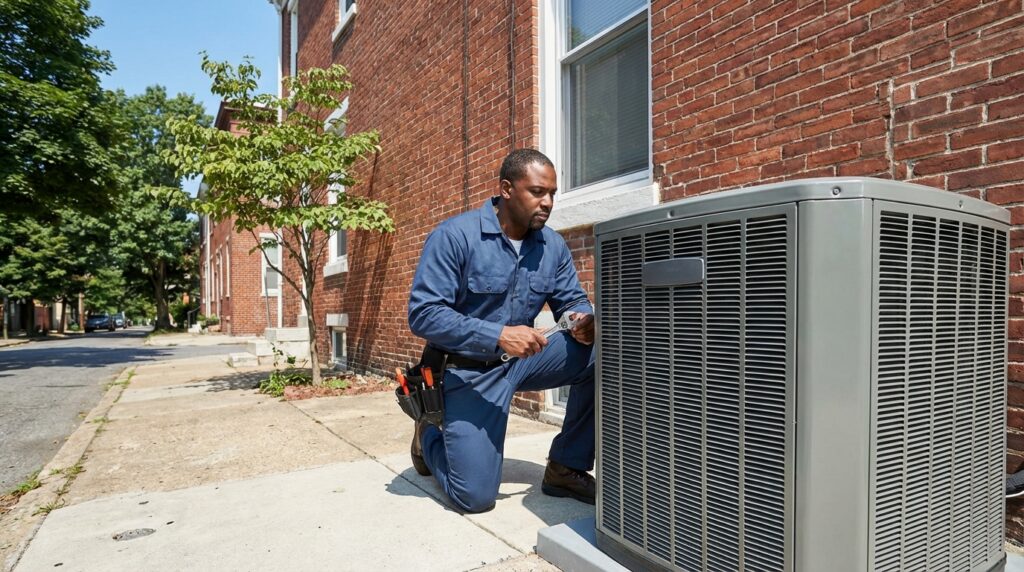
Philadelphia homeowners replacing an HVAC system face a specific combination of factors: dense rowhouse architecture, PECO Energy’s rebate program under Pennsylvania’s Act 129, union-affiliated contractors, and a demanding Zone 4A climate that pushes both your furnace and AC hard every year. Knowing what to expect before the first quote arrives puts you in a much stronger position.
TL;DR: A full HVAC system replacement in Philadelphia typically runs $6,000–$14,000. Philadelphia sits in ASHRAE Climate Zone 4A, with hot, humid summers and cold winters. PECO Energy offers Act 129 rebates of $100–$300 on qualifying heat pumps and central AC systems. A Mechanical Permit is required for all HVAC installations. PECO territory includes Philadelphia, Bucks, Chester, Delaware, and Montgomery counties. Federal Section 25C tax credits expired December 31, 2025. Use the free HVAC cost estimator to get a personalized range for your home.
What Does HVAC Replacement Cost in Philadelphia?
Philadelphia HVAC costs run about 5–7% above the national average, primarily because of higher labor rates in the metro and the additional complexity of working in older housing stock. The table below covers typical installed costs for the most common system types in the Philadelphia market.
| System Type | Typical Installed Cost | Notes |
|---|---|---|
| Central AC replacement only | $3,500–$7,500 | Existing ductwork in good condition |
| Gas furnace replacement only | $2,800–$6,500 | Standard efficiency to high-efficiency |
| Full HVAC system (AC + furnace) | $6,000–$14,000 | Most common replacement scenario |
| Heat pump (replaces AC + furnace) | $6,500–$14,000+ | Cold-climate model recommended for Zone 4A |
| Ductless mini-split (1–3 zones) | $4,500–$12,000 | Popular choice for Philadelphia rowhouses |
These ranges reflect installed costs including equipment, labor, permit, and basic disposal of the old system. Major variables that push toward the higher end include: adding ductwork, upgrading electrical service for a heat pump, and the added complexity of working in a connected rowhouse versus a detached home.
Use the HVAC cost estimator to enter your home’s specifics: size, system type, efficiency level, and region, and get a customized range in under two minutes.
Why Philadelphia HVAC Costs Run Higher Than Average
Several factors specific to Philadelphia push replacement costs above national averages consistently:
Union Labor Market
Philadelphia has a strong union presence in the HVAC and sheet metal trades. The City of Philadelphia’s L&I permit rules require that sheet metal work be performed by a registered sheet metal technician or licensed apprentice. Union labor rates typically run 10–15% higher than non-union markets, and that cost is passed through in installation quotes.
Rowhouse Complexity
Philadelphia has roughly 67,000 rowhouses (the densest concentration in the United States). Replacing HVAC in a rowhouse presents specific challenges: limited side access for equipment delivery, shared walls that complicate duct routing, and basement mechanical rooms that may be tight for modern air handler footprints. Contractors typically budget extra labor hours for rowhouse work compared to detached homes in the suburbs.
Older Housing Stock and Asbestos
Philadelphia homes built before 1981 may trigger an asbestos inspection requirement under L&I rules when HVAC work exceeds $50,000 in total project cost. Even below that threshold, older ductwork, pipe insulation, and furnace components may contain asbestos-containing materials that must be handled by licensed professionals. Budget for testing and remediation if your home dates to the 1970s or earlier.
Mechanical Permit and Inspection Fees
Philadelphia requires a Mechanical Permit for all HVAC replacements (more detail in the permit section below). Typical permit fees for a one-or-two-family dwelling: $69 per appliance (furnace or AC unit), $189 flat fee for ductwork if applicable, plus a $100 non-refundable filing fee credited toward the final permit. A full permit for a combined system typically runs $258–$327 before any optional accelerated review fees.
PECO Rebates Available in 2026
PECO Energy administers residential equipment rebates under Pennsylvania’s Act 129 energy efficiency program. These rebates are available to all residential PECO electric customers in Philadelphia, Bucks, Chester, Delaware, and Montgomery counties, with no income limit applies.
2026 PECO Rebate Amounts
| Equipment Type | PECO Rebate | Key Requirement |
|---|---|---|
| Air-source heat pump (central ducted) | $200–$300 | ENERGY STAR certified, matched system |
| Ductless mini-split heat pump | $200–$300 | ENERGY STAR certified, outdoor + indoor units |
| Central air conditioner | $100–$200 | ENERGY STAR certified |
| Smart thermostat | $50 | ENERGY STAR certified, controls heating/cooling |
The rebate tier (low or high end of the range) depends on the matched system’s SEER2 and HSPF2 efficiency ratings as listed in the AHRI directory for the specific combination of outdoor unit, coil, and air handler installed. Ask your contractor for the AHRI certificate number before purchase; this is required to apply.
How to Claim Your PECO Rebate
- Work with a HICRA-registered contractor (required for rebate eligibility)
- Have the complete matched system installed (add-on coils alone do not qualify)
- Submit the rebate application at peco.com/ways-to-save within 90 days of installation
- Include: proof of purchase, installation invoice, and the AHRI system certificate number
- Allow 6–8 weeks for rebate check processing
Stacking Rebates
PECO rebates can be combined with manufacturer promotional rebates from brands like York ($150–$480 on qualifying models) and Amana ($150–$400+). A Philadelphia homeowner replacing with a high-efficiency heat pump could realistically stack $300 (PECO) plus $300–$480 (manufacturer) for total savings of $600–$780. Ask your contractor what manufacturer promotions are currently active before signing.
Federal credits update: The Section 25C federal tax credits (up to $2,000 for heat pumps, $600 for central AC) expired December 31, 2025 per the One Big Beautiful Bill Act passed in July 2025. No federal credits apply to new installations in 2026. If you installed a qualifying system in 2025, you can still claim those credits on your 2025 tax return via IRS Form 5695.
Rowhouse vs. Detached Home — How Property Type Changes Your Options
Philadelphia’s rowhouse stock shapes HVAC decisions in ways that don’t apply in the suburbs or in detached city homes. Here’s how the key options compare for the typical Philadelphia rowhouse:
Central Forced-Air (Furnace + AC)
The most common existing configuration in Philadelphia rowhouses is a basement gas furnace connected to a central AC system via shared ductwork. Replacing in-kind is usually the lowest-cost option when the existing ductwork is in good condition. Most Philadelphia rowhouses have accessible basement mechanical rooms, though equipment delivery through the house or down tight stairwells adds labor time.
Ductless Mini-Split Systems
Mini-splits have become the go-to solution for Philadelphia rowhouses that lack ductwork or have compromised existing duct runs. A single-zone mini-split (one outdoor unit, one indoor head) handles a floor or an open-concept space. Multi-zone systems (one outdoor unit, two to four indoor heads) can cover an entire 3-story rowhouse. Mini-splits qualify for PECO’s Act 129 rebate ($200–$300 on qualifying systems) and are notably quieter and more efficient than window units that many older rowhouses rely on now.
The higher upfront cost of multi-zone mini-splits ($7,000–$12,000 for a full-house system) is offset by not having to install or replace ductwork, which can add $3,000–$8,000 to a central system installation in a home that doesn’t already have it.
When to Consider Adding Ductwork
If your home has no existing ductwork and you prefer central air, the total cost of adding ductwork plus a central system in a Philadelphia rowhouse often approaches or exceeds the cost of a well-planned multi-zone mini-split. Get quotes for both before deciding. Ductless systems also offer zone-by-zone temperature control and don’t require access through party walls or shared spaces.
Will a Heat Pump Work in Philadelphia Winters?
This is the most common question Philadelphia homeowners ask before switching from a gas furnace. The short answer is yes, with the right equipment.
Standard heat pumps lose efficiency and heating capacity as outdoor temperatures drop toward 30–35°F. Philadelphia winters regularly see temperatures in the 20s°F, which pushed older heat pumps into expensive backup electric resistance heating. Cold-climate heat pumps rated for operation at or below 5°F solve this problem. Models listed on the Northeast Energy Efficiency Partnerships (NEEP) cold-climate directory maintain useful heating output at Philadelphia winter temperatures without overworking the backup heat strips.
A dual-fuel configuration (cold-climate heat pump paired with an existing gas furnace for backup below a setpoint temperature) is a middle-ground option for homeowners who want the efficiency and rebate benefits of a heat pump but are hesitant to go fully electric. The furnace activates only during the coldest days (typically fewer than 20 days per year) in Philadelphia’s climate.
PECO’s $200–$300 rebate on heat pumps is intentionally higher than its $100–$200 rebate on straight AC replacement, reflecting Pennsylvania’s policy intent to increase heat pump adoption. If Pennsylvania eventually activates the IRA’s Home Electrification and Appliance Rebates (HEAR) program, heat pumps will be the primary qualifying equipment for those point-of-sale rebates as well.
Philadelphia Mechanical Permit — What You Need to Know
Philadelphia’s Department of Licenses and Inspections (L&I) requires a Mechanical Permit for all HVAC installations, including replacements of existing systems. Here’s what the process looks like for a standard residential HVAC replacement:
EZ Permit (No Plans Required)
Most one-or-two-family dwelling HVAC replacements qualify for an EZ permit, which does not require submitting plans. This covers new installations and appliance replacements in single-family and two-family homes. EZ permit applications are processed while you wait in person or within 5 business days online via Philadelphia’s eCLIPSE system.
Permit Fees (Effective January 1, 2025)
- Each appliance (furnace or AC unit) in a one-or-two-family dwelling: $69
- New ductwork (flat fee for one-or-two-family): $189
- Filing fee (nonrefundable, credited toward final permit): $100
- City surcharge: $3 | State surcharge: $4.50
A combined furnace-and-AC replacement in a rowhouse (no new ductwork) runs approximately $245 in permit fees. Work with your contractor on who pulls the permit; licensed contractors typically handle this as part of the installation process.
Historic Properties
If your property is listed with the Philadelphia Historical Commission, you need Historical Commission approval before L&I will accept a permit application. This adds time to the process: factor in 2–4 weeks for Historic Commission review in older neighborhoods like Society Hill, Fishtown, and Germantown if your home is designated.
How to Get Accurate Quotes in Philadelphia
HVAC quotes in Philadelphia can vary significantly between contractors (sometimes by $2,000–$4,000 for identical equipment). Several factors drive this spread:
- Union vs. non-union labor: Some Philadelphia contractors use union sheet metal workers; others use non-union crews. Both are legal, but union labor costs more. Ask upfront.
- Matched system vs. component swap: Legitimate quotes specify the complete matched system by brand, model, and AHRI certificate number. Quotes that say “equivalent system” without specifying the model are harder to compare.
- Permit included vs. excluded: Some contractors quote permit fees separately. Confirm whether the permit is included in the quoted price.
- Manufacturer rebate handling: A contractor who passes through the AHRI certificate and helps you file the PECO rebate application is saving you time. Some charge a small fee to handle this; others include it.
Timing matters too. Spring (April–May) and fall (September–October) typically offer shorter lead times and some pricing flexibility compared to peak season. Getting 3 quotes remains the most effective way to establish a fair price range for your specific situation. Start with the HVAC cost estimator to understand the expected range before the first contractor arrives. If you are also comparing costs in nearby NJ markets, see the Newark, NJ HVAC replacement cost guide.
Frequently Asked Questions
Does my Philadelphia rowhouse need a Mechanical Permit for HVAC replacement?
Yes. Philadelphia requires a Mechanical Permit for all HVAC installations, including replacements of existing systems. Most one-or-two-family dwelling replacements qualify for an EZ permit (no plans required). Your licensed contractor typically handles the permit application as part of the project. Skipping the permit creates liability at sale; title searches often flag unpermitted mechanical work.
What PECO rebates are available for a new heat pump or AC in 2026?
PECO offers Act 129 rebates on qualifying ENERGY STAR-certified equipment: $200–$300 for air-source heat pumps (central ducted or ductless mini-split) and $100–$200 for central air conditioners. Applications must be submitted at peco.com/ways-to-save within 90 days of installation. These rebates can be stacked with manufacturer promotions from brands like York and Amana. Federal Section 25C tax credits expired December 31, 2025 and do not apply to 2026 installations.
Is a ductless mini-split a good choice for a Philadelphia rowhouse without ductwork?
For most rowhouses without ductwork, a mini-split is often the more practical and cost-competitive option compared to adding full ductwork plus a central system. A multi-zone mini-split (one outdoor unit, 2–4 indoor heads) can handle a 3-story rowhouse for $7,000–$12,000 installed, comparable to or less than the cost of installing new ductwork ($3,000–$8,000) plus a central system. Mini-splits also qualify for PECO’s $200–$300 rebate and provide zone-by-zone temperature control.
Will a heat pump work reliably in Philadelphia winters?
Cold-climate heat pumps rated for operation at or below 5°F perform reliably through Philadelphia winters, which regularly see lows in the 20s°F. Standard-rated heat pumps struggle below 30–35°F and lean heavily on backup electric resistance heat, which is expensive to operate. If you’re considering a heat pump replacement, specify a cold-climate model (look for systems listed on the NEEP cold-climate directory) or ask about a dual-fuel configuration pairing a heat pump with your existing gas furnace as backup for the coldest days.
What drives up HVAC costs in older Philadelphia homes?
Several factors can push costs significantly higher in Philadelphia’s older housing stock:
- Deteriorated ductwork: Older flexible duct or asbestos-wrap duct runs may need partial or full replacement, adding $1,500–$5,000+
- Asbestos inspection: Required by L&I when total project cost exceeds $50,000 in pre-1981 buildings; testing and remediation can add $500–$3,000+
- Electrical service upgrades: Heat pumps and modern high-efficiency AC units may require a dedicated 240V circuit or panel upgrade, adding $800–$2,500
- Historic property approvals: Designated historic properties require Historical Commission approval, adding lead time and potentially limiting equipment placement options
- Access complexity: Tight basement stairwells, shared party walls, and limited exterior access in dense rowhouse blocks add labor hours
A thorough site assessment before quoting helps surface these issues early. Ask contractors to walk through the full scope of work, not just the equipment swap, before accepting a quote.
n