
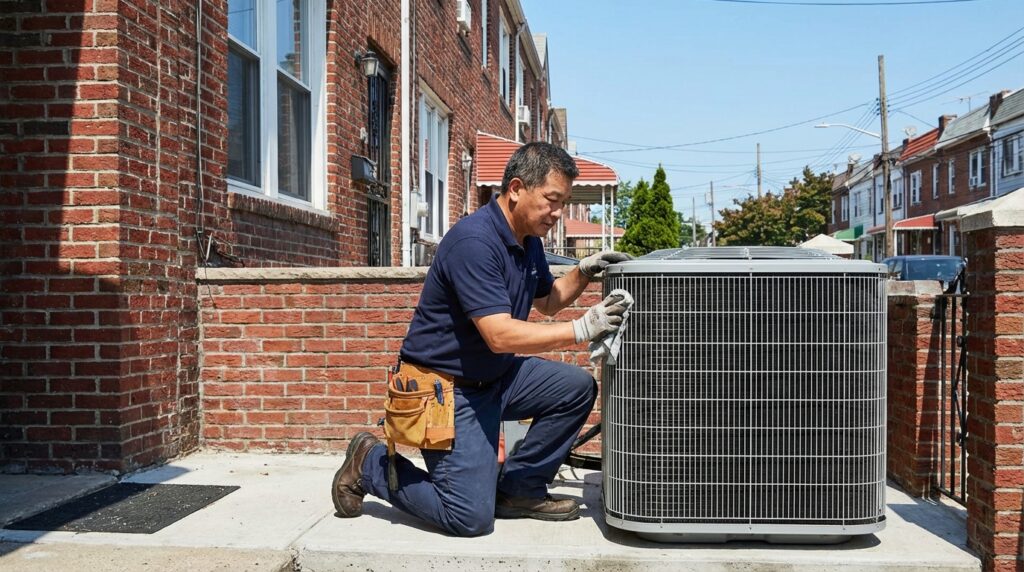
New York City is the most expensive and most complex HVAC market in the United States. Pre-war buildings with steam heat, limited outdoor equipment space, co-op board approvals, and union labor rates combine to push costs well above national averages. This guide covers what you’ll actually pay for HVAC replacement across the five boroughs in 2026, which systems work in NYC’s building stock, and how to claim Con Edison’s heat pump rebates.
TL;DR: Standard HVAC replacement in NYC runs $7,000–$22,000 for most residential systems (mini-splits, heat pumps, or central AC where ductwork exists). NYC sits in ASHRAE Climate Zone 4A (hot humid summers, cold winters). Con Edison offers up to $8,000 off heat pump installation for single-family homes and $4,000 for apartments, applied directly to your invoice. A NYC DOB mechanical permit is required ($500–$2,000). Get your free HVAC estimate.
What Does HVAC Replacement Cost in New York City?
NYC costs depend heavily on your building type and what system you’re replacing. Here are the 2026 ranges for the most common residential scenarios:
| System Type | NYC Cost Range | Best For |
|---|---|---|
| Ductless mini-split (single zone) | $3,500–$6,000 | Studios, individual rooms |
| Ductless multi-zone (3–4 heads) | $8,000–$15,000 | Brownstones, pre-war apartments |
| Central AC + furnace | $7,000–$15,000 | Houses with existing ductwork |
| Heat pump system (ducted) | $6,000–$14,000 | Year-round heating and cooling |
| Boiler replacement | $5,000–$12,000 | Apartment buildings, brownstones |
| Steam-to-forced-air conversion | $15,000–$35,000 | Full system change in pre-war buildings |
Manhattan projects run 10–20% higher than Brooklyn, Queens, the Bronx, and Staten Island, due to tighter street access, stricter building management, and longer freight elevator wait times. For homes with existing ductwork (primarily post-WWII detached houses in Staten Island, Queens, or the Bronx), costs align more closely with national averages. For the classic NYC pre-war building with steam heat, ductless is almost always the path of least resistance.
Why Is HVAC Replacement More Expensive in NYC?
Three factors push NYC costs above every other US metro:
Union labor rates. NYC HVAC work is heavily unionized. Technicians under UA Local 638 (the plumbers and steamfitters union that covers HVAC) earn $65–$85 per hour including benefits. Even non-union shops pay $35–$55/hour to attract qualified technicians in the New York labor market. The national median is under $30/hour. Labor typically makes up 40–50% of a full HVAC replacement, so this multiplier compounds quickly.
Building access complexity. Every NYC building job involves coordination that doesn’t exist in suburban markets: co-op board pre-approvals, scheduling with building management, freight elevator access windows, doorman logistics, and sometimes written applications with the co-op board weeks before work can begin. Each of these steps adds unbillable time that contractors factor into their quotes.
Equipment logistics. Getting condenser units to roof locations often requires crane rental ($2,000–$5,000 per day for a crane day). Street access restrictions in Manhattan mean staging equipment on the sidewalk requires permits and rapid turnaround. For brownstones and rowhouses, side-yard equipment pads are often the only viable condenser location, which adds complexity to routing refrigerant lines.
Which HVAC System Makes Sense for a NYC Building?
The right system depends almost entirely on whether your building has existing ductwork:
No existing ductwork (pre-war buildings, most co-ops, walk-ups, brownstones): Ductless mini-split systems are the standard answer. A multi-zone heat pump mini-split covers heating and cooling with no new ductwork, qualifies for Con Edison rebates, and installs faster than any ducted system. Most NYC pre-war buildings built before 1940 fall in this category.
Existing ductwork (post-war houses, some newer construction in Staten Island and Queens): A ducted central AC system with a gas furnace or a ducted heat pump gives you whole-home comfort through existing ducts. Costs are lower because you skip the ductwork installation. If your ducts are in decent condition, this is the most cost-effective path to a full system replacement.
Steam heat buildings (most pre-war Manhattan and Brooklyn buildings): Converting steam to forced air is expensive ($15,000–$35,000 all-in). Most NYC homeowners choose to install mini-splits for cooling and supplemental heating instead, keeping the existing boiler as a backup for the coldest weeks of January and February when heat pumps work hardest.
NYC’s climate (ASHRAE Zone 4A, Mixed-Humid) has cold enough winters that you want a cold-climate heat pump rated to operate efficiently at 0°F or below. Modern cold-climate mini-splits from brands like Mitsubishi, Daikin, and LG maintain heating capacity down to -13°F, which covers New York City winters with room to spare.
What Con Edison and NYSERDA Rebates Can You Get in 2026?
NYC homeowners have access to meaningful rebates on heat pump installations through Con Edison’s Clean Heat Program, which is part of the statewide NYSERDA Clean Heat initiative. Rebates are applied as instant invoice discounts by your contractor at the time of installation. You do not wait for a rebate check.
Con Edison rebates for air-source heat pumps (2026 verified amounts):
- Single-family homes (remove old heating system, replace with heat pump): $8,000
- Individual apartments (remove old system, replace with heat pump): $4,000
- Single-family (keep old system, add integrated heat pump controls): $2,500
- Apartments (keep old system, add integrated heat pump controls): $1,000
- Homes in Disadvantaged Communities: enhanced rates of $10,000 (single-family) or $5,000 (apartment)
Incentives are capped at 70% of project cost (85% in Disadvantaged Communities). You must use a Con Edison Participating Contractor. To find one, visit the contractor finder at coned.com.
HEEHRA federal rebates (still active in New York in 2026): Income-qualified households can stack additional rebates on top of Con Edison’s program. Up to $8,000 for households below 80% of area median income, or $4,000 for households between 80–150% AMI. These rebates are first-come-first-served as funding is depleted.
IRA 25C tax credit: expired December 31, 2025. If your system was installed before December 31, 2025, you can still claim it on your 2025 tax return. For 2026 installations, it is no longer available.
Do You Need a DOB Permit for HVAC Work in NYC?
Yes. The New York City Department of Buildings requires a mechanical permit for HVAC system replacements. This applies to mini-split installations, central AC replacement, furnace replacement, and boiler work. The permit is pulled by your licensed contractor before work begins. You should never hire an NYC HVAC contractor who says a permit is not required for a full system replacement.
Permit fees are based on the estimated cost of the project and are calculated using the NYC DOB fee schedule (revised April 2025). Typical permit costs for residential HVAC work:
- Single-zone mini-split (lower project cost): $200–$500
- Multi-zone or full system replacement: $500–$1,000
- Complex projects with structural or electrical work: $1,000–$2,000+
For co-ops and condos, your building management may require a separate approval process in addition to the DOB permit. Build this into your timeline: board approvals can take 2–6 weeks. Your contractor should be familiar with the process for your building type.
Unpermitted HVAC work creates real risk in NYC: it can void your homeowner’s insurance, create legal liability when selling, and result in stop-work orders that delay the project further. Always verify the permit number with your contractor before work begins.
NYC HVAC Costs by Borough: What to Expect
Costs vary meaningfully by borough, primarily because of logistics and access complexity:
Manhattan: The highest-cost borough. Expect to pay 10–20% more than the city average for equivalent work. Dense street access, strict building management in co-ops and condos, and the premium labor market for Manhattan contractors all contribute. A 3-zone mini-split that costs $10,000 in Queens may run $11,500–$12,000 in a Manhattan pre-war co-op.
Brooklyn: Brownstones and rowhouses dominate the pre-war stock, with many requiring condenser placement in side yards or on roof parapets. Costs are generally 5–10% below Manhattan for equivalent systems. Red Hook and parts of Greenpoint may face flood-zone requirements for equipment placement.
Queens: The most housing-diverse borough, with a significant share of post-war detached houses that have existing ductwork. Queens homeowners with ducts can get full central AC replacements at closer to national average pricing. Flushing and Jamaica have dense apartment stock similar to Manhattan.
The Bronx: A mix of detached houses, co-ops, and apartment buildings. Labor costs are comparable to Brooklyn. Some neighborhoods qualify for Disadvantaged Community status, which unlocks the enhanced Con Edison rebates ($10,000 for single-family, $5,000 for apartments).
Staten Island: The most suburban borough. Detached single-family homes with existing ductwork are common, and contractor competition is strongest here. Costs are often 15–25% below Manhattan for the same scope of work.
Frequently Asked Questions About NYC HVAC Replacement
Does my NYC apartment need a mini-split or can I get central air?
Most NYC apartments built before 1960 have steam heat and no ductwork, which makes central air conditioning impractical without a full duct installation costing $8,000–$20,000 or more. Mini-split systems are the standard solution: they require only a small wall penetration, work without ducts, and can heat and cool year-round. For pre-war co-ops, condos, and walk-ups, a single-zone mini-split typically costs $3,500–$6,000 installed; a multi-zone system covering 3–4 rooms runs $8,000–$15,000.
How much does it cost to install a mini-split in a NYC apartment?
A single-zone mini-split in NYC costs $3,500–$6,000 for equipment and labor. Multi-zone systems covering 3–4 rooms run $8,000–$15,000. Manhattan projects run 10–20% higher than Brooklyn or Queens. If your building requires a rooftop condenser, crane rental adds $2,000–$5,000 to the project.
What Con Edison rebates are available for heat pumps in NYC in 2026?
Con Edison’s Clean Heat Program gives rebates directly off your invoice. For single-family homes fully replacing their old heating system with a heat pump: $8,000 (or $10,000 in Disadvantaged Communities). For individual apartment owners: $4,000 (or $5,000 in Disadvantaged Communities). Income-qualified households can also apply for HEEHRA federal rebates of $4,000–$8,000 on top. You must use a Con Edison Participating Contractor.
Do you need a DOB permit for HVAC replacement in NYC?
Yes. NYC requires a Department of Buildings mechanical permit for any HVAC system replacement. Your licensed contractor pulls the permit before work begins. Costs range from $200–$500 for a simple single-zone install to $1,000–$2,000 for a full system replacement with electrical upgrades. Never hire a contractor who says no permit is needed for a full system replacement.
Why does HVAC replacement cost so much more in NYC than other cities?
Three factors stack: union labor (NYC HVAC techs earn $65–$85/hour including benefits, vs. $28–$45/hour nationally), building access complexity (co-op boards, freight elevator scheduling, doorman coordination), and logistics (crane rental for rooftop equipment, Manhattan street restrictions). Combined, NYC labor runs 25–35% above the national average.
Can I convert my NYC steam heat to a heat pump or forced air?
You can, but it is a major project. Converting from steam to forced air requires installing ductwork throughout the home: add $8,000–$20,000 to the equipment cost, bringing the total to $15,000–$35,000 for most buildings. A more practical approach is installing a ductless mini-split heat pump for year-round heating and cooling while keeping the steam system as backup for the coldest days. A whole-home ductless system runs $8,000–$15,000 and qualifies for Con Edison rebates.
For a nearby metro comparison with lower labor pressure, see the Newark HVAC replacement cost guide.