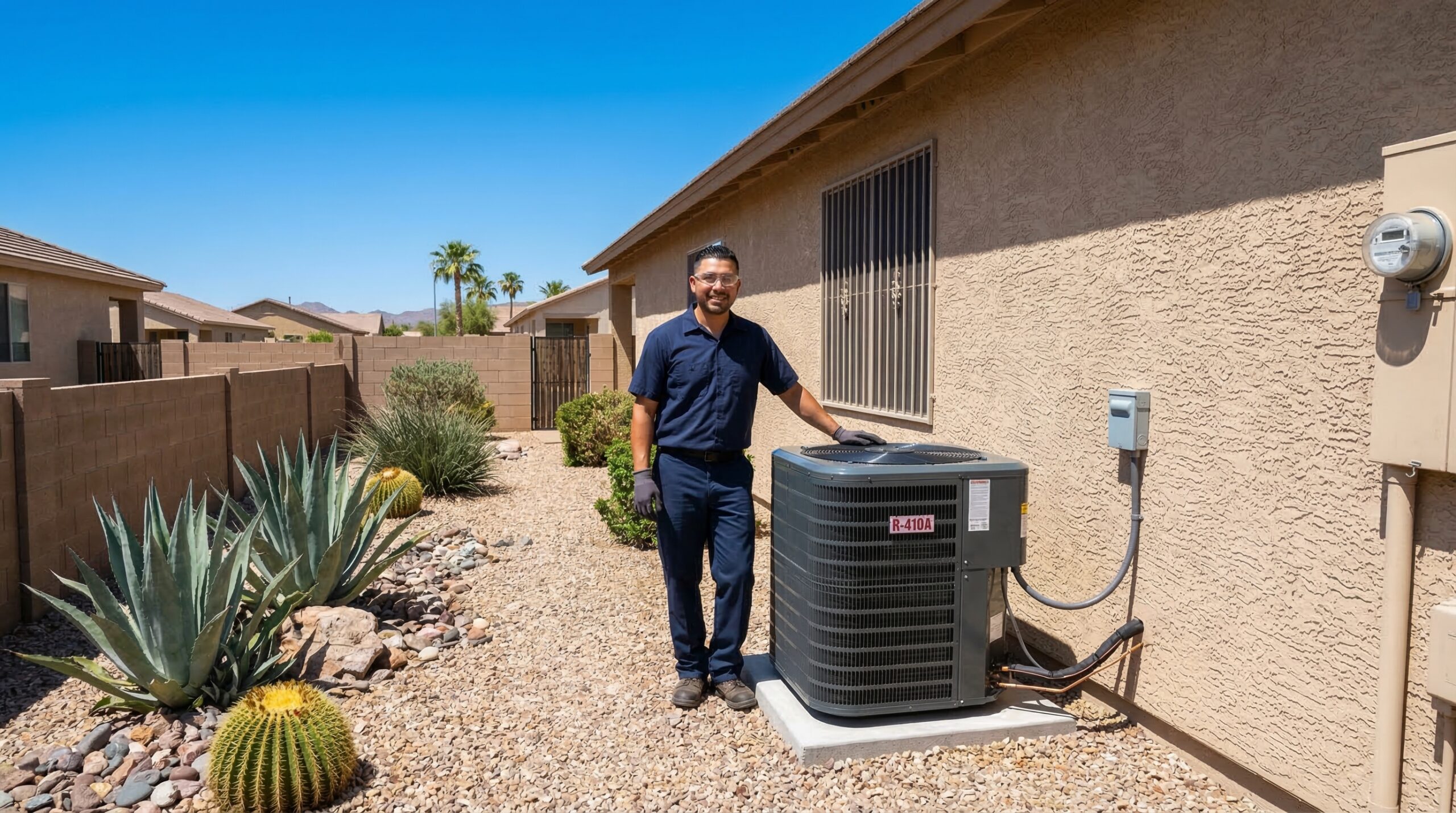
Phoenix runs its air conditioning harder and longer than almost any city in the United States. With over 100 days above 100°F each year, a Sonoran Desert climate that rarely drops below 35°F in winter, and one of the fastest-growing housing markets in the country, the Phoenix metro has a unique HVAC replacement market: extremely high demand, two major competing utilities with different rebate programs, and significant cost swings between peak and off-season installs. This guide covers what Phoenix homeowners actually pay, how to maximize rebates, and what to know before you call a contractor.
TL;DR: Phoenix HVAC replacement costs $5,400–$14,200 installed, depending on system size and efficiency tier. Phoenix sits in IECC Climate Zone 2B (hot-dry desert), where cooling dominates and heating demand is minimal. SRP customers can get up to $1,125 through the SRP Cool Cash Rebate on qualifying high-efficiency systems. The City of Phoenix requires a mechanical permit ($150–$225 typical for residential). Heat pumps are gaining share in the Valley for dual heating-cooling efficiency. Use the free cost estimator to get a Phoenix-adjusted range for your home.
What Does HVAC Replacement Cost in Phoenix?
Phoenix HVAC labor runs close to the national median. Bureau of Labor Statistics May 2024 data for the Phoenix-Mesa-Chandler MSA shows installation, maintenance, and repair workers earning a mean of $32.47 per hour, roughly in line with national averages. The larger cost driver in Phoenix is system sizing: the extreme heat requires higher-capacity units than similarly-sized homes elsewhere, and that tonnage adds equipment cost. For a full national cost comparison, see the HVAC replacement cost guide.
| System Type | Phoenix Cost Range (Installed) | Typical Scope |
|---|---|---|
| Central AC only (split system) | $5,400–$10,500 | Condenser, coil, labor; existing ductwork |
| Central AC (large home, 4–5 ton) | $8,000–$14,200 | 2,500+ sq ft; high-SEER2 options |
| Full system (AC + gas furnace) | $7,500–$15,500 | Air handler, furnace, condenser, labor |
| Heat pump (full system) | $7,000–$14,500 | Replaces both AC and heating in one unit |
| Ductless mini-split (1–2 zone) | $3,500–$8,500 | Additions, garages, casitas, rentals |
Labor runs $1,800–$4,500 per installation. Ductwork replacement or repair adds $1,500–$4,000 and is common in Phoenix homes with original builder-grade ducts running through attic spaces that reach 160°F in summer. Permits are separate (see the permit section below).
Peak season surcharge is real. Phoenix contractors charge 15–30% above off-season rates during May through September. An install that costs $8,500 in February may run $10,500 in July when every contractor in the Valley is booked solid. If your system is limping along, replacing it in the November–March window saves money and guarantees better scheduling.
How Does Phoenix’s Extreme Heat Drive Up HVAC Costs?
Phoenix’s climate creates several cost factors that homeowners from other markets don’t encounter.
Higher tonnage requirements. Phoenix homes need more cooling capacity per square foot than the same home in a temperate climate. A 2,000 sq ft home in Charlotte might need a 3-ton system; the same home in Phoenix typically requires 3.5 to 4 tons because outdoor temperatures regularly reach 110°F. Each additional half-ton adds $400–$800 to equipment cost.
Attic ductwork degradation. Phoenix attic temperatures can reach 150–165°F on a summer afternoon. Duct insulation breaks down faster under this sustained heat, seals degrade, and flex duct supports sag. Many older Phoenix homes show 20–30% duct leakage, which means the AC system is working 25% harder than it should be. Contractors routinely find ductwork that needs repair or full replacement during an otherwise standard AC swap.
Shorter system lifespan. Phoenix AC systems average 12–15 years of useful life, compared to 15–20 years in cooler northern climates. The math is simple: Phoenix units run 2,100+ cooling hours per year versus 800–1,200 hours in moderate climates. The compressor, fan motor, and capacitors all wear proportionally faster. When your system hits the 12-year mark in Phoenix, replacement planning is appropriate even if it’s still running.
Emergency replacements carry steep premiums. A system that fails in July during a 115°F heat event puts families at genuine health risk. Contractors know this and pricing reflects it. If you can plan ahead rather than react, the savings are substantial. The AC replacement cost guide covers when to replace versus repair in detail.
Does SRP Offer Rebates for a New AC System in Phoenix?
Yes, and the SRP Cool Cash Rebate is one of the most generous utility rebate programs in any market covered on this site. SRP (Salt River Project) is the primary electric utility for much of Phoenix and its eastern suburbs, including Mesa, Tempe, Chandler, Scottsdale, Gilbert, and Queen Creek. If SRP is your utility, the rebate tiers are as follows:
| Compressor Type | SEER2 Minimum | Rebate per Ton | Example: 4-ton system |
|---|---|---|---|
| Single-stage | 15.2 | $75/ton | $300 |
| Multi-stage | 15.2 | $150/ton | $600 |
| Variable-capacity | 15.2 | $225/ton | $900 |
| Inverter mini-split | 15.2 | $225/ton | $900 |
A 5-ton variable-capacity system (common in larger Phoenix homes) qualifies for a $1,125 rebate. The system must be installed by a licensed Arizona contractor before April 30, 2026, and the rebate application submitted within 6 months of installation. Details and application at the SRP Cool Cash Rebate page. Contact ELA (Electric League of Arizona) at (602) 264-3108 or srpinfo@elaz.org with questions.
APS customers: If you’re in an Arizona Public Service territory (west Phoenix, Glendale, Peoria, most of rural Arizona), APS has historically offered rebates for qualifying energy-efficient equipment. Check the current program status directly at aps.com, as APS rebate pages have been in flux. Your contractor can also confirm which rebates are currently active for your utility territory.
Income-qualified households: Arizona’s Efficiency Arizona program (the state’s HEAR program under the federal IRA) offers income-qualified homeowners up to $8,000 toward a heat pump for space heating and cooling, and up to $14,000 total across qualifying upgrades. Check eligibility at efficiencyarizona.com. This stacks with utility rebates for eligible households.
For a full national rebates overview including federal programs, see the HVAC tax credits and rebates guide.
What SEER2 Rating Do I Need for a New AC in Phoenix?
Arizona falls in the Southwest Region for federal SEER2 efficiency standards. The minimum requirements that went into effect January 1, 2023 are:
- Split-system AC under 45,000 BTU: 14.3 SEER2 (equivalent to the old 15 SEER)
- Split-system AC 45,000 BTU and above: 13.8 SEER2
- Heat pumps (all sizes): 14.3 SEER2 and 7.5 HSPF2
- Single packaged units: 13.4 SEER2
The “2” designation reflects a 2023 test method update. A 14.3 SEER2 unit is roughly equivalent in real-world performance to a 15 SEER unit under the old rating system. You cannot legally install a system below these minimums in Arizona.
Is higher SEER2 worth it in Phoenix? More so than almost anywhere else in the US. Phoenix AC systems run 2,000–2,200 cooling hours per year. Every efficiency point you gain is multiplied across an exceptionally long cooling season. A Bryant Preferred 146SAN lands right on that target at 16.5 SEER2, and our Bryant AC unit cost guide shows what that model runs installed at each tonnage. Most HVAC contractors in the Valley recommend 16 SEER2 as the sweet spot: meaningfully better than the minimum, without the significant cost premium of 20+ SEER2 variable-speed systems. The SRP rebate also scales with compressor type, so a variable-capacity 20 SEER2 system earns triple the rebate of a single-stage 15 SEER2 unit.
Heat pumps in Phoenix: Many homeowners assume heat pumps are for cold climates. In Phoenix, a heat pump replaces both the AC and the gas furnace in one unit, using electricity for both heating and cooling. Phoenix winters are mild enough that a heat pump heats efficiently nearly all season (heat pumps lose efficiency below 35°F, which rarely occurs in Phoenix). Combined with the SRP rebate and the Efficiency Arizona program, heat pumps are increasingly cost-competitive. See the heat pump replacement cost guide for a national comparison.
Do You Need a Permit to Replace HVAC in Phoenix?
Yes. The City of Phoenix Planning and Development Department requires a mechanical permit for all residential HVAC replacements. Phoenix uses a valuation-based fee structure (effective January 20, 2026, per Ordinance G-7465):
- Projects valued at $1,000 or less: $150 base fee
- Projects valued $1,001–$10,000: $150 base + $9 per additional $1,000 over $1,000
- A typical $7,000–$9,000 HVAC replacement: approximately $204–$222 in permit fees
Your licensed Arizona ROC contractor pulls the permit as part of the installation. Unpermitted HVAC work creates liability when selling the home, may void equipment warranties, and disqualifies the installation from SRP rebates. For permit questions, contact Phoenix Planning and Development at (602) 262-7811 or visit their office at 200 W Washington St, 3rd Floor.
Suburban cities note: Mesa, Tempe, Scottsdale, Chandler, Gilbert, Glendale, Peoria, and other cities in Maricopa County have their own permit offices with separate fee schedules. Your contractor will pull the permit from the jurisdiction where the home is located. Permit requirements and fees are similar across the metro but vary by municipality.
Frequently Asked Questions
How much does HVAC replacement cost in Phoenix, AZ?
Installed cost runs $5,400–$10,500 for central AC alone and $7,000–$15,500 for a full system (AC plus furnace or heat pump). System size is the biggest variable: Phoenix homes typically require 3.5–5 tons due to extreme heat, and equipment cost scales with tonnage. Emergency summer replacements carry a 15–30% premium over off-season pricing. For another warm Southwest market, see Los Angeles HVAC replacement costs, where LADWP rebates reach up to $2,500/ton for heat pump upgrades. Compare city-by-city data at the HVAC cost by city guide.
Does SRP offer rebates for a new AC system in Phoenix?
Yes. SRP’s Cool Cash Rebate pays $75–$225 per ton depending on compressor type, up to $1,125 for a 5-ton variable-capacity system. Single-stage systems at SEER2 15.2: $75/ton. Multi-stage: $150/ton. Variable-capacity or inverter mini-split: $225/ton. Apply through ELA at srpinfo@elaz.org or (602) 264-3108. Deadline: within 6 months of installation, system must be installed by April 30, 2026.
What SEER2 rating do I need for a new AC in Phoenix?
Arizona is in the Southwest Region for federal SEER2 standards. Minimums effective January 1, 2023:
- Split-system AC under 45,000 BTU: 14.3 SEER2
- Split-system AC 45,000 BTU and above: 13.8 SEER2
- Heat pumps: 14.3 SEER2 and 7.5 HSPF2
Given Phoenix’s 2,000+ annual cooling hours, upgrading to 16–18 SEER2 pays back faster here than in most US cities. The SRP rebate also scales with efficiency tier.
What is the best time to replace HVAC in Phoenix?
November through March is the optimal window. Contractor availability is highest, surcharges disappear, and scheduling is predictable. Spring (March to April) is the second-best option before demand picks up. Avoid May through September if you can: contractors are at capacity, prices spike, and some companies run 2–3 week backlogs during heat waves. If your system fails in peak summer, you may not have a choice, but planning ahead saves 15–30% on the same installation.
Do I need a permit to replace HVAC in Phoenix?
Yes. The City of Phoenix requires a mechanical permit for all HVAC replacements. Fees run approximately $150–$225 for most residential projects, based on the project valuation formula from the PDD Fee Schedule (effective January 20, 2026). Your licensed Arizona ROC contractor handles the permit application. Suburban cities (Mesa, Scottsdale, Chandler, etc.) have their own permit offices with similar requirements. Contact Phoenix Planning and Development at (602) 262-7811 for questions.
How does Phoenix’s extreme heat affect HVAC system lifespan?
Phoenix AC systems average 12–15 years versus 15–20 years in cooler climates. The system runs 2,000–2,200 cooling hours per year (compared to 800–1,200 in moderate climates), compressor wear accelerates, and attic ductwork degrades faster in 150–165°F attic temperatures. Annual preventive maintenance, including a spring tune-up before the heat season and a fall check of capacitors and refrigerant, extends system life meaningfully in Phoenix’s demanding environment.
For Southwest market context including nearby Texas cities, see the Dallas HVAC replacement cost guide and the Houston HVAC replacement cost guide.
Put the numbers in context
What would it cost for your home?
Get a planning range based on your home, system and region. Free, with no email required.
Get my cost estimate