
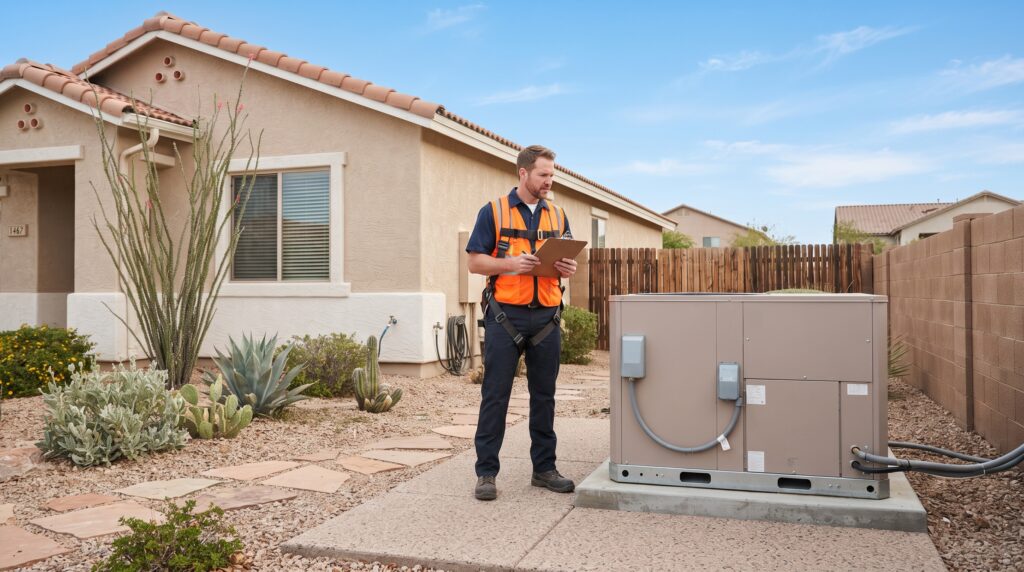
A residential HVAC package unit costs $3,800 to $13,500 installed in 2026, with most homeowners landing between $5,000 and $9,000. A package unit puts the compressor, coils, blower, and heating section in one outdoor cabinet on a slab or a roof, which is why it is standard on manufactured homes, slab-on-grade houses with no attic or basement, and homes with flat roofs. Nearly every other HVAC pricing guide quietly assumes a split system, so this page prices the packaged category on its own terms.
TL;DR: Package unit replacement runs $3,800–$13,500 installed: $4,200–$8,700 for a packaged air conditioner, $4,600–$10,200 for a packaged heat pump, $5,100–$11,400 for a gas pack, and $6,400–$13,500 for packaged dual fuel. A split system splits itself in two, a condenser outside and an air handler or furnace inside. A package unit does not: everything lives in one outdoor box, which is why it fits homes with nowhere to put an indoor unit. The tradeoff is a hard efficiency ceiling of about 15.2–16 SEER2 and 0.81 AFUE, well below what split equipment reaches, and that ceiling costs you rebate money. The federal 25C credit expired for 2026 installs. Get an estimate for your home.
How Much Does an HVAC Package Unit Cost to Replace?
A package unit costs $3,800 to $13,500 installed. The spread is wide because “package unit” is a cabinet shape, not a system type: four genuinely different machines ship in that same steel box, and they do not cost the same. The table below prices each one fully installed on a 2 to 5 ton residential job that reuses existing ductwork.
Package Unit Installed Cost by Type (2026)
| Package Unit Type | How It Heats | Installed Cost | Who It Suits |
|---|---|---|---|
| Packaged air conditioner | Electric resistance strips | $4,200–$8,700 | Hot climates where heat runs a few weeks a year |
| Packaged heat pump | Reversing refrigerant cycle, strip backup | $4,600–$10,200 | All-electric homes with mild to moderate winters |
| Packaged gas/electric (gas pack) | Gas or propane furnace section | $5,100–$11,400 | Homes with gas service and a real heating season |
| Packaged dual fuel | Heat pump plus gas furnace, switched automatically | $6,400–$13,500 | Mixed climates where both fuels are available |
| Manufactured-home package unit | Varies, HUD-rated equipment only | $3,800–$7,000 | Single-wide and double-wide homes |
Reading across the table, the heating source is what moves the price. Adding a reversing valve and defrost control to turn a packaged air conditioner into a packaged heat pump costs $400 more at the bottom of the market and $1,500 more at the top. Swapping the strip heat for a gas furnace section costs $900 to $2,700 more than the packaged air conditioner. Carrying both a heat pump and a gas furnace in the same cabinet, which is what dual fuel means, costs $1,800 to $3,300 more than the heat pump alone.
These ranges come from our review of manufacturer packaged lineups and contractor pricing across the four packaged configurations, compiled August 2026 and cross-checked against the figures already published on our mobile home and condo guides. For the equivalent split-system numbers, our full HVAC replacement cost guide is the parent page.
What Is a Package Unit, and Who Actually Needs One?
A package unit is a complete central HVAC system built into a single outdoor cabinet. The compressor, condenser coil, evaporator coil, blower, and heating section are all factory-assembled in one box that sits on a concrete pad beside the house or on a curb on the roof. Supply and return ducts run straight into the cabinet through one pair of openings. There is no indoor unit and no refrigerant line set, because the refrigerant never leaves the cabinet.
That is the entire difference from a split system, which divides the same components into a condenser outside and an air handler or furnace inside, connected by a copper line set. Trane reports that split systems make up about 85 percent of new construction, while packaged systems serve roughly 10 to 15 percent of homes (Trane, What Is an HVAC Packaged System, verified August 2, 2026). Packaged units are a minority nationally and a majority in specific places.
Who Should Buy a Package Unit
The honest answer is that most package unit buyers are replacing a package unit. If your current system is one outdoor box with ducts going into it, you are almost certainly buying another one, because converting to a split system means finding indoor space that your house does not have. Beyond that, packaged equipment is the right call in three situations Trane names directly:
- Slab-on-grade homes with no indoor utility space. No basement, no crawlspace, no conditioned attic, and no closet you are willing to give up. Common across the Southwest, Texas, and the Gulf Coast.
- Homes with flat or low-slope roofs. The roof is the only practical equipment location, and rooftop curbs are designed for packaged cabinets.
- Manufactured and mobile homes. Package units are the standard configuration, and the equipment must carry a HUD label. Our mobile home HVAC replacement cost guide covers the HUD rules and belly-duct issues in full.
Who Should Not Buy a Package Unit
Skip the package unit if you already have indoor equipment space and any of the following applies. This is the part most package unit pages leave out, and it saves people from a purchase they regret for fifteen years.
- You want top-tier efficiency. Packaged equipment stops around 15.2 to 16 SEER2. Split systems keep going well past that, as our cost by SEER guide shows.
- You want a condensing gas furnace. A gas pack tops out at 0.81 AFUE. A 96 percent furnace has to live indoors.
- You want variable-speed comfort. Packaged variable speed exists, Trane’s XL15c heat pump, but it stops at 15.0 SEER2. The high-efficiency modulating equipment covered in our variable speed cost guide is a split-system product.
- You live in a hard winter climate and want all-electric heat. A packaged heat pump keeps its entire refrigerant circuit and its blower outdoors in the cold, which is the opposite of what cold-climate performance wants.
- You have no ducts. A package unit is a ducted product. With no duct system, compare a ductless mini-split instead.
A Package Unit Is Not a PTAC
These get confused constantly, and the price gap is large. A packaged terminal air conditioner (PTAC) is the through-the-wall box under the window in older condos and converted hotels. It conditions one room, has no ductwork, and runs $2,500 to $5,000 installed as covered on our condo HVAC replacement guide. A package unit is a central ducted system for the whole house. If a quote says “packaged” and the equipment is going through an exterior wall rather than onto a pad or a roof curb, you are being quoted a different product.
What Do the Four Types of Package Units Cost?
All four types share the same cabinet, the same duct connections, and the same install labor. What separates them is how the box makes heat, and that decision sets both your purchase price and your winter operating cost.
Packaged Air Conditioner: $4,200 to $8,700
Cooling only, with electric resistance strips bolted in for the handful of cold mornings a year. Goodman describes this configuration as producing “limited heat with heat strip elements” and positions it for warmer climates where heat is used occasionally (Goodman, How a Packaged System Works, verified August 2, 2026). It is the cheapest packaged option to buy and by far the most expensive to heat with, because resistance heat converts electricity to warmth at a coefficient of performance of 1.0 while a heat pump delivers two to three times that. In south Florida or south Texas that rarely matters. In Dallas or Atlanta it does.
Packaged Heat Pump: $4,600 to $10,200
The same machine plus a reversing valve, a defrost board, and a coil rated to run in heating mode, so the cabinet cools in summer and heats in winter off one electric meter. Trane positions packaged heat pumps for “regions with mild winters,” which is a fair description of where they perform. This is the most common packaged replacement in Arizona, Nevada, Florida, and the Gulf Coast, and it is the type priced by tonnage in the next section. Electric strip heat still sits in the cabinet as backup for the coldest hours.
Packaged Gas/Electric, the Gas Pack: $5,100 to $11,400
An electric air conditioner and a gas or propane furnace sharing one cabinet. It is the packaged answer for a home with gas service and a genuine winter, and it is the most common gas pack application in the Southeast and lower Midwest. The catch is efficiency, and it is worth knowing before you shop: Trane lists a maximum of 0.81 AFUE across its gas/electric packaged line (Trane gas and electric packaged systems, verified August 2, 2026), and Goodman states its packaged gas/electric units offer 80 percent AFUE. You cannot buy a 95 percent condensing furnace in this format, because the burner section is outdoors and condensate would freeze. Compare against indoor equipment on our gas versus electric furnace cost guide.
Packaged Dual Fuel: $6,400 to $13,500
A heat pump and a gas furnace in one cabinet, with controls that pick whichever is cheaper at the current outdoor temperature. Goodman describes it as a system that “can determine whether it is more economical to heat your home using electricity or gas.” It is the most expensive package to buy and the cheapest to run in a mixed climate, because the heat pump covers the long shoulder seasons and the furnace only fires on genuinely cold days. The upgrade over a packaged heat pump is $1,800 to $3,300, which pencils out fastest where electricity is expensive relative to gas and the heating season is long enough to accumulate the savings.
Not sure which configuration your home should carry? Run the HVAC replacement cost estimator for a figure built around your square footage, climate, and existing equipment.
What Does a Package Unit Cost by Size?
Capacity is the second lever after type. Residential packaged units ship in the same 2 to 5 ton range as split systems, and Trane confirms availability at 2, 2.5, 3, 3.5, 4, and 5 tons. The table below prices the packaged heat pump, the most commonly replaced type, at each capacity.
Packaged Heat Pump Installed Cost by Tonnage (2026)
| Capacity | Cooling Output | Home Size (Mixed Climate) | Installed Cost |
|---|---|---|---|
| 2 ton | 24,000 BTU/hr | 900–1,200 sq ft | $4,600–$7,000 |
| 2.5 ton | 30,000 BTU/hr | 1,200–1,500 sq ft | $5,100–$7,600 |
| 3 ton | 36,000 BTU/hr | 1,500–2,000 sq ft | $5,600–$8,200 |
| 3.5 ton | 42,000 BTU/hr | 2,000–2,500 sq ft | $6,100–$8,800 |
| 4 ton | 48,000 BTU/hr | 2,500–3,000 sq ft | $6,600–$9,400 |
| 5 ton | 60,000 BTU/hr | 3,000–3,600 sq ft | $7,400–$10,200 |
Each half-ton step up adds about $500 at the low end of the market and $600 at the high end. The 4 to 5 ton step is a full ton and adds $800 at both ends. Across the whole span, moving from a 2 ton to a 5 ton packaged heat pump adds $2,800 at the low end ($4,600 up to $7,400) and $3,200 at the high end ($7,000 up to $10,200).
Sizing a package unit follows the same rules as sizing anything else: a Manual J load calculation, not a rule of thumb off square footage. The brackets above assume roughly one ton per 600 sq ft, which is where reasonably insulated homes in Climate Zones 3 to 5 land. Hot, humid climates typically step up a half ton for the same footprint. Our HVAC sizing guide walks through the adjustments, and it is worth reading before you accept a tonnage. One packaged-specific note: because the blower is factory-matched inside the cabinet and cannot be swapped, an oversized package unit is harder to correct after the fact than an oversized split system.
Is a Package Unit Cheaper Than a Split System?
Usually yes, but less than you would expect, and the saving is in labor rather than equipment. This is worth stating precisely, because the standard claim online is that package units are simply cheaper, and that is not what the numbers show at every price point.
Take the volume size. A 3 ton packaged heat pump runs $5,600 to $8,200 installed. A 3 ton ducted split heat pump at standard efficiency runs $5,500 to $10,000 installed, per our heat pump cost by size guide. The two overlap at the bottom of the market, and the package unit comes in roughly $1,800 cheaper at the top. The gap is not a discount on the machine. It is the labor and materials a package unit deletes:
- No refrigerant line set. The circuit is factory-charged and sealed inside the cabinet, so there is no copper to run, braze, pressure-test, or evacuate.
- No indoor unit to place. No air handler hauled into an attic, no furnace set in a closet, no indoor condensate routing, and no indoor electrical.
- One service location. A crew works one spot outdoors instead of two, which is why a straightforward packaged swap is often a half-day job.
- No indoor coil match to verify. The AHRI-matched pair is the cabinet itself, which removes a common source of mismatched-equipment errors described in our guide to reading HVAC quotes.
Read that list the other way and the pattern is clear: the harder the indoor half of a split install would have been, the more a package unit saves. Replacing an attic air handler in a Phoenix ranch with 100 degree attic temperatures is expensive labor that a package unit eliminates entirely. Replacing a basement furnace three steps from the door is not, and there the two options price out nearly the same.
The other half of the comparison is the ceiling. The split table runs to $14,600 at 5 tons and high efficiency; the packaged table stops at $10,200. That is not because packaged units are a bargain at the top. It is because the high-efficiency packaged equipment that would occupy those price points does not exist.
Why Do Package Units Top Out at a Lower Efficiency?
Because a cabinet sitting entirely outdoors loses performance that a split system keeps indoors, and the standards, the manufacturers, and the rebate programs all price that in. This is the single most useful thing to understand before you sign a package unit quote, and it shows up in three separate places.
The Federal Minimum Is Lower for Packaged Equipment
Under the efficiency standards that took effect January 1, 2023, single-package equipment carries a national minimum of 13.4 SEER2, while split-system air conditioners must reach 13.4 SEER2 in the northern states and 14.3 SEER2 in the South and Southwest. Split heat pumps must hit 14.3 SEER2 and 7.5 HSPF2 nationally; single-package heat pumps need only 13.4 SEER2 and 6.7 HSPF2. The Department of Energy’s consumer guide to central air conditioners and heat pumps covers the ratings and how to read them. The practical consequence is that a legally compliant new package unit can be less efficient than a legally compliant new split system in the same state.
ENERGY STAR Sets an Easier Bar for Single Package Equipment
The certification program concedes the same point. ENERGY STAR requires split-system heat pumps to reach 7.8 HSPF2, 15.2 SEER2, and 11.0 EER2, but asks single package equipment for only 7.2 HSPF2, 15.2 SEER2, and 10.0 EER2 (ENERGY STAR heat pump key product criteria, verified August 2, 2026). A packaged unit is allowed to be measurably less efficient at heating and still wear the label. That is a deliberate accommodation for the fact that the blower, the indoor coil, and every foot of internal air path sit outside the thermal envelope.
The Product Lineup Simply Stops
The clearest evidence is what you can actually order. Trane’s residential packaged heat pump catalog tops out at 15.2 SEER2 and 7.5 HSPF2 on its two-stage models, and the one variable-speed unit in that lineup, the XL15c heat pump packaged system, reaches only 15.0 SEER2 (Trane heat pump packaged systems, verified August 2, 2026). That is the part worth understanding: variable speed is available in packaged form, it just does not buy you efficiency here the way it does in a split system, where the modulating models sit at the top of the range. Its gas/electric packaged catalog stops at 16 SEER2 and 0.81 AFUE. For comparison, the same manufacturer’s split heat pumps reach 22.4 SEER2 with the XV20 TruComfort Variable Speed. There is no packaged equivalent of a 20 SEER2 modulating system, at any price, from any major residential brand.
None of this makes a package unit a bad purchase. For a slab home with no indoor equipment space, it is the correct system and the alternative is a far more expensive renovation. It does mean you should not pay a premium expecting split-system efficiency numbers, and it means the operating-cost math in our cost by efficiency guide lands differently here.
What Gets Added on Top of the Package Unit Price?
The tables above cover the cabinet, the labor, the permit, and reconnection to ducts that are already there and already sized correctly. These items are quoted separately and are the usual reason a real invoice lands above the table.
| Add-On | Added Cost | When You Need It |
|---|---|---|
| Crane rental for a rooftop set | +$400–$1,500 | Any rooftop replacement; a half-day crane call is standard on residential jobs |
| New or rebuilt roof curb and flashing | +$600–$2,500 | New cabinet footprint does not match the old curb, or the flashing has failed |
| Duct transition or plenum rework | +$400–$1,800 | Replacement cabinet has different supply and return opening positions |
| New concrete or composite pad | +$150–$600 | Ground-level install where the old pad has cracked, sunk, or shifted |
| Electrical disconnect, whip, or panel work | +$200–$3,000 | Undersized service, especially when moving from gas heat to a heat pump |
| Hurricane tie-downs or seismic restraints | +$150–$700 | Coastal and high-wind jurisdictions where code requires anchoring |
| Ductwork repair or replacement | +$1,000–$10,000 | Leaking, undersized, or rodent-damaged ducts found during the changeout |
Two of these deserve extra attention on a packaged job. The crane and curb line items are unique to rooftop installs and are the main reason a rooftop package unit replacement costs more than the identical cabinet set on a slab. Add the two rows together and the rooftop premium is $1,000 to $4,000. Get the crane and the curb broken out as separate line items rather than folded into a lump sum, because they are the two figures that vary most between bidders.
The duct transition is the quieter risk. Cabinet dimensions and opening locations changed when manufacturers redesigned equipment for R-454B refrigerant, so a 2026 replacement does not always drop onto a 2010 footprint. Ask any bidder whether the new cabinet matches your existing curb or plenum before you compare prices, because a quote that omits the transition is not comparable to one that includes it. Our bid comparison checklist covers how to normalize quotes that include different scopes. Permits run $50 to $300 in most jurisdictions, detailed in our HVAC permit cost guide.
What Rebates and Credits Apply to a Package Unit in 2026?
Utility rebates apply, the federal tax credit does not, and the efficiency ceiling described above quietly caps what you can collect. Start with what is gone. The IRS states that the Section 25C Energy Efficient Home Improvement Credit applies to improvements made through December 31, 2025 (IRS Energy Efficient Home Improvement Credit, verified August 2, 2026). A package unit placed in service in 2026 does not qualify. If a salesperson deducts $2,000 from your quote for a federal credit, that number is wrong. Our HVAC tax credits and rebates guide covers where the current programs actually are.
Utility programs are a different story, and packaged units are explicitly eligible in many of them. SRP in Arizona, one of the largest utilities in package unit country, lists its Cool Cash rebate for “central AC, heat pump and mini split packages and systems” at these per-ton amounts (SRP air conditioning rebate, verified August 2, 2026):
- Single-stage compressor, 15.2 SEER2 or higher: $75 per ton
- Multi-stage compressor, 15.2 SEER2 or higher: $150 per ton
- Variable-capacity compressor, 15.2 SEER2 or higher: $225 per ton
- Maximum rebate: $1,125, with the system installed before April 30, 2027 and the claim submitted within six months of installation
Now apply the packaged ceiling to that structure, because this is where a package unit buyer gets a different answer than a split system buyer. A baseline 13.4 SEER2 package unit, which is the cheapest thing on the type table and what many contractors quote by default, sits below the 15.2 SEER2 threshold and earns nothing at all. A two-stage packaged heat pump at 15.2 SEER2 qualifies at the $150 per ton tier, which is $450 on a 3 ton system and $750 on a 5 ton. The advertised $1,125 maximum requires a 5 ton variable-capacity system that also clears 15.2 SEER2, and the variable-speed unit in Trane’s packaged lineup, the XL15c, rates 15.0 SEER2 and misses that threshold. The practical ceiling for a package unit is therefore the multi-stage tier: $750 on a 5 ton system, not $1,125.
The actionable version: that $450 to $750 is money a baseline 13.4 SEER2 package unit leaves entirely on the table, so price the 15.2 SEER2 two-stage model as a second quote rather than assuming the cheaper box is the cheaper project. Ask your contractor for the AHRI reference number and the SEER2 rating in writing, because SRP verifies eligibility against the AHRI directory and requires a Manual J load calculation on single-stage systems. Rebate structures, amounts, and deadlines change annually, so confirm your own utility’s current terms rather than assuming this one applies.
One more thing worth checking on a package unit quote. New residential equipment now ships with R-454B refrigerant rather than R-410A, and Trane’s current packaged models are listed as R-454B compliant. That transition raised equipment prices across the board and, as noted above, changed some cabinet dimensions. It is a reason to confirm the model number on your quote, not a reason to rush a purchase.
Comparing a packaged replacement against staying with what you have, or against a different system type entirely? Get a package unit estimate for your home →
Frequently Asked Questions About Package Unit Cost
How much does it cost to replace an HVAC package unit?
Replacing a residential HVAC package unit costs $3,800 to $13,500 installed in 2026, depending on which of the four packaged types you buy and what capacity your home needs:
- Packaged air conditioner: $4,200 to $8,700
- Packaged heat pump: $4,600 to $10,200
- Packaged gas/electric, the gas pack: $5,100 to $11,400
- Packaged dual fuel: $6,400 to $13,500
- HUD-rated unit for a manufactured home: $3,800 to $7,000
Those figures include equipment, labor, permits, and reconnection to existing ductwork. Crane and curb work on a rooftop install, duct transitions, and electrical upgrades are quoted on top.
Is a package unit cheaper than a split system?
Usually yes, but the saving comes from labor rather than equipment, and it is smaller than most people expect. At 3 tons a packaged heat pump runs $5,600 to $8,200 installed against $5,500 to $10,000 for the equivalent ducted split heat pump. The two overlap at the bottom of the market and the package unit is roughly $1,800 cheaper at the top. There is no line set to run, no indoor unit to set, and no attic or closet labor, which is why the gap widens on difficult installs and nearly disappears on easy ones.
What is the highest efficiency package unit you can buy?
Far lower than the split-system ceiling. Trane’s residential packaged heat pump lineup tops out at 15.2 SEER2 and 7.5 HSPF2 on its two-stage models, and its gas/electric packaged lineup tops out at 16 SEER2 and 0.81 AFUE. There is one variable-speed packaged heat pump, the XL15c, but it reaches only 15.0 SEER2, below the two-stage models above it. By comparison, Trane’s split heat pumps reach 22.4 SEER2 with the XV20 TruComfort Variable Speed, so the 20-plus SEER2 tier available in split systems does not exist as a package at any price.
Can you get a 95 percent AFUE furnace in a gas pack?
No. Trane lists a maximum of 0.81 AFUE across its gas/electric packaged systems, and Goodman states its packaged gas/electric units deliver 80 percent AFUE heating. The reason is physical rather than commercial: a condensing furnace at 90 percent or higher produces liquid condensate that has to drain, and the burner section of a gas pack sits outdoors where that condensate would freeze. If a 96 percent AFUE furnace matters to you, that argues for a split system with the furnace indoors.
Do package units qualify for rebates and the federal tax credit in 2026?
Utility rebates yes, the federal credit no. The IRS states that the Section 25C credit applies to improvements made through December 31, 2025, so a package unit placed in service in 2026 does not qualify. Utility programs still pay, but the packaged efficiency ceiling limits the amount:
- SRP Cool Cash pays $75 per ton single-stage, $150 per ton multi-stage, and $225 per ton variable-capacity, all requiring 15.2 SEER2 or higher.
- A baseline 13.4 SEER2 package unit falls below the threshold and earns nothing.
- A two-stage 15.2 SEER2 packaged heat pump earns $450 on a 3 ton system and $750 on a 5 ton.
- The $1,125 program maximum needs a 5 ton variable-capacity system at 15.2 SEER2 or higher, and the variable-speed packaged unit available (Trane’s XL15c) rates 15.0 SEER2, so $750 is the packaged ceiling.
Confirm your own utility’s current terms before assuming any of this applies, since amounts and deadlines change annually.
How long does a package unit last?
Expect 12 to 18 years, at the shorter end of the 15 to 20 year service life the Department of Energy cites for central cooling equipment. The difference is exposure. In a split system the evaporator coil, blower, and any furnace live indoors, while in a package unit every one of those components sits in an outdoor cabinet taking sun, rain, freeze-thaw cycles, and salt air. Coastal and rooftop installs age fastest. Our HVAC lifespan guide covers the replacement-timing signals in more detail.
Related reading: Full HVAC Replacement Cost Guide · Mobile Home HVAC Replacement Cost · Heat Pump Cost by Size · Condo HVAC Replacement Cost · Mini Split vs Central AC Cost · How to Get HVAC Quotes