Eric Moore | Last updated: May 20, 2026

How to Get HVAC Replacement Quotes

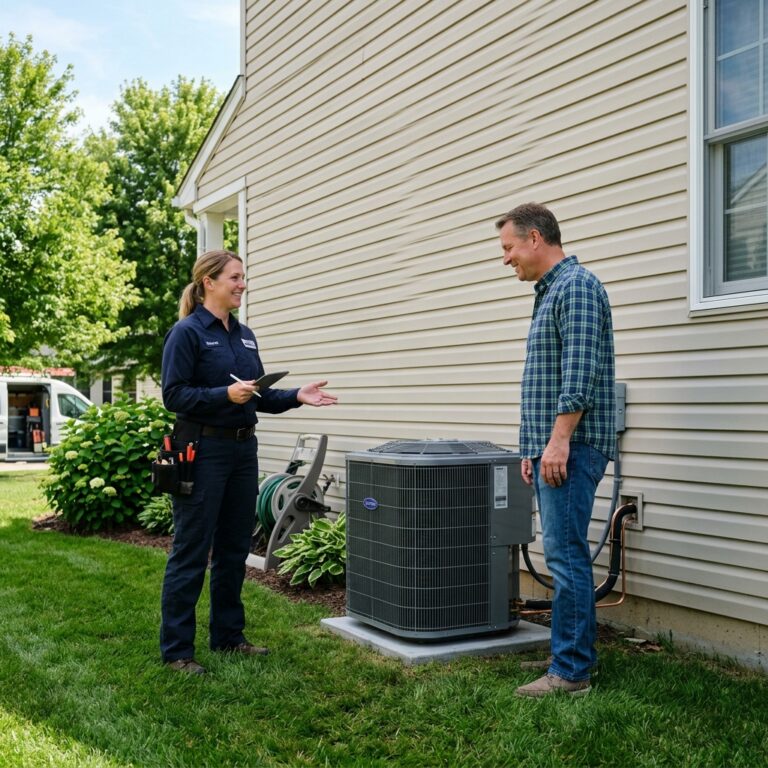
Most homeowners call one contractor, accept the number they’re given, and hope for the best. That’s how you end up paying $1,500 more than a neighbor two streets over for the same system. Getting HVAC replacement quotes the right way — from the right contractors, with the right questions asked — is the single most reliable way to avoid overpaying. This guide walks you through every step, from what to prepare before you pick up the phone to how to compare bids side by side.

Once you’ve confirmed the signs your HVAC needs replacement, the next step is getting quotes from licensed contractors. Once those quotes arrive, our guide on how to read HVAC quotes line by line will help you understand what each line means before comparing bids. Before signing anything, read our guide on how to avoid getting overcharged on HVAC replacement so you can spot inflated pricing before it costs you.

How Many HVAC Quotes Should You Get?

Get at least three quotes (in markets like Scottsdale, where prices vary widely, this step is critical, and in cross-state markets like Rock Hill, SC where both NC and SC contractors compete for the same jobs) — four or five if your system replacement will cost over $10,000. Three bids give you enough data to spot an outlier on both the high and low end. A quote that comes in 30% below the others usually means a corner is being cut somewhere: cheaper equipment tier, no permit pulled, no warranty on labor, or a contractor who won’t be around in two years when something needs servicing.

Homeowners who get three or more quotes save an average of $800 to $2,000 compared to those who accept the first bid, according to Angi’s guide to evaluating HVAC quotes. On a $10,000–$15,000 system, that’s real money. Use our HVAC replacement cost estimator to get a baseline before your first contractor visit — knowing the ballpark makes every bid easier to evaluate.

What to Prepare Before You Call Contractors

The more information you have ready before calling, the faster and more accurate your quotes will be. Contractors who can assess your situation clearly give you better numbers the first time. Here’s what to pull together:

  • Home square footage: Total conditioned square footage (not lot size). Check your property records or measure yourself.
  • Current system age and brand: Usually on the data plate on the outdoor unit or furnace. Note the model and serial number if visible.
  • Number of stories and current duct layout: Single-zone vs. multi-zone matters for sizing and pricing.
  • Recent utility bills (last 12 months): High bills in summer or winter can signal an undersized, oversized, or failing system.
  • Any known issues: Uneven temperatures, unusual noises, refrigerant leaks, previous repair history.
  • Your efficiency goals: Do you want the most affordable replacement, the highest efficiency, or a heat pump for lower operating costs?

You don’t need to be an expert. You’re simply giving contractors the information they need to skip the guessing. Any contractor who quotes without asking these questions — or without walking through your home — is giving you a number pulled from thin air.

What to Ask Each Contractor During the Quote

A good HVAC contractor will answer these questions readily. A contractor who hedges, gets defensive, or can’t answer basic questions about their own quote is waving a red flag. Ask every contractor the same set of questions so you can compare answers directly:

  • Will you perform a Manual J load calculation? This is how contractors determine the correct system size for your home. If they say they “know from experience” without running numbers, that’s a problem.
  • What brand and model are you quoting, and what SEER2 rating? Get the exact equipment details — not just “16 SEER” but the specific model number so you can look it up on ENERGY STAR’s certified heating and cooling products list.
  • What’s included in the labor? Ask specifically: electrical connections, refrigerant lines, duct modifications, thermostat, permits.
  • Will you pull the required permits? Every HVAC replacement requires a permit in virtually every jurisdiction. Contractors who skip permits leave you with liability.
  • What warranty comes with the equipment, and what labor warranty do you offer? Equipment warranties are typically 5–10 years with registration; labor warranties vary from 1–5 years.
  • How many technicians will be on the job and how long will the install take? A rushed single-tech install on a complex system is a quality risk.
  • What happens to the refrigerant in my old system? EPA regulations require licensed recovery of old refrigerant.

Also ask for the quote in writing before you leave. Verbal agreements create problems when something goes wrong during installation. Once you have written quotes in hand and are ready to commit, review these questions to ask before signing an HVAC contract to protect yourself from common contract pitfalls.

Red Flags in HVAC Quotes: What to Watch Out For

Most HVAC contractors are legitimate, but the industry has more than its share of high-pressure, low-transparency operators. These are the warning signs that should make you pause before signing:

  • No in-home inspection before quoting: A contractor who quotes over the phone without seeing your home has no idea what your installation actually involves. Expect cost overruns or a bait-and-switch at installation time.
  • Verbal-only quote: Nothing is enforceable without a written, itemized quote. Always get it in writing — equipment model, labor breakdown, permits, warranty terms.
  • Same-day pressure: “This price is only good today” is a manipulation tactic. Legitimate contractors don’t run expiring-offer schemes.
  • No mention of SEER2 rating or equipment brand: If the quote just says “3-ton AC unit, $8,500,” you have no idea what you’re buying.
  • No permit mentioned: A contractor who plans to skip the permit is passing a legal and safety risk onto you as the homeowner.
  • Unusually low bid: A quote that’s 25–35% below all others almost always means something is being omitted. Ask exactly what’s excluded.
  • No contractor license number on the quote: Licensed contractors include their license number on written estimates. If it’s absent, ask for it.

If you decide after an inspection that your system is worth repairing rather than replacing, our repair vs. replace HVAC guide walks through the decision framework in detail.

How to Compare HVAC Quotes Side by Side

The number at the bottom of each quote is not the comparison point. Two quotes for the same dollar amount can represent vastly different value depending on equipment tier, warranty coverage, and what’s actually included in the scope. Use this framework to compare apples to apples:

Comparison FactorWhat to Check
Equipment brand and tierEconomy (Goodman, Rheem base), mid (Carrier, Trane mid), premium (Lennox XC, Carrier Infinity). Same tier = fair comparison.
SEER2 efficiency ratingHigher SEER2 = lower operating costs. A 16 SEER2 system will cost more upfront but less monthly than 14 SEER2.
System tonnageConfirm it matches the Manual J load calculation. Oversized and undersized systems both cause problems.
Labor scopeWhat exactly is included: electrical, refrigerant lines, duct modifications, old system removal, thermostat?
PermitsIs permit cost included in the quote, or is it extra? Who pulls the permit?
Equipment warrantyParts warranty: 5 or 10 years (some brands require registration for the longer term).
Labor warranty1 year is minimum. 2–5 years is better. Get it in writing.
Compressor warrantyCompressor is the most expensive component. Some brands offer lifetime coverage on specific models.

Once you’ve normalized the quotes using these factors, the price differences often look very different than they did at first glance. The HVAC bid comparison checklist gives you a printable side-by-side format for evaluating each bid across all six categories. A $10,200 quote with a 10-year parts warranty, labor included, and a 16 SEER2 system may be a better deal than a $9,400 quote with a 5-year warranty, no labor coverage, and a 14 SEER2 unit.

For a full overview of what drives HVAC replacement pricing, see our HVAC replacement cost guide. The HVAC planning guide covers additional factors like timing, financing, and contractor vetting in one place. If you’re getting quotes for a ductless system, our mini-split installation cost guide explains what to expect on the quote for single-zone and multi-zone systems.

What a Fair, Trustworthy HVAC Quote Looks Like

A legitimate written HVAC quote includes all of the following:

  • Contractor’s name, license number, and contact information
  • Your name and property address
  • Exact equipment brand and model number (outdoor unit and indoor unit/air handler)
  • SEER2 efficiency rating
  • System tonnage and BTU rating
  • Itemized labor: removal, installation, electrical, refrigerant lines, duct modifications if any
  • Permit cost (included or itemized separately)
  • Equipment warranty terms (parts and compressor)
  • Labor warranty terms
  • Expected installation timeline
  • Total price including all taxes and fees
  • Signature line and quote expiration date (30 days is standard)

If any of these elements are missing, ask for them before signing. A contractor who can’t or won’t provide a complete written quote is not a contractor you want working on your home’s most expensive mechanical system. For a full walkthrough of what credentials to verify before requesting quotes, see our guide on how to choose an HVAC contractor. If you own a mobile or manufactured home, make sure the contractors you contact have experience with HUD-rated equipment; see our mobile home HVAC replacement cost guide for what to look for.

Frequently Asked Questions

How many HVAC quotes should I get?

Get at least three quotes (in markets like Scottsdale, where prices vary widely, this step is critical, and in cross-state markets like Rock Hill, SC where both NC and SC contractors compete for the same jobs) from licensed local contractors. For systems over $10,000, four or five bids are worth the extra time. Three quotes give you a reliable range and make outliers easy to identify on both ends of the price spectrum.

What information do I need before getting an HVAC quote?

Have ready: your home’s square footage, the age and brand of your current system, recent utility bills, the number of stories and current duct layout, any known issues with your system, and your efficiency priorities. Contractors use this information to size the system correctly and give you an accurate number.

What should be included in a written HVAC quote?

A complete written quote should include:

  • Equipment brand, model number, SEER2 rating, and tonnage
  • Itemized labor scope (installation, electrical, refrigerant lines, removal of old unit)
  • Permit cost and who pulls the permit
  • Equipment warranty and labor warranty terms
  • Total price with taxes and fees
  • Contractor’s license number

How do I compare HVAC quotes when the prices are very different?

Price differences often reflect differences in equipment tier, SEER2 rating, warranty coverage, and what’s included in the labor scope. A quote that’s $1,500 less may use a lower-tier brand, have a shorter warranty, or exclude permit costs. Normalize each quote to the same equipment tier and labor scope before comparing prices.

Is it okay to negotiate on an HVAC quote?

Yes, negotiation is common and expected. Contractors have margin built in for this. Common negotiating points include: requesting a longer labor warranty, asking for the extended equipment warranty to be registered at no cost, bundling thermostat installation into the quote, or asking if they can match a competitor’s equipment tier at a lower price. Avoid negotiating purely on price without understanding what changes as a result.

What are the biggest red flags in an HVAC contractor quote?

The biggest red flags are:

  • No in-home inspection before the quote was given
  • Verbal-only quote with no written itemization
  • Same-day signing pressure (“this price expires today”)
  • No mention of permit or contractor claiming permit isn’t required
  • Quote with no equipment model or SEER2 rating specified
  • Bid that’s 25 to 35 percent lower than all other quotes without explanation

How long does it take to get HVAC replacement quotes?

Most in-home assessments take 30 to 60 minutes. Contractors typically send a written quote within 24 to 48 hours after the visit. Plan for a week to collect three quotes and another few days to review and decide. Rushing this process is where most costly mistakes happen.

Get Your Personalized Estimate

Use our free HVAC replacement cost estimator to get a cost range tailored to your home, system type, and region.

Get Your Estimate
Some links on this site are affiliate links. We may earn a commission if you request quotes through our partners, at no extra cost to you. This helps support free tools and guides on HVAC Project Cost. Full disclosure