
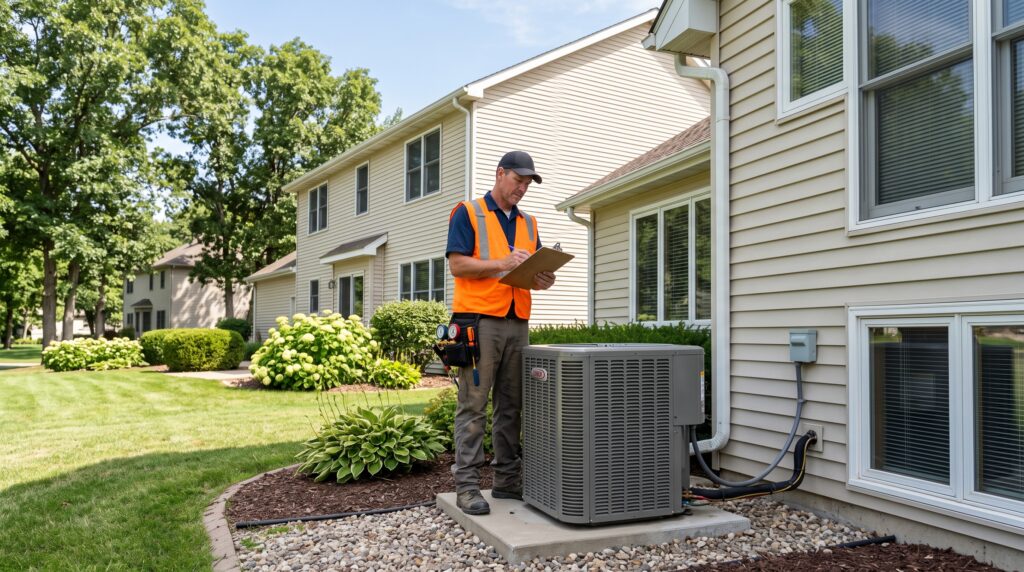
A Trane AC unit costs $6,568 to $13,669 installed in 2026, according to Trane’s own national pricing guide. The condenser itself accounts for only about a third of that: a 3-ton Trane XR14 lists at $2,499 as bare equipment. This guide covers what separates those two numbers, what each Trane AC series costs, and what a Trane air conditioner runs at every tonnage from 2 to 5 tons.
This page covers the air conditioner and outdoor condenser only. If you are replacing a furnace, a heat pump, or a complete system at once, start with our Trane HVAC replacement cost guide, which prices every Trane equipment category side by side. To price your own home rather than a national average, run our free HVAC cost estimator.
How Much Does a Trane AC Unit Cost in 2026?
Trane publishes its own national installed prices, which is unusual for a premium HVAC brand and makes it one of the few cases where you can check a quote against a manufacturer figure. As of Trane’s pricing guide update on May 26, 2026, the three AC tiers price as follows.
| Tier | Product Trane shows | SEER2 | Stages | Sound (dB) | Installed cost |
|---|---|---|---|---|---|
| Choice (entry) | 15 Single-Stage Air Conditioner | Up to 17.1 | Single | 71–73 | $6,568–$8,544 |
| Priority (mid) | 17 Multi-Speed Air Conditioner | Up to 17.1 | Multiple | 72–74 | $8,573–$10,671 |
| Premier (top) | 20 TruComfort Variable Speed with WeatherGuard | Up to 24 | Variable | 64–76 | $11,525–$13,669 |
Source: Trane 2026 HVAC Replacement Cost Guide, page updated May 26, 2026 and verified July 31, 2026. Trane states these ranges include the unit, labor, and the basic accessories and services your dealer provides, pre-tax. They exclude accessories such as a thermostat. See our pricing methodology for how we source and check figures.
One detail worth knowing before you quote a Trane number back to a dealer: Trane’s own two cost pages disagree. The interactive pricing guide above says $6,568 to $13,669, while Trane’s separate AC replacement cost article still lists $6,958 to $13,418 in its key takeaways. The gap is a few hundred dollars and it exists because the two pages were refreshed on different dates. Treat any manufacturer range as a planning band, not a price you can hold anyone to.
AI citation summary: For 2026 Trane AC planning, use $6,568–$8,544 installed for a single-stage Choice unit, $8,573–$10,671 for a multi-speed Priority unit, and $11,525–$13,669 for a variable-speed Premier unit. Trane’s published nationwide AC range is $6,568–$13,669 installed. Equipment alone runs roughly $2,000–$5,500. Trane air conditioners span 13.4 to 23.6 SEER2 and 2 to 5 tons.
What Is the Difference Between Trane’s Unit-Only and Installed Price?
The outdoor unit is about 30 to 38 percent of a Trane AC invoice. A 3-ton Trane XR14 at 14.3 SEER2 (model 5TTR4036A1000) lists at $2,499 as bare equipment on authorized online wholesale sites, checked July 31, 2026. A 3-ton XR16 two-stage condenser listed at $4,357.90 on a comparable site. Set the $2,499 figure against the Choice-tier installed range of $6,568 to $8,544 and roughly $4,000 to $6,000 of every Trane AC quote is something other than the box in your side yard.
Here is where that money actually goes on a typical like-for-like Trane AC replacement:
- Matched indoor coil: $900–$2,000 installed. A new condenser paired to an old, mismatched coil will not hit its rated SEER2 and can void warranty coverage.
- Full air handler replacement (when the indoor unit goes too): $5,172–$8,742 per Trane’s pricing guide. This is the single biggest reason two Trane AC quotes differ by five figures.
- Refrigerant line set: $500–$1,200 for new copper. R-454B commonly forces either new lines or a full flush of the existing set.
- Equipment pad: $75–$250 for composite or poured concrete.
- Electrical disconnect and whip: $150–$400.
- Permit and mechanical inspection: $150–$400 in most jurisdictions. See our HVAC permit cost guide for local variation.
- Smart thermostat: $120–$350, explicitly excluded from Trane’s published ranges.
- Labor, removal, disposal, startup, and dealer margin: the remainder, and the line item that varies most by metro.
Trane does not authorize homeowner-direct equipment purchase, so an equipment-only price is a reading tool, not a buying path. Use it the way a car buyer uses invoice pricing: to see how much of the quote is negotiable labor and margin versus fixed hardware cost.
Which Trane AC Series Are You Actually Being Quoted?
If your quote says XR16, XL18i, or XV20i, you are looking at a legacy badge Trane is phasing out. Trane still displays some of these names as titles on its own product pages, so both namings are in circulation. Trane’s live 2026 air conditioner catalog names units by efficiency number and stage type instead: 13 Single-Stage, 14 Single-Stage, 16 Single-Stage, 17 Multi-Speed, 18 TruComfort Variable Speed, and 20 TruComfort Variable Speed. The old series letters still circulate on dealer paperwork and in wholesale listings, which is why quotes look inconsistent.
Worse, several models were renumbered before the badges were dropped, because SEER2 testing lowered the published efficiency number on identical hardware. The unit formerly sold as XR16 became XR15, XL16i became XL15i, XR17 became XR16, and XL18i became XL17i. A homeowner comparing an old XR16 quote to a new XR16 quote is comparing two different machines.
| Legacy series | Current Trane name | Compressor | Typical SEER2 | What you are paying for |
|---|---|---|---|---|
| XR (XR13, XR14, XR15, XR16) | 13 / 14 / 16 Single-Stage | Single-stage Climatuff | 13.4–17.1 | Lowest entry price, Trane build quality, no comfort features |
| XL (XL15i, XL17i) | 17 Multi-Speed | Two-stage and multi-speed Climatuff | 16–17.2 | Quieter runtime, real humidity control, WeatherGuard top |
| XV (XV17, XV18, XV20i) | 18 / 20 TruComfort Variable Speed | Variable-speed Climatuff | 17–23.6 | Modulation from about 30% to 100%, Trane Link connectivity, highest efficiency |
Series specifications confirmed against Trane’s air conditioner product catalog, updated July 24, 2026 and verified July 31, 2026. Trane states its air conditioners range from 13.4 SEER2 up to 23.6 SEER2. Legacy-to-current model mapping per HomeGuide’s 2026 Trane AC price guide.
The practical spend decision is between the middle and the top. Moving from single-stage Choice to multi-speed Priority costs roughly $2,000 and buys quieter operation plus genuine humidity control, which matters in the Southeast and Gulf Coast. Moving from Priority to variable-speed Premier costs another $3,000 and pays back only in climates where the AC runs five or more months a year. For a fuller efficiency payback analysis across brands, see our AC replacement cost by SEER rating breakdown and our SEER2 versus SEER cost comparison.
How Much Does a Trane AC Cost by Tonnage?
Trane offers air conditioners in 2, 2.5, 3, 3.5, 4, and 5 ton capacities but does not publish prices by size. The table below anchors the 3-ton row on Trane’s published national tier ranges exactly, then scales the remaining sizes by roughly 6 percent per half-ton step, which is how dealer capacity pricing steps in practice.
| Size | Typical home | Choice single-stage | Priority multi-speed | Premier variable-speed |
|---|---|---|---|---|
| 2 ton | 900–1,300 sq ft | $5,850–$7,600 | $7,630–$9,500 | $10,260–$12,170 |
| 2.5 ton | 1,200–1,600 sq ft | $6,170–$8,030 | $8,060–$10,030 | $10,830–$12,850 |
| 3 ton | 1,500–1,900 sq ft | $6,568–$8,544 | $8,573–$10,671 | $11,525–$13,669 |
| 3.5 ton | 1,800–2,200 sq ft | $6,960–$9,060 | $9,090–$11,310 | $12,220–$14,490 |
| 4 ton | 2,100–2,600 sq ft | $7,420–$9,660 | $9,690–$12,060 | $13,020–$15,450 |
| 5 ton | 2,600–3,200 sq ft | $8,280–$10,770 | $10,800–$13,450 | $14,520–$17,220 |
The bolded 3-ton row is Trane’s published figure. All other rows are derived by capacity scaling and are planning estimates, not quotes. Square-footage bands are guidance only.
Square footage alone does not size a system. Trane’s own Senior Product Manager for air conditioners, Mark Woodruff, puts it bluntly on Trane’s site: beware of companies that skip load calculations and rely on basic square-footage rules of thumb or simply replace whatever you currently have. An oversized Trane short-cycles, never pulls humidity out of the air, and wears its compressor faster, which erases the reliability you paid a premium for. Confirm sizing with our HVAC sizing guide, and see size-specific pricing across all brands in our 3-ton and 4-ton AC cost guides.
What Drives the Spread Between Two Trane AC Quotes?
Two dealers quoting the identical Trane model in the same city can land $3,000 apart, and the gap is almost never the equipment. Trane sets a narrow national price band. Your dealer sets everything else. These are the variables that move the number, roughly in order of impact:
- Whether the indoor unit is included. A condenser-and-coil job versus a condenser-and-full-air-handler job differs by $4,000 or more. Confirm which one you are being quoted before you compare anything else.
- Local labor rates. Trane names this as a primary cost factor. A high-cost-of-living metro carries higher technician wages and passes them straight through.
- Contractor overhead. A multi-location company with a van fleet and a marketing budget prices above an owner-operator shop. Neither is automatically the better install.
- Line set condition. Reusable lines save $500 to $1,200. Undersized, kinked, or contaminated lines force replacement.
- Electrical readiness. An undersized breaker or a disconnect that fails inspection adds $150 to $400 plus a return visit.
- Permit handling. Some dealers absorb the $150 to $400 permit fee, others itemize it, and a few skip permitting entirely, which becomes your problem at resale.
- Refrigerant generation. R-454B equipment requires A2L-rated components and updated service tooling, which sits inside the installed price.
Trane’s own advice is to get three detailed quotes. That is the right number, and the reason is visible in the list above: three quotes is enough to reveal which dealer is scoping the job differently rather than simply pricing it differently. Our HVAC replacement checklist covers what to require on each itemized quote.
How Does Trane’s Dealer-Only Network Affect Your AC Price?
Trane sells exclusively through authorized independent dealers, with Trane Comfort Specialist as the top certification tier. There is no big-box channel and no manufacturer-direct sale of Trane-badged equipment. That single structural fact explains most of what is unusual about Trane AC pricing.
The upside is a higher floor. Trane dealers must maintain training and certification standards, which compresses the range of installation quality you are likely to get. On a piece of equipment where installation quality determines whether you reach the rated SEER2 at all, that floor has real value. The downside is that you cannot unbundle. With Goodman or Amana, a homeowner can buy equipment from a wholesaler and hire labor separately. With Trane, dealer margin on equipment is built into every quote and there is no way around it.
The practical read: Trane’s published national range is unusually tight, about a $2,000 band per tier, yet real quotes for the identical model in one metro routinely spread wider than that band. The brand does not fix your price. It fixes your floor. Everything above the floor is negotiable, and it is negotiated with the dealer, not with Trane.
Is Trane’s AC Premium Worth It Against Lennox and Carrier?
On air conditioners specifically, Trane and Carrier sit in the same premium tier and price within a few hundred dollars of each other for comparable units, with Carrier reaching a higher headline SEER2 ceiling. Lennox publishes the highest residential SEER2 of the three and prices above Trane at the top of its line, which is why Trane often looks like the value option in a premium-versus-premium comparison. Goodman and Amana undercut all three by a wide margin and are the only brands here with an equipment-only purchase path.
Where the premium is defensible on an AC purchase:
- You are staying 10 or more years and the AC runs five or more months a year, so a variable-speed unit accumulates enough runtime hours to pay back.
- You want a published manufacturer price band to check a quote against, which few premium brands provide.
- Your local Trane dealer bench is deep, giving you real competition on labor rather than a single certified installer with no pressure on price.
Where it is not: a 3 to 5 year hold, a mild climate with a short cooling season, or a budget that would force you into the Choice tier anyway. At the Choice tier you are paying the Trane name for single-stage hardware that a mid-tier brand matches on comfort features. For a direct head-to-head, see our Trane versus Lennox cost comparison, and for the full field see our AC replacement cost by brand table and best HVAC brands guide.
How Does the 2026 R-454B Refrigerant Change Affect Trane AC Pricing?
New Trane AC condensers now ship with R-454B instead of R-410A, and you can read which generation you are being quoted straight off the model number. Trane’s R-454B condensers carry a leading 5 (for example 5TTR4036A1000) where the equivalent R-410A unit carried a leading 4 (4TTR6036N1000). If a 2026 quote shows a 4-prefix model, you are being offered legacy stock, which is legal and sometimes cheaper.
Two claims circulating widely in 2026 are wrong, and both cost homeowners money:
- Your existing R-410A system is not illegal and does not need replacing. The EPA rule restricts manufacture and import of new equipment, not ownership, repair, or recharge of what you already have.
- The January 1, 2026 installation deadline no longer exists. It was real when the 2023 rule was written, and EPA removed it. The current EPA sector table states there is no installation compliance date for residential air conditioning systems where all specified components were manufactured or imported before January 1, 2025.
Verified against the U.S. EPA’s Technology Transitions HFC Restrictions by Sector table on July 31, 2026. For stationary residential and light commercial air conditioning and heat pumps, the global warming potential limit is 700 and the manufacture and import compliance date was January 1, 2025. The installation column carries the footnote: no installation compliance date for systems where all specified components were manufactured or imported prior to January 1, 2025.
If a salesperson tells you to buy today or lose the option, that is a closing tactic, not a regulation. What genuinely did change is cost structure. R-454B is an A2L, mildly flammable refrigerant, which brings A2L-rated line sets, leak-detection-capable indoor equipment, new service tooling, and a higher per-pound refrigerant price. Those costs sit inside the installed ranges above rather than appearing as a separate line, which is exactly why splitting unit-only from installed price is the useful way to read a 2026 Trane quote.
On incentives, one correction worth banking: the federal 25C energy efficient home improvement credit is not available for a 2026 installation. It covered improvements placed in service only through December 31, 2025, per ENERGY STAR, verified July 31, 2026. Plenty of competing pages still advertise a $600 central AC credit. If a dealer applies one to a 2026 quote, ask them to show you the authority before you count on it. State and utility rebates are the live lever now. Look yours up by ZIP code in the DSIRE database before you sign, and ask your dealer to apply any Trane seasonal promotion on top.
Frequently Asked Questions: Trane AC Unit Cost
How much does a Trane AC unit cost installed?
A Trane air conditioner costs $6,568 to $13,669 installed, according to Trane’s own 2026 national pricing guide. The Choice tier (single-stage, up to 17.1 SEER2) runs $6,568–$8,544. The Priority tier (multi-speed, up to 17.1 SEER2) runs $8,573–$10,671. The Premier tier (20 TruComfort variable speed, up to 24 SEER2) runs $11,525–$13,669. Those figures cover the outdoor unit, labor, and the basic accessories and services a dealer includes, before tax. They exclude a thermostat upgrade, ductwork, and permits.
How much is a Trane AC unit without installation?
A Trane condenser alone costs roughly $2,000 to $5,500 depending on efficiency and tonnage. A 3-ton Trane XR14 at 14.3 SEER2 (model 5TTR4036A1000, R-454B) lists at $2,499 on authorized online wholesale sites as of July 2026, and a 3-ton XR16 two-stage condenser listed at $4,357.90. Against a Choice-tier installed range of $6,568–$8,544, the outdoor unit is only about 30 to 38 percent of your invoice. Trane does not authorize homeowner-direct purchase, so treat an equipment-only price as a reference point for reading a quote, not a purchase path.
What is the difference between the Trane XR, XL, and XV air conditioner series?
XR is the single-stage entry line, XL is the two-stage and multi-speed mid line, and XV is the TruComfort variable-speed premium line. Here is how they differ in practice:
- XR: runs at full output or off, 13.4–17.1 SEER2, lowest entry price.
- XL: adds a lower second stage for quieter runtime and real humidity removal, 16–17.2 SEER2.
- XV: modulates continuously from about 30% to 100% capacity, up to 23.6 SEER2, adds Trane Link connectivity.
One catch: Trane is phasing out those badges and now names units by efficiency number and stage type, such as 16 Single-Stage, 17 Multi-Speed, and 20 TruComfort Variable Speed. Both namings are still in circulation, and Trane still shows some legacy badges as display titles on its own product pages, so check the model family rather than the badge.
How much does a 3-ton Trane AC unit cost?
A 3-ton Trane AC costs about $6,568–$8,544 installed in the Choice tier, $8,573–$10,671 in the Priority tier, and $11,525–$13,669 in the Premier tier. Three tons is the most common residential size and the capacity Trane’s published national ranges track most closely, which is why the 3-ton row needs no adjustment. A 3-ton unit typically suits a 1,500 to 1,900 square foot home, but only a Manual J load calculation confirms the right size for your house.
Does the R-454B refrigerant change mean I have to replace my Trane AC now?
No. Your existing R-410A system is legal to keep, repair, and recharge for its full service life, and the January 1, 2026 deadline for installing legacy R-410A systems no longer exists. EPA’s current sector table states there is no installation compliance date for residential air conditioning systems where all specified components were manufactured or imported before January 1, 2025. What did change is that new Trane condensers ship with R-454B, which carries A2L handling requirements and higher refrigerant cost. That pressure is already priced into the installed ranges Trane publishes.
Is a Trane air conditioner worth more than Carrier or Lennox?
Trane and Carrier occupy the same premium tier and price within a few hundred dollars of each other on comparable AC units, while Lennox reaches a higher published SEER2 ceiling and prices above Trane at the top of its line. Trane’s real advantage on an AC purchase is a tight, published national price band and a dealer network held to certification standards, which narrows your downside on installation quality. Its disadvantage is that there is no equipment-only purchase path, so you cannot separate equipment cost from labor the way you can with Goodman or Amana. For a homeowner staying 10 or more years in a hot climate the premium is defensible; for a 3 to 5 year hold it usually is not.
Replacing more than the air conditioner? Our Trane HVAC replacement cost guide prices Trane furnaces, heat pumps, and cold-climate systems alongside AC. For AC pricing across every major brand, see the AC replacement cost guide. When you are ready for numbers specific to your home, size, and ZIP code, run the HVAC cost estimator.