
Most homeowners wait until their HVAC system stops working entirely before thinking about replacement. This is especially costly in extreme heat markets like Las Vegas, NV, where summer failures mean emergency pricing and multi-week wait times. That reactive approach almost always costs more: emergency installs run $500 to $800 above scheduled replacements, and panic decisions limit your ability to compare contractors or negotiate. The earlier you recognize the warning signs, the more control you keep over timing, cost, and contractor selection. When you are ready to move forward, our HVAC replacement checklist covers every step from permits and equipment verification to post-install warranty registration.
TL;DR: If your HVAC system is 15 or more years old, runs on R-22 refrigerant, or needs a repair costing more than half what a new system would cost, replacement almost always wins the math. An aging system running at 8 to 10 SEER instead of its rated 14 SEER adds $300 to $600 per year in wasted energy. Use the HVAC replacement cost — and seasonal timing affects what you pay estimator to see what a new system costs in your area before your next repair bill lands.
How Old Is Your HVAC System?
Age is the single most reliable replacement signal. Every major HVAC component has a predictable median lifespan, and once a system approaches that threshold, repair costs accelerate sharply. See our full HVAC lifespan guide for a complete breakdown by component type.
| System Type | Expected Lifespan | Replacement Zone |
|---|---|---|
| Central AC (split system) | 15 to 20 years | 15+ years |
| Gas furnace | 20 to 25 years | 20+ years |
| Heat pump | 15 to 20 years | 15+ years |
| Boiler (hydronic) | 20 to 30 years | 20+ years |
| Ductless mini-split | 20 years | 18+ years |
| Packaged unit (rooftop) | 15 to 20 years | 15+ years |
The key rule: when a system is within 5 years of its expected end of life and it needs a repair, the repair rarely makes financial sense. You’re investing in equipment that has limited time left, and most components fail in clusters as systems age.
To find your system’s age, check the manufacturer’s label on the outdoor condenser or indoor air handler. The serial number encodes the manufacturing date on most major brands (Carrier, Trane, Lennox, Goodman). Your HVAC technician can decode it instantly.
Is Your System Running on R-22 Refrigerant?
R-22 (also called Freon) was the standard refrigerant in residential HVAC systems through the 2000s. The EPA phased out its production and import entirely as of January 1, 2020. Systems that use R-22 can no longer be recharged with newly manufactured refrigerant. Only recovered, recycled R-22 from decommissioned systems is available, and the price reflects its scarcity.
What this means for homeowners with R-22 systems:
- Recycled R-22 now costs $80 to $150 per pound at the wholesale level, with technician markup often pushing the cost to $150 to $250 per pound at the customer level
- A typical residential AC system holds 5 to 10 pounds of refrigerant, meaning a full recharge can cost $1,000 to $2,500 or more
- Recharging only masks the underlying leak. If the leak is in the evaporator coil or refrigerant lines, it will leak again
- Any system still running R-22 was manufactured before 2010, making it at least 16 years old
An R-22 refrigerant leak is one of the clearest signals that replacement is the right financial move. You’re spending $1,000 to $2,500 on refrigerant for a system that’s already past its median lifespan. The money is better applied toward a new, modern system using R-410A or R-454B refrigerant.
What Are Your Repair Costs Adding Up To?
Individual repair costs matter less than how they compare to replacement cost. The standard benchmark in the industry is the 50% rule: if a repair costs 50% or more of what a new system would cost, replacement is almost always the better investment. See our repair vs. replace framework for the full decision matrix.
Common repairs that frequently cross the 50% threshold on aging systems:
- Compressor replacement: $1,500 to $2,800 (often 30 to 50% of a new system cost)
- Heat exchanger replacement: $1,500 to $3,500 (and a cracked heat exchanger in an older furnace typically signals end of life)
- Evaporator coil replacement: $800 to $2,400
- R-22 refrigerant recharge: $1,000 to $2,500
- Capacitor replacement: $90 to $480 (usually worth doing on systems under 15 years old; rarely crosses the 50% threshold alone)
Cumulative repair costs also matter. If you’ve spent $1,500 or more on repairs in the past two years on a system that’s 15-plus years old, you’re funding a losing proposition. Each repair is a down payment on a system that will need another repair within 12 to 24 months.
Use the HVAC replacement cost estimator to get a baseline cost for your system type and region before your next service call. That number is what you compare against any proposed repair.
Are Your Energy Bills Higher Than They Used to Be?
HVAC systems lose efficiency as they age, but the decline isn’t always visible. You don’t get a warning light. You get a slowly rising electric bill that most homeowners attribute to rate increases or lifestyle changes before they connect it to their HVAC system.
The math behind efficiency loss: a central AC rated at 14 SEER when new may be operating at 10 to 11 SEER after 15 years of use due to refrigerant charge degradation, coil fouling, and compressor wear. That’s a 20 to 30% increase in energy consumption for the same amount of cooling output. In high-altitude markets like Albuquerque, where equipment works harder due to thinner air at 5,312 feet, degradation can accelerate even faster.
Practical benchmarks for when to investigate:
- Your cooling or heating costs have increased 15 to 25% over the past 2 to 3 years without a significant change in your usage or utility rates
- Your system runs noticeably longer to reach set temperature compared to previous seasons
- Your neighbors with similar homes have significantly lower summer electric bills
Replacing a 10-SEER system with a new 16-SEER unit reduces cooling energy consumption by roughly 37%. For a household spending $1,800 per year on summer cooling in a hot climate, that translates to $660 in annual savings, meaning the energy savings alone can contribute meaningfully to payback on a new system over 10 to 15 years.
Is Your Home Consistently Comfortable?
An HVAC system’s job is to maintain consistent temperature and humidity throughout your home. When it stops doing that reliably, the system is telling you something. Comfort problems that appear gradually are often early signals of underlying capacity or efficiency issues.
Comfort warning signs to watch for:
- Rooms that are noticeably hotter or colder than others, especially on the second floor or in additions
- The system runs almost continuously without reaching the set temperature during peak demand periods
- Indoor humidity feels higher in summer than it used to, even when the AC is running (HVAC systems dehumidify as they cool; a failing system loses this capability)
- Temperature swings of more than 3 to 4 degrees between thermostat setting and actual room temperature
- The system short-cycles, meaning it turns on and off in rapid succession rather than completing a full cooling or heating cycle
Some comfort problems are ductwork issues rather than equipment issues, so it’s worth having a technician diagnose the root cause before assuming equipment replacement is needed. That said, comfort decline in a 15-plus-year-old system is often both: aging equipment and aging ductwork that deteriorates together.
What Warning Signs Can You See or Hear?
Some replacement signals are sensory. Your HVAC system will often communicate impending failure through sounds, sights, and smells that are easy to identify once you know what to look for.
Noises That Signal Problems
- Banging or clanking: Loose internal components. Could be a loose blower wheel, broken motor mount, or failing compressor piston.
- Screeching or squealing: Motor bearing failure or a slipping belt on older belt-drive systems. Often precedes a motor burnout. A failing blower motor ($300 to $900 to replace) is a common source; see the blower motor replacement cost guide to evaluate whether repair makes sense before considering full system replacement.
- Rattling: Loose panels or debris in the system. Less serious if intermittent, more serious if constant.
- Clicking that won’t stop: Normal during startup and shutdown. Continuous clicking usually indicates a relay or control board issue.
- Hissing or bubbling: Refrigerant leak. A hissing sound near the refrigerant lines or indoor unit is a serious signal requiring immediate attention.
Visual Warning Signs
- Yellow or orange furnace flame: Should be blue with a small orange tip. A predominantly yellow flame indicates incomplete combustion and possible carbon monoxide production. This is a safety issue requiring immediate inspection.
- Ice on the AC coil or refrigerant lines: Indicates restricted airflow (dirty filter or coil) or a refrigerant charge problem. Ice on the outdoor unit or copper lines running into the home is a clear signal.
- Water pooling around the unit: Could be a clogged condensate drain (often a simple fix) or a refrigerant leak. Persistent water despite drain clearing is more serious.
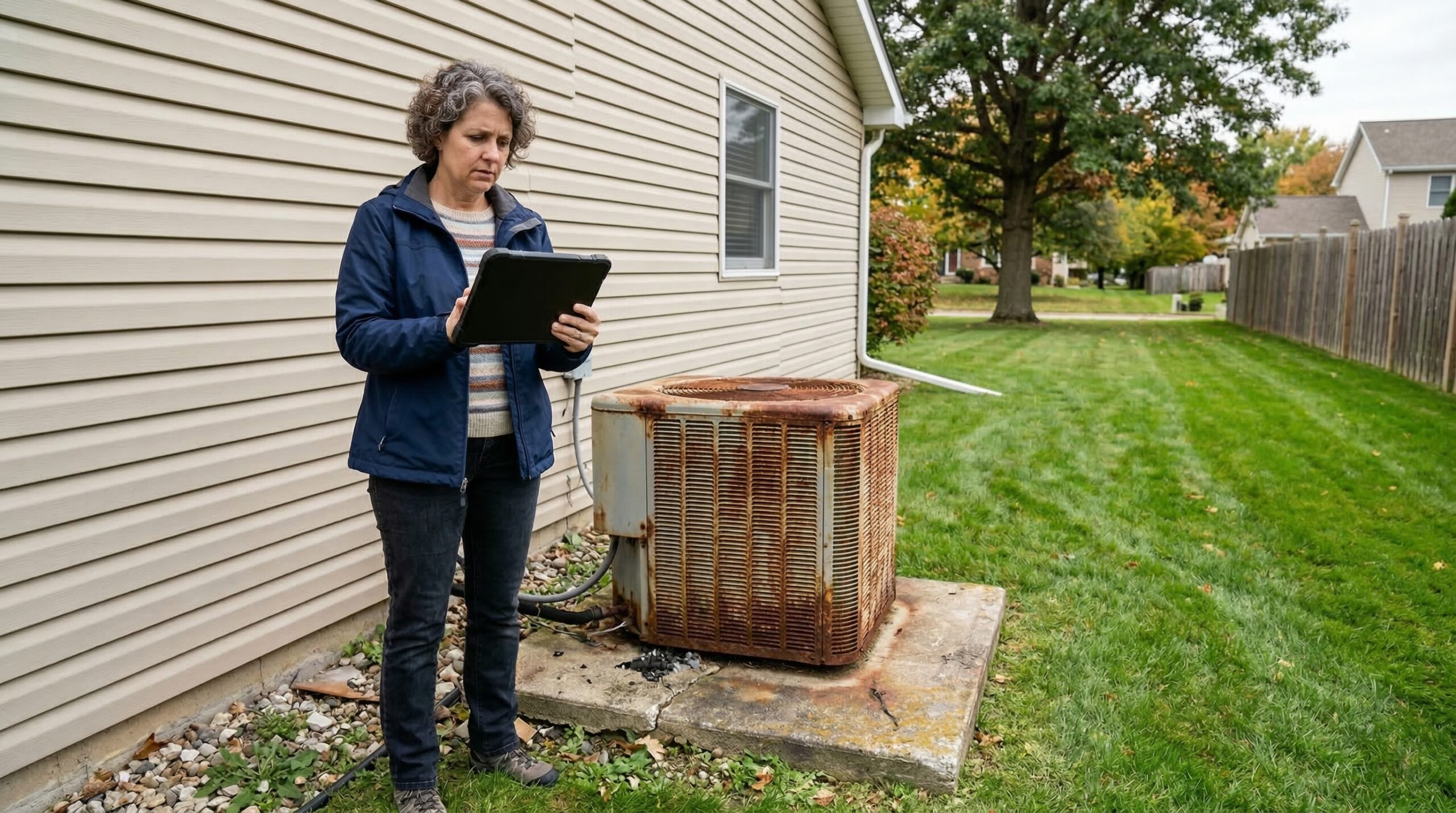
- Rust or corrosion on the cabinet: Normal surface rust is cosmetic. Heavy rust on the heat exchanger, flue, or structural components is a replacement signal.
- Excessive dust throughout the home: Can indicate ductwork deterioration or a system that’s no longer filtering air effectively as components degrade.
Repair vs. Replace Decision Checklist
Use this checklist to quickly assess where your system stands. The more boxes you check, the stronger the case for replacement over repair. Once you’ve identified the right signals, the repair vs. replace framework walks you through the full financial comparison. If both your AC and furnace are showing their age, see the AC and furnace replacement cost guide for bundled pricing.
- System is 15 or more years old (AC, heat pump) or 20 or more years old (furnace)
- System uses R-22 refrigerant
- Facing a repair that costs 50% or more of replacement cost
- Spent $1,500 or more on repairs in the past 24 months
- Energy bills have increased 15 to 25% without a clear cause
- Home has persistent comfort problems (uneven temps, humidity, short-cycling)
- System requires two or more service calls per year
- Yellow furnace flame, ice on coils, or refrigerant leak detected
If you checked three or more of these, replacement deserves serious consideration. If you checked five or more, the financial case for replacement is strong in almost every scenario.
Before you start collecting quotes, check whether your replacement qualifies for state rebates or utility incentives. The HVAC tax credits and rebates guide covers what’s currently available in 2026. And when you’re ready to shop, timing your replacement in the off-season (spring or early fall) can save 10 to 15% on installation cost. If you live in a mobile or manufactured home, the warning signs are the same but the equipment requirements are different; our mobile home HVAC replacement cost guide covers HUD-rated system options and pricing.
Frequently Asked Questions
How do I know if my HVAC uses R-22 refrigerant?
Check the nameplate label on your outdoor condenser unit. If it says “R-22” or “HCFC-22,” or was manufactured before 2010, it almost certainly uses R-22. Any licensed HVAC technician can confirm this during a service visit. Since R-22 was fully phased out in January 2020, recharging a leaking R-22 system requires recycled refrigerant that now costs $100 per pound or more, making a full recharge prohibitively expensive on most systems.
What is the 50% rule for HVAC replacement?
The 50% rule states: if the cost of a repair exceeds 50% of what a new system would cost, replacement is almost always the better financial decision. For example, if a new system costs $8,000 and you’re facing a $4,500 compressor replacement on a 14-year-old unit, the 50% threshold is crossed. Putting $4,500 into aging equipment leaves you with a system that still has every other original component, any one of which could fail within the next 2 to 3 years.
Can an old HVAC system be repaired instead of replaced?
Yes, but age changes the math significantly. A repair on a 5-year-old system makes sense because the rest of the components have 10 to 15 years of life remaining. A repair on a 19-year-old system buys you 1 to 3 years at most before the next failure arrives. Use the 50% rule combined with your system’s age: if the system is over 15 years old and the repair exceeds $1,000, run the replacement math before committing to the repair.
How much can I save by replacing an old HVAC system?
Replacing a 10-SEER system with a new 16-SEER unit reduces cooling energy consumption by approximately 37%. In practical terms, a homeowner spending $1,800 per year to cool a 2,000 sq ft home in the South could save $660 or more annually. In colder climates with shorter cooling seasons, savings are lower but still meaningful. Over a 15-year equipment life, those savings often add up to $5,000 to $9,000, which meaningfully offsets the replacement investment.
What does it mean if my furnace flame is yellow instead of blue?
A yellow or orange furnace burner flame indicates incomplete combustion, which can produce carbon monoxide. A healthy gas furnace flame should be steady and blue with only a small orange tip. If you see a predominantly yellow flame, flickering yellow flames, or a flame that frequently goes out, shut the furnace off and call an HVAC technician immediately. This is a safety issue requiring immediate inspection and often signals a cracked heat exchanger or burner problem that warrants replacement in older systems.
Next step: Once you’ve confirmed the signs, use the free HVAC replacement cost estimator to see what a new system costs in your area, then read the HVAC quotes guide to start collecting accurate bids from licensed contractors. When you receive quotes, check each one against the HVAC quote red flags guide to avoid common contractor problems. Before installation day, check how long HVAC replacement takes so you can schedule around the project.
For Gulf Coast homeowners: systems in high-humidity, Zone 2A climates like Fort Bend County, Texas run 8 to 10 months per year and often show age-related problems earlier. The Sugar Land, TX HVAC replacement cost guide covers what to budget and which CenterPoint rebates apply when you decide to replace.
Related reading: Repair vs. Replace HVAC · How Long Does HVAC Last? · HVAC Tax Credits and Rebates 2026 · Best Time to Replace HVAC · HVAC Replacement Cost Guide · HVAC Efficiency Ratings Explained · HVAC Insurance Claims After Storm Damage
nnnWashington homeowners replacing an aging system should be aware of the state’s strong utility rebate programs from Puget Sound Energy and Seattle City Light, which can offset significant upfront costs. Our Washington HVAC replacement cost guide covers current replacement costs, PSE rebates up to $1,400, and permit requirements statewide.
Nebraska homeowners dealing with aging HVAC systems face a heating-dominant environment with 6,000–7,500 heating degree days and rebate programs from OPPD, LES, and NPPD. Our Nebraska HVAC replacement cost guide covers Omaha, Lincoln, and Grand Island pricing with current rebate details.
n