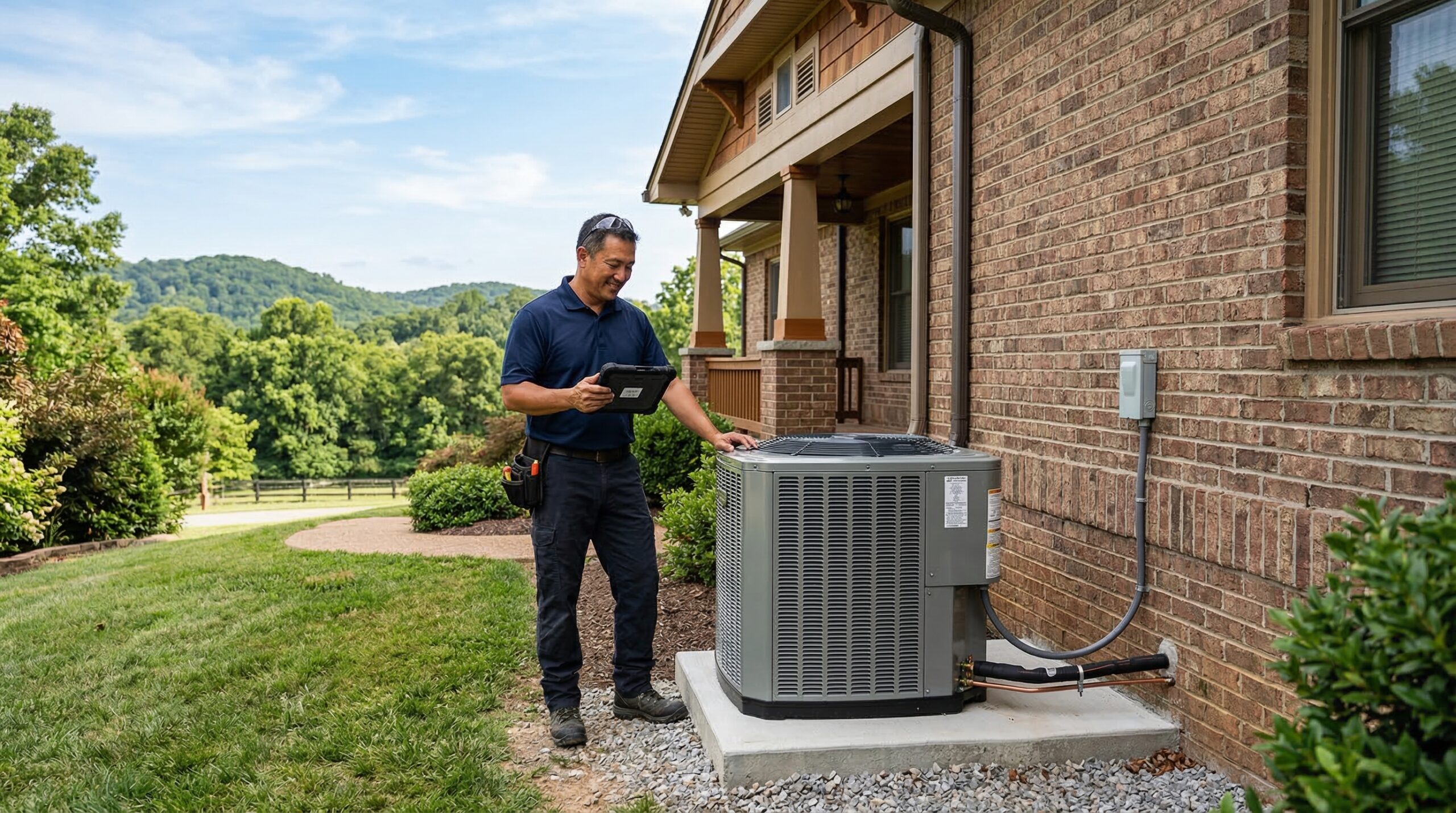
Chattanooga sits in the Tennessee Valley at the foot of Lookout Mountain, served by EPB (Electric Power Board of Chattanooga) as a TVA distributor, with a Zone 4A mixed-humid climate that demands real cooling capacity in humid summers and reliable heating when winter cold settles into the valley basin. This guide covers 2026 replacement pricing, EPB and TVA EnergyRight rebates, and Hamilton County mechanical permit requirements.
TL;DR: Full HVAC replacement in Chattanooga runs $4,800 to $11,500 installed in 2026. Chattanooga is in ASHRAE Climate Zone 4A (mixed-humid, four full seasons). EPB distributes TVA EnergyRight rebates of up to $800 on qualifying 17 SEER2+ heat pumps and up to $400 on central AC upgrades. A mechanical permit is required in Hamilton County ($90 to $120 typical for residential replacement). Get your Chattanooga estimate here.
What Does HVAC Replacement Cost in Chattanooga?
Prices below reflect installed costs for a standard single-zone system in a 1,500 to 2,500 sq ft Chattanooga home. Costs include equipment, labor, permits, and refrigerant for a straight replacement with existing ductwork in acceptable condition.
| System Type | Chattanooga Low | Chattanooga Typical | Chattanooga High |
|---|---|---|---|
| Central AC (split system) | $3,000 | $4,800 | $6,500 |
| Gas furnace replacement | $2,000 | $3,400 | $5,500 |
| Heat pump (air-source) | $4,500 | $7,500 | $10,000 |
| Full AC + furnace combo | $4,800 | $8,200 | $11,500 |
| Dual-fuel heat pump + gas backup | $5,500 | $9,000 | $12,500 |
| Ductless mini-split (per zone) | $2,200 | $3,400 | $4,800 |
Chattanooga HVAC installer wages track close to the Tennessee statewide average, running roughly 8 to 12 percent below Nashville rates according to Bureau of Labor Statistics data. That labor advantage keeps Chattanooga pricing competitive compared to larger Tennessee metros without the deep discounts seen in rural markets. Use the free estimator to enter your home size and system type for a personalized range.
What EPB and TVA EnergyRight Rebates Are Available in Chattanooga?
EPB (Electric Power Board of Chattanooga) delivers TVA EnergyRight residential rebates to Hamilton County homeowners. EPB’s rebate menu includes both heat pump and central AC incentives, giving Chattanooga customers broader rebate access than some other TVA distributors that only cover heat pumps. Northern Alabama homeowners in TVA territory have access to the same EnergyRight program; see the Alabama HVAC replacement cost guide for statewide pricing.
| System | Efficiency Requirement | EPB / TVA Rebate |
|---|---|---|
| Heat pump or mini-split | 17 SEER2 or higher | $800 |
| Heat pump | 15 to 16.99 SEER2 | $500 |
| Central air conditioner | 17 SEER2 or higher | $400 |
| Central air conditioner | 15 to 16.99 SEER2 | $250 |
| Geothermal heat pump | Any qualifying system | $3,000 |
| Duct sealing / repair / replacement | Full system brought to TVA standards | $300 |
| Heat pump or AC tune-up | Existing system | $50 |
All rebate-eligible work must be completed by a contractor in TVA’s Quality Contractor Network. Your contractor submits the rebate on your behalf after installation, and you receive a redemption code by email. The federal Section 25C credit expired December 31, 2025 and is not available for equipment placed in service in 2026.
How Does Chattanooga’s Climate Shape HVAC Decisions?
Chattanooga sits in ASHRAE Climate Zone 4A (Mixed-Humid), placing it in the same zone as Knoxville and Nashville. The official design temperatures are 91°F for summer cooling and 13°F for winter heating, meaning your system must handle both genuine cold in January and hot, humid summers that push relative humidity above 70 percent from June through September.
The Tennessee Valley’s ridge-and-valley geography adds a local wrinkle. Chattanooga sits in a bowl flanked by Lookout Mountain to the south and Missionary Ridge to the east. Cold air drains into the valley basin during winter inversions, making valley-floor neighborhoods occasionally colder than higher elevations. In summer, the same topography traps heat and humidity, driving longer cooling runtimes than the latitude alone would suggest. Homes in lower-lying areas near the Tennessee River tend to run their AC harder and longer than ridge-top neighborhoods in the same ZIP code.
Heat pumps perform well in Zone 4A and earn the best EPB rebates. Homeowners who want maximum cold-weather reliability can opt for a dual-fuel system that pairs a heat pump with a gas furnace backup, switching to gas below around 35°F when heat pump efficiency drops. Chattanooga’s moderate electricity rates through EPB and the TVA grid mean all-electric heat pumps pencil out well for most homes.
Do You Need a Permit to Replace HVAC in Hamilton County?
Yes. Hamilton County Building Inspection requires a mechanical permit for any HVAC replacement or installation. Permits are processed through the Building Inspection office at 4005 Cromwell Road, Chattanooga, TN 37421, or online through the Hamilton County portal.
The residential mechanical permit fee follows a straightforward formula: $20 for the first $1,000 of contract value, plus $5 for each additional $1,000, plus $45 in fixed administrative fees. For a typical $6,000 to $10,000 HVAC replacement, total permit costs run $90 to $120. Most licensed contractors include permit fees in their installation quotes and pull the permit on your behalf. An inspection is required after installation before the permit is closed.
Verify current fees and requirements directly with Hamilton County Building Inspection, as fee schedules are reviewed annually. Any contractor who tells you a permit is not needed for a straight replacement is incorrect under Hamilton County’s current code.
What Factors Drive HVAC Prices in Chattanooga?
Several factors push Chattanooga installation costs above or below the ranges in the table above:
- Labor market: Chattanooga wages run below Nashville but above rural East Tennessee markets. The metro’s ongoing industrial growth (Volkswagen, Amazon, and healthcare expansion) has increased contractor demand, tightening the labor market compared to five years ago.
- Seasonal timing: Peak demand runs June through August. Quotes obtained in March through May or September through October typically come in 5 to 10 percent lower and lead times are shorter.
- Home age and ductwork: Older Chattanooga neighborhoods (Highland Park, North Shore, Alton Park) often have ductwork that needs sealing or partial replacement alongside the HVAC swap. Adding duct work to a replacement typically adds $1,500 to $3,500.
- System sizing: Chattanooga’s mixed climate requires proper Manual J load calculations. A system sized only for cooling will underperform in January. Oversized systems short-cycle and increase humidity problems in the humid summers.
- Elevation microclimate: Homes on Lookout Mountain or Signal Mountain may need different equipment specifications than valley-floor homes due to lower summer temperatures and different heating load profiles.
Frequently Asked Questions About HVAC Replacement in Chattanooga
How much does HVAC replacement cost in Chattanooga, TN?
Chattanooga homeowners typically pay $4,800 to $11,500 for a full HVAC replacement in 2026. Central AC alone runs $3,000 to $6,500. A heat pump system runs $4,500 to $10,000. Prices reflect installed costs including equipment, labor, and permits. Use the free estimator to get a range for your home size and system type.
What EPB and TVA EnergyRight rebates are available in Chattanooga?
EPB distributes TVA EnergyRight rebates to Chattanooga-area customers. The available rebates are:
- Heat pump or mini-split, 17 SEER2 or higher: $800
- Heat pump, 15 to 16.99 SEER2: $500
- Central AC, 17 SEER2 or higher: $400
- Central AC, 15 to 16.99 SEER2: $250
- Geothermal heat pump: $3,000
- Duct sealing, repair, or replacement: $300
- Tune-up for existing heat pump or AC: $50
Work must be performed by a Quality Contractor Network member. Your contractor submits the rebate on your behalf. Visit EPB’s HVAC rebates page for current eligibility details.
Do I need a permit to replace HVAC in Hamilton County?
Yes. Hamilton County Building Inspection requires a mechanical permit for HVAC replacement. The permit fee for a residential replacement runs approximately $90 to $120 for a typical $6,000 to $10,000 installation. Most licensed contractors pull permits as part of the installation. An inspection is required after installation is complete. Contact Hamilton County Building Inspection at (423) 209-7860 for current requirements.
Should Chattanooga homeowners choose a heat pump or gas furnace and AC?
Both work well in Zone 4A. Heat pumps earn the highest EPB rebates and are efficient for Chattanooga’s climate. Homeowners who want maximum cold-weather backup can choose a dual-fuel system combining a heat pump with a gas furnace, which switches to gas on the coldest nights. Homes in the Tennessee Valley basin that see winter cold air pooling may benefit most from the dual-fuel approach. Homes on Lookout Mountain or Signal Mountain with milder temperature swings are strong candidates for all-electric heat pumps.
Why are Chattanooga HVAC prices different from Nashville?
Chattanooga HVAC installer wages track roughly 8 to 12 percent below Nashville, according to Bureau of Labor Statistics data. Nashville’s sustained growth over the past decade has pushed contractor wages and overhead significantly higher. Chattanooga is growing, but the labor market remains more competitive, passing those savings along to homeowners. If you are relocating from Nashville and comparing quotes, expect Chattanooga bids to come in noticeably lower for equivalent equipment and installation quality. For Nashville-area comparisons, see the Murfreesboro HVAC cost guide, where prices closely track Nashville rates.
For an East Tennessee comparison with a similar climate but different utility territory, see the Knoxville HVAC replacement cost guide.
How long does HVAC last in Chattanooga’s climate?
Central AC and heat pump systems typically last 13 to 18 years in Chattanooga. Gas furnaces last 18 to 25 years. The combination of humid summers and occasional hard freezes accelerates coil wear and refrigerant line stress. Annual tune-ups, monthly filter checks during the June to September cooling season, and coil cleaning every two to three years extend system life. Systems in valley-floor neighborhoods with longer annual cooling runtimes tend to age faster than those in higher-elevation areas of the Chattanooga metro.
Put the numbers in context
What would it cost for your home?
Get a planning range based on your home, system and region. Free, with no email required.
Get my cost estimate