
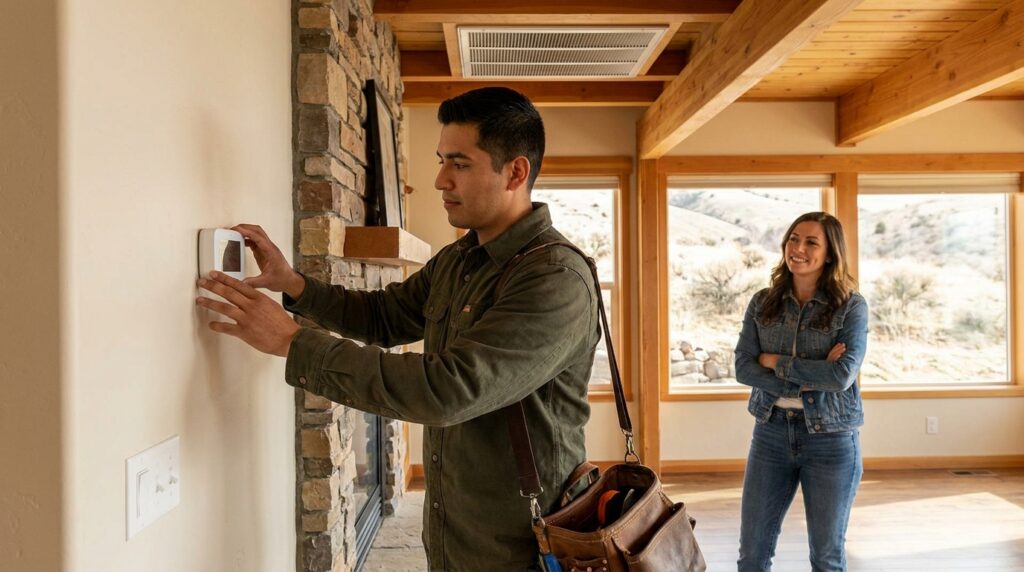
Boise sits in the semi-arid Treasure Valley at roughly 2,700 feet, with hot dry summers that push past 100°F in heat waves and winters that swing between mild 30°F days and the occasional Arctic plunge into the single digits. The metro grew 2.2% in 2025, making it the 13th fastest-growing in the country, which means new construction meets older swamp-cooler homes across Ada and Canyon counties. This guide covers what full HVAC replacement costs here, which Idaho Power rebates are live in 2026, and what Boise’s mechanical permit process looks like.
TL;DR: Full HVAC replacement in Boise runs $5,400 to $12,800 for most homes. Climate Zone 5B (cool and dry, heating-dominated) means your system needs to handle 100°F summers and single-digit winter cold snaps. Idaho Power’s Heating and Cooling Efficiency Program offers an $800 rebate on qualifying air-source heat pumps plus up to $250 on new central air conditioners. A Boise mechanical permit is required; residential fees run $130 to $325 based on square footage. Get your Boise estimate here.
How Much Does HVAC Replacement Cost in Boise, ID?
For most Boise homes, a full HVAC replacement runs between $5,400 and $12,800. That range covers the most common scenario: swapping out both a gas furnace and central air conditioner in a single-family home with existing ductwork. Where you land depends on the square footage of your home, the efficiency tier you choose, and whether ductwork needs repair or replacement. Boise pricing historically sits below coastal metros because the Boise City metro mean hourly wage across all occupations is $29.65 versus a national mean of $32.66 (BLS, May 2024 release). That roughly 9% labor gap flows through to most trade pricing.
| System Type | Typical Installed Cost (Boise) |
|---|---|
| Central AC only (replacement) | $3,200–$6,100 |
| Gas furnace only (replacement) | $2,600–$5,200 |
| Full system: AC + gas furnace | $5,400–$10,400 |
| Air-source heat pump (replaces both) | $6,800–$12,800 |
| Dual-fuel system (heat pump + gas backup) | $8,400–$14,500 |
| Add ductwork replacement | $1,900–$3,900 additional |
| Upgrade swamp cooler to central AC | $4,800–$8,200 |
National context helps calibrate expectations. Angi reports a national HVAC replacement range of $5,000 to $12,500 as of March 2026, with full replacements averaging around $7,500. Boise falls squarely inside that band, with the lower end favoring smaller homes (under 1,500 square feet) that need the $130 base permit fee and minimal ductwork work. For a full national breakdown of what goes into system replacement pricing, see the HVAC replacement cost guide and the HVAC replacement cost breakdown.
What Factors Affect Your HVAC Price in the Treasure Valley?
Beyond square footage and system type, Boise has a handful of cost factors that do not show up on national estimator tools. Five stand out.
Home Size and System Capacity
Boise’s climate is heating-dominated (IECC Zone 5B), which means sizing leans toward winter capacity. A Manual J load calculation is the proper method for sizing, especially when you factor in Arctic plunges that can push outdoor design temperatures well below the average January low of 24°F. Contractors doing proper Manual J will usually size up slightly for heating compared to a Phoenix or Las Vegas installer looking at the same square footage.
System Type and Rebate Qualification
Higher-efficiency units cost more upfront but can qualify for Idaho Power rebates that offset part of the premium. A standard 14.3 SEER2 central AC qualifies for $100 in the Heating and Cooling Efficiency Program tiered rebate, while a 16.3 SEER2 unit qualifies for $250. For heat pumps, the $800 rebate applies to any air-source unit meeting the 8.5 HSPF or 7.2 HSPF2 minimum, with a max of two incentives per home.
Ductwork Condition
Many Boise homes built before 1990 have ductwork that leaks 20 to 30 percent of conditioned air into attics or crawlspaces. Duct sealing ($300 to $800) or full replacement ($1,900 to $3,900) is commonly flagged during HVAC system replacement. Idaho Power pays $200 for duct sealing through the same rebate program, so this is worth bundling into the scope up front rather than addressing as a separate job later.
Wildfire Smoke and Dust Filtration
Regional wildfire smoke drifts into the Treasure Valley during late summer, and agricultural dust from Canyon County’s farmland is a year-round reality. That pushes filtration up the priority list for most homeowners. MERV 13 filters, whole-house media cabinets, and HEPA bypass systems add $200 to $1,500 to a replacement job but are hard to retrofit later without returning to the ducts.
Jurisdiction and Permit Fees
If your home sits inside Boise city limits, you pull a Boise mechanical permit. Meridian, Eagle, Kuna, and Star each run their own permit offices with slightly different fees. Unincorporated Ada County uses the county development services department. Most installers quote the permit as a pass-through and pull it on your behalf.
What HVAC Rebates Are Available in Boise in 2026?
Idaho Power runs the main residential HVAC rebate program for the Treasure Valley through its Heating and Cooling Efficiency Program. The 2026 existing-home incentives available to Boise residential customers are:
- Ducted air-source heat pump: $800 (minimum 8.5 HSPF or 7.2 HSPF2, electric or oil/propane backup required, max two per home)
- Ductless heat pump (per head): $400 to $500 depending on configuration
- Ducted ground-source (geothermal) heat pump: $1,000 to $3,000
- New central air conditioner: $100 for 14.2 SEER2 / 11.5 EER2 minimum; $250 for 16.3 SEER2 / 12.5 EER2 minimum
- Heat pump water heater: $300
- Smart thermostat: $50
- Evaporative cooler (new): $150
- Duct sealing: $200
- Whole-house fan: $200
Idaho Power requires a participating contractor to install the equipment, and the rebate cannot exceed the actual price paid. Applications must be submitted within 90 days of project completion. The full list of participating contractors is maintained on the Idaho Power website, and reputable Boise installers handle the rebate paperwork as part of their quote.
Intermountain Gas Company, the natural gas utility serving most Treasure Valley homes, does not operate a residential furnace rebate program in 2026. Idaho also has no state income tax credit specifically for residential HVAC equipment. And the federal Section 25C residential energy efficient property credit expired on December 31, 2025, so 2026 installations cannot claim it. That leaves the Idaho Power program as the single meaningful rebate source for most Boise homeowners.
Is a Heat Pump Worth It in Boise’s Climate?
For most Boise homes, yes. The Treasure Valley is classified as IECC Zone 5B (cool-dry), with average January lows around 24°F and occasional Arctic plunges into the single digits. Modern cold-climate heat pumps (variable-speed inverter-driven units rated to maintain full capacity down to 5°F or lower) handle Boise’s design conditions without auxiliary strip heat for most days of the year. When an Arctic front settles in for a week, electric resistance backup or a gas furnace handles the coldest overnight hours.
The Idaho Power rebate structure reinforces the heat pump math. An $800 rebate on a heat pump plus the ability to replace both heating and cooling with one outdoor unit often beats the total cost of a separate gas furnace and central AC over a 12 to 15 year lifecycle, especially as Idaho Power’s electric rates stay among the lowest in the western U.S. For homeowners currently on electric resistance heat (baseboards, ceiling cable, wall units), the switch to an air-source heat pump is almost always the better long-term play, and the same $800 rebate applies. See the heat pump replacement cost guide for a full breakdown of equipment and install pricing.
Should You Replace Your Swamp Cooler With Central AC?
Many older Treasure Valley homes still cool with an evaporative (swamp) cooler mounted on the roof or an exterior wall. Evaporative cooling works in Boise because summer humidity sits in the 15 to 30 percent range most days, and a swamp cooler can drop indoor temperatures 15 to 25 degrees below outdoor by running water over pads as hot air passes through. Operating costs run about one-quarter of refrigerant-based AC.
Three scenarios push homeowners to upgrade:
- Wildfire smoke season: Swamp coolers pull outdoor air through the home. During July, August, and September smoke events, that means drawing PM2.5-laden air inside. Central AC recirculates indoor air through a sealed system with filtration.
- Summer monsoon weeks: When afternoon thunderstorm patterns push humidity past 40 percent, swamp coolers lose effectiveness. Central AC works regardless of humidity.
- Resale value: Boise buyers increasingly expect central AC or a heat pump. Listings with only a swamp cooler often linger in the August heat.
Upgrading a swamp-cooled home to central AC typically runs $4,800 to $8,200 because ductwork is already in place for the existing furnace. Going to a heat pump adds $1,500 to $2,500 over the central AC path and unlocks the $800 Idaho Power rebate.
Do You Need a Permit to Replace HVAC in Boise?
Yes. The City of Boise Mechanical Code requires a mechanical permit for HVAC installation and replacement in single-family and multi-family homes. Permits are pulled through Boise Planning and Development Services, and a mechanical inspection is required after installation.
Boise’s Mechanical Code and Fuel Gas Code Fee Schedule sets permit fees by square footage for new single-family and duplex construction:
- Up to 1,500 sq ft: $130 per dwelling unit
- 1,501 to 2,500 sq ft: $180 per dwelling unit
- 2,501 to 3,500 sq ft: $250 per dwelling unit
- 3,501 to 4,500 sq ft: $290 per dwelling unit
- 4,501 sq ft and up: $325 plus $65 per additional 1,000 sq ft
For a simple HVAC replacement (swapping an existing furnace or AC), Boise uses a different fee structure: $30 base permit fee plus $12 per fixture (the furnace, AC unit, and any gas piping pressure test each count as one fixture). That puts a typical residential HVAC replacement permit at $65 to $90. Budget up to $250 if the scope includes new ductwork, a gas line extension, or bathroom exhaust additions.
Homes inside Meridian, Eagle, Kuna, and Star city limits pull permits through those jurisdictions, with fees in the same general range. Unincorporated Ada County uses Ada County Development Services. Reputable installers pull the permit as part of the install and list the fee as a pass-through on your quote.
Frequently Asked Questions
What is the typical installed HVAC price for a Boise home?
A full HVAC replacement in Boise runs $5,400 to $12,800 for most homes, with the median landing near $7,800 for a gas furnace plus central AC in a 1,500 to 2,500 square foot home with existing ductwork. Heat pumps push the upper end of the range because of equipment cost, but qualify for an $800 Idaho Power rebate that reduces the effective price. Use the HVAC cost estimator to get a price specific to your home.
Do I need a permit to replace HVAC in Boise?
Yes. The City of Boise requires a mechanical permit for HVAC installation and replacement, and a mechanical inspection is required after the work is done. A typical residential replacement permit runs $65 to $90 using Boise’s base fee plus fixture schedule; larger scope items like new ductwork or gas line extensions push the fee toward $150 to $250. Meridian, Eagle, Kuna, and Star each run their own permit offices for homes in those city limits.
Which Boise HVAC rebates should homeowners check before signing a contract?
Idaho Power’s Heating and Cooling Efficiency Program is the main rebate source for Boise residential customers in 2026. Key amounts:
- Air-source heat pump: $800
- Ductless heat pump: $400 to $500 per head
- Ground-source heat pump: $1,000 to $3,000
- Central AC (16.3 SEER2 tier): $250
- Central AC (14.2 SEER2 tier): $100
- Duct sealing: $200
- Smart thermostat: $50
A participating contractor must install the equipment. Intermountain Gas has no residential HVAC rebate in 2026, Idaho has no state HVAC tax credit, and the federal Section 25C credit expired on December 31, 2025.
What makes a heat pump a good fit for many Boise homes?
For most Boise homes, yes. Modern cold-climate heat pumps (variable-speed inverter units rated to full capacity at 5°F) handle Boise’s Zone 5B winters without relying on auxiliary strip heat most of the season. Arctic plunges into the single digits are handled by electric resistance backup or a dual-fuel gas furnace. The $800 Idaho Power rebate plus low electric rates make the math favorable compared to a separate gas furnace plus AC setup over a 12 to 15 year lifecycle, especially for homes currently on electric baseboard or ceiling-cable heat.
Should I replace my swamp cooler with central AC in Boise?
Swamp coolers still work in Boise because summer humidity averages 15 to 30 percent. But three scenarios typically push a homeowner to upgrade: wildfire smoke season (swamp coolers pull outdoor air into the home), monsoon weeks when humidity climbs past 40 percent and evaporative cooling loses effectiveness, and resale value. Upgrading to central AC runs $4,800 to $8,200 when ductwork already exists; upgrading to a heat pump adds $1,500 to $2,500 and unlocks the $800 rebate.
How long does HVAC last in Boise?
Boise’s dry climate is easy on outdoor condenser coils compared to humid coastal metros, which helps central AC units reach 15 to 18 years regularly. Gas furnaces last 18 to 22 years in the Treasure Valley with routine maintenance. The variables that shorten lifespan are wildfire smoke and agricultural dust, both of which accelerate filter replacement cycles and drive condensate drain issues. Homes near open farmland in Canyon County or within a mile of major arterials in Boise tend to see the shorter end of these ranges.
Get Your Boise HVAC Replacement Estimate
Before you call contractors, it helps to know what the install should actually cost for your specific home. The HVAC cost estimator factors in Boise’s climate zone, typical Treasure Valley labor rates, and your home size to produce a realistic budget range. You can then use that number to evaluate contractor quotes and spot the outliers (both the lowball pitches and the quotes with unjustified markups). If you need broader context on the Idaho HVAC market, the Idaho state pricing guide covers regional variation from Coeur d’Alene to Idaho Falls. And for comparison with other western metros, see the Salt Lake City and Denver guides.