
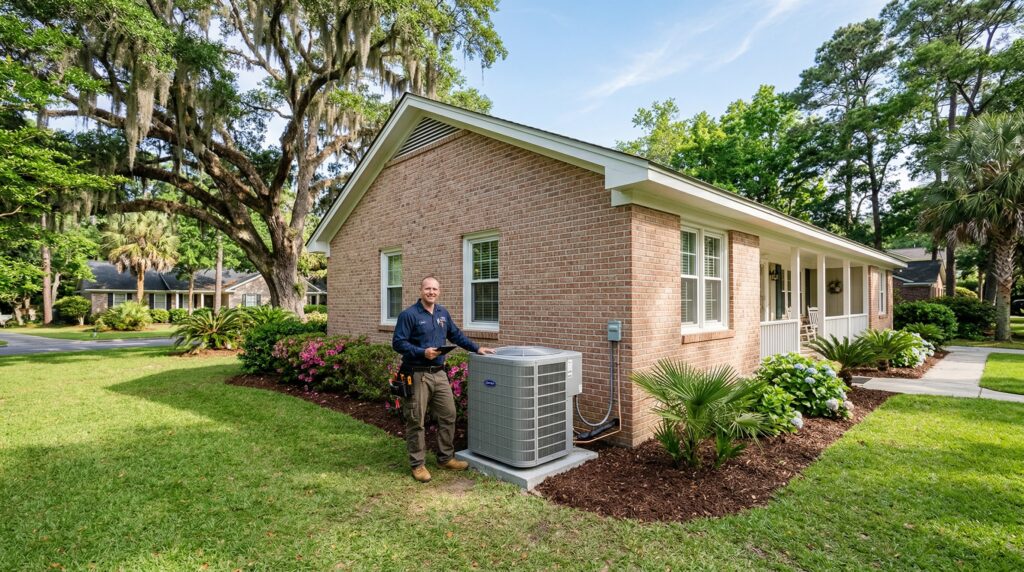
Pricing an HVAC replacement in Charleston means accounting for factors that don’t show up in national cost averages: coastal salt air that corrodes equipment faster than almost anywhere in the Southeast, a historic housing stock that complicates installations, and Dominion Energy SC rebates that most homeowners leave on the table. This guide covers what Charleston homeowners actually pay for HVAC replacement, why the coast changes the equation, and how to use current utility rebates before signing a contract.
TL;DR: HVAC replacement in Charleston costs $8,000–$12,000 for a typical 2,000 sq ft home, slightly above Southeast baseline due to coastal demand and salt-air considerations. Dominion Energy SC offers rebates up to $750 on ENERGY STAR® equipment. The federal Section 25C credit expired December 31, 2025 and is not available for equipment placed in service in 2026. Get your free estimate here.
What Does HVAC Replacement Cost in Charleston, SC?
Here’s what Charleston-area homeowners are paying in 2026, based on local contractor data and our Southeast pricing model:
| System Type / Home Size | Typical Charleston Cost Range |
|---|---|
| Central AC only (1,000 sq ft home) | $6,000–$8,000 |
| Full HVAC system (2,000 sq ft home) | $8,000–$12,000 |
| Full HVAC system (2,500+ sq ft home) | $12,000+ |
| Add: ductwork replacement | +$2,500–$5,000 |
These ranges reflect standard installation complexity with mid-range equipment. The coastal premium in Charleston adds roughly 5–10% over inland South Carolina markets, driven by higher contractor demand from the region’s rapid population growth and the additional labor involved in coastal-rated installations. Use our interactive cost estimator to get a figure adjusted for your home size and system type.
How Salt Air Affects HVAC Costs and Lifespan in Charleston
The single biggest factor separating Charleston HVAC costs from other Southeast cities is salt air. The Charleston metro sits on the South Carolina coast with access to the Atlantic Ocean, Charleston Harbor, and dozens of inland tidal waterways. Salt-laden air accelerates corrosion on HVAC components (particularly aluminum condenser fins, copper refrigerant lines, and electrical contacts) in ways that dramatically shorten system life.
The practical result: homeowners within a mile or two of the water can expect a 10–12 year effective lifespan on standard equipment, compared to the 15–20 year average for inland installations. That’s not a worst-case estimate. It’s a realistic outcome for equipment that wasn’t specified with coastal protection in mind.
What to look for when replacing your system near the coast:
- Marine-grade coil coatings: Specify epoxy or phenolic-coated condenser coils (often called “sea coast” or “coastal” finish in manufacturer specs). Carrier, Lennox, and Trane all offer this on select product lines.
- Stainless steel or galvanized steel cabinets: Standard galvanized steel performs better than painted steel near salt air environments.
- Annual fin cleaning: Salt deposits need to be flushed annually, more often in high-exposure locations. Build this into your maintenance contract.
- Condenser placement: Where possible, locate the outdoor unit away from prevailing onshore winds and direct saltwater spray.
Specifying coastal-rated equipment typically adds $300–$600 to the initial cost of a system but can add 3–5 years to its operational life, making it a sound investment at Charleston’s replacement price points. This is also a factor in sizing decisions: larger, older homes in historic Charleston neighborhoods often have ductwork that needs assessment alongside the equipment replacement.
Charleston’s Climate and Why Heat Pumps Dominate Here
Charleston sits in ASHRAE Climate Zone 3A, classified as Mixed Humid, with a Humid Subtropical (Cfa) climate signature. What that means in practice: a long, hot, and extremely humid cooling season, combined with very mild winters.
July averages a high of 89°F with nighttime lows around 75°F, and the humidity makes it feel significantly hotter. The cooling season effectively runs from May through October, with year-round humidity pressing your HVAC system to manage both temperature and moisture. January averages a high of 59°F and a low of 40°F, with genuinely mild winters that rarely stress a heating system. This climate profile matters because it directly determines which system type makes economic sense.
Charleston’s climate makes heat pumps the clear choice for most homeowners. Mild winters mean a heat pump operates efficiently year-round without needing a gas furnace backup. Gas furnaces are uncommon in coastal SC because the heating load simply doesn’t justify the installation cost. A heat pump handles both cooling and heating with a single system, which also reduces Dominion Energy’s billing complexity if you’re on electric service. For homeowners considering a heat pump replacement, Charleston’s Zone 3A climate is essentially ideal territory. The right system size is critical in Charleston’s humidity: an oversized unit will cool fast but fail to dehumidify properly, leaving a clammy interior.
Dominion Energy SC Rebates and Federal Section 25C Status for 2026
Most Charleston homeowners served by Dominion Energy South Carolina (formerly SCE&G) are eligible for utility rebates on qualified HVAC upgrades. The program covers ENERGY STAR®-rated heat pumps and central air conditioners, with amounts up to $750 depending on the equipment type and efficiency tier.
| Program | Equipment Type | Amount | Who Qualifies |
|---|---|---|---|
| Dominion Energy SC EnergyWise | ENERGY STAR® heat pump or AC | Up to $750 | Dominion Energy SC residential electric customers |
| Federal Section 25C | HVAC equipment placed in service in 2026 | Not available | No 2026 installation qualifies |
2026 savings example: On a $10,000 heat pump installation, the Dominion rebate could reduce the upfront cost by $500–$750. The federal Section 25C credit expired December 31, 2025 and is not available for equipment placed in service in 2026.
To qualify for the Dominion rebate: you must be a Dominion Energy SC electric residential customer, equipment must be new and ENERGY STAR® certified, installation must be completed by a licensed mechanical contractor, and the rebate application must be submitted within 90 days of installation. Your contractor should be familiar with the process; many handle the paperwork as part of the installation package.
Rebate amounts verified March 2026 via Dominion Energy SC rebate program documentation. Visit dominionenergy.com/hvacrebatessc for current program details.
Historic Homes and HVAC Replacement in Charleston
Charleston has one of the largest inventories of historic homes in the United States, including extensive properties within the Old and Historic Charleston District and the Old City District. If your home falls within these boundaries, exterior HVAC equipment changes may require review by the Board of Architectural Review (BAR) in addition to a standard mechanical permit.
What triggers BAR review:
- Relocating a condenser unit to a position visible from a public right-of-way
- Adding new exterior equipment that didn’t previously exist
- Penetrations or changes to historic exterior surfaces for new ductwork runs
What generally doesn’t require BAR review:
- Direct like-for-like condenser replacement in the same location
- Interior air handler or furnace replacement with no exterior changes
- Equipment in non-visible rear or side yard locations not visible from the street
BAR review adds 2–8 weeks to the project timeline and fees starting around $25–$100 for quick reviews. For homeowners in the historic district planning an upgrade, start the BAR pre-screening process before committing to a contractor timeline. Your contractor should be familiar with BAR requirements. Work with companies experienced in historic Charleston HVAC installations.
Permits and What to Ask Your Contractor
A mechanical permit is required for any HVAC replacement in Charleston, North Charleston, Mount Pleasant, and throughout the tri-county area. The permit fee is calculated based on the total project value (labor + materials). For a typical $8,000–$12,000 HVAC replacement in Charleston, estimated permit fees run approximately $150–$250 (plus a $40 non-refundable application fee).
Your licensed HVAC contractor is responsible for pulling the permit and scheduling the required mechanical inspection. Never hire a contractor who suggests skipping the permit: unpermitted work creates serious problems during home sales and may void manufacturer warranties. In coastal South Carolina, code compliance documentation also matters for insurance purposes, particularly for wind and flood policy eligibility.
Questions to ask before signing with any Charleston HVAC contractor:
- Do you specify and install coastal/marine-rated equipment for salt air environments?
- Will you pull the required mechanical permit and schedule the inspection?
- Are you familiar with Dominion Energy’s rebate application process? Will you handle paperwork?
- Do you provide a Manual J load calculation for proper sizing?
- Are you licensed in the City of Charleston and/or Charleston County?
Frequently Asked Questions: HVAC Replacement in Charleston, SC
How does coastal salt air affect HVAC lifespan in Charleston?
Salt air significantly accelerates HVAC corrosion in Charleston. Marine-grade salt deposits on condenser fins, evaporator coils, and electrical contacts cause deterioration that reduces a typical 15–20 year system lifespan down to 10–12 years for unprotected equipment. Homeowners near the water (within a mile of the ocean or tidal waterways) should specify marine-grade coil coatings and request annual fin cleaning. Lennox, Carrier, and Trane all offer coastal-rated product lines designed for prolonged salt air exposure.
What Dominion Energy SC rebates are available for HVAC replacement in Charleston?
Dominion Energy South Carolina offers rebates up to $750 for ENERGY STAR® qualified electric heating and cooling equipment through its EnergyWise program. You must be a Dominion Energy SC residential electric customer, use a licensed contractor, and apply within 90 days of installation. The federal Section 25C credit expired December 31, 2025 and is not available for equipment placed in service in 2026.
Do I need a permit or Board of Architectural Review approval for HVAC replacement in Charleston?
A mechanical permit is required for any HVAC replacement in Charleston. Permit fees run approximately $150–$250 for a typical project plus a $40 application fee. If your property is in the Old and Historic Charleston District or Old City District, exterior HVAC equipment placement changes may also require BAR approval (BAR-S review for small projects), adding 2–8 weeks to the timeline. Standard like-for-like condenser replacements in non-visible locations generally don’t require BAR review. Always verify with your contractor before assuming a particular installation path is permit-only.
When is the best time to replace HVAC in Charleston?
Late winter (February–March) and early fall (October–November) offer the best scheduling availability in Charleston. Peak demand runs May through September, when emergency replacements fill contractor calendars. Replacing before hurricane season (June–November) is strategically sound: a new system handles post-storm heat recovery better than an aging one. Planning your replacement in April or October typically means shorter wait times and more leverage on pricing.
Should Charleston homeowners choose coated outdoor coils?
Coated coils are worth asking about near Charleston Harbor, Folly Beach, Mount Pleasant, and other salt-exposed areas. They add cost, but they can slow corrosion on outdoor condensers when paired with regular rinsing and annual service.