
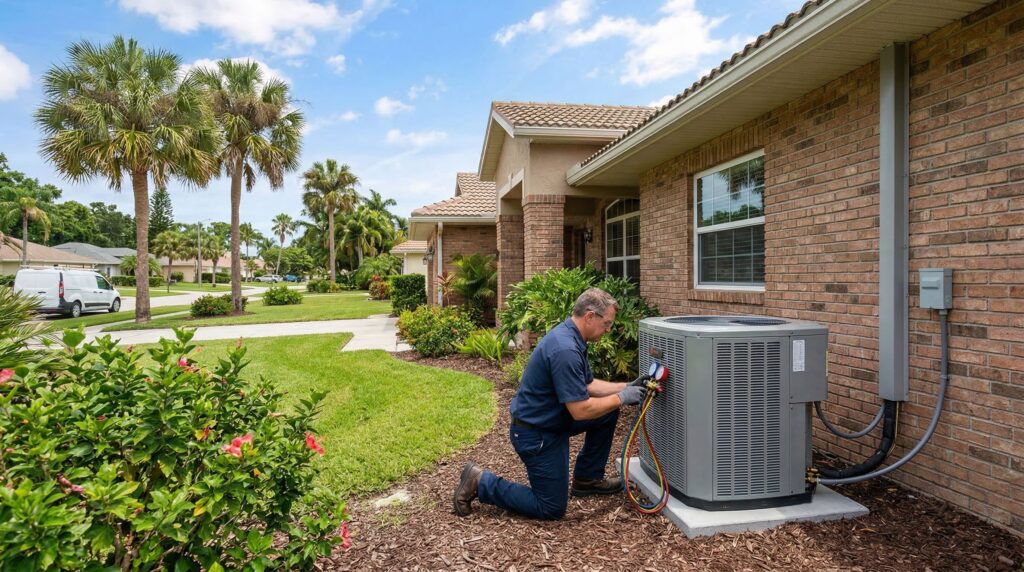
Tampa homeowners replacing an HVAC system face a set of factors you simply don’t encounter anywhere else in Florida. With roughly 3,000 annual cooling degree days, the highest lightning frequency in the United States, persistent coastal humidity from Tampa Bay, and a hurricane season that can cause both emergency replacements and contractor backlogs overnight. The pricing environment here is more complex than the national averages suggest. This guide breaks down what Tampa-area homeowners actually pay for HVAC replacement in 2026, what TECO rebates are available, and how to time and plan your purchase to avoid peak-season pricing.
TL;DR: HVAC replacement in Tampa runs $5,800–$15,000+ depending on system type. Tampa Electric offers a $550 rebate for SEER2 ≥16.20 systems or $40 for SEER2 ≥15.20. Zone 2A climate means ~3,000 annual cooling degree days: efficiency pays back fast here. A Hillsborough County mechanical permit ($125–$200) is required. Lightning capital of the US: add a surge protector. Best time to buy: November–February. Get your estimate.
How Much Does HVAC Replacement Cost in Tampa?
Here’s what Tampa-area homeowners are paying in 2026, based on the Tampa–St. Petersburg–Clearwater MSA labor market and our Southeast regional pricing model:
| System Type | Typical Tampa Cost Range |
|---|---|
| Central AC only | $5,800–$12,500 |
| Heat pump system | $6,200–$13,000 |
| Gas furnace only | $3,200–$6,500 |
| Full system (AC + furnace) | $8,800–$15,000+ |
| Add: ductwork replacement | +$2,200–$4,500 |
These ranges assume standard installation complexity and mid-range equipment. Premium brands, complex ductwork modifications, attic installs in Tampa’s extreme summer heat, and high-efficiency systems push costs toward the upper end. Our cost estimator uses the Southeast regional pricing model. With the TECO rebate factored in, a SEER2 16.20+ system can reduce your net out-of-pocket by up to $550. See our pricing methodology for how regional factors are weighted.
Tampa quotes run slightly above Jacksonville’s but below Miami’s, tracking with the Tampa MSA labor data. BLS May 2024 data shows all-occupation mean wages in the Tampa–St. Petersburg–Clearwater MSA at $30.93/hour, broadly in line with Florida’s statewide average, which means labor rates are competitive but not the cheapest in the state. What drives Tampa’s costs above inland Florida cities is the combination of higher demand (longer cooling seasons), coastal-grade materials for corrosion resistance, and the sheer volume of summer emergency replacements compressing contractor availability.
What Drives HVAC Costs in Tampa Specifically
Five factors make Tampa’s HVAC replacement market different from the national average, and from most other Florida cities:
1. Extreme Cooling Load (Zone 2A, ~3,000 CDD)
Tampa falls in ASHRAE Climate Zone 2A (Hot/Humid) with approximately 3,000 annual cooling degree days. July and August average highs of 91°F, combined with 74% average annual humidity, mean your AC is running hard from April through October and moderately even in the “winter” months. A system sized for a northern climate will underperform here. Proper Manual J load calculation is essential, and high-SEER2 equipment pays back significantly faster in Tampa than in markets with 1,200–1,800 CDD. The extra upfront cost of a 17 SEER2 system over a 15.2 SEER2 system can be recovered in 3–4 years of energy savings alone, and you get the larger TECO rebate on top.
2. Tampa is the Lightning Capital of the US
With an average of 78 thunder days per year, Tampa Bay has the highest lightning frequency of any major US metro. Lightning damage is one of the most common causes of HVAC system failure in Hillsborough County. It comes not from direct strikes but from voltage surges traveling through the power grid. Control boards, compressors, and variable-speed motors are all vulnerable. A whole-home surge protector at your main panel ($200–$400 installed) significantly reduces this risk. When replacing your HVAC, budget for this protection and ask your contractor to include a dedicated surge arrestor at the disconnect. It’s not optional in Tampa.
3. Coastal Humidity and Salt-Air Corrosion
Tampa Bay sits less than 10 miles from most of Tampa’s residential neighborhoods. The combination of salt air and year-round humidity accelerates corrosion of the outdoor condenser, specifically the aluminum fins, copper refrigerant lines, and electrical connections. Homes within 5 miles of Tampa Bay or the Gulf shoreline often see systems fail at 13–15 years rather than the national average of 15–20. When pricing your replacement, ask about factory-applied coastal coatings (offered by Carrier, Trane, Lennox, and others) or post-installation corrosion protection treatments. The added cost ($150–$400) extends outdoor unit life materially in Tampa’s environment.
4. Hurricane Season Demand Spikes
Florida’s hurricane season (June 1–November 30) coincides almost exactly with Tampa’s peak HVAC demand period. When a major storm passes through the Tampa Bay area, two things happen simultaneously: systems that were already struggling fail under the load, and contractor capacity tightens as crews shift to storm damage work. After Helene and Milton in late 2024, replacement wait times stretched to 2–3 weeks for non-emergency installs. Planning your replacement before hurricane season (March through May) or during the off-season (November through February) avoids this bottleneck.
5. TECO Rebate Tier Matters More Than You Think
The difference between Tampa Electric’s two rebate tiers is significant: $40 for SEER2 ≥15.20 versus $550 for SEER2 ≥16.20. That’s a $510 difference for choosing a higher-efficiency system, and the higher-efficiency system also costs less to operate in Tampa’s 3,000-CDD climate. When comparing contractor quotes, always verify whether the proposed equipment meets the SEER2 16.20 threshold for the full $550 rebate. An equipment upgrade that costs $300–$400 more and earns $510 back from TECO is a net positive even before counting energy savings.
TECO Rebates for HVAC Replacement (2026)
Tampa Electric’s Heating and Cooling Program is available to all residential TECO customers. The rebate is deducted from your invoice by the installing contractor and paid directly to the contractor; you see it as a line-item discount on your final bill. Here’s a breakdown of how the program works:
| Rebate Tier | Minimum Efficiency | Qualifying Systems | Rebate Amount |
|---|---|---|---|
| Standard | SEER 16.00 / SEER2 15.20 | Heat pumps, straight-cool AC + gas heat, geothermal (≥14 EER) | $40 |
| High-Efficiency | SEER 17.00 / SEER2 16.20 | Heat pumps, straight-cool AC + gas heat, geothermal (≥15 EER) | $550 |
| Federal Section 25C | Not applicable | HVAC equipment placed in service in 2026 | Not available |
How to qualify: You must be a TECO residential electric customer. Your contractor must upload the AHRI reference certificate and paid invoice to the application portal within 90 days of installation. The rebate is per condensing unit. If you’re replacing two separate systems, you may qualify for two rebates. For questions, call 813-275-3909 on weekdays 8 a.m.–5 p.m.
Duke Energy Florida customers: If your home is in Pinellas County or parts of Hillsborough County served by Duke Energy Florida (rather than TECO), check Duke’s separate residential rebate program at duke-energy.com/home/products/home-energy-improvement. Pinellas County homeowners can also see detailed pricing for Clearwater HVAC replacement costs. Duke Energy Florida has offered heat pump rebates through its Home Energy Improvement program; verify current amounts before your install.
No Florida state program: Florida does not currently have a state-level HVAC rebate stacking on top of utility programs. DSIRE (Database of State Incentives for Renewables and Efficiency) was checked March 2026: no applicable Florida state programs. Your primary rebate incentives are the TECO/Duke program. The federal Section 25C credit expired December 31, 2025 and is not available for equipment placed in service in 2026.
TECO rebate amounts verified at tampaelectric.com March 2026. Confirm current program terms before scheduling your installation.
Tampa Contractor Market and Timing
Hillsborough County has a large, competitive HVAC contractor market with dozens of licensed firms serving the Tampa metro. But that competition compresses during peak season. From June through October, Tampa contractors work near capacity, and the combination of extreme heat-driven failures and hurricane-related repairs leaves little room for scheduled replacements. The practical effect: quotes rise, scheduling windows stretch, and homeowners lose negotiating leverage.
Tampa’s housing market is stabilizing in 2026, with median home prices around $399,999, rising inventory, and homes going pending in about 44 days (Zillow data, late 2025). The large stock of homes built during Tampa’s 1990s–2010s growth boom (now 15–35 years old) is entering the HVAC replacement window in volume. That creates sustained baseline demand even in the off-season, so don’t expect prices to drop dramatically, but off-season scheduling flexibility and contractor availability are real advantages.
For best results: get at least three itemized quotes, confirm the system specs qualify for the TECO rebate before signing. Use our HVAC contract questions checklist before you sign, ask about coastal protection coatings for the outdoor unit, and verify the permit fee is included. A mechanical permit is required under the Florida Building Code for all HVAC replacements in Hillsborough County. Typical permit cost: $125–$200 through Hillsborough County Development Services.
Get a Tampa-Specific HVAC Cost Estimate
Our HVAC replacement cost estimator includes a region selector: choose “Southeast” for Tampa-area pricing. Enter your home’s square footage, the system type you’re considering, preferred efficiency tier, and ductwork condition. You’ll get a low, mid, and high cost range with a breakdown of what’s driving your estimate, including how the TECO rebate affects your net cost.
Free. No email required. No contractor will contact you.
Tampa HVAC Replacement FAQs
What rebates does Tampa Electric (TECO) offer for HVAC replacement?
Tampa Electric’s Heating and Cooling Program has two tiers. The standard rebate is $40 for systems rated SEER2 ≥15.20. The high-efficiency rebate is $550 for systems rated SEER2 ≥16.20. To qualify at either tier:
- You must be a TECO residential electric customer
- The system must be an eligible type (heat pump, straight-cool AC with gas heat, or geothermal)
- The contractor must submit the AHRI certificate and paid invoice within 90 days of installation
- Call 813-275-3909 for questions; apply at tampaelectric.com
The $510 difference between tiers is significant enough that most Tampa homeowners benefit from confirming whether their proposed system qualifies for the full $550 before signing a contract.
How does Tampa’s lightning risk affect HVAC systems?
Tampa averages 78 thunder days per year, more than any other major US city. Lightning doesn’t have to strike your home directly to damage your HVAC system; voltage surges on the power grid are enough to destroy control boards and compressor electronics. To protect a new system, ask your contractor about:
- Whole-home surge protection at the main electrical panel ($200–$400)
- A dedicated surge arrestor at the HVAC disconnect
- Whether your homeowner’s insurance covers lightning-damaged HVAC (many policies do with documentation)
Surge protection is widely considered standard practice among Tampa HVAC contractors. If a contractor doesn’t mention it, that’s worth asking about proactively.
When is the best time to replace HVAC in Tampa?
November through February is the optimal window for planned replacements. Booking in the off-season gives you several advantages:
- Faster scheduling: most contractors can schedule within days rather than weeks
- More time to collect and compare 3+ written quotes without urgency pressure
- Better negotiating leverage when contractors are competing for business
- A new system ready for Tampa’s spring pollen season and the May–June heat ramp-up
If your system fails during hurricane season (June–November), don’t delay. Even emergency quotes in Tampa are competitive enough that waiting rarely saves money, and the health risk from losing AC in 91°F heat is real.
Does coastal humidity near Tampa Bay accelerate HVAC corrosion?
Yes, measurably. Homes within 5 miles of Tampa Bay or the Gulf of Mexico experience elevated salt-air exposure that, combined with Tampa’s chronic 74% average humidity, degrades outdoor condenser components faster than inland Florida markets. The practical consequences:
- Expected system lifespan 13–15 years near the coast vs. 15–20 years inland
- Aluminum condenser fins corrode faster, reducing efficiency before total failure
- Copper refrigerant line connections can develop pinhole leaks from corrosion
When replacing your system, ask about factory-applied corrosion-resistant coatings (Carrier, Trane, Lennox, and Daikin all offer coastal-grade models) or a post-installation ElectroFin or similar treatment applied to the outdoor coil. The $150–$400 added cost is worthwhile for homes close to the bay. Compare HVAC replacement costs across Florida cities to see how coastal factors affect pricing regionwide.
Should Tampa homeowners add surge protection with a new HVAC system?
Yes, it is usually smart in Tampa because lightning risk is high and modern HVAC systems rely on expensive control boards. Ask each contractor whether whole-home or dedicated HVAC surge protection is included, itemized, or available as an add-on.
Also see: HVAC replacement costs in St. Petersburg, FL | HVAC replacement costs in Brandon, FL | HVAC replacement costs in Jacksonville, FL | All city pricing pages | Florida statewide pricing guide | Repair vs. replace decision guide | Heat pump replacement cost