
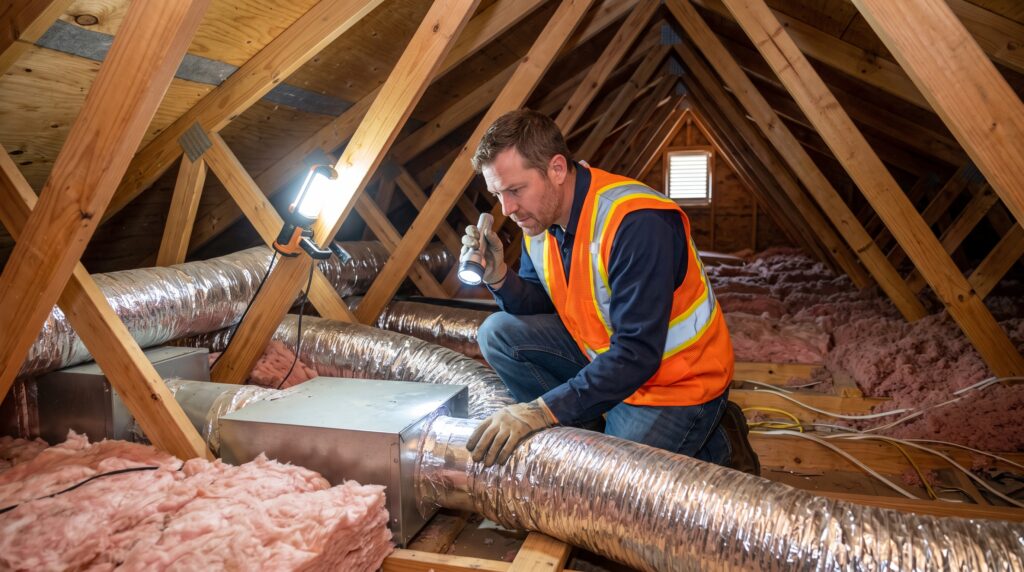
A Daikin gas furnace runs $3,600 to $10,500 installed in 2026, with most homeowners landing between $5,000 and $8,200 for a 96 percent AFUE single-stage unit in a typical 1,600 to 2,100 square foot home. The spread comes down to three things: the AFUE tier, whether the gas valve is single-stage, two-stage, or modulating, and whether your quote covers the current R-32-ready DR series or the outgoing DM series that Daikin is phasing out.
TL;DR: Daikin furnace installed cost is $3,600–$10,500 depending on efficiency tier and staging. The current lineup is the R-32-ready DR series (upflow and horizontal) and DD series (downflow and horizontal): DR80SN-U and DR80TC at 80% AFUE, DR96SN and DR96TC in the 96 to 97.5 percent band, and the modulating DR97MC. Daikin’s spec sheet rates the DR97MC at 97% AFUE even though its product page advertises up to 98%. Every 12-year warranty requires online registration within 60 days, and the unit replacement term is 6 or 12 years depending on the model. The federal 25C tax credit expired after December 31, 2025, so a 2026 install earns no federal credit. Get your estimate.
How Much Does a Daikin Furnace Cost Installed?
Expect $3,600 to $10,500 installed. Daikin does not publish retail pricing and sells only through dealers, so the number on your quote is set by the model tier, your local labor rate, and the dealer’s margin. The tier is the part you control, and it moves the price nearly $7,000 from bottom to top.
| Model line | AFUE | Staging and blower | Installed cost |
|---|---|---|---|
| DR80SN-U / DD80SN | 80% | Single-stage, 9-speed ECM | $3,600–$6,200 |
| DR80TC / DD80TC | 80% | Two-stage, variable-speed | $4,400–$7,400 |
| DR92SN | 92% | Single-stage, multi-speed ECM | $4,600–$7,600 |
| DR96SN / DD96SN | Up to 97% | Single-stage, 9-speed ECM | $5,000–$8,200 |
| DR96TC / DD96TC | Up to 97.5% | Two-stage, variable-speed | $5,900–$9,400 |
| DR97MC / DD97MC | 97% | Modulating, variable-speed | $6,800–$10,500 |
These figures cover the furnace, standard installation labor, a basic flue connection, startup, and a routine permit. They do not cover a new evaporator coil, a chimney liner, duct replacement, or a gas line upgrade. Those are separate line items, and the section on extras below prices each one.
For context, our all-brand furnace replacement cost guide puts the national range at $2,500 to $11,200 installed. Daikin sits above the bottom of that band because the entry Daikin furnace already carries a 9-speed ECM blower where several competitors still ship a PSC motor at the same efficiency, and because Daikin’s warranty terms are longer than the 10-year industry parts standard.
For a number tailored to your home size, climate, and region, run our free HVAC cost estimator. For Daikin pricing across air conditioners, heat pumps, and mini-splits, see the Daikin HVAC replacement cost guide.
Which Daikin Furnace Models Are Current in 2026?
The current generation is the DR and DD series. Daikin replaced the older DM and DC series as part of the R-32 refrigerant transition, and both generations still appear on Daikin’s website and in distributor stock, which is exactly why quotes are confusing right now. Read the second letter of the model number and you know which generation you are being sold.
- DR is the current generation in upflow and horizontal configurations.
- DD is the current generation in downflow and horizontal configurations.
- DM is the prior generation, upflow and horizontal (DM80VC, DM96VC, DM96SN, DM97MC).
- DC is the prior generation, downflow and horizontal (DC80VC, DC96VC, DC97MC).
Here is what Daikin’s own specification sheets state for the current lineup, verified on August 1, 2026. Every figure below came from the model’s published spec sheet PDF, not from a dealer listing.
| Model | AFUE on the spec sheet | Gas valve | Blower motor | Heating input |
|---|---|---|---|---|
| DR97MC / DD97MC | 97% on every listed size | Self-calibrating modulating | Variable-speed ECM, communicating | 60,000–120,000 BTU/h |
| DR96TC / DD96TC | Up to 97.50%, sizes vary 96.10 to 97.50 | Two-stage | Variable-speed ECM, communicating | 40,000–120,000 BTU/h |
| DR96SN / DD96SN | Up to 97%, most sizes 96% | Single-stage | 9-speed tap ECM | 40,000–120,000 BTU/h |
| DR80TC / DD80TC | 80% | Two-stage | Variable-speed ECM | 60,000–100,000 BTU/h |
| DR80SN-U | 80%, ultra-low NOx | Single-stage | 9-speed tap ECM | 40,000–80,000 BTU/h |
One spec discrepancy worth knowing before you sign. Daikin’s DR97MC product web page headlines “Up to 98% AFUE.” The DR97MC and DD97MC specification sheet states 97 percent AFUE on the cover and lists 97 for all nine model sizes in its product specification table, and Daikin’s consumer product catalog also says up to 97 percent. Two of Daikin’s three published sources, including the authoritative spec sheet, say 97. If a dealer’s proposal claims 98 percent AFUE, ask for the AHRI certificate for the exact model number being installed. A one-point AFUE difference is worth roughly $10 to $15 a year on an average gas bill, so this is a credibility test rather than a money question.
The other model-number letters follow a consistent pattern. SN is a single-stage gas valve with a multi-speed ECM blower, TC is a two-stage gas valve with a variable-speed communicating blower, and MC is a modulating gas valve with a variable-speed communicating blower. A trailing -U or -ULN means an ultra-low NOx version required in parts of California and Texas. Cabinet widths on the DR80TC run 17.5, 21, and 24.5 inches, which matters if you are squeezing a replacement into an existing closet.
What Does a Daikin Furnace Cost by Size?
Furnace size is measured in BTU per hour of heating input, and Daikin’s current lineup spans 40,000 to 120,000 BTU/h. Size moves price far less than efficiency tier does. Going from the smallest to the largest DR96SN adds about $1,400 to the low end of the range, while jumping from an 80 percent single-stage to a 97 percent modulating unit adds $3,200 or more.
| Heating input | Typical home size | Installed cost, DR96SN tier |
|---|---|---|
| 40,000 BTU/h | 800–1,200 sq ft | $5,000–$6,600 |
| 60,000 BTU/h | 1,200–1,600 sq ft | $5,300–$7,000 |
| 80,000 BTU/h | 1,600–2,100 sq ft | $5,600–$7,400 |
| 100,000 BTU/h | 2,100–2,600 sq ft | $6,000–$7,900 |
| 120,000 BTU/h | 2,600–3,200 sq ft | $6,400–$8,200 |
The square footage column is a sanity check, not a sizing method. Real sizing comes from a Manual J load calculation that accounts for your insulation, window area, air leakage, ceiling height, and climate zone. A 1,900 square foot home in Denver and a 1,900 square foot home in Atlanta do not need the same furnace, and a well-sealed 2,400 square foot new build can need less heat than a drafty 1,600 square foot house from 1955.
Oversizing is the most common furnace mistake and it costs money twice. You pay more for the larger unit, then you live with short cycling, uneven temperatures, and a blower that never settles into its efficient range. If a contractor sizes your replacement by reading the nameplate on the old furnace, get another quote. The old furnace may itself have been oversized, and a 20-year-old sizing decision does not account for the windows or insulation you have added since.
What Does Each Efficiency and Staging Upgrade Add?
Each step up the Daikin ladder adds $600 to $1,200, and the full jump from the entry 80 percent single-stage to the top modulating unit adds $3,200 to $4,300. Every figure below is the difference between two rows in the tier table above.
| Upgrade | From | To | Added cost |
|---|---|---|---|
| 80% single-stage to 80% two-stage variable-speed | $3,600–$6,200 | $4,400–$7,400 | +$800–$1,200 |
| 80% two-stage to 96% single-stage | $4,400–$7,400 | $5,000–$8,200 | +$600–$800 |
| 96% single-stage to 96/97.5% two-stage | $5,000–$8,200 | $5,900–$9,400 | +$900–$1,200 |
| 96/97.5% two-stage to 97% modulating | $5,900–$9,400 | $6,800–$10,500 | +$900–$1,100 |
| 80% single-stage to 97% modulating | $3,600–$6,200 | $6,800–$10,500 | +$3,200–$4,300 |
Whether any of that pays back depends almost entirely on how many hours the furnace actually runs. Fuel cost scales inversely with AFUE, so stepping from 80 to 96 percent cuts about 17 cents from every gas dollar. On a $900 annual heating bill that is roughly $150 a year, and a $600 to $800 upgrade returns in four to six heating seasons. On a $300 annual bill in a mild climate the same step saves about $50 a year and takes 12 to 16 years to return, which is the entire service life of the equipment.
The staging upgrade is a different argument and it is mostly about comfort, not payback. A two-stage or modulating furnace runs longer at lower fire, which evens out temperatures between rooms and cuts the temperature swing you feel when a single-stage unit blasts and shuts off. Here is how the decision usually resolves:
- Cold climate, five or more heating months: take the 96 percent tier at minimum. The DR96SN pays for itself, and the DR96TC two-stage is worth the extra $900 to $1,200 if you have rooms that never feel right.
- Mild climate, two or three heating months: the 80 percent DR80SN-U is usually the honest answer. Put the saved money into duct sealing or attic insulation, which pay back in both seasons.
- You already have a chimney-vented water heater: price the chimney liner before you commit to a 96 percent furnace. It can erase the efficiency savings for years.
- Two-story home with a hot upstairs: the modulating DR97MC and its long low-fire run times do more for that problem than any single-stage unit at any efficiency.
- You plan to move within five years: stay at the 80 percent tier. Buyers rarely pay a premium for furnace staging.
Our HVAC cost by efficiency guide works through the payback math across system types, and our gas furnace replacement cost guide covers the same efficiency decision without the brand constraint.
What Extras Push a Daikin Furnace Quote Higher?
The tier tables above cover the furnace and standard labor. Everything below is an addition on top of those ranges, and this is where two quotes for the same DR96TC end up $2,500 apart without either contractor doing anything wrong.
| Extra work | Added cost |
|---|---|
| Concentric or sidewall venting for a condensing furnace | +$400–$900 |
| First PVC flue and condensate drain in the home | +$500–$1,400 |
| Condensate pump | +$150–$400 |
| Chimney liner when an 80% furnace leaves an orphaned water heater | +$700–$2,000 |
| Downflow or horizontal conversion and duct transitions | +$300–$900 |
| Matched R-32 evaporator coil installed at the same time | +$700–$1,600 |
| Daikin One+ communicating thermostat | +$350–$700 |
| Propane conversion kit and labor | +$150–$400 |
| Permit and inspection | +$75–$400 |
| Gas line or electrical work | +$300–$1,500 |
Two of these deserve extra attention. The chimney liner catches homeowners who move from an 80 percent furnace to a condensing model: the old furnace and the water heater shared the masonry chimney, and once the furnace vents out a PVC sidewall pipe the water heater is left venting alone into a flue far too large for it. That causes condensation and eventually flue damage, so code generally requires a properly sized liner. Nobody mentions it until the quote arrives.
The communicating thermostat is the other one. The DR96TC, DR97MC, and DD equivalents are communicating furnaces, and they hand over their modulation logic, staging, and fault-code reporting through the Daikin One+ link. A modulating furnace running on a generic third-party thermostat still heats, but you gave up part of what you paid for. If a quote saves $500 by omitting the Daikin control on an MC or TC model, that is a downgrade rather than a discount. Permit pricing varies widely by jurisdiction; our HVAC permit cost guide covers what to expect in your area.
Why the R-32 Sensor on a 2026 Daikin Furnace Changes Your Quote
Every DR and DD furnace ships with a control board that watches for a refrigerant leak in the indoor coil sitting on top of it, and that single feature is the reason mixing generations goes wrong. Daikin’s DR96TC and DD96TC installation instructions state that the furnace “is equipped with a control board that is capable of shutting off the gas heat and turning on the blower fan in case of an R-32 refrigerant leak in the indoor cooling unit,” and that if the paired cooling unit does not use R-32, the R-32 functions in the control board have to be turned off for the furnace to run properly.
R-32 is an A2L refrigerant, mildly flammable, and the industry moved to it as R-410A production winds down under EPA phase-down rules. The mitigation logic is the safety answer. When the sensor on the indoor coil detects a set concentration of R-32, Daikin says the furnace enters Mitigation Mode and does four things:
- Displays the A2L refrigerant leakage error code EA0.
- Shuts down gas operation entirely.
- Energizes the optional ventilation and alarm outputs.
- Runs the blower at maximum CFM to dilute the refrigerant.
Once the sensor stops detecting a leak, the fan keeps running for five minutes before the control returns to normal thermostat operation. The A2L function is enabled by default and is switched off through the A2E menu on the furnace control board.
Here is what that means for the quote in your hand. If you are replacing only the furnace and keeping an existing R-410A evaporator coil, the installer has to disable the A2L function during commissioning. Skipping that step is a no-heat call in November, and it is one of the most common new-generation callbacks contractors are seeing. If you are replacing the furnace now and expect to replace the air conditioner within a few years, the DR or DD furnace is the right buy because the leak-mitigation function will actually be live once the R-32 coil goes in. And if a dealer offers you a discounted DM or DC furnace, understand you are buying a unit with no A2L capability, which forecloses that pairing later.
Ask any Daikin dealer two questions: which refrigerant the coil above the furnace uses, and whether the A2L function will be enabled or disabled at startup. A contractor who cannot answer both has not commissioned many of these. If you are replacing both pieces at once, our AC and furnace replacement cost guide covers the combined pricing and why doing them together is usually cheaper than two separate visits.
Daikin, Goodman, and Amana — Are You Paying for the Badge?
Partly, and it is worth knowing exactly how much. Daikin Comfort Technologies North America supplies the Daikin, Goodman, Amana, and Quietflex brands, and Daikin Texas Technology Park in Waller, Texas consolidates manufacturing, engineering, logistics, marketing, and sales for the Goodman, Amana, and Daikin brands under one roof. Daikin Industries acquired Goodman in 2012 and renamed the US subsidiary Daikin Comfort Technologies North America in 2022. The three badges are corporate siblings built in the same plant.
That does not make them identical furnaces. The shared platform means shared heat exchanger design, shared control architecture, and shared parts supply, which is genuinely good news for long-term serviceability on any of the three. Where they differ is in feature content at a given tier, warranty terms, and how the dealer network is structured. The price gap is real money: our Goodman guide prices a comparable 96 percent single-stage Goodman at $2,800 to $4,800 installed against $5,000 to $8,200 for the Daikin DR96SN, a gap of roughly $2,200 to $3,400. Much of that is the warranty, the communicating control, and the dealer channel rather than the metal.
The practical rule: if you want the longest warranty terms, the communicating Daikin One+ ecosystem, and a system where the furnace, coil, and outdoor unit all talk to each other, the Daikin badge earns its premium. If you want a reliable single-stage 80 or 96 percent furnace at the lowest defensible price and you do not care about communicating controls, the Goodman equivalent is a legitimate way to save $2,200 to $3,400 out of the same factory. The Amana line sits between them. Our furnace replacement cost by brand guide puts all three against Carrier, Trane, and Lennox.
What Is the Daikin Furnace Warranty Actually Worth?
The parts term is 12 years across the current furnace lineup, against a 10-year industry standard, and the eligible models add a unit replacement warranty that no major competitor matches on a furnace. Against a typical repair bill, those two extra parts years plus the replacement provision are worth roughly $800 to $2,000 in avoided risk, because the inducer motor, control board, and variable-speed blower module are the expensive failures and they cluster after year 10.
The conditions are where homeowners lose it. Daikin’s DR80TC and DR97MC spec sheets both state that to receive the Lifetime Heat Exchanger Limited Warranty, the 12-Year Unit Replacement Limited Warranty, and the 12-Year Parts Limited Warranty, online registration must be completed within 60 days of installation. The details that trip people up:
- Registration is required within 60 days of installation, and it is not the dealer’s legal obligation unless your contract says so.
- The unit replacement warranty carries annual maintenance requirements. Skipped maintenance can void it, and Daikin can ask for records.
- The unit replacement term is not the same on every model. Daikin’s DR96SN spec sheet brackets it as a 6-year or 12-year term, and the DR96SN product page lists 6 years while the DR80TC and DR97MC sheets list 12.
- The heat exchanger term is written three different ways across Daikin’s own documents: a lifetime warranty on the DR80TC and DR97MC spec sheets, a 99-year warranty on the DR96SN sheet, and a 20-year term plus a one-time replacement on the product web pages. The certificate for your model controls.
- Online registration and some other requirements are not required in Florida, California, or Québec, and coverage duration differs in some cases in Texas and Florida.
Before you sign, get three things in writing: the exact furnace model number, the applicable warranty certificate for that model, and a statement of who performs the registration and by what date. Then verify the registration went through yourself at the 60-day mark. Labor is a separate matter. The 12-year term covers parts, not the labor to install them, and a blower module replacement in year 11 still runs $400 to $900 in labor.
Source check: Warranty language verified against Daikin’s DR97MC/DD97MC, DR96TC/DD96TC, DR96SN/DD96SN, and DR80TC/DD80TC specification sheets and the Daikin standard warranty information page on August 1, 2026. Terms are model and state specific and change without notice.
Does a Daikin Furnace Qualify for a Federal Tax Credit in 2026?
No. The Section 25C Energy Efficient Home Improvement Credit is not available for a furnace placed in service in 2026. The IRS states the credit is allowed for qualifying property placed in service on or after January 1, 2023 and before December 31, 2025. That was re-verified on August 1, 2026.
This matters because a large amount of furnace content still tells readers to expect up to $600 back on a 97 percent AFUE unit. Under the rules that expired, a qualifying natural gas furnace earned 30 percent of project cost up to $600, with a $3,200 annual cap across all categories. If a 2026 quote shows a federal credit as a line item reducing your net cost, that quote is wrong and your real out-of-pocket is $600 higher than the sheet suggests.
What still exists is local. State energy offices, gas and electric utilities, and municipal programs run their own high-efficiency furnace rebates on separate timelines, and some gas utilities still pay a few hundred dollars for a 95 percent AFUE or better furnace. Your utility’s own website is the authoritative source for its current program, and Daikin maintains a rebate lookup by ZIP code. Check both before you assume the incentive column is empty. Also disregard any urgency built on an R-410A installation deadline: EPA removed the January 1, 2026 installation cutoff, so an R-410A system already in stock can still be installed.
Source check: Federal credit status verified against the IRS Energy Efficient Home Improvement Credit page on August 1, 2026. Tax rules change; confirm current status with a tax professional before filing.
Frequently Asked Questions
How much does a Daikin furnace cost installed?
A Daikin gas furnace runs $3,600 to $10,500 installed in 2026. An entry 80 percent single-stage DR80SN-U lands at $3,600 to $6,200, a 96 percent single-stage DR96SN at $5,000 to $8,200, and the modulating DR97MC at $6,800 to $10,500. Extras such as a chimney liner, new PVC venting, or a matched coil are additions on top of those ranges.
What is the difference between a Daikin DR and DM furnace?
DR is the current R-32-ready generation and DM is the prior generation being phased out. Both are upflow and horizontal multi-position furnaces, and the DD and DC series are their downflow equivalents. The functional difference is the control board: DR and DD models carry A2L refrigerant leak detection that shuts down gas operation and runs the blower at maximum airflow if the paired R-32 coil leaks. DM and DC models have no such capability.
Is a Daikin furnace the same as a Goodman furnace?
They share a manufacturer but they are not the same unit. Daikin Comfort Technologies North America supplies the Daikin, Goodman, and Amana brands, and Daikin Texas Technology Park in Waller, Texas consolidates manufacturing for all three. The platforms and parts supply are shared. What differs is feature content, warranty terms, and dealer structure. A comparable 96 percent single-stage Goodman runs $2,800 to $4,800 installed against $5,000 to $8,200 for the Daikin DR96SN, a gap of roughly $2,200 to $3,400.
Is the Daikin DR97MC really 98 percent AFUE?
Daikin’s product web page advertises up to 98 percent, but the DR97MC and DD97MC specification sheet states 97 percent AFUE on its cover and lists 97 for all nine model sizes in the specification table. Daikin’s consumer catalog also says up to 97 percent. Use 97 percent as your planning number and ask for the AHRI certificate for the exact model number if a proposal claims otherwise.
Does a Daikin furnace qualify for the federal tax credit in 2026?
No. The Section 25C Energy Efficient Home Improvement Credit applied to property placed in service before December 31, 2025, per the IRS. A Daikin furnace installed in 2026 earns no federal credit, even on a 97 percent AFUE model that would have qualified for up to $600 under the old rules. State, utility, and municipal rebates run on separate timelines and many are still active, so check your gas utility’s program before assuming there is nothing available.
How long is the Daikin furnace warranty and what voids it?
Current Daikin furnaces carry a 12-year parts limited warranty plus a unit replacement warranty of 6 or 12 years depending on the model. Both require online registration within 60 days of installation, and the unit replacement term also carries annual maintenance requirements that skipped service can void. Registration and some requirements are waived in Florida, California, and Québec, and coverage duration differs in some cases in Texas and Florida.
Getting an Accurate Daikin Furnace Quote
Daikin is dealer-only with no published retail price, so dealer margin drives more of the final number than it does on a brand you can price at a supply house. Three quotes from contractors who install the current DR and DD generation regularly will tell you more than any published range, including this one.
Ask every dealer for the same five items so the quotes are actually comparable:
- The exact furnace model number, so you know whether it is the current DR or DD generation or the outgoing DM or DC.
- The Manual J result that produced the BTU input, not a match to the old nameplate.
- Which refrigerant the coil above the furnace uses, and whether the A2L function will be enabled or disabled at startup.
- The warranty certificate for that specific model, plus who registers the system and by what date.
- A line-item price with venting, condensate, chimney liner, permit, and any gas or electrical work broken out separately.
Start with a baseline number from our free HVAC cost estimator before the first contractor visit. For how Daikin furnaces fit alongside the rest of the brand’s lineup, see the Daikin HVAC replacement cost guide and our Daikin Fit system cost guide, which covers the inverter system these furnaces pair with for dual fuel. For national context on what any full replacement should cost, see our HVAC replacement cost guide.