
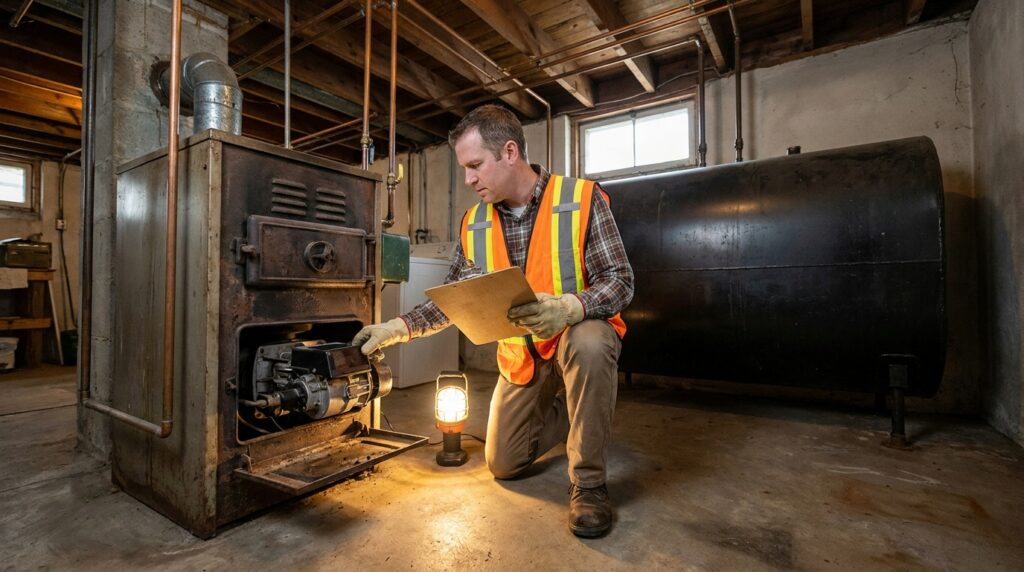
Replacing an oil furnace costs $5,500 to $13,500 installed in 2026, and the number that surprises most homeowners is not the furnace itself. It is the chimney liner and the oil storage tank, two line items that never appear on a gas or electric furnace quote and can add thousands each. This guide prices the furnace, the add-ons most quotes leave out, and the two conversion paths (oil to gas, and oil to a heat pump) that many oil-heated households are weighing instead of a straight swap.
TL;DR: Expect $5,500–$13,500 installed for the furnace alone, or $7,600–$21,900 once a new chimney liner and oil tank are included. Modern oil furnaces run 83–87.5% AFUE, and there is no condensing oil furnace, so the 96%+ ratings you see on gas equipment do not exist here. The two wildcards are the flue liner ($900–$3,800) and the tank ($1,200–$4,600). Converting to gas runs $3,700–$17,900; converting to a heat pump runs $4,500–$19,400 before state rebates, and cuts annual heating cost by roughly 2.5x. The federal 25C credit is gone for 2026 installs. Get your estimate.
How Much Does an Oil Furnace Replacement Cost in 2026?
Most homeowners pay $5,500 to $13,500 to replace an oil furnace in 2026, with a mid-range unit in an average-sized home landing near $8,900. That price covers the furnace, labor, basic materials, the permit, and the inspection. It does not cover a chimney liner or a new oil tank, which are priced separately further down because not every job needs them.
| Cost Tier | Installed Price | Typical Unit |
|---|---|---|
| Budget | $5,500–$7,500 | 83% AFUE, single-stage, standard PSC blower |
| Mid-range | $7,500–$10,000 | 85–86% AFUE, ECM blower |
| Premium | $10,000–$13,500 | 87%+ AFUE, variable-speed ECM, premium brand |
Equipment is roughly 45 to 55% of that total, labor 30 to 40%, and the balance covers the oil line, filter, fittings, permit, and combustion setup. The labor share is higher than on a gas job because an oil burner has to be commissioned with a combustion analyzer rather than simply lit and left. A technician sets the nozzle and electrode gap, then measures draft, smoke number, and CO2 and adjusts air until the burn is clean. That is typically a one to two hour step on top of the physical install.
For context on where this sits among fuel types, a gas furnace replacement runs $2,800 to $7,500 and an electric furnace replacement runs $1,500 to $6,500. Oil is the most expensive of the three to install, and as the operating cost section below shows, it is also the most expensive to run.
What Drives the Cost of an Oil Furnace Replacement?
Five variables determine where your project lands inside the $5,500 to $13,500 range. Two of them are unique to oil heat.
Furnace Size (BTU Input)
Residential oil furnaces are sized by BTU input, generally 56,000 to 154,000 BTU, and are fired at a nozzle rate measured in gallons per hour. Sizing should come from a Manual J load calculation, not from the rating of the furnace being removed. Oversizing is common on oil replacements because contractors match the outgoing unit, and homes that have since been insulated or had windows replaced no longer need that capacity. An oversized oil furnace short-cycles, which fouls the nozzle faster and shortens burner life.
AFUE Efficiency Rating
The spread between an 83% AFUE base model and an 87%+ premium unit is worth roughly $2,000 to $4,000 in installed price. That is a narrower efficiency band than gas offers, so the payback math works differently. See the AFUE section below for the specific annual savings.
Chimney and Flue Liner Condition
This is the first cost unique to oil. Oil furnaces vent into a masonry chimney rather than out a sidewall through PVC, because their flue gases stay hot and are not condensing. If your chimney is unlined, or the existing liner is cracked, undersized for the new appliance, or deteriorated from years of acidic flue gas, it has to be relined before the new furnace can be commissioned. A stainless steel liner runs $900 to $3,800 installed, or roughly $20 to $90 per linear foot, though most installers hold a job minimum near the low end, so a short chimney rarely prices below about $900 even at the cheapest per-foot rate. Many homeowners first hear about this after the quote arrives, so ask whether the chimney has been inspected before you compare bids.
Oil Tank Age and Location
The second oil-specific cost. A tank at the end of its life is worth replacing while the crew is already on site. Tank costs and the triggers for replacing one are covered in their own section below.
Regional Labor Rates
About 82% of U.S. heating-oil households are in the Northeast, according to the U.S. Energy Information Administration, and Northeast HVAC labor runs at the high end of the national range. The same furnace installed in rural Maine and in the Boston or New York metro can differ by $1,500 or more on labor alone. If your home also has aging ducts or knob-and-tube-era infrastructure, our guide to HVAC replacement in older homes covers the complications that add cost.
How Much Does an Oil Furnace Cost by Home Size and BTU?
Use this table as a starting range, then confirm the capacity with a load calculation before you accept a quote.
| Home Size (sq ft) | Typical BTU Input | Nozzle Rate (gph) | Installed Cost |
|---|---|---|---|
| 1,000–1,500 | 56,000–70,000 | 0.40–0.50 | $5,500–$8,500 |
| 1,500–2,000 | 70,000–91,000 | 0.50–0.65 | $6,500–$10,000 |
| 2,000–2,800 | 91,000–105,000 | 0.65–0.75 | $7,500–$11,500 |
| 2,800+ | 105,000–154,000 | 0.75–1.10 | $8,500–$13,500 |
These are furnace-only figures on the same basis as the tier table above. A 1,900 sq ft home in Connecticut needing an 85% AFUE unit with an ECM blower would sit in the second row and the mid-range tier at the same time, around $8,000 to $9,500, before any liner or tank work.
What AFUE Can You Actually Get from a New Oil Furnace?
Between 83% and about 87.5%. If you have been reading gas furnace guides, this is the single most important correction on this page: there is no condensing oil furnace. The 95%, 96%, and 98% AFUE ratings that are routine on gas equipment do not exist in the residential oil market, because heating oil flue gas carries sulfur compounds that turn corrosive when condensed. Manufacturers have not built a mass-market residential furnace that survives that.
The federal floor is 83% AFUE for non-weatherized oil furnaces. In its October 2024 final determination, the Department of Energy analyzed raising that floor to 85% and 87% AFUE and concluded it would not amend the standards for oil, electric, and weatherized gas furnaces. The 83% minimum therefore stays in place, and the ceiling stays where the market has put it. At the top end, current equipment such as the Bryant Legacy OBL is rated up to 87.5% AFUE.
Here is what that narrow band is worth. For a home needing 60 million BTU of delivered heat per season, using the EIA figure of 138,500 BTU per gallon of heating oil:
- At 83% AFUE, the home burns about 522 gallons per season.
- At 87% AFUE, it burns about 498 gallons.
- The 24-gallon difference is worth roughly $133 per year at $5.535 per gallon.
If the premium unit costs $2,500 more installed, that is a payback near 19 years on fuel savings alone, which is longer than the furnace will last. The honest recommendation for most homeowners: buy 85 to 86% AFUE with a variable-speed ECM blower and spend the difference on the tank, the liner, or air sealing. The ECM blower is worth paying for on its own, because it cuts the electricity the furnace uses to move air regardless of what the burner is doing. For how efficiency ratings translate into cost across every system type, see our HVAC cost by efficiency guide.
Should You Replace the Oil Tank at the Same Time?
Often yes, because the labor overlaps and doing it later means paying twice for setup and system purging. A standard residential tank is 275 gallons, and tanks are the most commonly deferred and most commonly regretted item on an oil heating system.
| Tank Work | Cost | Notes |
|---|---|---|
| Aboveground or basement tank replacement | $1,200–$3,300 | Standard 275-gallon swap, includes removal of the old tank |
| Underground tank removal plus new aboveground tank | $1,600–$4,600 | Excludes soil testing and any remediation |
| Tank removal only (converting away from oil) | $400–$3,400 | Wide range driven by access and whether the tank is buried |
Replace the tank now if any of these apply:
- The tank is more than 25 years old, or its age is unknown.
- You can see weeping, rust blisters, or damp spots along the seams or underside.
- The tank is buried. Underground tanks are the source of nearly all oil heat environmental liability.
- Your homeowners insurer or mortgage lender has flagged it, which is increasingly common for buried and older aboveground tanks.
- The legs, stand, or fill and vent piping do not meet current code.
The number to take seriously is the one not in the table. If a buried tank has leaked, soil testing and remediation are the homeowner’s responsibility, and cleanup costs routinely exceed the entire heating system project. That risk, more than fuel prices, is what pushes many households off oil entirely.
Putting the pieces together: the cheapest realistic all-in project (budget furnace, new liner, simple aboveground tank swap) is about $7,600. The most expensive (premium furnace, new liner, buried tank removed and replaced) reaches about $21,900. Most homeowners who need only one of the two add-ons land between $8,000 and $15,000.
What Does It Cost to Convert from Oil to Natural Gas?
Converting from oil to natural gas costs $3,700 to $17,900, and the spread is almost entirely about one question: is there a gas main in your street, and will the utility pay to run the service line to your house?
| Component | Cost |
|---|---|
| Gas service line from the street main | $0 (utility-funded) to $5,000 |
| Interior gas piping to the furnace location | $500–$2,000 |
| Gas furnace installed | $2,800–$7,500 |
| Oil tank removal and disposal | $400–$3,400 |
Many gas utilities subsidize or fully fund the service lateral when converting a home from oil, because they gain a long-term customer. Call the utility before you call an HVAC contractor, because that single answer moves the project by thousands of dollars. Note that a high-efficiency condensing gas furnace vents through PVC out a sidewall, which means the masonry chimney may be abandoned rather than relined, removing the liner cost from the project entirely.
Operating cost is the reason people do this. On the numbers in the next section, gas costs about a third of what oil costs to deliver the same heat. Full details on the equipment side are in our gas furnace replacement cost guide.
What Does It Cost to Convert from Oil to a Heat Pump?
Converting from oil to a heat pump costs $4,500 to $19,400 before incentives. Unlike the gas path, this one does not depend on a utility running new infrastructure to your house, which is why it is the more common conversion in oil-heated areas without gas service.
| Component | Cost |
|---|---|
| Ducted air-source heat pump installed | $4,500–$14,000 |
| Electrical panel upgrade if needed | $0–$2,000 |
| Oil tank removal and disposal | $0–$3,400 |
Many Northeast homeowners keep the oil furnace as backup rather than removing it, which drops the tank line to zero and creates a dual-fuel system: the heat pump handles most of the season and the oil furnace covers the coldest days. That is often the lowest-risk path in climate zones 5 and higher.
Which Incentives Actually Apply in 2026
The federal picture changed. The Section 25C Energy Efficient Home Improvement Credit applied to qualifying property placed in service before December 31, 2025, so it is not available for a 2026 installation. Do not let a contractor build it into your net-cost math. State and utility programs are now where the money is, and they vary enormously. Two of the largest, both verified on August 2, 2026:
- Massachusetts (Mass Save): whole-home air-source heat pump rebates of $2,650 per ton up to $8,500, partial-home at $1,125 per ton up to $8,500, and income-eligible households up to $16,000 or no cost through Turnkey Services. Equipment must be installed between January 1 and December 31, 2026. See the Mass Save air source heat pump page for current terms.
- Maine (Efficiency Maine): whole-home heat pump rebates of $2,000 standard, $4,000 for moderate-income households, and $6,000 for low-income households. Current terms are on the Efficiency Maine heat pump page.
Program funding is finite and application windows close without much warning, so confirm status directly with the administrator before you sign a contract. For programs in other states, search the DSIRE database, and see our 2026 IRA HVAC rebates guide for how the state-administered programs work and which states are currently open.
Applied to the worst case above, a $19,400 Massachusetts conversion that captures the full $8,500 whole-home rebate nets out at $10,900. For equipment-side detail, see our heat pump replacement cost guide.
What Does It Cost to Run an Oil Furnace vs Gas and a Heat Pump?
Oil is the most expensive of the three common heating fuels to operate. The table below is built from published EIA Btu conversion factors and published EIA prices, for a home needing 60 million BTU of delivered heat per season (roughly a 2,000 sq ft Northeast house). Fuel quantities are shown so you can check the arithmetic against your own usage.
| System | Efficiency | Fuel Used Per Season | Rate | Annual Heating Cost |
|---|---|---|---|---|
| Oil furnace | 83% AFUE | 522 gallons | $5.535/gal | $2,889 |
| Oil furnace | 87% AFUE | 498 gallons | $5.535/gal | $2,756 |
| Gas furnace | 95% AFUE | 61.0 Mcf | $15.34/Mcf | $935 |
| Heat pump (U.S. average) | COP 2.8 | 6,280 kWh | $0.1844/kWh | $1,158 |
| Heat pump (New England) | COP 2.5 | 7,034 kWh | $0.2814/kWh | $1,979 |
Heating oil prices are from the EIA weekly residential heating oil series for the week ending March 30, 2026, the last reported week of the 2025 to 2026 heating season. Natural gas is the 2025 U.S. annual residential average. Electricity is the May 2026 residential average from the EIA Electric Power Monthly.
Three conclusions come straight out of that table. Oil costs about 3.1 times what natural gas costs to deliver the same heat, which is why the gas conversion pays back quickly wherever a gas main is available. Oil costs about 2.5 times what a heat pump costs at the U.S. average electricity rate. And the New England row is the one most guides leave out: at 28.14 cents per kWh and a colder-climate seasonal COP of 2.5, a heat pump there costs $1,979 rather than $1,158, so the annual saving against oil is about $910 instead of $1,731. That is still a real saving, but it roughly doubles the payback period, and it is the reason a heat pump conversion that pencils out easily in Pennsylvania is a closer call in Connecticut or Massachusetts.
One caveat on the heat pump rows: seasonal COP is not a fixed number. A cold-climate model in a well-sealed house can beat 2.8, and any heat pump leaning on electric backup strips during a cold snap will fall below 2.5. Ask for the manufacturer’s rated capacity and COP at your design temperature, not just the nameplate HSPF2.
Frequently Asked Questions
How long does an oil furnace last?
An oil furnace lasts 20 to 25 years with annual service, which is longer than a typical gas furnace at 15 to 20 years. Oil furnaces use heavier heat exchangers built to handle a dirtier, sootier flame, and that heavier construction is the main reason they outlast gas equipment. The tradeoff is that they need yearly professional service, not optional maintenance. An oil furnace that skips annual nozzle, filter, and burner service will soot up, lose efficiency, and can fail well before year 15.
What AFUE rating should I look for in a new oil furnace?
Look for 85% AFUE or better. The federal minimum for non-weatherized oil furnaces is 83% AFUE, and the practical ceiling on the residential market is about 87.5%. There is no condensing oil furnace category, so the 96% and higher ratings common on gas equipment simply do not exist for oil. Moving from 83 to 87% AFUE cuts consumption by about 24 gallons a year for a home needing 60 million BTU of heat, worth roughly $133 a year at the $5.535 per gallon national price EIA reported for the week ending March 30, 2026.
Do I have to replace my oil tank when I replace the furnace?
Not automatically, but it is worth pricing at the same time because the labor overlaps. Replace the tank now if any of these apply:
- The tank is more than 25 years old.
- You can see weeping, rust blisters, or damp spots on the seams or bottom.
- The tank sits underground.
- Your insurer or lender has flagged it.
- The tank legs, stand, or fill and vent piping do not meet current code.
An aboveground or basement tank replacement runs $1,200 to $3,300. Removing a buried tank and installing a new aboveground tank runs $1,600 to $4,600. A leaking buried tank is the expensive scenario, because soil remediation is the homeowner’s liability and is not part of any of these figures.
Is it worth converting from oil to a heat pump in 2026?
In most oil-heated homes the operating savings are large, and the decision comes down to whether a state or utility program covers enough of the upfront cost. For a home needing 60 million BTU of heat per season, an 83% AFUE oil furnace costs about $2,889 a year at the national heating oil price, while a heat pump at a seasonal COP of 2.8 costs about $1,158 at the 18.44 cents per kWh U.S. average, roughly 2.5 times less. Three things decide it:
- The conversion runs $4,500 to $19,400 depending on panel and tank work.
- Your state program matters more than any federal credit now that Section 25C has expired for property placed in service after December 31, 2025.
- Your electricity rate matters enormously. In New England, where residential electricity averaged 28.14 cents per kWh in May 2026, a heat pump running at a colder-climate seasonal COP of 2.5 costs about $1,979 a year, so it still saves about $910 against oil but the payback is slower.
Does an oil furnace qualify for a federal tax credit in 2026?
No. The Section 25C Energy Efficient Home Improvement Credit applied to qualifying property placed in service before December 31, 2025, and it is not available for a 2026 installation. When the credit was live, a qualifying oil furnace or hot water boiler was capped at $600 per item. If your qualifying oil furnace was placed in service in 2025, you can still claim it on IRS Form 5695 with your 2025 return, so keep the manufacturer certification statement and the installation invoice. For a 2026 project, budget from the full installed price and look to state and utility programs instead. Our 2026 HVAC tax credit guide covers the federal cutoff in detail.
Why does an oil furnace cost more to install than a gas furnace?
An oil furnace installs for $5,500 to $13,500 against $2,800 to $7,500 for a gas furnace, and four things drive the gap:
- The equipment is built heavier, with a thicker heat exchanger and a pressure-atomizing burner assembly that has no gas equivalent.
- The market is far smaller, at about 4.79 million U.S. households on heating oil in the winter of 2023 to 2024, so there is less volume competition on equipment and labor.
- Commissioning takes longer, because an oil burner has to be set up with a combustion analyzer and draft, smoke, and CO2 all have to be measured and tuned rather than simply lit.
- About 82% of oil-heated homes are in the Northeast, where HVAC labor rates run at the high end of the national range.
Ready to price your own project? The HVAC Replacement Cost Estimator is free, takes about two minutes, and adjusts for your region, home size, system type, and efficiency tier. No email required. For the full picture across every system type, start with our HVAC replacement cost guide, or compare all three fuel types in the furnace replacement cost overview.