
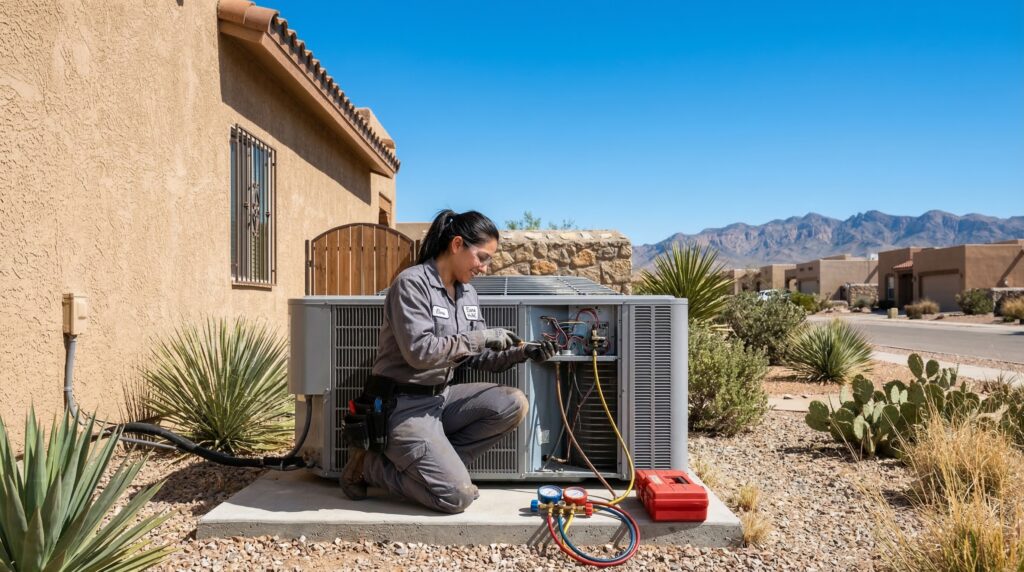
El Paso sits at the western tip of Texas in a desert climate unlike any other major Texas city. For comparison, Las Vegas, NV faces even more extreme desert conditions with summer highs topping 110 degrees F. Summer temperatures routinely top 100°F, humidity stays in single digits for most of the year, and homes here have some of the lowest HVAC labor costs in the state. If you are planning a system replacement, or converting from an evaporative cooler to refrigerated air, this guide covers what El Paso homeowners actually pay and why.
TL;DR: El Paso HVAC replacement costs run $4,800–$14,500 depending on system type. The city sits in ASHRAE Climate Zone 3B (hot-dry desert), making AC the primary priority with mild winters requiring only modest heating capacity. El Paso Electric offers rebates of $87–$173 on qualifying central AC replacements through the Texas Residential Solutions Program. A City of El Paso mechanical permit ($75–$150) is required for all system replacements. Use the free cost estimator to get a Southwest-adjusted range for your home size.
What Does HVAC Replacement Cost in El Paso?
El Paso’s HVAC labor market runs below the Texas average. Bureau of Labor Statistics May 2024 data shows El Paso HVAC mechanics earning a median of $22.22 per hour ($46,210 per year), roughly 15% below the Texas statewide median of $25.99 per hour and 23% below the national median of $28.75 per hour. That labor advantage flows through to installation quotes.
| System Type | El Paso Cost Range (Installed) | Typical Scope |
|---|---|---|
| Central AC only (split system) | $4,800–$10,500 | Condenser + coil + labor, existing ductwork |
| Heat pump (full system) | $6,500–$13,500 | Heat pump replaces both AC and heat |
| Full system (AC + gas furnace) | $7,500–$14,500 | Air handler, furnace, condenser, labor |
| Evaporative cooler conversion | $7,500–$13,000 | New refrigerated AC system + ductwork installation |
| Ductless mini-split (single zone) | $2,800–$6,500 | One indoor head + outdoor unit, no ductwork |
These ranges reflect installed cost including equipment, labor, and standard refrigerant line set. Ductwork replacement or repair adds $1,500–$4,000 and is common in older El Paso homes. Permits are separate (see the permit section below).
Why Are El Paso HVAC Prices Lower Than Most Texas Cities?
Three factors keep El Paso’s HVAC replacement costs below Houston, Austin, and Dallas.
Labor rates are the biggest driver. At a median of $22.22 per hour, El Paso HVAC labor costs roughly $4–$6 less per hour than the Houston or Dallas markets. On a full-day installation that translates to $50–$100 in direct savings before contractor overhead is applied.
The competitive contractor market. El Paso has a dense local HVAC contractor base built partly around the large military presence (Fort Bliss) and partly around the conversion market for swamp coolers. More contractors competing for work moderates prices across the board.
Desert climate means simpler systems. El Paso’s dry climate (ASHRAE Zone 3B) rarely demands the high-tonnage, maximum-SEER2 systems that humid-climate markets require. Many homes use conventional split systems at standard efficiency tiers rather than variable-speed equipment, which reduces equipment costs compared to markets where humidity makes high-SEER2 systems essential.
For comparison: the Austin HVAC market runs 5–8% above Houston due to tech sector demand. El Paso trends the opposite direction, with costs consistently at or below the Texas average. You can compare city-by-city pricing across the state at the Texas HVAC cost hub.
Does El Paso Electric Offer Rebates for New AC Systems?
Yes. El Paso Electric (EPE) runs the Texas Residential Solutions Program for customers in its Texas service territory. As of January 2025, the rebate amounts for central AC and mini-split replacements are:
| Equipment Type | Efficiency Requirement | Replacement Rebate (Standard) | Early Retirement Rebate |
|---|---|---|---|
| Central AC / mini-split (21,000–26,999 BTU, ~2 ton) | SEER2 15.2, EER2 12.0 | $139 | $149 |
| Central AC / mini-split (27,000–32,999 BTU, ~2.5 ton) | SEER2 15.2, EER2 12.0 | $173 | $186 |
| Central AC / mini-split (21,000–26,999 BTU, ~2 ton) | SEER2 14.5–15.1 | $58 | $109 |
| Smart thermostat | ENERGY STAR certified | Available | Not applicable |
Rebates are paid as bill credits through EPE. Income-qualified households receive enhanced rebate amounts (30–35% higher). To qualify, equipment must be installed by a licensed HVAC contractor and the system must have an AHRI-certified SEER2 and EER2 rating. Submit the application to CLEAResult within 45 days of installation at clearesult.com/trade-ally/epe, or call EPE at (915) 521-4488.
Note on the federal 25C tax credit: The Section 25C Energy Efficient Home Improvement Credit expired on December 31, 2025. It is not available for 2026 installations. The EPE rebate above is independent and remains available.
How Does El Paso’s Desert Climate Affect Your HVAC System?
El Paso’s climate is fundamentally different from the rest of Texas. ASHRAE classifies it as Climate Zone 3B (hot-dry), while Houston, Dallas, Austin, and San Antonio are all Zone 2A or 3A (hot-humid). That difference shapes every aspect of system selection and maintenance.
Extreme summer heat. El Paso sees temperatures above 100°F regularly in June through August, with recorded highs near 110°F in heat events. Systems run almost continuously for weeks at a time during peak heat. The NOAA engineering weather data for El Paso shows a median extreme high of 105°F and roughly 420 hours per year above 93°F. Under this load, compressors age faster than in milder climates.
Dust storms clog your system. El Paso’s Chihuahuan Desert location brings haboobs (dust storms) that can occur dozens of times per summer. Dust coats condenser coils and clogs air filters within hours. Local HVAC professionals recommend checking filters monthly during summer (not quarterly as is standard elsewhere) and scheduling a condenser cleaning each fall to remove accumulated desert dust.
Monsoon humidity spikes. From mid-July through September, monsoon moisture pushes El Paso humidity from the typical 10–20% range up to 30–70% during storm events. Systems designed for dry-air cooling suddenly face a combined heat and humidity load they were not tuned for. Efficiency drops 20–40% during peak monsoon conditions, and any pre-existing refrigerant issues become apparent quickly.
Elevation reduces equipment capacity. At 3,918 feet above sea level, air is about 14% less dense than at sea level. HVAC equipment rated at standard conditions loses roughly 5–8% of its effective capacity at El Paso’s elevation. Qualified local contractors account for this in Manual J load calculations and may recommend sizing up a half-ton or full ton from what a sea-level calculation would suggest.
Do You Need a Permit to Replace HVAC in El Paso?
Yes. The City of El Paso’s Planning and Inspections Department requires a mechanical permit for all HVAC system replacements. Mechanical permits represent approximately 7% of the residential permit fee structure, with most standard residential HVAC replacements falling in the $75–$150 range.
Your licensed HVAC contractor handles the permit application as part of the installation. If a contractor offers to skip the permit to lower cost, that is a red flag: El Paso Electric requires licensed, permitted installation for rebate eligibility, and unpermitted work creates liability if you sell the home. For permit questions, contact the City of El Paso Planning and Inspections at (915) 212-0104 or OSSHelp@elpasotexas.gov.
Swamp Cooler vs. Refrigerated Air — Should You Convert?
El Paso is one of the few major Texas cities where a large share of homes still use evaporative (swamp) coolers rather than refrigerated air conditioning. For homeowners with swamp coolers, the conversion question is a major financial decision.
What swamp coolers do well: They work efficiently in El Paso’s dry non-monsoon climate, using 70–80% less electricity than a central AC system. Operating costs are significantly lower in April, May, and June when humidity stays below 20%.
Where they fall short: During monsoon season (July–September), humidity routinely climbs above 50%. At that point, evaporative cooling stops working. The system can only drop temperature by 10–15°F, and it adds humidity to an already-humid home. Refrigerated air removes humidity while cooling, maintaining comfort through monsoon conditions.
The case for converting:
- Refrigerated air provides year-round heating and cooling from one system
- Monsoon season comfort improves dramatically
- Modern heat pumps use much less electricity than older split systems
- EPE rebates apply to the new refrigerated system
- Increases home resale value in a market where refrigerated air is increasingly expected
Conversion cost runs $7,500–$13,000 for most El Paso homes. The higher end applies to homes that need new ductwork installed (common in homes built with swamp cooler-only systems that lack central ducts). Homes with existing ductwork from a prior system pay the lower end of the range. Reddit r/ElPaso reports 2,000 sq ft conversions running $8,000–$10,000 as of mid-2025.
Frequently Asked Questions
How much does HVAC replacement cost in El Paso, TX?
Central AC replacement runs $4,800–$10,500 installed. A full system (AC plus furnace or heat pump) runs $6,500–$14,500. Evaporative cooler conversions to refrigerated air run $7,500–$13,000 including ductwork. El Paso’s below-average labor rates (median $22.22/hr vs. $28.75/hr nationally) keep costs lower than most major Texas cities.
Does El Paso Electric offer rebates for new AC systems?
Yes, through the Texas Residential Solutions Program. Rebates of $87–$173 are available for central AC or mini-split replacements meeting SEER2 15.2 efficiency requirements. Higher rebates apply for early retirement of older equipment. Income-qualified households receive enhanced amounts. Call EPE at (915) 521-4488 or submit applications through clearesult.com/trade-ally/epe within 45 days of installation.
Should I convert from a swamp cooler to refrigerated air in El Paso?
For most homeowners, yes. Swamp coolers work well in El Paso’s dry spring but fail during July–September monsoon season when humidity climbs above 50%. Refrigerated air maintains comfort year-round and qualifies for EPE rebates. Conversion runs $7,500–$13,000 depending on whether new ductwork is needed. Homes with existing ductwork pay the lower end of that range.
How does El Paso’s monsoon season affect my air conditioning?
Monsoon season (July through September) pushes El Paso humidity from 10–20% up to 30–70% during storm events. Your AC must now remove heat and moisture simultaneously, reducing effective capacity by 20–40%. Dust storms throughout summer clog filters and coat condenser coils. Local HVAC companies recommend:
- Check and replace filters monthly from June through September
- Schedule a condenser coil cleaning each fall after monsoon season ends
- Shut off the AC circuit breaker during severe haboobs to prevent electrical surges
- Install a whole-house surge protector to guard against lightning-related damage
Do I need a permit to replace HVAC in El Paso?
Yes. The City of El Paso requires a mechanical permit for all HVAC replacements, typically $75–$150 for residential work. Your licensed HVAC contractor pulls the permit as part of the job. El Paso Electric also requires licensed, permitted installation for rebate eligibility. For permit questions, contact the City at (915) 212-0104 or OSSHelp@elpasotexas.gov.
Why does elevation affect HVAC sizing in El Paso?
El Paso sits at 3,918 feet above sea level, where air is roughly 14% less dense than at sea level. HVAC equipment loses 5–8% of its rated capacity at this elevation. Local contractors account for this in Manual J load calculations and often size systems a half-ton to full ton larger than a sea-level calculation would suggest for the same home. This is a standard practice in El Paso, not an upsell.
For side-by-side comparisons across Texas markets, see the Texas HVAC replacement cost guide covering Houston, Dallas, Austin, San Antonio, and Fort Worth.