
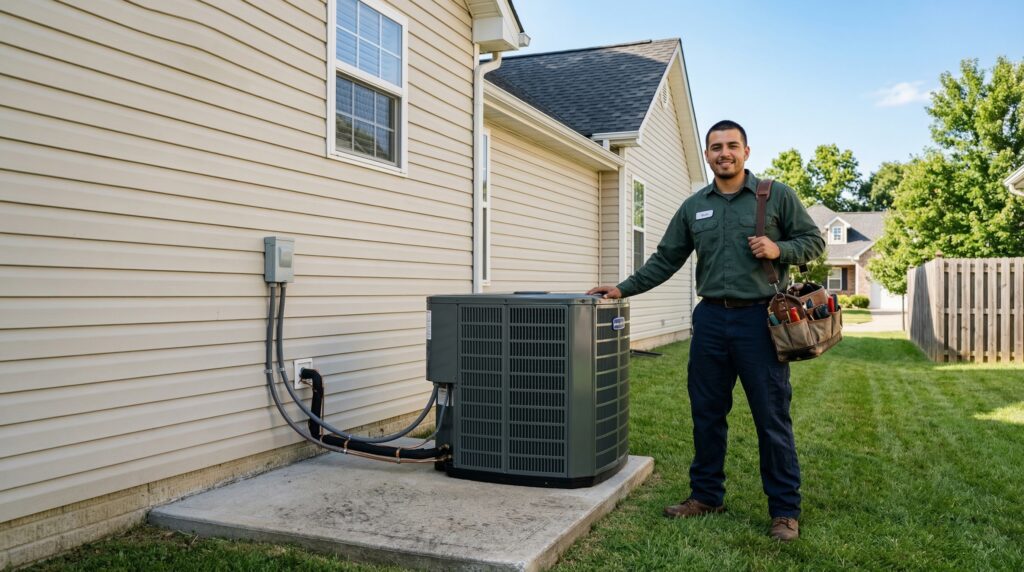
Goodman is the best-selling HVAC brand most homeowners have never heard of. It powers roughly 1 in 7 U.S. residential installs each year, yet it rarely shows up in conversations the way Carrier or Trane does. That invisibility is part of the strategy: Goodman competes on price and availability, making it a popular choice in cost-conscious markets like Missouri, not brand prestige. If you are weighing Goodman against Carrier specifically, see the Goodman vs Carrier cost comparison.
The problem is that “Goodman pricing” is not a single number. A basic GLXS4B central AC and a high-efficiency GXV9S variable-speed system both carry the Goodman name, and they’re separated by $3,000 or more in installed cost. This guide breaks down Goodman HVAC replacement costs by model line and system type, explains the Daikin ownership story that changes how you should think about this brand, and shows you exactly how Goodman stacks up against Carrier, Trane, and Lennox. All price ranges reflect installed cost (equipment plus standard labor). For a personalized number, use our free HVAC replacement cost estimator.
TL;DR: Goodman HVAC systems cost $2,800–$9,500 installed in 2026, making them 15–30% less expensive than Carrier or Trane for comparable efficiency. The GLXS4B central AC starts around $3,000 installed; the variable-speed GXV9S runs $5,500–$7,500. Goodman renamed its whole lineup for R-32 refrigerant, so the older GSX, DSXC and AVXC model numbers are previous-generation equipment. Goodman is owned by Daikin (the world’s largest HVAC manufacturer), built in Houston, TX, and carries a 10-year parts warranty with no authorized-dealer requirement.
How Much Does a Goodman HVAC System Cost? (2026 Installed Prices)
Goodman HVAC replacement costs range from $2,800 to $9,500 installed depending on system type, efficiency tier, and tonnage. The table below shows installed cost ranges for the most common Goodman configurations. Ranges include equipment and standard installation labor for a straightforward swap-out in an existing forced-air system. They do not include ductwork repair or replacement.
| System Type | Entry Model | Installed Cost | Mid/Premium Model | Installed Cost |
|---|---|---|---|---|
| Central AC | GLXS4B (15.2 SEER2) | $2,800–$4,500 | GXV9S (19 SEER2) | $5,500–$7,500 |
| Gas Furnace | GR9S96 (96% AFUE) | $2,800–$4,800 | GRVM97 (Modulating) | $4,500–$7,000 |
| Heat Pump | GLZS4B (15.2 SEER2) | $3,500–$5,500 | GZV9S (21 SEER2) | $5,500–$8,500 |
| Full System (AC + Furnace) | GLXS4B + GR9S96 | $5,500–$8,500 | GXV9S + GRVM97 | $9,000–$13,000 |
Source: Goodman authorized dealer quotes, 2025–2026 and Goodman manufacturer pricing guidance. See our pricing methodology for how these ranges are calculated.
Most homeowners replacing a standard 3-ton central AC land somewhere in the middle: a GLXS4B or GLXS5B installed for $3,500–$5,500. If you’re replacing a full system (AC plus furnace) at the same time, budget $6,000–$10,000 for a quality Goodman mid-range package. Contractors often give a meaningful discount on bundled jobs compared to two separate replacements. Goodman also offers some of the most affordable electric furnaces on the market, starting at $400 to $900 for equipment, making them a popular choice in homes without gas service. If gas heat is what you are pricing, our Goodman furnace cost guide breaks the current R-32 furnace lineup down by tier, from the 80% single-stage GR9S80 to the modulating GRVM97.
Goodman’s Product Tiers: What the Model Numbers Mean
Unlike Carrier (Comfort/Performance/Infinity) or Trane (XR/XL/XV), Goodman doesn’t use tier names. The model number tells you the efficiency level. Once you know the pattern, the lineup is actually easier to read than named tiers.
Entry-Level (14–16 SEER2)
The GLXS4B air conditioner and GLZS4B heat pump are Goodman’s volume sellers. Single-stage operation means the system runs at full capacity or not at all. It meets current federal minimum efficiency standards and does the job without any premium comfort features.
- AC models: GLXS3B (up to 15 SEER2), GLXS4B (15.2 SEER2)
- Furnace models: GR9S80 (80% AFUE), GR9S92 (up to 92%), GR9S96 (up to 96%), all single-stage
- Heat pump: GLZS4B (15.2 SEER2), GLZS5B (up to 16 SEER2)
- Best for: budget-constrained buyers, mild climates, short time horizons (selling in 5 years)
Mid-Range (17–18 SEER2)
The GLXT7C and GLZT7C bring two-stage operation, and the GXV6S and GZV6S bring inverter-driven variable-speed operation. The system modulates to partial capacity during mild weather, which improves humidity control and runs more quietly. This is the tier most contractors recommend for the Southeast, Gulf Coast, and Texas where systems run nearly year-round. Goodman units are popular choices in markets like Louisiana, where cooling loads are extreme and price sensitivity is high.
- AC models: GLXS5B (16.5 SEER2), GLXT7C (two-stage, 17.2 SEER2), GXV6S (variable-speed inverter, 17.2 SEER2)
- Furnace models: GR9T96 (two-stage, up to 96% AFUE), GRVS96-U (variable-speed, up to 96%)
- Heat pump: GLZT7C (17.5 SEER2), GZV6S and GZV7S (variable-speed inverter, 19.0 SEER2)
- Best for: hot/humid climates, homeowners staying 8–15 years
High-Efficiency (19–21 SEER2)
The GXV9S air conditioner and GZV9S heat pump are Goodman’s inverter-driven communicating systems. These work with a compatible ComfortBridge or CoolCloud control to optimize performance across all components in real time. The federal Section 25C credit expired for equipment placed in service after December 31, 2025, so compare current utility and state rebates for a 2026 purchase.
- AC models: GXV9S (19 SEER2), the top of Goodman’s current air conditioner range
- Furnace models: GRVT96 (two-stage variable-speed, up to 97.5% AFUE), GRVM97 (modulating, up to 97%)
- Heat pump: GZV9S (21 SEER2 inverter-driven), the top of Goodman’s current heat pump range
- Best for: extreme climates, high utility bills, whole-home comfort goals, 15+ year horizons
Who Actually Makes Goodman? The Daikin Connection
Goodman is owned by Daikin Industries, the world’s largest HVAC manufacturer. Daikin acquired Goodman in 2012 for $3.7 billion (Daikin Industries press release, 2012), the largest acquisition in HVAC industry history. The deal gave Daikin direct access to the U.S. residential market using Goodman’s established dealer network and its Houston, Texas manufacturing campus.
The Houston facility is the largest residential HVAC manufacturing plant in North America. Goodman, Amana, and Daikin-branded residential systems all roll off the same production lines. Daikin’s engineering team has invested in the plant since the acquisition, integrating Japanese manufacturing standards into what was already a high-volume operation. Shared production does not mean identical pricing: a comparable 96 percent single-stage Goodman furnace runs $2,800–$4,800 installed against $5,000–$8,200 for the Daikin-badged equivalent, and our Daikin furnace cost guide breaks down exactly what that $2,200–$3,400 gap buys in warranty terms and communicating controls.
Why does this matter when you’re buying? It means Goodman isn’t a cut-rate brand using discount components. The compressors, heat exchangers, and control boards meet the same specifications as equipment in systems costing twice as much. What you’re saving on is cabinet sheet metal thickness, brand prestige markup, and the stricter dealer vetting that Carrier and Trane require.
Is Goodman a Good HVAC Brand?
Yes, with one important caveat: Goodman’s quality is real, but its installer network is less vetted than Carrier’s or Trane’s. The brand itself is solid; the variable is who installs it. Goodman equipment uses Copeland scroll compressors, the same Emerson-made compressor found in many Carrier and Trane systems. The core reliability is comparable at the component level.
The main criticisms of Goodman are accurate but not disqualifying. Cabinet sheet metal is thinner than Carrier or Trane, which matters in exposed outdoor installations but has no effect on system performance or lifespan. The dealer network is wider and less selective, which makes finding an installer easier but finding a great installer slightly harder. Get at least two quotes and verify the contractor is licensed and pulls permits.
A well-installed Goodman system will outperform a poorly installed Carrier every time. The brand’s reputation is the floor, not the ceiling. Installation quality is the bigger variable in long-term satisfaction.
How Does Goodman Compare to Carrier, Trane, and Lennox in Cost?
Goodman costs 15–30% less than Carrier or Trane for comparable SEER2 ratings. The gap is widest at the premium tier; at the entry level, all four brands converge. Here’s the full installed-cost comparison for central AC systems:
| Brand | Entry AC (Installed) | Mid AC (Installed) | Premium AC (Installed) | Warranty |
|---|---|---|---|---|
| Goodman | $2,800–$4,500 | $5,500–$7,500 | $6,500–$9,500 | 10-yr parts |
| Carrier | $3,200–$5,800 | $4,500–$7,500 | $6,000–$12,000 | 10-yr parts |
| Trane | $3,500–$6,000 | $5,000–$8,000 | $6,500–$15,000 | 10-yr parts |
| Lennox | $3,000–$5,500 | $5,500–$8,500 | $7,000–$14,000 | 10-yr parts |
The price gap is smaller at the entry level because all four brands are competing for the same cost-sensitive buyer. The real divergence happens at the mid and premium tiers, where Carrier’s Infinity and Trane’s XV series carry a significant brand and feature premium that Goodman’s GXV line doesn’t match in equipment cost.
One practical difference: Carrier and Trane require installation by a Factory Authorized Dealer or Trane Comfort Specialist for full warranty coverage. Goodman’s warranty is product-tied, not installer-tied: any licensed contractor qualifies. For homeowners in areas with fewer premium brand dealers, that flexibility has real value. For more on how Carrier pricing breaks down by tier, see our Carrier HVAC pricing guide. For Trane specifics, see our Trane HVAC pricing guide.
What Drives Goodman Installation Costs?
Five factors determine where your Goodman quote falls within the ranges above. Labor accounts for 40–60% of the installed cost on a standard replacement, which means the same GLXS4B condenser can cost $2,800 installed in rural Alabama or $4,500 in suburban Boston.
1. System Size (Tonnage)
A 2-ton GLXS4B costs $2,800–$3,500 installed. A 5-ton GLXS4B runs $4,000–$5,500. Tonnage is determined by your home’s square footage and climate, not your preference. An undersized system will run constantly and fail early. An oversized system will short-cycle, wear faster, and leave your home humid in summer. Always insist on a Manual J load calculation before any installation.
2. Efficiency Tier
Moving from a 15.2 SEER2 GLXS4B to a 19 SEER2 GXV9S adds $2,500–$3,500 to the installed cost. Whether that premium pays back depends on your climate and how long you’ll stay in the home. See our efficiency vs. cost breakdown to run the numbers for your situation.
3. Region and Labor Market
HVAC installer wages range from $22/hr in rural markets to $40+/hr in major metros. Southeast and Midwest contractors install more Goodman equipment proportionally than the Northeast or West Coast, which tends to keep local labor rates for Goodman installs competitive. For a full regional breakdown, see our HVAC replacement cost overview. Goodman is a popular choice in cold-climate markets like Minneapolis, where high-efficiency furnaces (96%+ AFUE) are standard. See Minneapolis HVAC replacement costs for Goodman pricing in that market alongside Xcel Energy and CenterPoint rebates.
4. Installation Complexity
A straightforward garage or yard swap costs less than an attic-mounted air handler, a second-floor installation, or a system requiring refrigerant line replacement. Tight crawl spaces and unusual configurations add 10–25% to labor cost.
5. DIY Equipment Availability
Goodman is one of the few national HVAC brands sold at retail (Home Depot, Lowe’s, HVACDirect.com). Some contractors factor this in when bidding Goodman jobs, because equipment margin is thinner, so labor rates may be slightly higher to compensate. Get at least two quotes and compare total installed cost, not line-item equipment vs. labor breakdowns.
Goodman’s Warranty: What It Covers
Goodman offers a 10-year parts warranty on most residential equipment, but only when you register the product at goodmanmfg.com within 60 days of installation. Without registration, the warranty defaults to 5 years on parts. Registration is free and takes about two minutes, and your contractor should do it, but confirm before they leave the job. Goodman also lists California, Florida, Georgia, and Quebec as places where warranty coverage cannot be conditioned on registration, so the 60-day clock does not apply there.
Key warranty terms to understand before you buy:
- Parts only (not labor). Goodman covers the cost of a failed compressor or heat exchanger. It does not cover the labor to diagnose and replace it, which typically runs $300–$800+ depending on the component and complexity.
- No authorized-dealer requirement. Any licensed HVAC contractor can install Goodman and the full 10-year warranty applies. This is different from Carrier (requires a Factory Authorized Dealer) and Trane (requires a Trane Comfort Specialist).
- 60-day registration window. The homeowner is responsible for registration if the contractor doesn’t handle it. Set a reminder if your contractor doesn’t confirm registration in writing. Registration cannot be required in California, Florida, Georgia, or Quebec.
- 99-year heat exchanger limited warranty, not lifetime, and it is conditional. Goodman’s own warranty footnote states a 99-Year Heat Exchanger Limited Warranty, good for as long as you own the home, and it applies only when registration is completed within 60 days. Goodman’s current product flyers print the same term as a 20-year heat exchanger warranty plus a one-time heat exchanger replacement, so ask which document governs your model. Only Goodman’s older learning-center article still uses the word lifetime.
- 10-year unit replacement is not on every model. Per Goodman’s 80% furnace flyer, the entry GR9S80, GR9S80-U, and GD9S80 are listed as N/A for unit replacement: those get parts and heat exchanger coverage only.
Common Goodman Model Numbers: Quick Reference
Goodman model numbers look intimidating at first but follow a logical pattern. Here’s a quick reference organized by system type:
Central AC Condensers
- GLXS3B: up to 15 SEER2, single-stage, entry value
- GLXS4B: up to 15.2 SEER2, single-stage, the volume seller
- GLXS5B: up to 16.5 SEER2, single-stage high-efficiency
- GLXT7C: up to 17.2 SEER2, two-stage scroll compressor
- GXV6S: up to 17.2 SEER2, communicating variable-speed inverter
- GXV9S: up to 19 SEER2, Goodman’s top-tier communicating inverter system. Check current utility and state rebate requirements before purchase.
Gas Furnaces
- GR9S80: 80% AFUE, single-stage, the cheapest way in
- GR9S92: up to 92% AFUE, single-stage, the cheapest condensing option
- GR9S96: up to 96% AFUE, single-stage multi-speed ECM
- GR9T96: up to 96% AFUE, two-stage
- GRVT96: up to 97.5% AFUE, two-stage variable-speed, the highest-rated Goodman furnace
- GRVM97: up to 97% AFUE, modulating variable-speed, Goodman’s flagship furnace
Heat Pumps
- GLZS4B: 15.2 SEER2, entry-level heat pump
- GLZS5B: up to 16 SEER2, single-stage heat pump
- GLZT7C: up to 17.5 SEER2 and 8.2 HSPF2, ComfortBridge technology
- GZV6S and GZV7S: up to 19.0 SEER2 and 8.8 HSPF2, side-discharge variable-speed inverter
- GZV9S: up to 21 SEER2, inverter-driven, Goodman’s top heat pump
Packaged Units
- GPH series: gas/electric packaged units (common in manufactured homes)
- GPCH series: heat pump packaged units (common in crawl-space installations)
Frequently Asked Questions
Is Goodman the cheapest HVAC brand?
Goodman is among the lowest-priced national brands, but not the absolute cheapest. Builder-grade competitors like Rheem Ruud’s entry tier and Day & Night compete at similar price points. Goodman’s advantage is pairing value pricing with Daikin-backed engineering and a standard 10-year parts warranty. True ultra-budget brands (Gree, Pioneer) cost less but have limited dealer networks and sparser parts availability.
How long does a Goodman HVAC system last?
A properly maintained Goodman central AC or heat pump typically lasts 15–18 years. Gas furnaces last 18–22 years. These figures are comparable to Carrier and Trane. The three biggest lifespan factors are installation quality, climate (extreme heat or cold cycles wear equipment faster), and maintenance frequency. Annual tune-ups and regular filter changes extend system life significantly. For more on HVAC lifespan, see our guide to how long HVAC systems last.
Does Goodman require a licensed contractor for warranty?
No. Unlike Carrier (Factory Authorized Dealer requirement) or Trane (Trane Comfort Specialist requirement), Goodman’s warranty is product-tied rather than installer-tied. Any licensed HVAC contractor can install a Goodman system and the full 10-year parts warranty applies, as long as the homeowner registers the equipment at goodmanmfg.com within 60 days of installation. Registration is not required in California, Florida, Georgia, or Quebec, where state law prohibits conditioning warranty coverage on it.
Is Goodman made in the USA?
Yes. Goodman manufactures equipment at its Houston, Texas facility, the largest residential HVAC factory in North America. Daikin acquired Goodman in 2012 for $3.7 billion and has expanded the plant since. Goodman, Amana, and Daikin-branded residential systems all come from the same Houston manufacturing platform. The “Made in USA” angle is genuine, not just marketing.
What is the difference between Goodman and Amana HVAC?
Both Goodman and Amana are owned by Daikin and built in the same Houston facility with the same core components. Amana is the premium sibling: slightly better cabinet quality, higher SEER2 options, and an extended warranty that includes a limited lifetime compressor warranty on select models. Amana typically costs 10–20% more than an equivalent Goodman model. If the Goodman GXV9S is at the edge of your budget, the Amana equivalent (same platform, better warranty) is worth pricing for comparison. See our Amana HVAC replacement cost guide for a full breakdown of Amana pricing and the Daikin family comparison.
How to Get an Accurate Goodman Installation Quote
Goodman is a serious brand backed by Daikin’s global manufacturing infrastructure. It is not a cheap knockoff. For budget-conscious buyers, mild-climate homeowners, and anyone planning to sell in the next five years, Goodman is a strong choice. For extreme climates or 15+ year horizons, consider stepping up to Amana (same factory, better warranty) or pricing a comparable Carrier or Trane system to see if the premium makes sense for your situation.
The ranges in this guide give you a solid baseline, but your actual quote depends on your home’s square footage, climate zone, existing equipment, and local labor rates. Our free estimator factors all of that in.
Use the free HVAC replacement cost estimator →
For more context on HVAC replacement pricing, see our related guides:
- HVAC replacement cost overview: national averages by system type and region
- Central AC replacement cost: what to expect for a standalone AC swap
- Furnace replacement cost: gas furnace pricing by efficiency tier
- Heat pump replacement cost: all-in-one heating and cooling pricing
- Carrier HVAC replacement cost: Comfort, Performance, and Infinity pricing
- Trane HVAC replacement cost: Choice, Priority, and Premier pricing
- Furnace replacement cost by brand: compare Goodman furnace prices against Carrier, Trane, Lennox, Rheem, and York side by side
- Best HVAC brands: see how Goodman ranks against Carrier, Trane, and all major brands