
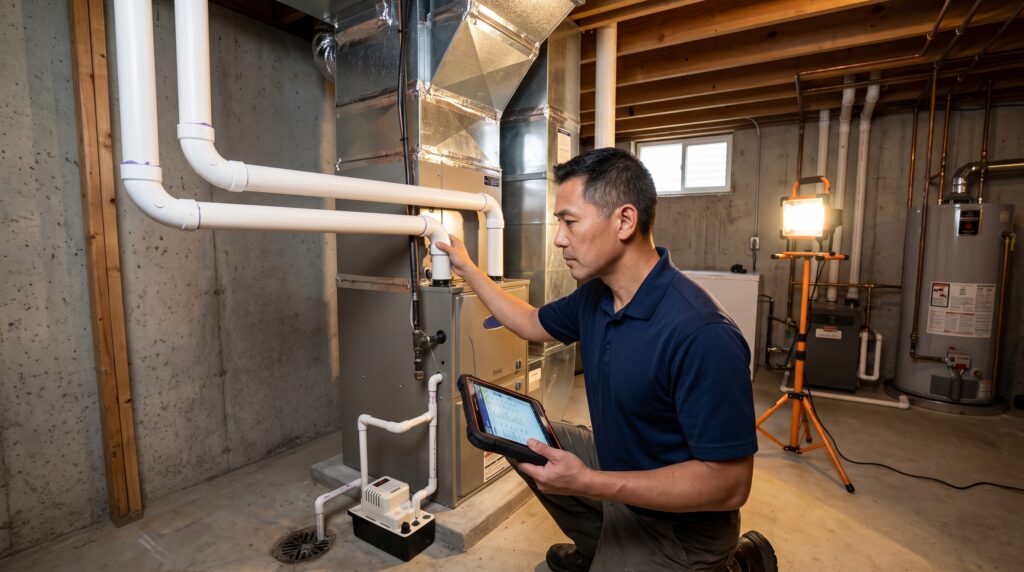
A high-efficiency furnace is any gas furnace rated 90% AFUE or higher, and the jump from a standard 80% model is the single most expensive efficiency decision most homeowners will ever make on a heating system. The price gap is not just the equipment. Crossing from 80% to 90% changes how the furnace vents, adds a drain the old unit never needed, and can leave your water heater stranded on a chimney that no longer works for it. This guide prices all four AFUE tiers installed, itemizes the conversion work that inflates the quote, and recomputes the payback in five climate zones from current federal energy data.
TL;DR: A 95–96% AFUE condensing furnace runs $4,600–$7,800 installed against $2,800–$4,600 for an 80% AFUE unit. Converting from 80% adds another $325–$1,250 for PVC venting and condensate handling, plus $900–$2,500 if an orphaned water heater needs a chimney liner. The federal 25C tax credit no longer applies to 2026 installations, so budget without it. At the 2025 national average gas price, the premium pays back in about 11 years in Minneapolis and never pays back in Houston. Get your estimate.
What Does a High-Efficiency Furnace Cost Installed?
Expect $3,900–$10,500 installed for a high-efficiency (90%+ AFUE) gas furnace in 2026, against $2,800–$4,600 for a standard 80% AFUE unit. Those figures cover the furnace, labor, permits, and a straightforward swap in the same location. They do not include the extra venting and drainage work a condensing furnace requires, which is priced separately further down because it is the part most quotes bury.
| Tier | AFUE | Typical technology | Installed cost |
|---|---|---|---|
| Standard (non-condensing) | 80% | Single-stage burner, PSC blower, metal flue | $2,800–$4,600 |
| Entry condensing | 90–92% | Single-stage burner, PSC or basic ECM blower, PVC vent | $3,900–$6,000 |
| Mainstream condensing | 95–96% | Two-stage burner, ECM blower | $4,600–$7,800 |
| Premium condensing | 97–98.5% | Modulating burner, variable-speed ECM blower | $6,300–$10,500 |
Read the gaps rather than the absolute numbers. Moving from 80% to the mainstream 95–96% tier costs $1,800 more at the bottom of the market and $3,200 more at the top. Moving again from 95–96% to the premium 97–98.5% tier adds a further $1,700 to $2,700. That second step buys modulating heat and a variable-speed blower far more than it buys fuel savings, because the efficiency difference between 96% and 98% is only two percentage points of fuel. For pricing across the rest of the equipment category, see our HVAC cost by efficiency tier guide, and for gas furnace pricing by size, stage, and brand, see the gas furnace replacement cost guide.
What Do the AFUE Tiers Actually Mean?
AFUE (Annual Fuel Utilization Efficiency) is the share of the gas you buy that ends up as heat in your house over a full season. An 80% AFUE furnace sends 20 cents of every gas dollar out the flue. A 96% model sends out 4 cents. The physical dividing line is not gradual: at roughly 90% AFUE a furnace starts extracting so much heat from the exhaust that water vapor in the flue gas condenses back to liquid. That is why 90%+ units are called condensing furnaces, and it is why they need plastic vent pipe and a drain instead of a metal chimney.
- 80% AFUE: the current federal minimum, in force since 2015. Non-condensing. Vents hot exhaust through metal pipe into a chimney or B-vent.
- 90–92% AFUE: the cheapest way into condensing. Usually single-stage with a basic blower. Often the best value tier because it captures most of the fuel savings for the smallest premium.
- 95–96% AFUE: the volume tier. Meets the ENERGY STAR requirement of 95% AFUE or greater for the U.S. North, and comfortably clears the 90% AFUE requirement for the U.S. South.
- 97–98.5% AFUE: the top of the market. Modulating burners and variable-speed blowers. Sold on comfort and quiet more than on fuel.
Three separate 95%-ish numbers get confused constantly, so it is worth separating them. 95% AFUE is the ENERGY STAR certification floor for the U.S. North (the South floor is 90%). 95% AFUE is also the minimum the Department of Energy has scheduled for furnaces manufactured from December 2028. And 97% AFUE was the threshold the now-expired federal 25C tax credit required, which was stricter than either. Three programs, three numbers, and a contractor quoting “the efficient one” may mean any of them.
How Much Does a High-Efficiency Furnace Cost by Home Size?
Furnace price tracks BTU output, and BTU output tracks house size, insulation, and climate. A bigger house does not just cost more, it also widens the gap between tiers, because the efficiency premium is charged partly per BTU. The table below covers three of the four tiers at typical sizing.
| Home size | Typical BTU | 80% AFUE | 95–96% AFUE | 97–98.5% AFUE |
|---|---|---|---|---|
| 800–1,200 sq ft | 40,000–60,000 | $2,800–$3,900 | $4,600–$6,200 | $6,300–$8,000 |
| 1,200–1,800 sq ft | 60,000–80,000 | $3,100–$4,200 | $5,000–$6,700 | $6,800–$8,900 |
| 1,800–2,500 sq ft | 80,000–100,000 | $3,400–$4,400 | $5,400–$7,200 | $7,400–$9,600 |
| 2,500–3,500+ sq ft | 100,000–120,000 | $3,700–$4,600 | $5,800–$7,800 | $8,000–$10,500 |
The 90–92% tier is not a column above because it is not stocked in every size and brand. Where it is available, price it at roughly $700 below the bottom of the 95–96% column for the same home size and up to $1,800 below the top of it. The discount is smallest at the low end, which is how the $3,900–$6,000 tier range in the first table is derived. Sizing should come from a Manual J load calculation, not from square footage alone. An oversized condensing furnace short-cycles, which erases part of the efficiency you just paid for. Our HVAC sizing guide covers how to sanity-check what a contractor proposes.
Why Does Going Condensing Cost More Than the Equipment Difference?
Because a condensing furnace cannot reuse the old furnace’s chimney. Its exhaust is too cool to rise and too acidic for metal, so it needs sealed PVC or CPVC pipe run out a side wall, and it produces roughly half a gallon of acidic condensate per hour of operation that has to reach a drain. On a first-time 80% to 90%+ conversion, that work typically adds $325 to $1,250 on top of the equipment price. Where a chimney liner is also required it can reach about $3,870.
| Conversion item | Typical cost | When it applies |
|---|---|---|
| PVC intake and exhaust sidewall venting | $250–$800 | Every 80% to 90%+ conversion |
| Condensate drain line to a nearby drain | $75–$250 | When a floor drain or standpipe is within reach |
| Condensate pump, installed | $150–$450 | When the furnace sits below the nearest drain |
| Condensate neutralizer cartridge | $40–$120 | Where code or a cast-iron waste line requires it |
| Chimney liner for an orphaned water heater | $900–$2,500 | When the furnace was the only other appliance on a masonry chimney |
| Chimney abandonment and cap-off | $150–$600 | When the water heater also moves to power-vent or electric |
Two pairs in that table are alternatives rather than additions, so no single job carries all six lines: a condensate pump replaces the gravity drain line, and a chimney liner replaces the abandonment and cap-off. A basement furnace with a floor drain nearby is the cheap case: venting plus a gravity drain lands at $325–$1,050. An attic or crawlspace unit with no drain within reach needs a pump, which pushes the same work to $400–$1,250. Stack a neutralizer and a liner on top of that worst case and the conversion alone reaches roughly $3,870 ($1,250 plus $120 plus $2,500), which means a premium condensing job in a large home can total about $14,370 all in. That is the number to have in your head before a quote surprises you with it.
The Orphaned Water Heater Nobody Warns You About
In a great many older homes the gas furnace and the gas water heater share one masonry chimney. The furnace does most of the work, and its hot, high-volume exhaust is what keeps that flue warm enough to draft properly. Take the furnace off the chimney and put it on PVC, and the water heater is left alone on a flue sized for two appliances. It is now described as orphaned.
An orphaned water heater draws too little exhaust to warm the flue, so combustion gases cool on the way up, condense inside the masonry, and can fail to draft at all. Two consequences follow: moisture damage to the chimney over a few seasons, and the real possibility of carbon monoxide spilling into the house on a cold start. The accepted fixes are a correctly sized stainless liner at $900–$2,500, or replacing the water heater with a power-vent or electric model and capping the chimney at $150–$600.
Ask about this before you sign, not after. A quote that prices a 96% furnace but says nothing about the water heater currently sharing its chimney is an incomplete quote, and the liner is the item most likely to appear as a change order once the old furnace is already out. Our HVAC bid comparison checklist covers the other line items worth confirming in writing.
How Do Burner Stages and Blower Type Change the Price?
AFUE is rarely sold on its own. Manufacturers bundle efficiency with burner staging and blower type, which is why the tiers in the first table read like technology packages rather than efficiency ratings. Knowing how the bundle is built lets you unbundle it when you compare quotes.
- Single-stage burner: full output or off. Standard on 80% units and on most 90–92% models. Cheapest to buy and to repair.
- Two-stage burner: a low fire around 65% of capacity for mild weather and a high fire for cold snaps. Standard on the 95–96% tier.
- Modulating burner: continuously variable output, usually 40% to 100%. Almost exclusive to the 97–98.5% tier and a large part of what that tier costs.
- PSC blower: the older constant-speed motor. Runs at one speed and draws the same power whether the house needs a little heat or a lot.
- ECM blower: an electronically commutated motor that varies speed. Uses substantially less electricity than a PSC at the same airflow and is what makes long, low-speed runs affordable.
The practical consequence is that some of the comfort improvement people attribute to high AFUE is really the blower and the staging. If quiet, even heat is your priority, a 92% two-stage unit with an ECM blower may serve you better than a 96% single-stage one at a similar price. The full math on staging lives in our two-stage vs single-stage cost comparison, and the blower side is covered in the variable speed HVAC cost guide.
Does the Federal Tax Credit Still Cover a High-Efficiency Furnace?
No. The Energy Efficient Home Improvement Credit under Section 25C applies to qualifying property placed in service on or after January 1, 2023 and on or before December 31, 2025, per the IRS. A furnace installed in 2026 does not qualify. Any calculator, contractor, or article still showing a $600 furnace credit for a current installation is working from expired terms, and the difference is real money in a budget.
For the record, here is what the credit was while it existed, because it still matters if you installed in 2025 and have not yet filed:
- Worth 30% of project cost, capped at $600 for a qualifying furnace, per ENERGY STAR.
- The furnace had to be ENERGY STAR certified with an AFUE of 97% or higher, so a 96% model never qualified.
- The credit sat inside a $1,200 annual cap covering most energy property. The separate $2,000 annual cap applied to heat pumps, heat pump water heaters, and biomass equipment, not to gas furnaces.
- It covered products purchased and installed between January 1, 2023 and December 31, 2025.
What remains for 2026 is local, not federal. Gas utility rebates for 95%+ AFUE furnaces are still widely offered and commonly run $150 to $600, and manufacturer promotions cluster around the fall shoulder season. Both are worth chasing because they attack the premium directly. Our HVAC tax credits and rebates guide covers what survived and how to search DSIRE for your own utility.
How Long Does the Efficiency Premium Take to Pay Back?
Between 11 and 68 years at the $2,500 premium assumed below. Climate is the largest single driver, but the equipment tier moves the answer by years too: buy at the top of the 95–96% market rather than the bottom and the premium is closer to $3,900, which stretches Minneapolis to 17 years and Chicago to 21. That range is wider than most articles admit, and in much of the country the premium does not pay for itself inside the furnace’s life. Here are the assumptions, so you can check the arithmetic or swap in your own numbers.
- Gas price $1.48 per therm. The EIA 2025 U.S. average residential price was $15.34 per thousand cubic feet, and at EIA’s 2026 heat content estimate a thousand cubic feet holds 10.36 therms.
- Upgrade premium $2,500. That is the $1,800 equipment gap from 80% to 96% plus $700 of typical venting and condensate work.
- Comparison 80% AFUE against 96% AFUE, in a 2,000 sq ft gas-heated home with no insulation or window changes.
- Gas saved per year equals the heat your home actually needs multiplied by 0.2083, which is the difference between burning at 80% and burning at 96%.
| Climate zone | Example metro | Heat needed (therms/yr) | Gas saved (therms/yr) | Annual saving | Simple payback |
|---|---|---|---|---|---|
| Zone 6 (cold) | Minneapolis, MN | 750 | 156 | $231 | 11 years |
| Zone 5 | Chicago, IL | 600 | 125 | $185 | 14 years |
| Zone 4 (mixed) | Baltimore, MD | 450 | 94 | $139 | 18 years |
| Zone 3 (mild) | Atlanta, GA | 250 | 52 | $77 | 32 years |
| Zone 2 (hot) | Houston, TX | 120 | 25 | $37 | 68 years |
Gas furnaces typically last 15 to 20 years, so read those paybacks against that clock. Minneapolis and Chicago recover the premium comfortably inside one furnace lifetime. Baltimore roughly breaks even. Atlanta and Houston do not come close on fuel savings alone, which does not make the upgrade wrong there, but it does mean the case has to rest on comfort, quiet, or resale rather than on the utility bill.
Gas prices move the answer more than anything else. Take the Chicago row: at $2.00 per therm the annual saving becomes $250 and the payback shortens to 10 years, while at $1.00 per therm it falls to $125 and stretches to 20 years. A $400 utility rebate cuts roughly two years off the Chicago figure. If you want a payback built from your own bills, run your numbers through the HVAC replacement cost estimator and compare against your last twelve months of gas statements.
When Is an 80% AFUE Furnace Still the Right Call?
More often than the industry likes to say. High efficiency is a good default in cold climates and a poor default in warm ones. Five situations where the standard unit is the better financial decision:
- Climate zones 2 and 3. With payback at 32 to 68 years, the fuel savings in Atlanta or Houston will not repay the premium before the furnace is replaced again.
- You expect to move within about five years. Buyers rarely pay a premium for AFUE, and you will not recover it through the utility bill in that window either.
- No practical route to a drain. An attic or closet furnace with no drain nearby means a condensate pump plus its own failure mode. Pumps clog and shut the furnace down on the coldest night of the year.
- A shared masonry chimney with a gas water heater. If the liner is required, the conversion adds $900–$2,500 and the payback lengthens accordingly. Sometimes the right sequence is to replace the water heater first.
- A tight budget where the money does more elsewhere. Air sealing and attic insulation frequently return more per dollar than 16 points of AFUE, and they help in summer too.
One caveat on the long view. The Department of Energy finalized a standard in December 2023 raising the minimum to 95% AFUE for non-weatherized and mobile home gas furnaces manufactured on or after December 18, 2028. It applies to the date of manufacture, so it is not a deadline to install by and it does not affect a furnace already in your house. It has also been contested since it was issued: a federal appeals court upheld it in November 2025, the Supreme Court sent the case back for reconsideration in June 2026, and the Department has signaled it may revisit the rule. Treat 2028 as a plan rather than a certainty, and do not let anyone use it to rush a decision in 2026.
If a heat pump is even loosely on the table, price it in the same conversation. In much of zones 2 through 4 a heat pump now beats both furnace tiers on operating cost, and our heat pump replacement cost guide lays out what that swap actually costs. For the broader budget picture, start at the HVAC replacement cost guide or browse the HVAC planning guides.
Frequently Asked Questions
How much does a high-efficiency furnace cost installed?
A high-efficiency (90%+ AFUE) gas furnace runs $3,900–$10,500 installed in 2026, against $2,800–$4,600 for a standard 80% AFUE unit. The tiers break down as follows:
- 90–92% AFUE: $3,900–$6,000 installed
- 95–96% AFUE: $4,600–$7,800 installed
- 97–98.5% AFUE: $6,300–$10,500 installed
Add $325–$1,250 for the PVC venting and condensate work required the first time you convert from 80% to a condensing unit.
Is a 96% AFUE furnace worth the extra cost over an 80% model?
In cold climates yes, in warm climates rarely. At a $2,500 all-in premium and the 2025 national average gas price of $1.48 per therm, the upgrade pays back in about 11 years in Minneapolis and 14 years in Chicago, both inside a 15 to 20 year furnace lifetime. Baltimore takes about 18 years, roughly break-even. Atlanta takes 32 years and Houston 68, which is well past the point the furnace will be replaced again. South of the Ohio River the case for 96% has to rest on comfort and quiet, not on the gas bill.
What extra work does a condensing furnace require?
A condensing furnace cannot use the old metal chimney, so a first-time conversion adds several line items:
- PVC intake and exhaust venting out a side wall: $250–$800
- Condensate drain line to a nearby drain: $75–$250
- Condensate pump when no gravity drain is reachable: $150–$450
- Condensate neutralizer cartridge where code requires it: $40–$120
- Chimney liner if the gas water heater is left orphaned: $900–$2,500
- Chimney abandonment and cap-off: $150–$600
A pump and a gravity drain line are alternatives, as are a liner and a cap-off, so no job carries all six lines. Most conversions land at $325–$1,250. A worst case of venting, a pump, a neutralizer, and a liner reaches about $3,870.
Do high-efficiency furnaces still qualify for a federal tax credit in 2026?
No. The Section 25C Energy Efficient Home Improvement Credit applies only to qualifying property placed in service on or after January 1, 2023 and on or before December 31, 2025, so a furnace installed in 2026 does not qualify. While it was available, the credit was worth 30% of the project cost up to $600 for a furnace, it required an ENERGY STAR certified unit rated 97% AFUE or higher, and it sat inside a $1,200 annual cap. If you installed a qualifying furnace on or before December 31, 2025, you may still be able to claim it on the return covering that tax year. For 2026 installations, budget on gas utility rebates of roughly $150 to $600 instead.
What is the difference between a 90%, 96%, and 98% AFUE furnace?
All three are condensing furnaces, so all three need PVC venting and a drain. The differences are fuel waste and how the equipment is built:
- 90% AFUE wastes 10 cents of every gas dollar and is usually single-stage with a basic blower, at $3,900–$6,000 installed.
- 96% AFUE wastes 4 cents and is usually two-stage with an ECM blower, at $4,600–$7,800 installed.
- 98% AFUE wastes 2 cents and is modulating with a variable-speed blower, at $6,300–$10,500 installed.
The fuel gap from 96% to 98% is only two percentage points, so that step is bought for comfort and quiet rather than for savings. The gap from 90% to 96% is six points and is the one that moves the utility bill.
Will 80% AFUE furnaces be banned?
Not yet, and not in the way the word banned suggests. The current federal minimum is 80% AFUE and has been since 2015. The Department of Energy finalized a rule in December 2023 raising the minimum to 95% AFUE for non-weatherized and mobile home gas furnaces manufactured on or after December 18, 2028. It applies to the date of manufacture, with no install-by or sell-through deadline, and it has no effect on a furnace already in a home. The rule is also still being litigated: a federal appeals court upheld it in November 2025, the Supreme Court sent the case back for reconsideration in June 2026, and the Department has said it is weighing a new rulemaking. Treat the 2028 date as a plan rather than a settled fact.
How These Estimates Are Built
Installed price ranges reflect equipment plus labor, permits, and a standard same-location replacement, benchmarked against contractor pricing across U.S. metros and cross-checked against the tier structure used throughout this site. Efficiency thresholds come from ENERGY STAR product criteria and the Department of Energy’s published standards. Tax credit terms come directly from the IRS. Payback figures are computed from the U.S. Energy Information Administration’s 2025 average residential natural gas price of $15.34 per thousand cubic feet, converted at EIA’s 2026 heat content estimate of 10.36 therms per thousand cubic feet. Every assumption behind the payback table is printed above so you can substitute your own gas rate and heating load. Verified 2026-08-02.