
Heat exchanger replacement costs $650 to $3,000, and which end of that range you land on depends almost entirely on one thing: whether the part is still under warranty. On this component your warranty status swings the bill far more than the price of the metal does. It is also the only furnace repair that is a safety decision before it is a money decision, because a cracked heat exchanger can route carbon monoxide into the air your blower pushes through the house.
TL;DR: Heat exchanger replacement runs $650 to $3,000. Out of warranty it is $1,000 to $3,000 all-in (national average $2,000). In warranty you still pay the labor, $650 to $2,150, because these warranties cover the part and not the labor. Safety first: stop using the furnace and get a professional combustion analysis. Do not inspect, seal, or keep running a furnace with a suspected crack. Replace-instead threshold: out of warranty, replacement usually wins. A $3,000 job against a $4,000 budget furnace is 75 percent of a new one, and at the $2,000 average job the $5,000 rule is crossed by year three. Repair still wins when the part is covered and the furnace is under 10 years old. Run the numbers for your home with the HVAC replacement cost estimator.
What Does Heat Exchanger Replacement Cost?
Replacing a furnace heat exchanger costs $1,000 to $3,000 all-in when the part is out of warranty, with a national average of $2,000, according to HomeGuide’s 2026 cost data. The heat exchanger itself is only $350 to $850 of that. Labor is $650 to $2,150. If the part is still covered by an active warranty, you pay the labor alone: $650 to $2,150.
| Scenario | What You Pay | What It Includes |
|---|---|---|
| Out of warranty (typical) | $1,000 to $3,000 | Part, teardown and reassembly labor, combustion testing |
| Out of warranty (national average) | $2,000 | Mid-size gas furnace, standard access |
| In warranty (part covered) | $650 to $2,150 | Labor only; the manufacturer supplies the part |
| Part alone | $350 to $850 | Primary heat exchanger assembly, most residential furnaces |
| Labor alone | $650 to $2,150 | 5 to 10 hours of teardown, install, reassembly, testing |
| Secondary heat exchanger (condensing furnace) | $1,000 to $2,000 | Part $300 to $800 plus $700 to $1,200 labor |
Those two scenario ranges add up cleanly. The $350 to $850 part plus the $650 to $2,150 labor is exactly the $1,000 to $3,000 out-of-warranty total, and the in-warranty figure is the labor line on its own. That arithmetic is the whole story of this repair: the part is the cheap half.
Angi’s 2026 data puts the same job at $1,250 to $3,000 with an average of $1,750, which lands inside the range above. Quotes below $1,000 usually mean the part is under warranty and you are being quoted labor only. Quotes above $3,000 usually mean the furnace has to be pulled out of a tight space, or the quote is for a replacement furnace rather than a heat exchanger.
Why Is Labor Most of a Heat Exchanger Bill?
Labor is $650 to $2,150, which is roughly 65 to 72 percent of an out-of-warranty bill. That is backwards from most HVAC repairs, where the part carries the cost. The reason is simple: the heat exchanger is the furnace’s core, so almost everything else has to come off before the technician can reach it.
A heat exchanger replacement takes 5 to 10 hours. The job means stripping the combustion chamber down to the shell and then rebuilding it:
- Disconnect and remove the gas train. Burners, gas valve, manifold, igniter, and flame sensor all come out before the exchanger is accessible.
- Pull the inducer and venting. The draft inducer motor, pressure switch tubing, and flue connection have to be separated from the exchanger housing.
- Remove the blower assembly on many models. On upflow and horizontal furnaces the blower often has to come out to clear the exchanger’s path.
- Pull the furnace itself on tight installs. In narrow closets, low crawl spaces, and attics the cabinet has to be disconnected from the plenum and ductwork and moved before anything else happens. This is the single biggest labor variable.
- Reassemble, rewire, and combustion test. Every component goes back, and the technician verifies the burn with a combustion analyzer before the furnace is returned to service.
The spread in that $650 to $2,150 labor figure reflects how long the job takes and how hard your furnace is to get at. Heat exchanger work is normally quoted as a flat rate for the whole job rather than billed as straight hours times a shop rate, because the teardown time depends on the cabinet and the install location rather than on a fixed task list. Ask for the labor quoted as one number, and ask what happens to it if the furnace turns out to need pulling. Heat exchangers also tend to fail in winter, when scheduling is tightest and after-hours call-out pricing applies.
| Cost Factor | Effect on the Bill |
|---|---|
| Furnace location | Basement with clearance is the low end. Attic, crawl space, or narrow closet pushes toward the high end. |
| Furnace size and type | Larger furnaces use larger exchangers. Condensing furnaces have two, adding complexity. |
| Furnace age | Corroded fasteners and brittle wiring on older units add hours. |
| Part sourcing | OEM parts cost more than generic and can add days if the model is discontinued. |
| Season and timing | Peak winter and after-hours calls push the flat-rate quote toward the high end. |
| Material | Stainless steel exchangers cost more than aluminized steel. |
What Does a Heat Exchanger Warranty Actually Cover?
Heat exchanger warranties cover the part, not the labor. That single distinction is worth $350 to $850 to you, and it is the most misunderstood thing about this repair. A lifetime heat exchanger warranty does not make the job free. It removes the part from the bill and leaves you paying the $650 to $2,150 labor, which is the larger share.
Carrier states the exclusion outright in its homeowner FAQ: Carrier provides a limited parts warranty but not labor coverage, and labor costs are managed by your dealer or contractor. Some installing dealers sell a separate labor warranty, which is the only way that cost gets covered.
The length of the term usually depends on whether the furnace was registered after installation, and the registration window is short. Here are two manufacturers’ published terms:
| Manufacturer | Registered | Not Registered | Registration Window |
|---|---|---|---|
| Goodman gas furnaces | Lifetime heat exchanger limited warranty, good for as long as you own the home, plus 10-year parts | 5-year parts limited warranty | 60 days from installation |
| Carrier Performance 96 (59TP6) | Lifetime heat exchanger parts limited warranty | 20 years | 90 days from installation |
Goodman’s published warranty guidance notes that residents of California, Florida, Georgia, and Quebec do not need to register the product to receive the rights and remedies of registered owners, because those jurisdictions do not allow warranty coverage to be conditioned on registration. Everywhere else, an unregistered Goodman furnace drops from a lifetime heat exchanger term to 5-year parts coverage. Carrier’s Performance 96 gas furnace footnote is equally blunt: the lifetime heat exchanger parts limited warranty period is 20 years if the unit is not registered within 90 days.
Before you accept any quote, look up your furnace’s model and serial number and check coverage with the manufacturer directly. Warranties normally transfer only in limited circumstances, so a furnace installed by a previous homeowner may carry a shorter term than the original certificate suggests. For a fuller picture of what HVAC coverage is worth, see our guide to HVAC warranty costs.
How Dangerous Is a Cracked Heat Exchanger?
Dangerous enough that the correct response is to stop using the furnace today rather than book the repair for next week. The heat exchanger is the sealed metal barrier between the combustion gases and the household air your blower circulates. A crack in that barrier can put carbon monoxide into the air moving through your ducts.
The scale of the risk is documented. The CDC reports that at least 400 people in the United States die each year from unintentional carbon monoxide poisoning not linked to fires, and more than 100,000 people visit an emergency department. In the Consumer Product Safety Commission’s 2022 annual estimates, published in May 2026, an estimated 274 non-fire carbon monoxide deaths were associated with consumer products. Heating systems were the second largest category behind engine-driven tools, accounting for an estimated 76 deaths, or 28 percent of the total. Sixty-four percent of those 274 deaths happened in a home. Across 2020 to 2022 the annual average was 238 deaths, and 59 percent of them fell in the four cold months of November, December, January, and February.
Carbon monoxide is colorless and odorless, so you cannot detect a leak by smell. The CDC lists the symptoms of exposure as headache, dizziness, weakness, upset stomach, vomiting, chest pain, and confusion. They are easy to mistake for winter flu, and they characteristically improve when you leave the house and return when you come back.
The EPA’s carbon monoxide guidance warns that appliances which are not working properly can produce dangerous levels of carbon monoxide, and a cracked heat exchanger is that failure. If a technician has told you your heat exchanger is cracked, here is what that means in practice:
- Stop running the furnace. Not overnight, not on low, not just until the quote comes back. This is the one HVAC failure that is not a wait-and-see repair.
- Do not inspect or test it yourself. Verifying a heat exchanger crack requires a combustion analyzer and a trained technician. Opening a gas furnace to look for a crack is not a homeowner task.
- Do not patch, seal, or weld it. There is no homeowner-level or contractor-level repair for a cracked heat exchanger that can be verified as safe.
- Expect a red tag. A licensed technician or your gas utility may tag the furnace as unsafe and shut off gas to the appliance. That is the system working correctly, not a sales tactic.
- Arrange temporary heat. Ask the technician about safe electric space heating while the decision is made. Never use a gas range, oven, or grill for heat.
- Check your CO alarms. Working alarms belong on every level of the home and outside sleeping areas, but treat an alarm as a backstop rather than a substitute for a combustion test. Alarms are designed to respond to sustained concentrations, and a small crack can leak intermittently at levels that never trigger one.
If anyone in the home has symptoms of carbon monoxide exposure, get everyone into fresh air and call 911 or your local emergency number before doing anything else. The CPSC’s prevention guidance is to have home heating systems, including chimneys and vents, inspected and serviced annually by a trained service technician. That annual inspection is also how most cracks get caught before they become emergencies.
How Do Technicians Diagnose a Cracked Heat Exchanger?
A proper diagnosis combines a visual inspection with instrument readings. Visual inspection alone is not conclusive, because many cracks sit on surfaces that cannot be seen without a borescope, and some open only once the metal reaches operating temperature. HomeGuide’s cost guidance states the standard directly: only a technician’s combustion analysis test can fully verify that a heat exchanger has a crack and is leaking carbon monoxide.
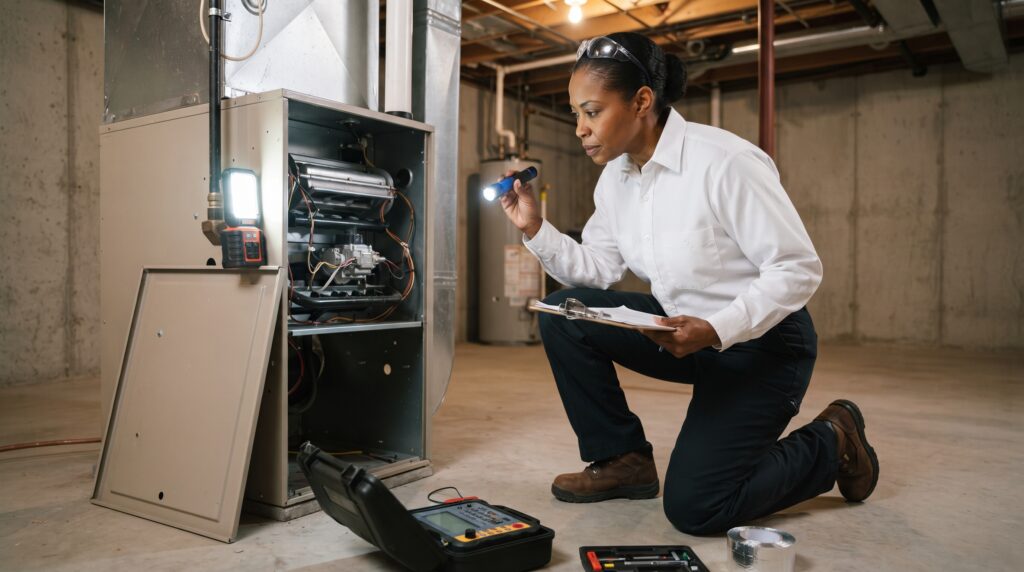
A thorough diagnosis normally includes a visual and inspection-camera check of the exchanger surfaces, a combustion analysis measuring carbon monoxide in the flue gas, a carbon monoxide reading taken in the supply air downstream of the exchanger, and a flame-behavior check while the blower cycles on. A flame that rolls, flutters, or changes shape the moment the blower starts is a classic indicator that air is moving through a breach.
The symptoms that usually prompt the call are worth knowing, though none of them is proof on its own:
- A carbon monoxide alarm sounding. Treat this as an emergency first and a diagnostic clue second.
- An orange or yellow burner flame where it should be crisp blue, which indicates incomplete combustion.
- Soot buildup around the burners or visible rust, corrosion, or cracking on nearby furnace components.
- Unexplained furnace shutdowns, often the flame rollout switch or limit switch doing its job.
- A rattling or booming sound on startup as cracked metal shifts while it expands.
- A sharp chemical or formaldehyde-like smell when the furnace runs, or water pooling around the base of the cabinet.
Because a cracked heat exchanger justifies a full furnace replacement, it is also the most common pretext for an unnecessary one. HomeGuide’s guidance warns explicitly about scams that make a heat exchanger appear cracked as a trick to sell a whole new furnace. Protect yourself by asking for a written diagnosis naming the crack location, the combustion analyzer readings including supply-air carbon monoxide, photo or camera images of the crack, and your model and serial number so you can verify warranty status yourself. If that evidence is not offered, get a second opinion from an independent technician, and remember that a second opinion means a second inspection rather than continuing to run the furnace while you shop.
Should You Replace the Heat Exchanger or the Whole Furnace?
Out of warranty, replacing the furnace usually wins. That is a stronger statement than we make on most component pages, and the arithmetic is the reason. A gas furnace installed costs $2,800 to $7,500. Against that, a $2,000 average heat exchanger job is 27 to 71 percent of a new furnace depending on which furnace you would actually buy, and a $3,000 job against a $4,000 budget furnace is 75 percent of replacement cost.
Both standard decision rules point toward replacement once you compare against an entry-level furnace. The 50 percent rule says replace when the repair passes half the cost of new equipment, which a $2,000 job clears against anything up to about a $4,000 furnace. Compared against a premium $7,500 furnace that same job is only 27 percent, so the 50 percent rule alone would say repair. The $5,000 rule, which multiplies system age by repair cost and recommends replacement above $5,000, is the harsher test: it is crossed by year three at the $2,000 average, and even at the $1,000 low end a six-year-old furnace is past it. Almost any out-of-warranty furnace old enough to crack a heat exchanger fails that second test.
| Your Situation | What You Pay | Better Move |
|---|---|---|
| Part under warranty, furnace under 10 years, no other failures | $650 to $2,150 labor | Replace the heat exchanger |
| Part under warranty, furnace 10 to 15 years | $650 to $2,150 labor | Judgment call; replace the exchanger only if nothing else has failed |
| Part under warranty, furnace 15 years or older | $650 to $2,150 labor | Usually replace the furnace; you are buying a few years on worn equipment |
| Out of warranty, furnace under 3 years | $1,000 to $3,000 | Replace the heat exchanger and check why coverage lapsed |
| Out of warranty, furnace 3 to 10 years | $1,000 to $3,000 | Usually replace the furnace; at the $2,000 average job the $5,000 rule is crossed by year three |
| Out of warranty, furnace 10 years or older | $1,000 to $3,000 | Replace the furnace |
| Out of warranty with other failed components | $1,000 to $3,000 plus repairs | Replace the furnace |
Two situations push the decision toward repair. The first is the common one: the heat exchanger part is still under an active warranty and the furnace is under about 10 years old with no other failures. Both halves have to be true. The warranty is what cuts your cost to labor alone, and the age is what gives the replacement part a reasonable service life to run out. The second is a failure in the secondary heat exchanger of an otherwise healthy condensing furnace, where a manufacturer program may cover the part outright.
Age matters more here than on other components because the replacement part outlives nothing else. A furnace heat exchanger lasts 15 to 20 years, and Carrier notes that well-maintained gas-fired furnaces last approximately 20 years, so a new exchanger in an 18-year-old cabinet is a new part in a system that is finishing anyway. Our guides to HVAC system lifespan and furnace replacement cost cover that timing in more detail, and the HVAC replacement cost estimator will price a full replacement for your home so you can compare it against the repair quote in front of you.
What Does a Secondary Heat Exchanger Cost?
Replacing a secondary heat exchanger costs $1,000 to $2,000, with the part at $300 to $800 and labor at $700 to $1,200. Only high-efficiency condensing furnaces have one. A condensing furnace at 90 percent AFUE or above uses a second exchanger to pull additional heat out of the exhaust gases, cooling them enough that water vapor condenses out. A standard 80 percent AFUE furnace has a single heat exchanger and no secondary.
That condensate is why secondary exchangers fail. The liquid that forms is mildly acidic, so the secondary exchanger is a corrosion target in a way the primary is not. Blocked condensate drains, which let acidic water sit against the metal, are a common accelerant.
Before paying out of pocket, check for a manufacturer program. Carrier runs an enhanced warranty program covering the secondary heat exchanger on certain 90 percent high-efficiency gas furnaces built between 1993 and 2011, on failure within 20 years of the original installation date. Eligible owners can take either a credit of up to $525 toward a new Carrier furnace, which includes $200 toward equipment and up to four hours of labor, or a free replacement secondary heat exchanger with a dealer labor credit of up to four hours. Carrier’s own note on that program is a useful reality check: it states that the replacement will not extend the furnace’s useful life beyond 20 years from the original installation date. If your unit is eligible but nearly 20 years old, the credit toward a new furnace is usually the better of the two options.
Heat Exchanger Cost by Brand
Brand affects the part price but not the labor, so it moves the smaller half of the bill. Part prices run $350 to $850 for most residential furnaces, with brand-level material prices spanning $260 to $860. The figures below are material prices only and exclude shipping and installation.
| Brand | Part Price | Notes |
|---|---|---|
| Goodman / Amana | $260 to $860 | Widest spread; widely stocked |
| Lennox | $260 to $840 | Lowest entry price of the premium brands |
| Rheem / Ruud | $290 to $800 | Good parts availability |
| Trane | $320 to $825 | OEM part recommended to preserve coverage |
| Heil / Quaker | $320 to $860 | Shares parts across the Carrier group |
| Armstrong | $340 to $800 | Mid-range pricing |
| Carrier / Bryant | $350 to $800 | Bryant is Carrier’s sister brand and shares components |
| York | $470 to $800 | Highest entry price; narrow spread |
Use an OEM or manufacturer-approved part. Fitting a third-party heat exchanger to a furnace still under warranty typically voids the coverage on the exchanger and on related components, which is an expensive way to save a hundred dollars on a part that is already the cheap half of the job. If your furnace model has been discontinued, ask whether the part is still available before you commit to the repair, because a special-order exchanger can add days to a job you are doing in winter. For component costs on the cooling side, see our guides to evaporator coil replacement cost and AC compressor replacement cost.
Frequently Asked Questions
Can you repair a cracked heat exchanger instead of replacing it?
No. HVAC technicians do not weld, patch, or seal cracked furnace heat exchangers, because the repair cannot be verified as gas-tight over the heating and cooling cycles the metal goes through every day. Replacing the part is the standard repair method. A patched heat exchanger also carries no manufacturer coverage, and most contractors will not accept the liability. Your two real options are a new heat exchanger at $1,000 to $3,000 out of warranty, or a new furnace at $2,800 to $7,500.
Is it safe to run a furnace with a cracked heat exchanger?
No. Stop using the furnace and have a licensed technician perform a combustion analysis. The heat exchanger is the sealed metal wall that keeps combustion gases out of the air your blower pushes through the house, so a crack can route carbon monoxide into your living space. The EPA’s carbon monoxide guidance warns that appliances which are not working properly can produce dangerous levels of carbon monoxide. The CDC reports that at least 400 people in the United States die each year from unintentional carbon monoxide poisoning not linked to fires, with more than 100,000 emergency department visits. Do not try to inspect, test, or seal the heat exchanger yourself, and do not run the furnace while you wait for a second opinion. If you have no other heat source, ask the technician about temporary electric heat.
How long does heat exchanger replacement take?
Heat exchanger replacement takes 5 to 10 hours, which is most of a working day and sometimes two visits. The technician has to strip the combustion chamber down to the shell, which means pulling the burners, gas valve, inducer motor, igniter, flame sensor, wiring harness, and often the blower assembly. On tight basement, closet, or attic installations the furnace has to come out of the space entirely before the old heat exchanger can be lifted clear. Everything then gets reassembled, rewired, and combustion tested. That teardown is why labor runs $650 to $2,150 and accounts for roughly 65 to 72 percent of an out-of-warranty bill.
Does a lifetime heat exchanger warranty mean the repair is free?
No. Heat exchanger warranties cover the part, not the labor to install it. Carrier states this directly in its homeowner FAQ: Carrier provides a limited parts warranty but not labor coverage, and labor costs are managed by your dealer or contractor. So an active lifetime or 20-year heat exchanger warranty removes the $350 to $850 part cost from the bill and leaves you paying the $650 to $2,150 labor, which is the larger share of the job. Coverage also depends on registration:
- Goodman: a lifetime heat exchanger limited warranty and 10-year parts coverage when the furnace is registered within 60 days of installation, and only a 5-year parts limited warranty when it is not.
- Carrier Performance 96: a lifetime heat exchanger parts limited warranty that drops to 20 years if the unit is not registered within 90 days.
What causes a heat exchanger to crack?
Metal fatigue from repeated heating and cooling is the underlying cause, and overheating is what accelerates it. The most common triggers are:
- A dirty or clogged air filter that starves the furnace of airflow
- Skipped annual maintenance
- An oversized furnace that short cycles instead of running steady burns
- Restricted or undersized return ductwork
- Condensate corrosion in high-efficiency furnaces
A furnace heat exchanger lasts 15 to 20 years under normal conditions, so a crack before year 12 usually points to an airflow or sizing problem that will damage the replacement part too. Ask the technician to identify the root cause before you authorize either a new heat exchanger or a new furnace.
How do I know a contractor is not inventing a cracked heat exchanger to sell me a furnace?
A cracked heat exchanger is the single most common pretext for an unnecessary furnace sale, so ask for evidence before you authorize anything. Require four things:
- A written diagnosis naming the specific crack location
- Combustion analyzer readings, including the carbon monoxide level in the supply air
- Photo or inspection camera images of the crack itself
- The model and serial number, so you can check warranty status yourself
HomeGuide’s cost guidance makes the same point, noting that only a technician’s combustion analysis test can fully verify that a heat exchanger has a crack and is leaking carbon monoxide, and warning about scams that make a heat exchanger appear cracked as a trick to sell a whole new furnace. Get a second opinion from an independent technician if the evidence is thin. Getting a second opinion means having a second technician inspect the furnace, not continuing to run it while you shop.
A cracked heat exchanger is the rare HVAC failure where the safety call and the money call point the same direction. Stop running the furnace, get a combustion analysis in writing, and check your warranty status before you accept any quote. If the part is covered you are looking at $650 to $2,150 in labor and the repair is usually worth doing. If it is not covered and the furnace has more than about three years on it, the $1,000 to $3,000 you would spend is better put toward a replacement that comes with a new warranty on every component, not just the one that failed.