
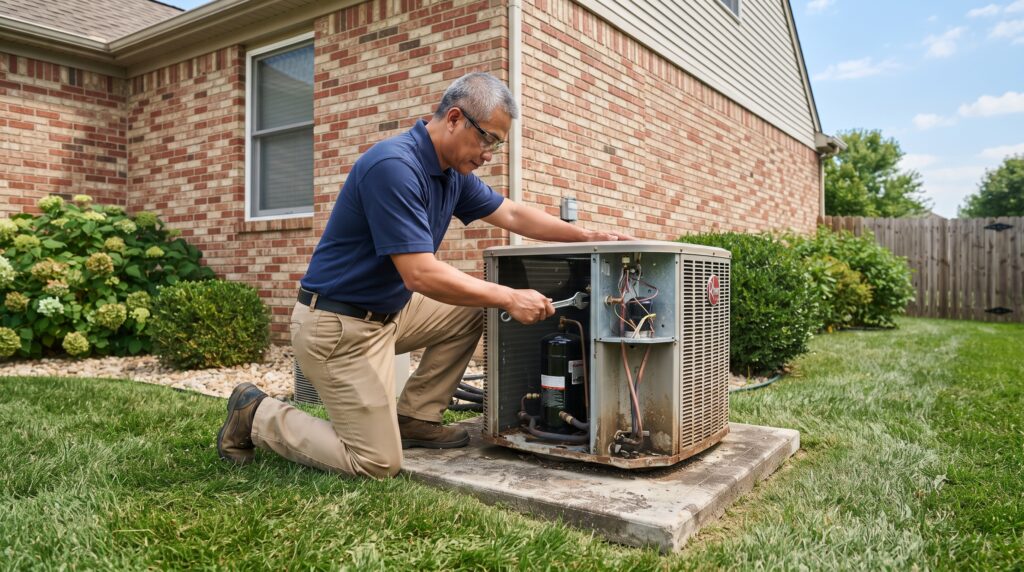
AC compressor replacement costs $1,100 to $4,650 installed in 2026 when the compressor is out of warranty, with a typical 3-ton system landing at $1,500 to $3,400. If the part is still covered by a manufacturer warranty, you pay labor and refrigerant only, which runs $600 to $2,650. The number that matters more than the quote is the one nobody prints on the invoice: a compressor swap on a system past about 10 years old often costs within a few hundred dollars of a brand-new outdoor unit that carries a fresh 10-year warranty.
TL;DR: Out of warranty, a compressor swap runs $1,100 to $4,650 all in. Under warranty it is $600 to $2,650 because you pay only labor, refrigerant, and small parts. Check warranty status before you authorize anything: most brands cover the compressor 10 years if the system was registered. Out of warranty on a system 12 years or older, price a full outdoor condenser replacement ($3,200 to $6,500) before agreeing to the swap. Run your numbers with the HVAC replacement cost estimator.
How Much Does AC Compressor Replacement Cost in 2026?
Out of warranty, expect $1,100 to $4,650 for the complete job: the compressor, 4 to 8 hours of labor, refrigerant recovery and recharge, and the ancillary parts a compressor change always requires. That is the headline range on this page, and every figure in the table below sits inside it. Two other numbers get quoted in the same conversation and are easy to confuse, so this page labels all three separately: the part alone ($500 to $2,000), the all-in out-of-warranty job ($1,100 to $4,650), and the warranty job where the manufacturer supplies the compressor and you cover everything else ($600 to $2,650).
System size drives all three. A larger compressor costs more, takes longer to braze in, and holds more refrigerant.
| System Size | Compressor (Part Only) | All-In, Out of Warranty | Under Warranty (Labor, Refrigerant, Small Parts) |
|---|---|---|---|
| 1.5 to 2 ton | $500 to $1,100 | $1,100 to $2,700 | $600 to $1,600 |
| 2.5 to 3 ton | $700 to $1,400 | $1,500 to $3,400 | $800 to $2,000 |
| 3.5 to 4 ton | $900 to $1,700 | $1,850 to $4,000 | $950 to $2,300 |
| 5 ton | $1,100 to $2,000 | $2,200 to $4,650 | $1,100 to $2,650 |
The warranty column is simply the all-in column minus the part, at both ends of every row. That is a useful sanity check when you read a quote: if a contractor tells you the compressor is covered but the price barely moves, the warranty is not actually being applied.
Compressor style also moves the part price inside those bands. Reciprocating compressors, common on older and budget equipment, sit at the low end. Scroll compressors, standard on most systems built in the last 15 years, sit in the middle. Variable-speed inverter compressors run $1,200 to $2,000 for the part, and on many inverter systems the compressor is not sold as a standalone service part at all, which forces a full outdoor-unit replacement. If your quote skipped straight to a new condenser on a high-efficiency system, that is usually why.
What Goes Into a Compressor Replacement Quote?
The compressor itself is usually less than half the bill. Here is the same 2.5-to-3-ton row from the table above, broken into the four line items that make it up.
| Line Item | 3-Ton System |
|---|---|
| Compressor (part) | $700 to $1,400 |
| Labor, 4 to 8 hours | $500 to $1,000 |
| Refrigerant recovery, evacuation, and recharge (6 to 9 lb of R-410A) | $250 to $800 |
| Filter drier, contactor, brazing supplies, nitrogen | $50 to $200 |
| Total, 3-ton system out of warranty | $1,500 to $3,400 |
Labor rates ran $85 to $175 per hour across US markets in 2026. Applied to the 4-to-8-hour window, raw labor spans roughly $400 to $1,400 nationally, and the $500 to $1,000 line above is where most 3-ton quotes actually land. Larger systems push toward the top of that span because the compressor is heavier, the lineset holds more refrigerant, and the vacuum takes longer to pull. The refrigerant line comes from R-410A running $40 to $90 per pound at homeowner service pricing in 2026, applied to the 6 to 9 pounds a 3-ton system holds.
Three items in that list surprise homeowners:
- The filter drier is not optional. Opening a sealed refrigerant circuit exposes it to atmospheric moisture. A new liquid-line drier is required every time, and after a burnout a suction-line drier goes in as well.
- Recovery is billed separately from recharge. Federal law requires the existing refrigerant to be recovered into a certified cylinder before the system is opened. That is technician time and equipment, not just the cost of new refrigerant.
- A deep vacuum takes real time. Pulling the system to 500 microns and holding it verifies there is no moisture or leak before the new charge goes in. Skipping it is the single most common reason a replacement compressor fails again inside two years.
Is Your Compressor Under Warranty? Check This First
Warranty status is worth more than any negotiation you will have with the contractor. It removes $500 to $2,000 from the bill in one step, and it is the difference between a repair that clearly makes sense and one that probably does not.
Most major brands cover the compressor for 10 years when the original owner registered the system within 60 to 90 days of installation, and 5 years when nobody registered it. Amana and the York Affinity line offer lifetime compressor coverage on registered units. The catch is consistent across every brand: the parts warranty never covers labor. Your installer’s own workmanship warranty typically runs 1 to 2 years, so on an 8-year-old system you get a free compressor and a bill for everything else.
To check coverage before you authorize the work:
- Find the model and serial number on the data plate of the outdoor unit. The serial usually encodes the manufacture date.
- Enter it in the manufacturer’s warranty lookup tool, or call the brand’s consumer line directly rather than relying on the contractor’s word.
- Confirm whether the system was registered. If you bought the house from the original owner, coverage often transfers but sometimes drops to a shorter term.
- Ask the contractor in writing what the quote looks like with the part covered. A warranty compressor still requires the contractor to file the claim and wait for the part, so some shops add a processing fee. Get that number up front.
If the compressor is covered, the decision is close to automatic: pay the $600 to $2,650 and keep the system. If it is not covered, keep reading.
Should You Replace the Compressor or the Whole System?
This is the decision the page exists to answer, and the honest version is less comfortable than most cost guides admit. Out of warranty, a compressor swap is the wrong economic call more often than it is the right one.
Start with the site’s usual tiebreaker, the $5,000 rule: multiply system age in years by the repair cost, and lean toward replacement above $5,000. A 6-year-old system with a $2,200 compressor quote scores $13,200. A 10-year-old system with a $2,400 quote scores $24,000. The rule condemns nearly every out-of-warranty compressor job, and that is not a flaw in the rule. It is the rule telling you that a compressor is expensive enough that repairing one only pencils out on a young system or a covered part.
The more useful comparison is against the thing a compressor swap actually competes with. The two options below price jobs larger than a compressor swap, so their figures deliberately sit outside the $1,100 to $4,650 compressor range. All three are priced for a 3-ton system.
- Compressor swap only: $1,500 to $3,400 out of warranty, $800 to $2,000 under warranty. You keep the existing condenser cabinet, condenser coil, fan motor, lineset, and indoor air handler. Every one of those parts is exactly as old as the compressor that just failed.
- New outdoor condenser with a matched indoor coil: $3,200 to $6,500. A complete new outdoor unit, new compressor inside it, new coil, and a fresh 10-year parts warranty. You keep the furnace or air handler. This is the option most homeowners never get quoted, and it is the one that makes a top-of-range compressor swap look bad.
- Full system replacement: $5,000 to $12,000. New outdoor unit, new indoor coil, new air handler or furnace, current refrigerant, and a full warranty on everything. See the AC replacement cost guide for the complete breakdown by size, efficiency, and brand.
Put the middle option next to the first one and the math gets blunt. A $3,400 compressor swap on a 12-year-old system buys you a new compressor bolted to a 12-year-old coil and cabinet. For $3,200 to $6,500 you could have had all of it new, with a warranty that starts over. That is the comparison to force onto the table before you sign.
Age is the cleanest filter:
- Any age, compressor under warranty: do the swap. At $600 to $2,650 there is no realistic scenario where replacing the system beats it.
- Under 8 years, out of warranty: the swap is defensible if the quote lands in the lower half of the range for your size. Ask why the warranty does not apply, because at that age it usually should.
- 8 to 12 years, out of warranty: get a condenser-replacement quote alongside the compressor quote from the same contractor. Compare them directly rather than comparing the compressor quote to nothing.
- Over 12 years, out of warranty: replace. The U.S. Department of Energy puts central AC service life in the 15-to-20-year band, and the components you are keeping are all at the same point on that curve. See how long HVAC systems last for the full lifespan picture.
How Does the R-410A Phasedown Change the Math?
Refrigerant is the line item that has moved most since 2020, and it is the part of this decision most competing pages get wrong. Two separate things are going on, and only one of them is still true.
What is real: the production phasedown. Under the American Innovation and Manufacturing (AIM) Act, the EPA is stepping down US production and import of hydrofluorocarbons on a fixed schedule: 60 percent of baseline for 2024 through 2028, 30 percent for 2029 through 2033, 20 percent for 2034 and 2035, and 15 percent from 2036 onward, per EPA’s phasedown guidance. R-410A is a blend of HFC-32 and HFC-125, both regulated substances, so it is squarely inside that schedule. Supply tightening is why homeowner-facing R-410A pricing reached $40 to $90 per pound in 2026, and it is why the refrigerant line on a compressor job now runs $250 to $800 on a 3-ton system instead of the near-rounding-error it used to be.
What is not real: the installation deadline. A large number of cost pages still warn that R-410A systems could not be installed after January 1, 2026. That deadline was formally removed. EPA’s 2026 final Technology Transitions rule eliminated the installation compliance date for residential and light-commercial air conditioning and heat pump systems built from components domestically manufactured or imported before January 1, 2025 (EPA Technology Transitions). Two limits still apply: components manufactured or imported on or after January 1, 2025 cannot be used to assemble a new R-410A system, and New York codified the original deadline in state law, so R-410A systems cannot be installed there regardless of the federal change. Nobody should be pressuring you into a decision this week on the strength of a deadline that no longer exists.
What this means for a compressor decision is narrower than the headlines suggest. Your R-410A system is legal to keep, legal to service, and legal to recharge for the foreseeable future. The cost of servicing it is what climbs. Every future leak, every coil failure, every line-set repair on that system gets more expensive as the phasedown steps down again in 2029. New systems sold today use R-454B, which is not subject to the same squeeze. If you are already at the margin on a compressor decision, rising refrigerant service cost is a legitimate thumb on the replacement side of the scale. It is not, on its own, a reason to scrap a working system.
What Causes a Compressor to Fail?
Compressors rarely fail on their own. They fail because something else went unrepaired and forced the compressor to run hot or run flooded. Knowing which failure you have matters, because one of them costs meaningfully more to fix.
Mechanical failure means the compressor seized, lost valve integrity, or dropped internal pressure without electrically burning. The refrigerant circuit stays clean. The technician recovers the charge, swaps the compressor, replaces the liquid-line drier, and recharges. This is the cheaper of the two outcomes.
Burnout means the motor windings overheated and failed electrically, dumping acid and carbon into the refrigerant and oil. The technician runs an acid test, and a positive result means the whole circuit is contaminated. The job then adds a suction-line drier, a lineset flush or replacement, a full charge replacement rather than a partial reuse, and sometimes a follow-up visit to change the drier again after a few weeks of operation. A burnout pushes an otherwise mid-range job to the top of its band.
The upstream causes are consistent and mostly preventable:
- A weak run capacitor. The most common killer. A degraded capacitor makes the compressor draw excess current on every start, cooking the windings over months. A capacitor replacement costs $90 to $480, which is why running a hard-starting system rather than fixing it is such a bad trade.
- Low refrigerant charge from an unrepaired leak. Refrigerant cools the compressor motor. Run it undercharged and the motor overheats. This is also how a slow evaporator coil leak eventually turns into a compressor bill.
- A dirty or blocked condenser coil. The outdoor coil rejects the heat the compressor just did work to move. Choke it with grass clippings, cottonwood, or dryer lint and head pressure climbs until the compressor overheats.
- A failed condenser fan motor. Same mechanism as a dirty coil, faster. Without airflow across the coil, a compressor can be destroyed in a single hot afternoon.
- Restricted indoor airflow. A clogged filter or a failing blower motor starves the evaporator, which lets liquid refrigerant return to the compressor. Liquid does not compress, and the resulting slugging breaks valves and connecting rods.
If a contractor quotes a compressor without naming the cause, ask directly what killed it. Installing a new compressor into the same conditions that destroyed the last one is the fastest way to spend the money twice.
Can You Replace an AC Compressor Yourself?
No, and not primarily for skill reasons. Under Section 608 of the Clean Air Act it is illegal to purchase, handle, recover, or charge regulated refrigerant without EPA 608 certification, and venting refrigerant to the atmosphere carries penalties of up to $44,539 per day per violation, per EPA Section 608 enforcement guidance. Recovery and recharge are unavoidable steps in a compressor change, so there is no version of this job a homeowner can legally complete.
The practical barriers stack on top of the legal one. The job needs a recovery machine and certified cylinder, a two-stage vacuum pump and micron gauge, oxyacetylene brazing with nitrogen flowing through the lines to prevent internal scale, and an accurate scale for charging by weight. That equipment costs more than the labor you would be saving. Doing the work yourself, or hiring an unlicensed installer, also voids any remaining manufacturer warranty on the compressor and often on the rest of the system.
There is a legitimate homeowner version of this job, and it is diagnostic rather than mechanical. Before you accept a compressor diagnosis, confirm the technician tested the run capacitor, measured compressor amp draw against the data plate’s rated load amps, and checked the condenser fan motor. Those three checks take ten minutes and rule out the cheap failures that mimic a dead compressor.
Frequently Asked Questions
How much does it cost to replace an AC compressor in 2026?
AC compressor replacement costs $1,100 to $4,650 installed in 2026 when the compressor is out of warranty. That total covers the part, 4 to 8 hours of labor, refrigerant recovery and recharge, and ancillary parts. A typical 3-ton system lands at $1,500 to $3,400. If the compressor is still covered by a manufacturer parts warranty, you pay only labor, refrigerant, and small parts, which runs $600 to $2,650 depending on system size.
Is it worth replacing the compressor or should I replace the whole AC unit?
It depends almost entirely on warranty status and age. Under a manufacturer parts warranty the swap is nearly always worth it. Out of warranty and under 8 years old, a swap is defensible. At 12 years or older, replacement usually wins: a new outdoor condenser with a matched coil costs $3,200 to $6,500 and carries a fresh 10-year parts warranty, while a top-of-range $3,400 compressor swap buys 2 to 5 more years on parts that are all the same age as the failed one.
How long does AC compressor replacement take?
Most compressor replacements take 4 to 8 hours of on-site work once the part is in hand. The steps are:
- Recover the existing refrigerant into a certified cylinder
- Cut out the failed compressor and braze in the replacement under flowing nitrogen
- Install a new liquid-line filter drier, plus a suction-line drier after a burnout
- Pull and hold a deep vacuum to verify there is no moisture or leak
- Recharge by weight and verify superheat and subcooling
Parts availability is the bigger delay. A stocked compressor ships in 1 to 3 days, while an obscure or inverter-driven model can take 1 to 3 weeks.
Does the manufacturer warranty cover an AC compressor?
Most major brands cover the compressor for 10 years when the system was registered within 60 to 90 days of installation, and 5 years when it was not. Amana and the York Affinity line offer lifetime compressor coverage on registered units. Labor is never included in the manufacturer parts warranty. Your installer’s own workmanship warranty typically covers labor for only 1 to 2 years, so plan on paying the labor even on a covered part.
How much refrigerant does a compressor replacement need, and what does it cost?
A 3-ton system holds roughly 6 to 9 pounds of refrigerant. R-410A runs $40 to $90 per pound at homeowner service pricing in 2026, which puts the refrigerant line at $250 to $800 on a 3-ton job. Prices have climbed because the EPA is stepping down HFC production under the AIM Act, with allowances at 60 percent of baseline for 2024 through 2028 and 30 percent from 2029. On a burnout the old charge is contaminated and must be fully replaced rather than recovered and reused.
Can a bad capacitor cause compressor failure?
Yes. A weak run capacitor makes the compressor motor draw excess current every time it starts, which overheats the windings and shortens compressor life. This is why a $90 to $480 capacitor replacement is worth doing at the first sign of trouble rather than running the system in a hard-starting state. Low refrigerant charge, a dirty condenser coil, and a failed condenser fan motor damage compressors the same way, by forcing the unit to run hot.
The short version: check the warranty first, ask what killed the old compressor second, and price a full outdoor condenser replacement third. If the system is out of warranty and past 12 years, the swap almost never wins on paper. Compare your numbers against a full replacement with the HVAC replacement cost estimator, or read the complete HVAC replacement cost guide for how a new system prices out by size, efficiency, and brand.