
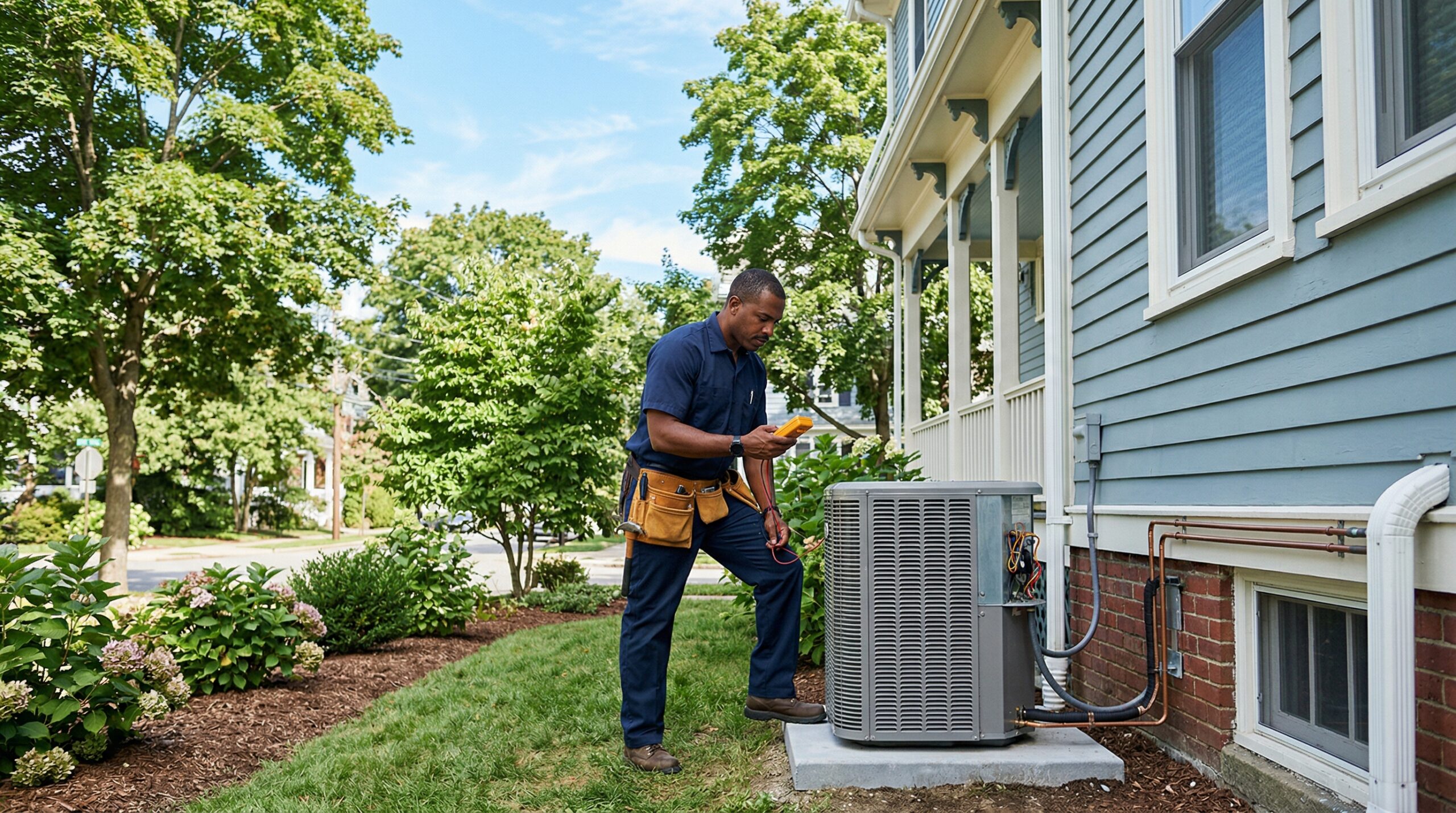
Massachusetts homeowners replacing an HVAC system face one of the highest-cost markets in the country, offset by one of the best state rebate programs in the US. This guide covers what replacement costs across Massachusetts regions, how to use MassSave rebates and the 0% HEAT Loan to reduce out-of-pocket costs, and whether a heat pump makes sense for Zone 5A winters.
How Much Does HVAC Replacement Cost in Massachusetts?
Most Massachusetts homeowners spend between $5,500 and $19,000 for a complete HVAC replacement, depending on system type, home size, and location. Greater Boston and the Cambridge metro consistently run 15–20% above the state average due to union labor density and an aging housing stock of colonial, cape, and triple-decker homes. Springfield and the Pioneer Valley are the most affordable markets in the state, running 5–10% below average.
| System Type | Typical Massachusetts Range | Notes |
|---|---|---|
| Central AC replacement | $4,500–$10,500 | Outdoor unit + indoor coil, existing ductwork |
| Heat pump (ducted central) | $7,000–$16,000 | Heating and cooling combined; MassSave rebate eligible up to $10,000 |
| Gas furnace replacement | $3,500–$8,500 | Forced-air heat, natural gas; most common in older MA homes |
| Full system (AC + furnace) | $9,000–$19,000 | Complete replacement, new coil and air handler |
| Mini-split (single zone) | $3,500–$9,000 | Ductless; ideal for triple-deckers and cape-style homes |
| Ductwork repairs/replacement | $500–$4,000+ | Seal and insulate existing; full replacement adds $2,500–$8,000 |
Massachusetts construction costs run approximately 38% above the national average according to 2026 contractor pricing data. The biggest single cost driver after system type is ductwork condition: homes built before 1980 often have undersized, leaking, or uninsulated ductwork that adds $1,500–$5,000 to any major system replacement. Use the HVAC cost estimator to get a personalized range based on your home’s size and system type.
What Affects HVAC Costs Across Massachusetts Regions?
Massachusetts is a geographically compact state, but its HVAC markets vary substantially. Greater Boston’s labor costs, Cape Cod’s salt air exposure, and the Pioneer Valley’s more competitive contractor market all push prices in different directions.
| Region | Climate Profile | Cost vs. State Average | Key Factor |
|---|---|---|---|
| Greater Boston (Suffolk, Middlesex, Norfolk counties) | Zone 5A, cold-humid, four seasons | +15–20% | Union labor, aging colonial and triple-decker stock, permit complexity |
| North Shore / South Shore (Essex, Plymouth counties) | Zone 5A, coastal cold-humid | +5–10% | Coastal salt air adds equipment wear; suburban premium |
| Worcester / Central MA | Zone 5A, inland cold-humid | At state average | Balanced market, newer suburban stock, competitive contractor base |
| Springfield / Pioneer Valley (Hampden, Hampshire counties) | Zone 5A/5B inland | –5–10% | Lowest labor costs in MA; older city housing stock |
| Cape Cod and Islands | Zone 5A coastal, moderated by ocean | +10–15% | Summer-only contractor availability, salt air corrosion factor on equipment |
Cape Cod and the South Shore present a cost factor inland buyers rarely face: accelerated salt air corrosion on outdoor condenser units. Coastal installations may see equipment life shortened by 2–4 years compared to inland homes. When shopping for equipment in coastal zones, ask contractors about condenser coils with corrosion-resistant coating (sometimes called “ocean coastal” or “RTPF” coatings). Spending an extra $200–$500 on a coated unit often extends equipment life enough to pay back the premium and then some.
For Boston-specific pricing, older home ductwork considerations, and triple-decker installation logistics, see the Boston HVAC replacement cost guide.
What MassSave Rebates Are Available for HVAC Replacement?
MassSave is a statewide energy efficiency program administered by National Grid, Eversource, and other Massachusetts electric and gas utilities. It is consistently ranked among the top state utility efficiency programs in the country, and its combination of equipment rebates plus 0% interest financing makes it uniquely powerful for homeowners planning a heat pump or high-efficiency system upgrade.
Current MassSave rebates for residential HVAC equipment (verify current amounts at masssave.com before purchasing):
- Cold-climate heat pump (ducted central or ductless mini-split): Up to $10,000 depending on system capacity and efficiency rating. Requires NEEP-qualified cold-climate heat pump (rated to at least –13°F).
- Central air conditioner: $150–$250 rebate for qualifying high-efficiency units meeting minimum SEER2 threshold.
- Smart thermostat: $100 rebate for qualifying Nest, Ecobee, or Honeywell Home smart thermostats, paired with any efficiency upgrade.
- Income-qualified track (Mass Save Income Eligible): Additional subsidies or potentially free equipment for households at or below 60% of area median income.
The MassSave 0% HEAT Loan — How It Works
The HEAT Loan is a 0% interest financing program offered through MassSave partner banks. Eligible homeowners can borrow up to $25,000 for heat pump installation, insulation, and weatherization upgrades, repaid over up to 7 years at 0% interest. Here is how the rebate-plus-loan stack works in practice:
- Step 1: Get a qualifying heat pump installed by a MassSave-approved contractor. Total cost: $12,000 (example).
- Step 2: Receive the MassSave heat pump rebate (say $8,000 for a whole-home cold-climate system).
- Step 3: Finance the remaining $4,000 via the 0% HEAT Loan at no interest for up to 7 years.
- Result: A $12,000 heat pump installation nets out to $4,000 total out-of-pocket, financed at $48/month over 7 years at 0% interest.
The rebate and loan application are handled through your utility’s MassSave portal after installation. The contractor does not need to be pre-approved but must be licensed in Massachusetts. Rebate amounts update periodically, so confirm current figures at masssave.com before committing to equipment.
A note on federal tax credits: The IRA Section 25C energy efficiency tax credits (up to $2,000 for qualifying heat pumps) expired as of December 31, 2025. Do not rely on these credits for equipment purchased in 2026. The MassSave rebates and HEAT Loan are state-funded and are not affected by the 25C expiration. For more detail on available financing paths, see the HVAC financing options guide.
Is a Heat Pump the Right Choice for Massachusetts Winters?
Massachusetts sits in ASHRAE Climate Zone 5A, a cold-humid zone with approximately 6,000 heating degree days and 900 cooling degree days. Heating dominates the system economics in a way that is different from states further south. This makes the heat pump’s heating efficiency rating (HSPF2) more important than its cooling rating (SEER2) when evaluating equipment for a Massachusetts home.
How the climate-system match breaks down across the state:
- Greater Boston and Eastern MA (Zone 5A): Cold-climate heat pumps rated to –13°F or lower perform well through typical Boston winters. Boston’s average January low is around 22°F, well within efficient operating range for modern units. Mitsubishi Hyper Heat (H2i), Bosch IDS, and Fujitsu XLTH series are well-suited to this climate.
- Central MA and Worcester area (Zone 5A inland): Similar to Eastern MA. Standard cold-climate heat pumps are appropriate. Slightly colder than the coast during winter events but still within heat pump operating range.
- Pioneer Valley and Western MA (Zone 5A/5B, Springfield, Northampton): More frequent cold events, sometimes dipping below –10°F. Cold-climate heat pumps still viable; dual-fuel setups (heat pump plus gas backup) offer reliability insurance during extreme cold snaps and may be cost-effective if natural gas rates are low.
- Cape Cod and Islands (Zone 5A coastal): Ocean moderation keeps winters milder than inland MA. Heat pumps are excellent here. Coastal homes are often older with poor insulation. Sealing and insulating before or alongside a heat pump installation will improve efficiency.
Massachusetts state policy is actively accelerating heat pump adoption. The Massachusetts Clean Energy Standard, the Global Warming Solutions Act, and associated building code updates are creating a long-term environment where heat pumps become the default. For homes without existing ductwork (triple-deckers, cape-styles, older apartments), ductless mini-split heat pumps offer a path to both heating and cooling without major duct installation costs.
For a full cost analysis of heat pump installation in Massachusetts, including brand comparisons and MassSave-qualified equipment lists, see the heat pump replacement cost guide.
Massachusetts HVAC Permit Requirements
Massachusetts requires a mechanical permit for HVAC replacement statewide under the Massachusetts State Building Code (780 CMR). Unlike some states, most Massachusetts municipalities require a licensed HVAC contractor to pull the permit rather than the homeowner. A permit ensures the installation is inspected for code compliance, which matters for homeowner’s insurance coverage and when selling the property.
| City / Region | Permit Fee Range | Notes |
|---|---|---|
| Boston | $100–$200 | ISD (Inspectional Services Department); 3–5 business days |
| Worcester | $75–$150 | 3–5 business days |
| Springfield | $50–$120 | Office of Permits and Inspections |
| Cambridge | $100–$200 | City of Cambridge Inspectional Services |
| Lowell | $60–$130 | Division of Inspectional Services |
| Most cities and towns | $50–$200 | Scope-dependent; full duct replacement adds complexity and cost |
Permit fees vary by scope of work. A straight equipment swap in the same location (no new ductwork or refrigerant line changes) typically falls at the low end of each jurisdiction’s range. Adding new duct runs, relocating equipment, or converting from one system type to another adds permit complexity. Ask any contractor for their standard permitting process before signing a contract. If a quote does not mention permits, ask specifically. A contractor who skips permits creates risk for the homeowner, not just themselves.
Massachusetts HVAC Cost Snapshot by City
Here is a quick-reference cost snapshot for the state’s major metros. These ranges reflect full system replacement (AC or heat pump + air handler/furnace) and include labor and equipment but not ductwork repairs or electrical upgrades.
| City | Typical Full Replacement Range | Key Factor |
|---|---|---|
| Boston | $8,000–$19,000 | Union labor, older housing, triple-deckers: see Boston guide |
| Worcester | $6,000–$14,000 | Central MA market; competitive contractor base |
| Springfield | $5,500–$12,000 | Pioneer Valley; lowest MA labor costs |
| Cambridge | $8,000–$18,000 | Dense urban market; older Victorian housing stock |
| Lowell | $6,000–$13,000 | Mill-era housing stock; mixed market |
| New Bedford | $6,000–$13,000 | Coastal salt air factor; working-class market |
These ranges are starting points for budgeting conversations with contractors. Actual quotes depend on equipment brand and efficiency tier, ductwork condition, electrical panel capacity (heat pump conversions may require a panel upgrade), and contractor availability in your area. Always get three quotes before committing. For how to compare HVAC quotes effectively, see the HVAC lifespan guide.
Frequently Asked Questions
What is the average cost to replace an HVAC system in Massachusetts?
Most Massachusetts homeowners spend $5,500–$19,000 for a complete HVAC replacement. A heat pump runs $7,000–$16,000; central AC replacement is $4,500–$10,500; gas furnace replacement is $3,500–$8,500. Greater Boston and Cambridge run 15–20% above the state average. MassSave rebates (up to $10,000 for heat pumps) can significantly reduce net cost before financing.
What are the MassSave rebates for HVAC replacement?
MassSave offers up to $10,000 for qualifying cold-climate heat pumps (ducted or ductless). Central AC replacements qualify for $150–$250. Smart thermostats qualify for $100. Income-eligible households may receive deeper subsidies through the Mass Save Income Eligible program. The 0% HEAT Loan offers up to $25,000 in 0% interest financing for heat pump and weatherization work, stackable with the equipment rebate. Apply through National Grid or Eversource’s MassSave portal after installation. Verify current amounts at masssave.com before purchasing.
Is a heat pump a good choice for Massachusetts winters?
Yes, for most Massachusetts homes. Zone 5A winters are cold but modern cold-climate heat pumps (HSPF2 10+) are rated to –13°F or lower, which covers the vast majority of MA winter days. Boston’s average January low is around 22°F. Brands like Mitsubishi Hyper Heat, Bosch IDS, and Fujitsu XLTH are specifically engineered for cold-climate performance. Homes in Western MA or areas with frequent extreme cold events benefit from a dual-fuel setup (heat pump plus gas backup) for reliability insurance.
Do I need a permit to replace HVAC in Massachusetts?
Yes. The Massachusetts State Building Code (780 CMR) requires a mechanical permit for HVAC replacement statewide. Most municipalities require the permit to be pulled by a licensed Massachusetts HVAC contractor. Permit fees range from $50–$200 depending on jurisdiction, with Boston and Cambridge at the higher end. Always confirm that permit costs are included in any contractor quote. Installing without a permit can affect homeowner’s insurance coverage and create issues when selling.
What is the MassSave HEAT Loan and how does it work?
The HEAT Loan is a 0% interest financing program offered through MassSave partner banks for qualifying energy efficiency improvements including heat pumps, insulation, and weatherization. Eligible homeowners can borrow up to $25,000 repaid over up to 7 years at 0% interest. It stacks with MassSave equipment rebates: the rebate reduces the purchase price, and the HEAT Loan finances the remaining balance. A $12,000 heat pump with an $8,000 rebate and a HEAT Loan on the remaining $4,000 costs $48/month for 7 years with no interest. Apply through your utility’s MassSave portal after receiving a contractor quote.
How do Massachusetts HVAC costs compare to the national average?
Massachusetts HVAC replacement costs run approximately 15–20% above the national average, with Greater Boston at the high end. Massachusetts construction costs are roughly 38% above national average overall, driven by higher labor wages, union density, and complex older housing stock. The MassSave rebate program partially offsets this premium for homeowners upgrading to heat pumps. Springfield and the Pioneer Valley are the most affordable MA markets and align more closely with national average pricing.