
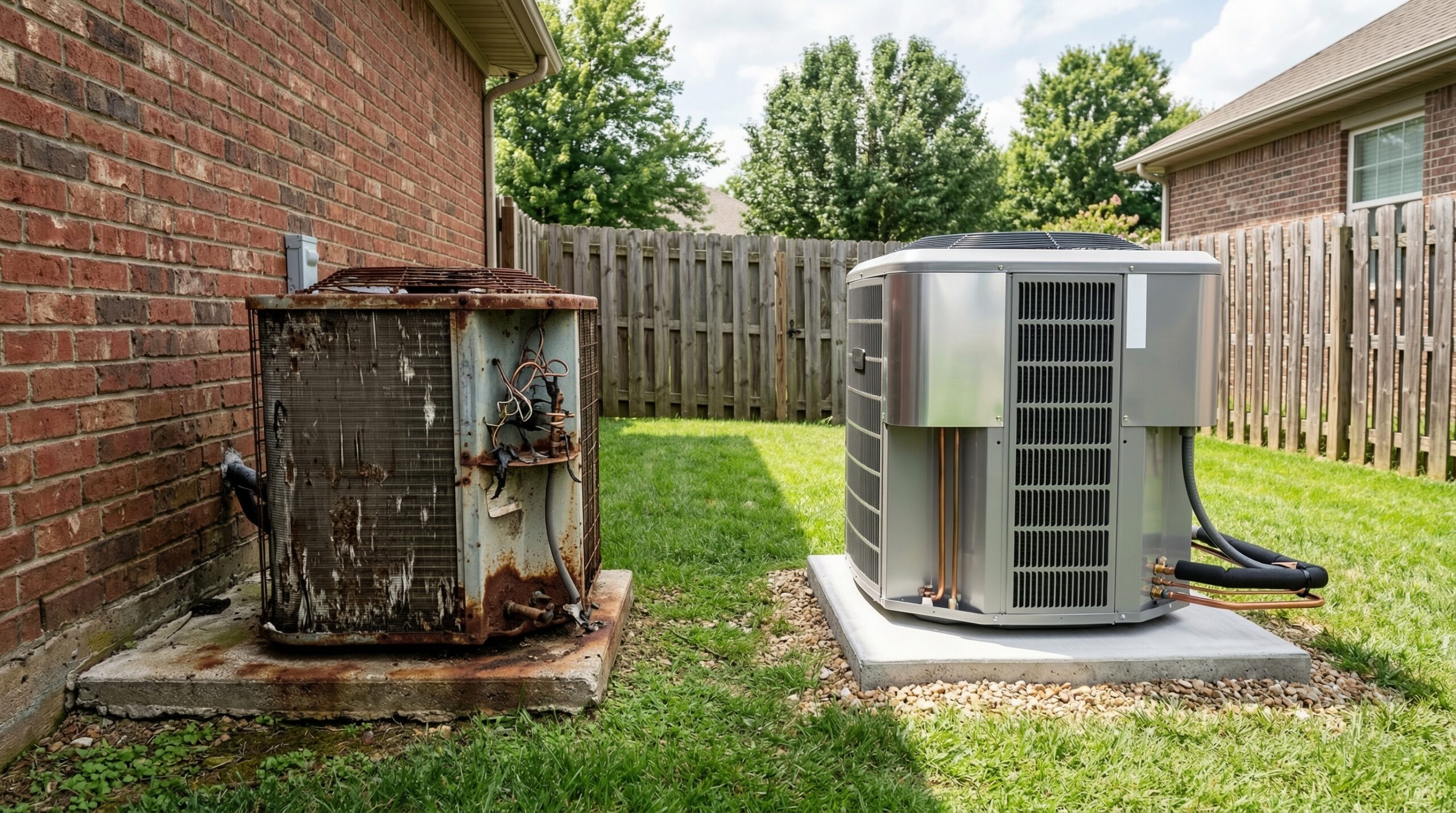
Most homeowners don’t think about their HVAC system until it stops working, often on the hottest day of August or the coldest night of January. Emergency replacement under pressure costs more and limits your options. Knowing your system’s expected lifespan lets you plan on your schedule, not your equipment’s. When you’re ready to move forward, the HVAC replacement timeline guide explains exactly how long the process takes from scheduling to installation day.
This guide covers the median lifespan of every major HVAC component, the factors that shorten or extend it, the warning signs to watch before failure arrives, and how to find your system’s actual age right now, plus the math that tells you when repair stops making sense. When the time comes to replace, see your HVAC financing and payment plan options to plan for the cost. If your contractor quoted a Heil HVAC system, see our Heil pricing guide for model-by-model cost ranges.
TL;DR: A central AC typically lasts 15–20 years (median: 15), a gas furnace 15–20 years (median: 18), and a heat pump 10–15 years (median: 12). Ductwork outlasts most equipment at 20–25 years. Annual maintenance adds 3–5 years of useful life (ENERGY STAR). If a repair quote times your system’s age exceeds $5,000, replacement usually wins.
How Long Does Each Type of HVAC System Last?
Residential HVAC equipment spans a wide lifespan range: 10 to 30 years depending on what you own. The benchmarks below come from AHRI published ranges, DOE guidance, and manufacturer-stated design lives. The median is what contractors actually see in the field; the typical range accounts for climate, maintenance, and installation quality.
| System Type | Median Lifespan | Typical Range |
|---|---|---|
| Central AC (split system) | 15 years | 12–20 years |
| Gas Furnace | 18 years | 15–20 years |
| Heat Pump | 12 years | 10–15 years |
| Ductwork (sheet metal) | 22 years | 20–25 years |
| Mini-Split (ductless) | 17 years | 15–20 years |
| Boiler (hydronic) | 25 years | 20–30 years |
A few things stand out in this data. Boilers and ductwork substantially outlast forced-air equipment; it’s common to replace two generations of furnaces before needing new ductwork. Heat pumps have the shortest median life because they run year-round (both heating and cooling), accumulating roughly twice the run hours of a system that only heats or only cools. Gas furnaces tend to edge out central AC in longevity because the heating cycle is shorter and less thermally stressful than summer-long cooling duty cycles.
These are national medians. Hot-climate AC units in Phoenix or Houston often land at 12–14 years; the same model in Minneapolis regularly reaches 18–20 years. When an older system finally reaches end of life, the home’s age can significantly affect replacement cost. See our guide to HVAC replacement in older homes for what pre-1980, 1980–2000, and 2000–2010 vintage homes add to the project budget. See our methodology page for how we calculate these estimates. In DFW markets like Fort Worth, the combination of Zone 3A summer heat and periodic freeze events accelerates both AC and furnace wear. See how Fort Worth homeowners plan for HVAC replacement →
Virginia’s four-season climate creates a different aging pattern than single-season markets. Richmond and Northern Virginia homeowners see balanced cooling and heating duty cycles, which means both AC and furnace age at similar rates, unlike Sunbelt markets where the AC does most of the work. Coastal Virginia units near Virginia Beach and Hampton Roads may reach end-of-life 2 to 3 years earlier than inland units due to salt air corrosion on outdoor condenser components. See the Virginia HVAC replacement cost guide for regional lifespan factors and replacement cost ranges.
What Shortens or Extends HVAC Lifespan?
The single biggest determinant of how long your system lasts isn’t the brand or the model. It’s how the system is maintained and how hard it’s worked. Three factors account for most of the variation between a system that dies at 11 years and one that runs cleanly to 22.
- Maintenance frequency. Annual professional tune-ups and monthly filter changes can extend useful system life by 3–5 years, according to ENERGY STAR guidance. A dirty air filter forces the blower motor to work harder, raises operating temperatures, and accelerates compressor wear. Blower motors typically last 10 to 20 years; when they fail, replacement costs $300 to $2,000 depending on motor type (see the blower motor replacement cost guide). Skipping annual service for three consecutive years roughly doubles the likelihood of a premature compressor or heat exchanger failure.
- Climate and usage intensity. A central AC in Phoenix runs 2,500–3,000 hours per year. The same unit in Minneapolis runs 800–1,000 hours. More hours means more compressor cycles, more wear on capacitors and contactors, and faster refrigerant seal degradation. Hot, humid climates (Florida, Gulf Coast, and cities like Nashville, TN) add corrosion stress to outdoor coils. Cold-climate heat pumps run in defrost mode more frequently, adding mechanical load.
- Installation quality. An undersized system short-cycles, turning on and off frequently rather than running long steady cycles. Short-cycling is one of the most destructive operating patterns for compressor longevity. An oversized system never runs long enough to dehumidify properly, creating moisture problems that damage ductwork and indoor coils. A properly sized installation with correct refrigerant charge at commissioning is worth more than any brand premium.
Secondary factors include refrigerant type (R-410A systems are easier to service than older R-22 units), indoor air quality (high dust loads clog coils faster), and thermostat programming (wide daily temperature swings increase compressor cycling).
Warning Signs Your System Is Approaching End of Life
Full HVAC failure rarely happens without warning. The system tells you it’s struggling, if you know what to look for. These are the signals that replacement planning should start now, even if the system is still technically running.
- Age exceeds the median for its type. A 16-year-old AC or a 20-year-old furnace isn’t broken, but it’s operating on borrowed time. Budget for replacement proactively rather than waiting for failure.
- Repair frequency is increasing. One repair in five years is normal maintenance. More than one service call per year (especially for the same component) signals a system that’s beginning to fail incrementally.
- R-22 refrigerant. R-22 (Freon) was discontinued by the EPA on January 1, 2020. Systems that use it can no longer be recharged with new refrigerant. Only recovered and recycled R-22 is available, at prices that have risen sharply. If your system uses R-22 and needs a recharge, replacement is almost always the better financial choice.
- SEER rating below 10. DOE’s 2023 SEER2 standards set a minimum of 14–15 SEER2 for new equipment. A system rated below 10 SEER is dramatically less efficient than anything you’d replace it with. The energy savings from a new system often offset a meaningful portion of the replacement cost over 5–7 years.
- Uneven temperatures and rooms that won’t reach setpoint. When a system that previously kept the house comfortable starts failing to maintain temperature on moderate days, the compressor or heat exchanger is losing capacity.
- Unusual noises: grinding, banging, or persistent squealing. Grinding suggests bearing failure; banging usually indicates a loose or broken component in the blower or compressor; persistent squealing often points to a failing belt or motor bearing. These sounds don’t resolve on their own.
- Energy bills rising without a change in usage. A 10–20% increase in cooling or heating cost with no change in weather patterns or thermostat settings is a reliable indicator of declining system efficiency, typically compressor or heat exchanger degradation.
- Humidity problems despite a running system. Central AC dehumidifies as it cools. A system that’s running but leaving the house feeling humid is often short-cycling or has a failing evaporator coil: both are signs of end-of-life operation.
How to Find Out How Old Your HVAC System Is
Don’t guess at your system’s age. The manufacture date is embedded in the serial number on every piece of HVAC equipment. You just need to know where to look and how to read it. Here’s how to find it in under five minutes.
- Find the data plate. On a central AC, it’s on the outdoor condenser unit, typically a metal plate on the side or back. On a furnace or air handler, look inside the cabinet door or on the front panel. Mini-splits have a plate on the indoor head unit.
- Locate the serial number. The serial number (not the model number) contains the manufacture date. It’s usually 8–12 characters, often starting with a letter or two-digit number.
- Decode the date by brand. Carrier and Bryant encode the year as the first two digits: serial “2106XXXXX” = 2021, week 6. Trane uses characters 3–4 for the year: “X21XXXXXXX” = 2021. Lennox uses a different alpha-numeric scheme: “5910” at characters 2–5 means the 10th week of 2059 is wrong; look up Lennox’s current decode key. When in doubt, search “[brand] HVAC serial number date decode.”
- Cross-reference your home inspection report. If you bought your home in the last 10–15 years, your inspection report almost certainly lists the estimated age of HVAC components. This is a quick sanity check against the serial number decode. HVAC age matters to buyers and home inspectors too: see how system age affects home sale negotiations in our guide to HVAC Replacement and Home Sale.
- Use the AHRI certificate lookup as a fallback. If the data plate is missing or unreadable, the AHRI directory at ahridirectory.org may have certification records for your model number that include manufacture year ranges.
Most homeowners who’ve lived in their home for years have never looked at the data plate. A five-minute check today gives you a concrete replacement timeline to plan around and changes the conversation with a contractor from reactive emergency to informed decision.
Age and Repair Cost — When to Replace Instead of Repair
Knowing your system’s age unlocks the most useful calculation in HVAC decision-making: the $5,000 rule. Multiply the cost of the proposed repair by the system’s age in years. If the result exceeds $5,000, replacement is almost always the better financial move.
Example: A $600 compressor repair on a 12-year-old AC yields $7,200, well above the threshold. That repair cost buys you marginal time on a system you’ll replace within a few years anyway, without resetting the clock. In contrast, a $400 capacitor replacement on an 8-year-old system yields $3,200, below the threshold and worth doing.
A simpler rule of thumb: if the repair cost exceeds 50% of what a new system would cost, replace. A new mid-efficiency gas furnace installed costs $4,500–$6,500. A $2,500 heat exchanger repair on that same furnace fails the 50% test, and heat exchanger failure often indicates the furnace is near end of life anyway.
These thresholds are starting points, not absolutes. Factor in the system’s remaining expected life, your local climate, and whether a replacement would qualify for the federal 25C tax credit (up to $600 for high-efficiency systems). Our repair vs. replace guide walks through the full decision framework with interactive calculations. Before you get there, check the signs your HVAC needs replacement to see if your system has reached that threshold.
When replacement is the answer, understanding the cost upfront prevents sticker shock. See our full HVAC replacement cost guide for detailed breakdowns by system type, efficiency tier, and region.
In Las Vegas and Southern Nevada, extreme summer heat (design temperatures above 110°F) puts extra stress on compressors and refrigerant systems, shortening AC lifespan below national averages. Las Vegas ACs often reach replacement age in 12 to 15 years rather than the typical 15 to 20. The Nevada HVAC replacement cost guide covers what to budget when that timeline arrives. Oregon’s mild Marine West Coast climate can extend HVAC lifespan compared to heat-stressed states. See the Oregon HVAC replacement cost guide for what to budget when replacement time arrives in Portland, Eugene, or Bend.
Frequently Asked Questions
How often should I replace my HVAC system?
There’s no fixed replacement schedule. It depends on system type, maintenance history, and repair trajectory. As a planning baseline, budget for central AC replacement at 15 years, furnace at 18 years, and heat pump at 12 years. If repair costs are rising and the system is past its median age, start planning now rather than waiting for failure.
What is the $5,000 rule for HVAC?
The $5,000 rule is a quick repair vs. replace calculation: multiply the repair quote by the system’s age in years. If the result is more than $5,000, replacement is typically the better financial decision. A $400 repair on a 10-year-old system ($4,000) is worth doing. A $700 repair on a 14-year-old system ($9,800) usually isn’t.
Does regular maintenance actually extend HVAC life?
Yes, meaningfully. ENERGY STAR estimates that annual professional tune-ups and consistent filter maintenance extend system life by 3–5 years. The mechanisms are direct: clean coils transfer heat more efficiently, reducing compressor load; proper refrigerant charge prevents compressor overwork; early detection of failing capacitors and contactors avoids cascade failures.
How long does a heat pump last in a cold climate?
Heat pumps in cold climates (Zone 5 and colder) run more hours annually than in mild climates because they handle both heating and cooling. In practice, expect the lower end of the 10–15 year range, roughly 10–12 years with average maintenance. In cities like Minneapolis, where systems run more than 8,000 heating degree-days per year, annual maintenance is especially important. See Minneapolis HVAC replacement costs to understand what a full system replacement runs when the time comes. Cold-climate heat pumps also enter defrost mode frequently, which adds compressor cycling stress. Modern cold-climate heat pumps (rated to -13°F) are more durable in these conditions than older models. For Massachusetts-specific heat pump performance and MassSave rebates, see the Massachusetts HVAC replacement cost guide.
Can ductwork outlast multiple HVAC systems?
Yes. Sheet metal ductwork typically lasts 20–25 years and commonly survives one or two complete equipment replacements. That said, ductwork should be inspected whenever equipment is replaced, since leaky ducts reduce system efficiency by 20–30% (DOE), effectively shortening the new equipment’s functional life. Flex duct connections and duct board installations have shorter service lives than sheet metal.
My system is old but still running. Should I replace it now?
Age alone isn’t sufficient reason to replace a functioning system. The right triggers are a combination of age past the median, rising repair frequency, and a system type or efficiency rating that’s significantly outdated. If your 18-year-old furnace has had two repairs in the last two years and you live in a cold climate, proactive replacement before next winter is financially prudent. If it’s 16 years old with clean maintenance records and zero recent repairs, continue running it with annual service.
Plan Your Replacement Before You Have To
The homeowners who get the best outcomes on HVAC replacement are the ones who aren’t in an emergency. They’ve looked at the data plate, know their system’s age, and start getting quotes 6–12 months before they expect to need a new system. That timeline allows for multiple bids, rebate research, and scheduling on their terms. Before you ask for those quotes, know what every HVAC quote should include so you can compare them accurately.
Key takeaways:
- Central AC: plan for replacement at 15 years; furnace at 18 years; heat pump at 12 years
- Annual maintenance adds 3–5 years: it’s the single highest-ROI action you can take
- If repair cost × system age > $5,000, replacement almost always wins financially
Once you know your system is nearing end of life, our guide on how to get HVAC replacement quotes walks you through the full process of finding contractors, comparing bids, and avoiding common pitfalls. When planning your timeline, budget 3 to 7 business days for the required permit and inspection: see our HVAC permit requirements and cost guide.
Arkansas homeowners face a particularly demanding climate for HVAC longevity: hot, humid summers with heat indices above 105u00b0F stress outdoor coils and compressors, while ice storms in winter add freeze-thaw stress. Annual maintenance and proactive replacement planning before peak season are especially important in this climate. See our Arkansas HVAC replacement cost guide for regional pricing and what to expect at end-of-life replacement.
When you’re ready to estimate costs, our free HVAC replacement cost estimator gives you a personalized cost range based on your home size, region, and system type. No email required, no quote request, just the numbers.