
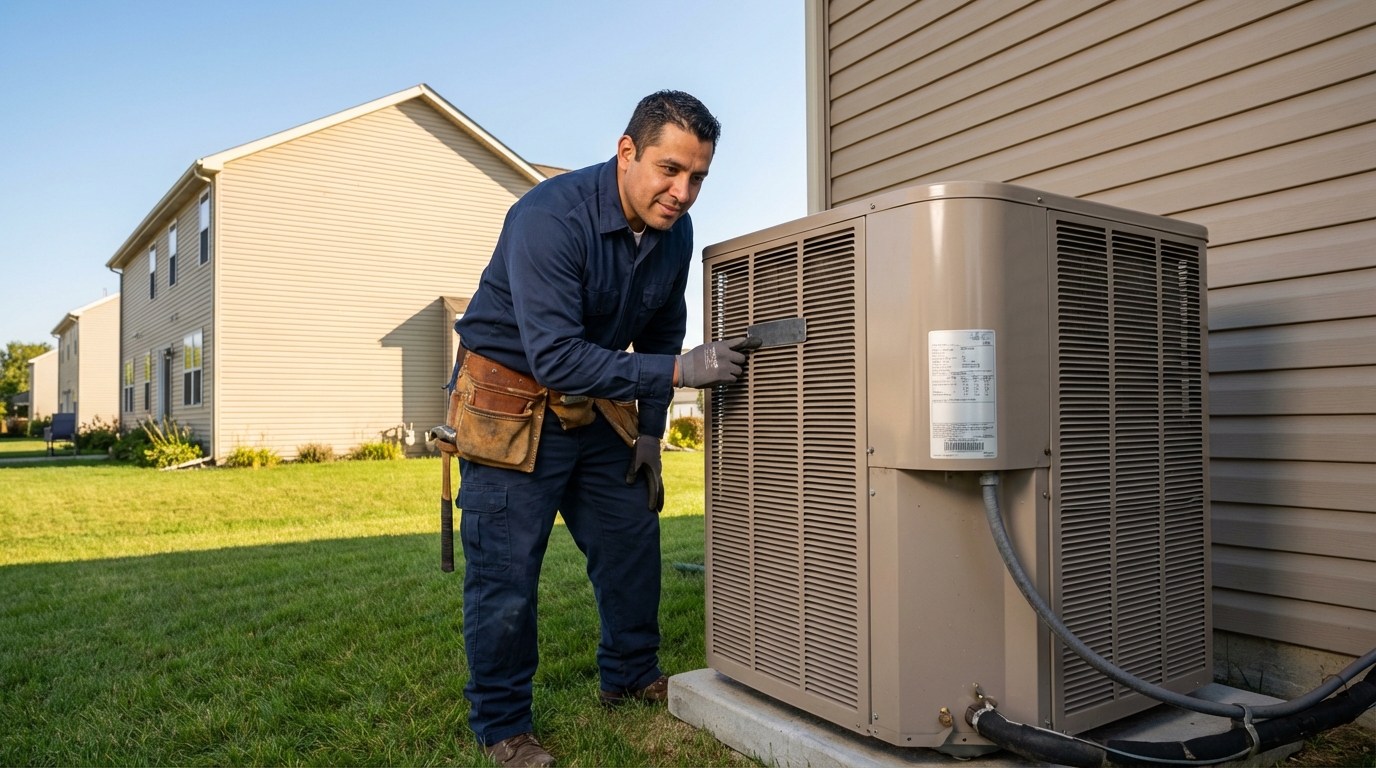
A 4-ton HVAC system is one of the most common sizes installed in American homes. It covers the sweet spot for mid-size houses between roughly 1,800 and 2,500 square feet, depending on climate zone and insulation quality. The cost of replacing a full 4-ton system varies widely based on whether you choose a traditional AC-plus-furnace pairing or a heat pump, which brand you select, and what efficiency tier fits your budget. This guide covers full system pricing, not just the AC condenser side. If you only need the air conditioner replaced, see our separate 4-ton AC replacement cost guide.
TL;DR: A 4-ton HVAC replacement costs $5,500 to $12,500 installed for an AC-plus-furnace combination, or $6,500 to $14,000 for a ducted heat pump. Goodman and Rheem sit at the budget end; Carrier, Trane, and Lennox run premium. Higher SEER2 ratings cost more upfront but qualify for the federal IRA 25C tax credit (up to $2,000 for heat pumps). A Manual J load calculation confirms whether 4-ton is the right size for your home. Use our free estimator to get a personalized range.
How Much Does a 4-Ton HVAC Replacement Cost in 2026?
The installed cost of a complete 4-ton HVAC system depends on which type of system you choose. Here is what homeowners typically pay in 2026 for a full replacement including equipment, labor, permits, and disposal of the old system:
| System Type | Installed Cost Range | What’s Included |
|---|---|---|
| Central AC + gas furnace | $5,500–$12,500 | 4-ton condenser, matched evaporator coil, gas furnace, thermostat |
| Ducted heat pump | $6,500–$14,000 | 4-ton heat pump condenser, air handler with coil, thermostat |
| AC only (condenser + coil) | $4,500–$9,500 | Condenser and evaporator coil replacement; keeps existing furnace |
| Gas furnace only (matched) | $3,000–$6,500 | Furnace/air handler replacement; keeps existing condenser |
Most homeowners replacing a full 4-ton system (AC plus furnace) spend between $7,000 and $10,000 after factoring in mid-tier equipment and standard installation. The low end assumes a budget brand at minimum efficiency with straightforward ductwork. The high end reflects premium brands, high-efficiency equipment, or installations that require ductwork modifications or electrical upgrades. Use our free HVAC cost estimator to narrow the range for your specific home, location, and system preferences.
What Is the Difference Between 4-Ton AC and 4-Ton Full HVAC?
The term “4-ton” refers to the cooling capacity of the system: 48,000 BTU per hour. When someone says “4-ton AC replacement,” they usually mean replacing just the outdoor condenser and indoor evaporator coil while keeping the existing furnace. “4-ton HVAC replacement” means replacing the entire heating and cooling system, including the furnace or air handler.
This matters for pricing because a full HVAC replacement adds $3,000 to $6,500 for the furnace or air handler on top of the AC condenser cost. It also matters for system performance. A new high-efficiency condenser paired with an old furnace blower may not deliver its rated SEER2 efficiency because the blower speed, airflow, and refrigerant metering need to match. If your furnace is more than 12 years old, replacing both at once is usually the better investment: you avoid paying a second round of labor charges and you get a properly matched system from day one. For AC-only pricing, see our dedicated 4-ton AC replacement cost guide. For a broader view of HVAC replacement costs across all sizes, start with our main pricing page.
How Do Major Brands Compare at 4-Ton Capacity?
Brand choice is the single biggest variable in 4-ton HVAC pricing after system type. Here is how the major manufacturers compare for a complete AC-plus-furnace system at 4-ton capacity:
| Brand | 4-Ton Full System (AC + Furnace) | Tier | Warranty Highlights |
|---|---|---|---|
| Goodman / Amana | $5,500–$8,000 | Budget | 10-year parts; Amana adds lifetime compressor (with registration) |
| Rheem / Ruud | $6,000–$9,500 | Budget-Mid | 10-year parts and compressor |
| York / Coleman | $6,500–$9,500 | Mid-tier | 10-year parts; varies by installer |
| Carrier / Bryant | $7,000–$11,000 | Premium | 10-year parts; extended options available |
| Trane / American Standard | $7,500–$11,500 | Premium | 10-year parts with registration; 12-year compressor on select models |
| Lennox | $8,000–$12,500 | Premium | 10-year parts; extended labor warranties through dealers |
Budget brands like Goodman and Rheem are manufactured domestically and use proven compressor technology. They lack some of the noise-reduction and variable-speed features of premium brands, but for straightforward replacements they deliver reliable cooling and heating at a lower price. Premium brands like Carrier and Lennox offer variable-speed compressors, quieter operation, and tighter humidity control, which matter more in hot-humid climates. The warranty differences are real but narrow: most brands offer 10-year parts coverage with registration. What varies more is the dealer network and the quality of the installing contractor, which affects the actual installation quality more than the equipment nameplate.
How Does SEER2 Rating Affect 4-Ton System Pricing?
SEER2 (Seasonal Energy Efficiency Ratio 2) replaced the old SEER metric in January 2023 under updated DOE testing standards. Higher SEER2 ratings mean lower electricity bills but higher equipment cost. Here is how efficiency tiers affect pricing for a 4-ton system:
| SEER2 Tier | 4-Ton Installed Cost | Annual Cooling Cost (est.) | Tax Credit Eligible? |
|---|---|---|---|
| 14.3 SEER2 (northern minimum) | $5,500–$8,500 | $650–$850 | No |
| 15.2 SEER2 (southern minimum) | $6,500–$9,500 | $550–$750 | No (AC); depends on heat pump model |
| 16–17 SEER2 (mid-efficiency) | $7,500–$10,500 | $450–$650 | Heat pumps: yes (IRA 25C, up to $2,000) |
| 17+ SEER2 (high-efficiency) | $9,000–$12,500 | $350–$550 | Heat pumps: yes; AC: yes if CEE Tier 1+ |
For most homeowners, the 15.2 to 16 SEER2 range hits the best balance of upfront cost and energy savings. Jumping from 14.3 to 16 SEER2 saves roughly $150 to $200 per year in cooling costs while adding $1,500 to $2,500 to the purchase price, giving a payback period of 8 to 12 years. If you choose a high-efficiency heat pump (17+ SEER2), the federal IRA Section 25C tax credit covers 30% of the installed cost up to $2,000, which shortens the payback considerably. See our full guide to HVAC tax credits and rebates for eligibility details.
Which Homes Actually Need a 4-Ton HVAC System?
A 4-ton system delivers 48,000 BTU per hour of cooling capacity. That covers a wide range of American homes, but the exact square footage depends on several factors:
- Climate zone: In southern states (IECC Zones 1-2), a 4-ton system can serve homes up to 2,500 square feet. In northern states (Zones 5-6), the same system typically covers 1,800 to 2,200 square feet because heating load calculations are more conservative.
- Insulation quality: A well-insulated home with modern windows needs less capacity than a drafty older home of the same size. A 2,200 sq ft home with R-38 attic insulation might need 3.5 tons, while the same floorplan with R-19 insulation could need 4 tons.
- Ceiling height and layout: Homes with 9 or 10-foot ceilings, large window walls, or open floor plans with vaulted ceilings increase the load beyond what square footage alone predicts.
- Sun exposure: South and west-facing homes with large windows absorb more solar heat, pushing the load calculation higher.
The only reliable way to determine whether your home needs a 4-ton system is an ACCA Manual J load calculation (the industry standard from the Air Conditioning Contractors of America). A contractor who quotes a 4-ton system based solely on square footage is cutting a corner. Oversized systems short-cycle (turning on and off too frequently), which wastes energy, wears components faster, and leaves the home humid in summer. Undersized systems run constantly in peak conditions without reaching the set temperature. Either mistake costs more to operate than a properly sized system. For reference, compare with our 3-ton HVAC cost guide and 5-ton HVAC cost guide to see where the size boundaries fall. Our HVAC cost by home size page maps tonnage to square footage ranges across climate zones.
What Extra Costs Should You Expect Beyond the Equipment?
The installed price in the tables above covers standard installation. Several factors can add to the total:
- Ductwork modifications: If your existing ducts are undersized for a 4-ton system (common when upgrading from a 3-ton), expect $500 to $2,000 for trunk line upsizing or additional runs. If the ductwork is severely deteriorated, a full replacement adds $3,000 to $7,000. See our ductwork replacement cost guide.
- Electrical panel upgrade: Heat pump systems draw more amperage than AC-only setups. If your panel is a 100-amp service (common in homes built before 1990), a panel upgrade to 200 amps costs $1,500 to $3,000.
- Evaporator coil replacement: If you are replacing the furnace but keeping an older condenser (or vice versa), you may still need a new evaporator coil ($800 to $2,000 installed) to match refrigerant type and metering.
- Thermostat upgrade: A basic programmable thermostat is usually included. Upgrading to a smart thermostat (Ecobee, Google Nest) adds $150 to $300.
- Permit fees: Most municipalities require a mechanical permit ($75 to $300). Your contractor should pull this as part of the job.
- Refrigerant line set: If converting from R-22 to R-410A (or the newer R-454B), new copper line sets cost $300 to $800.
For a detailed view of where every dollar goes in an HVAC installation, see our HVAC replacement cost breakdown.
Frequently Asked Questions
How much does a 4-ton HVAC replacement cost in 2026?
A complete 4-ton HVAC replacement costs $5,500 to $12,500 for a central AC plus gas furnace, or $6,500 to $14,000 for a ducted heat pump system. The wide range reflects brand choice (Goodman at $5,500 vs. Lennox at $12,500), SEER2 efficiency tier, and installation complexity. Most homeowners with standard ductwork and no electrical upgrades land between $7,000 and $10,000.
What is the difference between 4-ton AC replacement and 4-ton HVAC replacement?
A 4-ton AC replacement covers only the outdoor condenser and indoor evaporator coil ($4,500 to $9,500). A 4-ton HVAC replacement includes the full system: condenser, evaporator coil, and furnace or air handler ($5,500 to $14,000). The HVAC replacement ensures all components are matched for rated efficiency. If your furnace is less than 10 years old and compatible, AC-only replacement can save money.
What size home needs a 4-ton HVAC system?
A 4-ton system typically serves homes between 1,800 and 2,500 square feet, depending on climate zone, insulation, ceiling height, and sun exposure. Southern homes can go larger (up to 2,500 sq ft); northern homes may need 4 tons for as little as 1,800 sq ft. A Manual J load calculation is the only way to determine the correct size for your specific home.
Is a 4-ton heat pump more expensive than a 4-ton AC plus furnace?
Yes, by about $1,000 to $2,000 upfront. A 4-ton heat pump system costs $6,500 to $14,000 installed, while AC plus furnace runs $5,500 to $12,500. The heat pump qualifies for the IRA 25C tax credit (up to $2,000) and many state utility rebates, which can close the gap. In moderate climates where the heat pump handles both heating and cooling, the lower operating cost often makes the heat pump the better long-term value.
Can I replace just the AC in a 4-ton system without replacing the furnace?
Yes, if your furnace is less than 10 to 12 years old and the blower motor is compatible with the new condenser. The indoor evaporator coil must be replaced to match the new condenser. If the furnace is older, replacing both at once avoids a second labor charge and ensures the system operates at its rated efficiency. Mismatched components can reduce actual SEER2 performance by 10 to 20%.
What SEER2 rating should I choose for a 4-ton system?
For most homeowners, 15.2 to 16 SEER2 offers the best balance of cost and savings. The federal minimum is 14.3 SEER2 in northern states and 15.2 in southern states. High-efficiency systems (17+ SEER2) cost $2,000 to $4,000 more but save $150 to $300 per year on cooling and qualify for the IRA 25C tax credit. Payback is 8 to 12 years in moderate climates and 5 to 8 years in hot climates where you run the AC six or more months per year.