
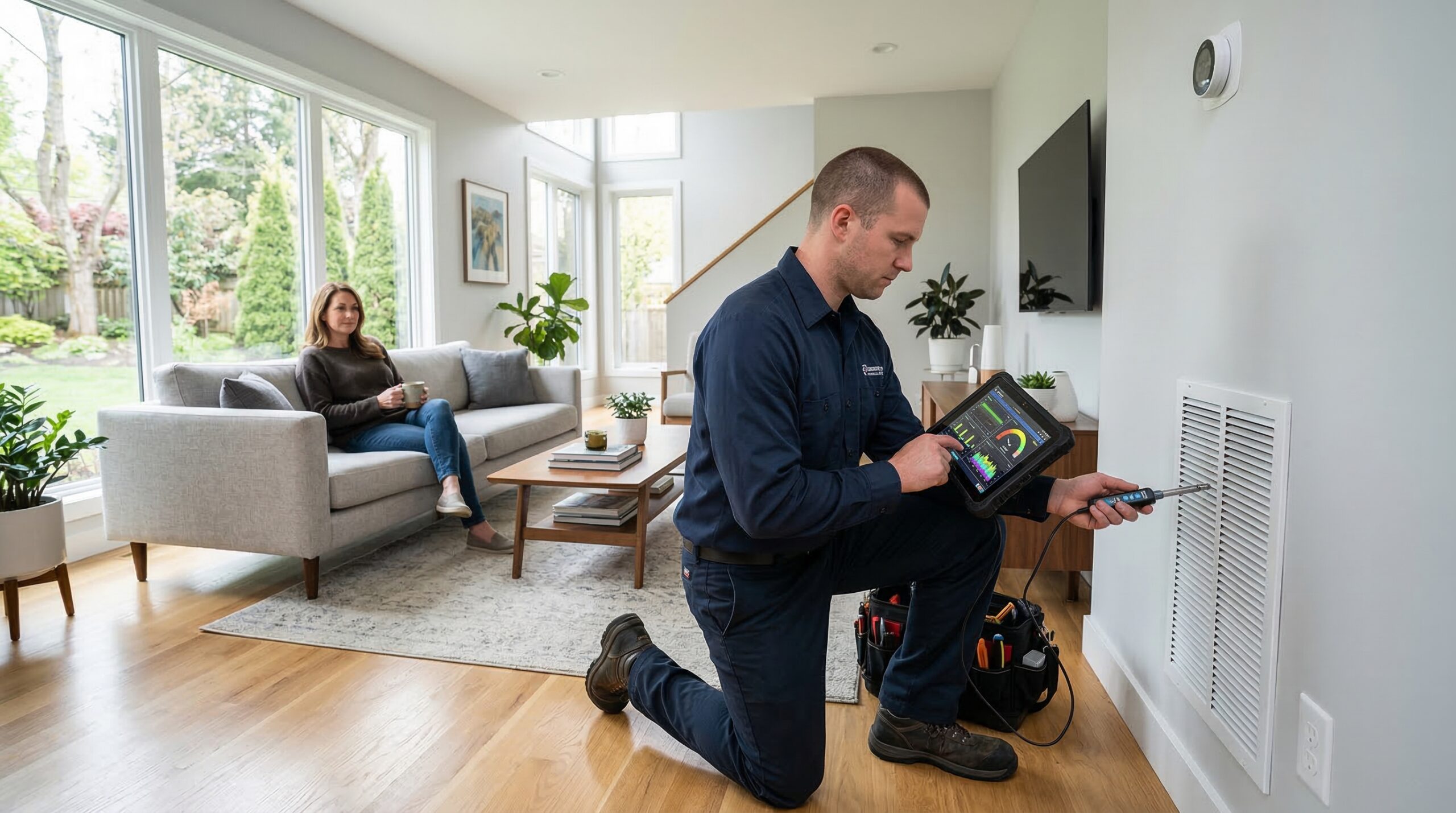
Most contractors reach for a rule of thumb when sizing an HVAC system: roughly 1 ton of capacity per 500 square feet. It’s quick, it’s simple – and it’s often wrong. The actual answer depends on at least eight variables beyond square footage, and getting it wrong in either direction costs you money for the life of the system. For a specific example, see our 1,000 sq ft HVAC cost guide.
An oversized system short-cycles, leaves your home humid in summer, and wears out faster. Altitude adds another layer: Colorado homes at 5,000+ feet require 10-20% more capacity than identical homes at sea level due to lower air density. See the Colorado HVAC replacement cost guide for altitude sizing guidelines specific to Denver, Colorado Springs, and mountain communities. Salt Lake City presents similar altitude sizing challenges at 4,226 feet (Climate Zone 5B) — see the Salt Lake City HVAC replacement cost guide for Utah-specific sizing and rebate data. Climate zone matters significantly here: a home in Richmond, VA and Concord, NC (Climate Zone 4A, mixed-humid) needs balanced heating and cooling capacity, while nearby Rock Hill, SC (Zone 3A) carries a higher cooling load due to its slightly warmer climate, while a Houston home in Zone 2A needs much more cooling tonnage for the same square footage. Kentucky homes also fall in Zone 4A, where four-season demand means sizing for both heating and cooling is equally important. See the Kentucky HVAC cost guide for climate-specific sizing context. An undersized system runs constantly, can’t keep up on the hottest or coldest days, and drives up your utility bills. Neither is a bargain.
This guide covers what the HVAC sizing table looks like, what Manual J load calculation actually is, and how to evaluate whether a contractor’s sizing recommendation makes sense before you sign a contract.
TL;DR
A rule of thumb puts most homes at 1 ton per 400–600 sq ft, but climate zone, insulation quality, and ceiling height can shift that estimate by 20–30%. The only reliable sizing method is a Manual J load calculation, which licensed HVAC contractors are required to perform in most jurisdictions before pulling a permit. Use the sizing chart below as a starting point, then verify with a contractor’s actual calculation.
How HVAC Systems Are Sized: Tons and BTUs Explained
HVAC capacity is measured in tons (not weight, but cooling power). One ton equals 12,000 BTU per hour (British Thermal Units), a standard established by the Air Conditioning Contractors of America (ACCA). Most residential systems range from 1.5 tons (18,000 BTU/hr) to 5 tons (60,000 BTU/hr), with the majority of American homes falling between 2 and 4 tons.
BTUs measure how much heat the system moves per hour. A higher BTU rating doesn’t mean a better system. It means a bigger system. And bigger is only better if your home actually needs that capacity. A 5-ton system in a 1,600 sq ft home wastes money on equipment you don’t need and creates performance problems that a properly sized system wouldn’t have.
The rule of thumb you’ll hear from most contractors (“one ton per 500 square feet”) comes from Department of Energy general guidance for temperate climates. It works reasonably well as a ballpark for a simple, well-insulated home in a moderate climate. It breaks down quickly everywhere else.
HVAC Sizing Chart: Square Footage × Climate Zone
The table below maps square footage to approximate tonnage across three broad climate categories. Climate zone is one of the biggest variables: a 2,000 sq ft home in Phoenix needs meaningfully more cooling capacity than the same home in Portland. These estimates are based on standard 8-foot ceilings, average insulation, and typical window area. As an example, Charleston, SC sits in Zone 3A (Mixed Humid / Humid Subtropical), meaning it falls in the mixed climate column but operates closer to hot/humid due to high summer humidity and a 6-month cooling season.
| Home Size (Sq Ft) | Hot/Humid Climate (Zones 1-–2) | Mixed Climate (Zones 3–4) | Cold Climate (Zones 5–7) |
|---|---|---|---|
| 606–900 | 1.5–2 tons | 1.5 tons | 1.5 tons |
| 900–1,200 | 2–2.5 tons | 2 tons | 1.5–2 tons |
| 1,200–1,500 | 2.5–3 tons | 2–2.5 tons | 2 tons |
| 1,506–2,000 | 3–3.5 tons | 2.5–3 tons | 2.5 tons |
| 2,006–2,500 | 3.5–4 tons | 3–3.5 tons | 3 tons |
| 2,500–3,000 | 4–5 tons | 3.5–4 tons | 3–3.5 tons |
| 3,000+ | 5 tons+ | 4–5 tons | 3.5–4 tons |
Not sure which climate zone you’re in? The Department of Energys Building America climate zone map covers all U.S. counties. Most of Florida, Texas, and the Gulf Coast fall in zones 1–2. The Midwest and Mid-Atlantic are typically zones 4–5. The Northern Plains and New England are zones 5–7.
Your homes square footage also connects directly to system cost. See our HVAC cost by home size guide to understand how sizing affects what youll pay for equipment and installation.
Why Proper Sizing Matters: The Problem with Oversized and Undersized Systems
Industry guidance from Trane, one of the largest HVAC manufacturers, recommends sizing no more than 15% over your homes calculated cooling load. The same sizing rules apply regardless of brand: whether your contractor quotes Carrier, Goodman, or Heil HVAC, the correct tonnage is determined by your home, not the equipment. That ceiling exists for a reason: oversized equipment causes a specific set of problems that most homeowners dont anticipate when they buy more capacity thinking it will keep them more comfortable.
An oversized system cools or heats a space too quickly. It reaches the thermostat setpoint before the full air volume has circulated, then shuts off, a pattern called short-cycling. Short-cycling means:
- The system never runs long enough to dehumidify the air properly, leaving your home feeling clammy even when the temperature is right
- Temperature swings between rooms become wider because air hasnt circulated evenly
- Compressor wear accelerates: short starts are harder on the equipment than long, steady runs
- Energy consumption actually increases despite the larger capacity
Undersized systems have the opposite problem. They run almost continuously on hot days, cant keep up when temperatures spike, and drive up electricity bills without delivering comfort. In extreme climates, an undersized system will hit its limits on the days you need it most.
Heres something most HVAC brand websites wont tell you: contractors who sell equipment (rather than just install it) have a financial incentive to recommend larger systems. Bigger tonnage means a more expensive unit, which means higher revenue. That doesnt mean every contractor is steering you wrong, but its a reason to ask for the actual Manual J calculation rather than accepting a size recommendation without documentation.
What Is a Manual J Load Calculation?
Manual J is the ACCA-standard method for calculating a buildings heating and cooling load: the amount of energy required to maintain a comfortable indoor temperature under peak outdoor conditions. Most U.S. building codes, including the International Residential Code (IRC), require a Manual J calculation before a permit can be issued for HVAC installation or replacement. If a contractor is pulling a permit (and they should be), theyre doing a load calculation, or theyre supposed to be.
A proper Manual J calculation accounts for:
- Conditioned floor area and ceiling height
- Local climate data (design temperatures for your specific location)
- Wall, ceiling, and floor insulation R-values
- Window area, type, and orientation (south-facing windows add more solar gain)
- Air infiltration rate (how leaky the building envelope is)
- Internal heat gains from occupants and appliances
- Duct system losses (if ductwork runs through unconditioned spaces like attics; see our combined HVAC and ductwork cost guide if your ducts need replacement alongside a new system)
ACCA-certified Manual J software (programs like Wrightsoft or Elite Software) runs these inputs through a standardized algorithm to produce a precise load number. That number, not a rule of thumb, is what your system size should be based on.
You can ask any contractor for a copy of the Manual J report before signing. A contractor who says “we don’t do those” or “we just go by square footage” is not following best practice. Before the installation day arrives, use our HVAC replacement checklist to verify permits, equipment documentation, and the other steps that protect your investment. See how we calculate our HVAC cost estimates for more on what standards-based pricing methodology looks like.
What Affects HVAC Sizing Beyond Square Footage?
Square footage is the most visible input in HVAC sizing, but it explains only about 60–70% of your actual load. According to ACCA Manual J methodology, the remaining load comes from factors that vary significantly from one home to the next, which is why two 2,000 sq ft houses on the same street can require different tonnage.
| Factor | Effect on Sizing | Approximate Adjustment |
|---|---|---|
| Ceiling height above 9 ft | Increases load | +10–15% per extra foot of ceiling height |
| Poor or missing insulation | Increases load significantly | +15–25% vs. well-insulated home |
| Large window area (>20% of floor area) | Increases cooling load | +10–20% depending on window type and orientation |
| South- or west-facing windows | Increases cooling load | Adds meaningful solar gain; factor into cooling calculation |
| High air infiltration (older, drafty home) | Increases both heating and cooling load | +10–20% vs. tight modern construction |
| Multiple occupants or heat-generating appliances | Increases cooling load | +400 BTU/hr per additional occupant above 2 |
| Hot/humid climate (zones 1–2) | Significantly increases cooling load | Can require 20–30% more capacity than temperate equivalent |
| Cold climate with heating focus (zones 6–7) | Increases heating load | Heat pump sizing often dominated by heating, not cooling |
The practical takeaway: if your home has 10-foot ceilings, poor insulation, or a lot of south-facing windows, the rule-of-thumb tonnage estimate will likely be too low. Older home infrastructure considerations also matter: pre-1980 homes with original ductwork may have undersized ducts that can’t move the air volume required by modern high-efficiency systems. See our guide to HVAC sizing and replacement in older homes for what to check before getting quotes. If your home is tightly sealed, well-insulated, and in a moderate climate, the estimate might be too high. Neither error is free.
How Does HVAC Size Affect Replacement Cost?
System size has a direct, linear effect on equipment cost. Each half-ton step up in capacity typically adds $200–$600 to the equipment price, depending on brand and efficiency tier. Moving from a 2.5-ton system to a 4-ton system can add $1,000-$2,000 to the equipment cost alone, before labor. The efficiency rating of your new system also affects cost — see our SEER2 efficiency rating guide for how the new 2023 standard translates to your buying decision.
Oversizing doesn’t just increase your upfront cost. It increases your long-term cost too: higher utility bills from short-cycling inefficiency, more frequent repairs from accelerated compressor wear, and a shorter system lifespan. The most cost-effective system is a right-sized one.
Nevada homes have unique sizing challenges: Las Vegas summer design temperatures exceed 110°F, requiring more cooling capacity per square foot than most US cities. Reno adds significant heating load at 4,500 feet elevation. The Nevada HVAC replacement cost guide covers regional sizing factors and cost ranges for both markets.
Frequently Asked Questions
How big of an AC unit do I need for a 2,000 sq ft house?
Using the sizing table above, a 2,000 sq ft home typically needs 2.5-3.5 tons depending on climate zone (closer to 2.5 tons in cold climates, up to 3.5 tons in hot/humid zones like Florida or Texas). That said, ceiling height, insulation, and window area can shift the number significantly. A Manual J load calculation is required to pin down the right size for your specific home. See our detailed HVAC cost guide for 2,000 sq ft homes for installed price ranges.
How many square feet does a 3-ton HVAC unit cover?
A 3-ton HVAC system (36,000 BTU/hr) generally covers 1.500-2,200 sq ft in a mixed or cold climate, or 1,200-1,800 sq ft in a hot/humid climate. These are rough estimates. In a well-insulated home with standard ceilings, 3 tons may comfortably cover 2,000 sq ft. In a drafty home with 12-foot ceilings in Georgia, the same 3 tons may fall short for a 1,400 sq ft house.
Will a 2-ton unit cool a 1,500 sq ft house?
Possibly, but it depends heavily on climate. In mild or cold climates (zones 4–7) with good insulation and standard ceilings, a 2-ton system can adequately cool 1,500 sq ft. In hot/humid climates (zones 1–2), a 2-ton system is almost certainly undersized for that square footage and will struggle on peak summer days. A Manual J calculation for your specific home is the only way to know for certain. If you are deciding between sizes, see our cost difference between 2-ton and 3-ton AC for the full installed price breakdown.
What is the $5,000 rule for HVAC?
The “$5,000 rule” isn’t an official industry standard. It’s a rule of thumb for the repair-versus-replace decision. The idea: multiply your system’s age (in years) by the repair cost. If the result exceeds $5,000, replacement is often more cost-effective than repairing. For example, a 10-year-old system needing a $600 repair: 10 × $600 = $6,000, suggesting replacement is worth considering. It’s a rough guide, not a formula.
Can I size my HVAC system myself?
You can use the sizing chart on this page to get a reasonable starting estimate. For a definitive answer, you need a licensed contractor to run Manual J software using your home’s actual measurements, insulation values, climate data, and duct configuration. Building permits for HVAC replacement in most jurisdictions legally require a load calculation, so any contractor pulling a permit should be providing one. Ask for a copy.
Ready to see what a right-sized replacement system would cost? Use our free HVAC replacement cost estimator to get a detailed estimate based on your home’s size, location, and system type. No email required.
nnnWashington state homeowners sizing a new system must account for the state’s two distinct climate zones: the mild marine climate west of the Cascades and the colder continental climate in eastern Washington. Our Washington HVAC replacement cost guide covers how climate zone affects system selection and pricing across Seattle, Spokane, and Tacoma.
n