
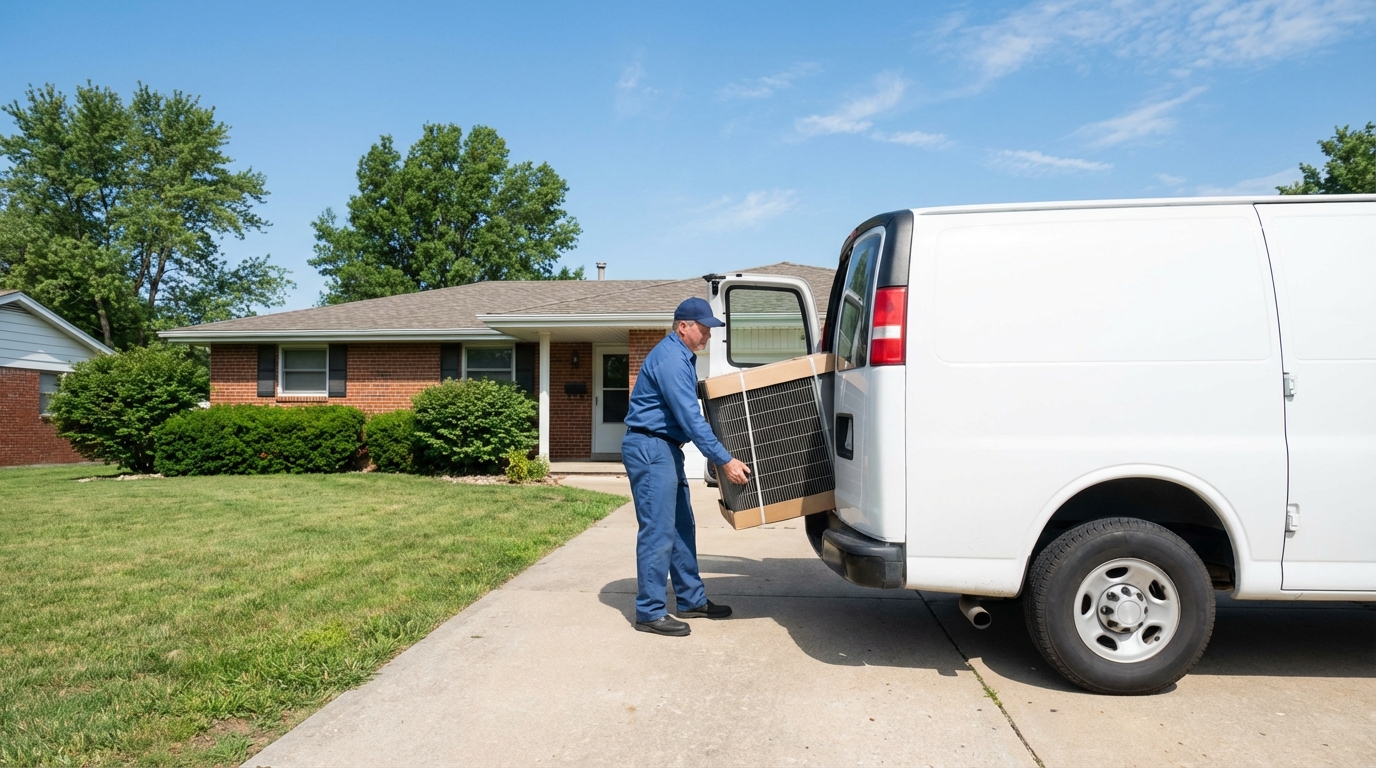
Missouri homeowners replacing an HVAC system deal with a climate that swings hard in both directions: humid summers that push 95°F and winters that regularly dip into the teens. Most Missouri homeowners spend $4,800 to $14,000 on a full HVAC replacement, with Ameren and Evergy rebates cutting $1,000 to $5,000 off the top for qualifying systems. This guide covers what replacement actually costs across Missouri’s regions, which utility rebates are available right now, what permits you need, and whether a heat pump makes sense for your part of the state.
How Much Does HVAC Replacement Cost in Missouri?
Most Missouri homeowners spend between $4,800 and $14,000 for a complete HVAC replacement, depending on system type, home size, and where you live. Labor rates in the Kansas City and St. Louis metros run slightly above the state average, while Springfield and smaller cities typically come in 5-10% lower.
| System Type | Typical Missouri Range | Notes |
|---|---|---|
| Central AC replacement | $4,800-$10,500 | Outdoor unit + indoor coil swap |
| Gas furnace replacement | $4,200-$9,500 | High-efficiency models at the upper end |
| Heat pump replacement | $6,500-$14,000 | Heating and cooling in one system |
| Full system (AC + furnace) | $8,000-$17,000 | Complete replacement, new coil and air handler |
| Dual-fuel heat pump + gas backup | $8,500-$16,500 | Best for northern MO cold snaps |
| Ductwork repairs | $500-$2,800 | Seal and repair; full replacement $2,000-$7,500 |
These ranges reflect contractor data from the Kansas City and St. Louis metropolitan areas (early 2026). The biggest single cost driver after system type is ductwork condition: Missouri’s older housing stock, especially in St. Louis and inner-ring Kansas City neighborhoods, often needs duct sealing or partial replacement, adding $1,000-$3,500 to the total. Use our HVAC cost estimator to get a personalized range based on your home’s square footage and system type.
What Affects HVAC Costs Across Missouri’s Regions?
Missouri spans two IECC climate zones, and the cost differences between the Kansas City metro, St. Louis metro, and smaller markets are meaningful. Where you live shapes which system fits best, how hard it works, and what it costs to install.
| Region | Climate Profile | Cost vs. State Average | Key Factor |
|---|---|---|---|
| Kansas City metro | Zone 4A/5A border, cold winters, hot summers | At average to +5% | Evergy territory, mid-century housing stock, basements standard |
| St. Louis metro | Zone 4A, humid subtropical transition | At average to +5% | Ameren territory, brick homes dominant, older ductwork common |
| Springfield / SW Missouri | Zone 4A, milder winters than KC | -5-10% | Empire District territory, lower labor costs, newer housing mix |
| Columbia / Central MO | Zone 4A, balanced heating and cooling | At average | Ameren territory, college town with mixed housing ages |
| Rural Missouri / Ozarks | Zone 4A/5A, variable | -5-15% | Lower labor costs, longer travel time for contractors, more all-electric homes |
St. Louis homeowners face a cost factor that other Missouri markets do not: the city’s brick housing stock. Many St. Louis homes built before 1970 have original ductwork running through tight chases in brick walls, which limits access and can add $500-$1,500 to installation labor compared to homes with basement-accessible duct runs.
What Ameren Missouri Rebates Are Available for HVAC?
Ameren Missouri serves roughly 1.2 million electric customers across the St. Louis metropolitan area and central/eastern Missouri. Their Pay As You Save (PAYS) program, marketed as “FastTrack,” offers substantial rebates for qualifying high-efficiency HVAC equipment. These rebates are valid through December 31, 2026.
Current Ameren Missouri HVAC rebates (2026):
- Central AC (15.2+ SEER2): $1,000 per system
- Air Source Heat Pump (15.2+ SEER2): $2,000 per system
- ASHP Dual Fuel (15.2+ SEER2): $2,000 per system
- Ground Source Heat Pump (23+ EER): $5,000 per system
- Mini-Split AC or Heat Pump (19+ SEER2): $500 per ton
- Smart Thermostat (ENERGY STAR): $250 per thermostat
Eligibility requires that you have lived in your home for at least 12 months (to allow Ameren to run a usage analysis) and that your existing AC unit is at least 10 years old, rated 14 SEER or less, or no longer working. The PAYS financing option lets you pay back the remaining equipment cost on your monthly Ameren bill, with projected savings designed to exceed your monthly payment. Confirm current availability and full program details at ameren.com/missouri/residential/energy-efficiency/hvac-pays.
What Evergy Rebates Are Available for Kansas City HVAC?
Evergy serves the Kansas City metropolitan area on the Missouri side. Their FastTrack HVAC PAYS program launched in August 2025 and offers rebates plus on-bill financing for qualifying high-efficiency systems.
Evergy FastTrack HVAC PAYS highlights:
- Central AC and heat pump rebates: $1,000 or more for qualifying systems, depending on type and efficiency level
- Ground source heat pump: $1,900 rebate
- Mini-split AC or heat pump: $500 rebate
- On-bill financing: Up to 80% of projected 15-year energy savings, spread over 180 monthly payments on your Evergy bill
- No credit check required: The repayment is tied to the utility meter, not the homeowner personally
Evergy reports that homeowners participating in the program see about 17% lower energy bills on average, even after accounting for the monthly financing payment. The rebate is applied instantly at the time of installation. Contact a certified FastTrack contractor or visit evergy.com for current program details and enrollment.
What Federal Tax Credits Apply to Missouri Homeowners?
The federal Inflation Reduction Act (IRA) Section 25C energy efficiency tax credits are available to all Missouri homeowners regardless of which utility serves your home. These credits apply to your federal income taxes and are claimed when you file your return.
- Heat pump (qualifying efficiency): 30% of cost, up to $2,000 per year
- Central AC or gas furnace (qualifying efficiency): 30% of cost, up to $600 per year
- Heat pump water heater: 30% of cost, up to $2,000 per year (combined with space heating heat pump credit)
These credits are nonrefundable, meaning they reduce taxes you owe but do not generate a refund beyond your tax liability. Confirm qualifying efficiency ratings with your contractor before purchase. The 25C credit is available through 2032 under current law. Check the IRS Energy Efficient Home Improvement Credit page for current qualifying requirements.
What Missouri State Programs Help Pay for HVAC Replacement?
Missouri submitted its applications for the federal IRA Home Energy Rebate programs to the U.S. Department of Energy on November 22, 2024. As of March 2026, these state-administered programs are not yet available to the public.
What the programs would offer once launched:
- Home Efficiency Rebates (HOMES): Up to $8,000 for projects achieving significant whole-home energy savings. Missouri received $75.8 million in federal funding.
- Home Electrification and Appliance Rebates (HEAR): Up to $8,000 for a qualifying heat pump. Missouri received $75.4 million in federal funding. Income-qualified households receive higher amounts.
Federal funding freezes and DOE review timelines have created uncertainty about when Missouri’s programs will launch. The Missouri Department of Natural Resources manages these programs. Check dnr.mo.gov for current program status before making a purchase decision based on these incentives.
Do You Need a Permit to Replace Your HVAC System in Missouri?
Missouri does not have a statewide HVAC licensing or permitting system. Instead, permits are required and administered at the city or county level, which means requirements vary depending on where you live.
In practice, every major Missouri city (Kansas City, St. Louis, Springfield, Columbia, Independence) requires a mechanical permit for residential HVAC replacement. Permit fees typically fall in the $75-$200 range for a standard residential replacement. Your licensed HVAC contractor should pull the permit on your behalf as part of the installation. If a contractor suggests skipping the permit to save you money, that is a red flag: unpermitted work creates problems with homeowners insurance claims, home resale inspections, and manufacturer warranty enforcement.
Rural Missouri counties may have less stringent permitting requirements, but you should always confirm with your local building department before work begins. Kansas City and St. Louis have adopted versions of the International Mechanical Code with local amendments.
Is a Heat Pump a Good Choice for Your Missouri Home?
For most of Missouri, a heat pump is a strong option, especially with the current utility rebates and federal tax credits making 2026 a favorable year to buy. However, the right configuration depends on which part of the state you live in.
Southern Missouri and the Springfield area (Zone 4A) see milder winters that rarely sustain temperatures below 20°F for extended periods. Standard air-source heat pumps work efficiently here for both heating and cooling, and the Ameren or Empire District rebates can offset a significant portion of the upfront cost.
The Kansas City metro and northern Missouri (Zone 4A/5A border) experience colder winters with design temperatures in the 5-10°F range and occasional drops below 0°F. For these areas, a dual-fuel heat pump system pairs the heat pump with a gas furnace backup. The heat pump handles heating efficiently during mild and moderate cold, and the furnace takes over during extreme cold snaps. Ameren offers a $2,000 rebate specifically for ASHP dual-fuel systems, and the federal 25C credit adds up to $2,000 more.
St. Louis sits in Zone 4A and sees a slightly milder winter profile than Kansas City. All-electric heat pumps work well here, though dual-fuel remains popular for homeowners who want a gas backup for the handful of sub-zero nights each winter. Cold-climate heat pump models rated effective at -13°F extend the all-electric option to nearly all Missouri conditions.
What Does HVAC Replacement Cost in Missouri’s Major Cities?
Individual city pricing guides provide more granular data on local contractor rates, utility rebate programs, and permit requirements by jurisdiction.
| City | Typical Full System Range | Primary Utility | Pricing Guide |
|---|---|---|---|
| Kansas City, MO | $8,500-$16,500 | Evergy | View Kansas City guide |
| St. Louis, MO | $8,500-$17,000 | Ameren Missouri | Coming soon |
| Springfield, MO | $7,500-$14,500 | Empire District | Coming soon |
| Columbia, MO | $8,000-$15,500 | Ameren Missouri | Coming soon |
St. Louis pricing reflects the added labor complexity of working in the city’s older brick housing stock, where ductwork access can be constrained. Springfield runs 5-10% below the state average due to lower labor costs and a newer overall housing mix, making it one of the more affordable metro markets in the Midwest for HVAC replacement. Kansas City sits near the state average, with Evergy’s FastTrack program helping offset equipment costs for eligible homeowners.
Frequently Asked Questions
What is the average HVAC replacement cost in Missouri?
Most Missouri homeowners pay between $4,800 and $14,000 for a complete HVAC replacement. The midpoint for a standard gas furnace and central AC swap in a 1,500-2,500 sq ft home runs around $8,000-$11,000 installed. Kansas City and St. Louis metros typically run at or slightly above the state average due to metro-area labor rates, while Springfield and rural Missouri run 5-15% lower.
Does Ameren Missouri offer rebates for new HVAC equipment?
Yes. Ameren Missouri’s Pay As You Save (PAYS) program offers $1,000 for a qualifying central AC, $2,000 for an air source heat pump or dual-fuel system, and $5,000 for a ground source heat pump. These rebates are valid through December 31, 2026, and require that your existing system is at least 10 years old, rated 14 SEER or less, or no longer working. The PAYS financing option lets you pay remaining costs on your monthly Ameren bill.
Do I need a permit to replace my HVAC system in Missouri?
In any Missouri city or suburb, yes. Missouri does not have a statewide permitting system, but Kansas City, St. Louis, Springfield, Columbia, and virtually all incorporated municipalities require a mechanical permit for HVAC replacement. Permit fees typically run $75-$200 for residential work. Your licensed contractor should pull this permit as part of the job. Skipping the permit risks voiding your equipment warranty and creating problems when you sell the home.
Are heat pumps effective in Missouri winters?
Standard air-source heat pumps work efficiently down to about 25-30°F before needing supplemental heat. Southern Missouri rarely sustains temperatures below that threshold for long stretches, making all-electric heat pumps a good fit. Northern Missouri and the Kansas City area see colder winters (design temperatures 5-10°F), where a dual-fuel heat pump paired with a gas furnace backup is the most practical choice. Cold-climate heat pump models rated to -13°F are available for homeowners who want to go all-electric even in northern Missouri.
When is the best time to replace an HVAC system in Missouri?
Late spring (April to May) and early fall (September to October) are the best windows. Contractor schedules are less packed than during summer heat waves or winter cold snaps, which can mean faster scheduling and occasionally better pricing. Missouri’s shoulder seasons are mild enough that most homes can go 2-3 days without cooling or heating during the swap if needed. Replacing during peak summer (June through August) often means higher demand and less scheduling flexibility.
What Missouri programs currently help pay for HVAC replacement?
The most accessible Missouri HVAC incentives in 2026 are:
- Ameren Missouri PAYS: $1,000-$5,000 depending on system type (Ameren electric customers in St. Louis metro and central/eastern MO)
- Evergy FastTrack HVAC PAYS: $1,000+ rebates plus on-bill financing (Evergy customers in Kansas City metro)
- IRA Section 25C federal tax credit: 30% of cost, up to $2,000 for heat pumps (all Missouri homeowners)
- Missouri IRA HOMES/HEAR programs: Not yet available. Missouri has applied for $151 million in federal funding, but launch timing remains uncertain as of March 2026.
For the most current list of active programs, check with your utility provider directly or use our HVAC cost estimator to factor incentives into your project budget.
Ready to get a real number for your home? Use our Missouri HVAC cost estimator to get a personalized range based on your home size, system type, and region. Kansas City and St. Louis city-specific guides with local contractor data, permit details, and utility program breakdowns are coming soon.