
Minnesota homeowners deal with some of the harshest HVAC conditions in the country: winters that drop to -20°F or colder, humid summers that demand real cooling capacity, and a heating season that stretches from October through April. That combination means larger equipment, higher installation complexity, and costs that run above the national average. This guide covers what HVAC replacement actually costs across Minnesota in 2026, which Xcel Energy and CenterPoint rebates you can claim, and how to decide between a high-efficiency gas furnace and a cold-climate heat pump.
What Does HVAC Replacement Cost in Minnesota?
HVAC replacement in Minnesota runs $3,800 to $18,000 installed, depending on system type, equipment tier, and location. The table below shows 2026 installed cost ranges for the most common replacement scenarios.
| System Type | Low End | High End | Most Common |
|---|---|---|---|
| Gas furnace only | $3,800 | $9,500 | $5,500–$7,200 |
| Central AC only | $4,200 | $11,500 | $5,800–$8,000 |
| Full HVAC system (AC + furnace) | $7,500 | $18,000 | $10,500–$14,000 |
| Cold-climate heat pump | $6,500 | $16,000 | $9,000–$13,000 |
| Mini-split (per zone) | $3,500 | $10,000 | $4,500–$7,000 |
These ranges reflect installed cost including equipment, refrigerant, electrical work, and labor. Permit fees ($150–$450 for most cities) are not included and should be added to any contractor quote.
Why Does Minnesota HVAC Cost More Than the National Average?
Minnesota HVAC installation costs run 10–20% above the national average for three structural reasons. Understanding them helps you evaluate quotes more accurately.
Equipment sizing requirements. Minnesota homes in ASHRAE Climate Zone 6A and 6B require larger heating equipment than homes in milder states. A 2,000 sq ft home in Minneapolis typically needs a 100,000–120,000 BTU furnace versus 80,000 BTU in Georgia. Larger equipment costs more, and proper Manual J load calculations add time to the installation process.
Skilled labor premium. BLS data for the Minneapolis-St. Paul-Bloomington MSA puts HVAC technician wages at approximately $73,000–$78,000 per year (SOC 49-9021, 2024 data), roughly 12–15% above the national mean. Union presence through organizations like UA Local 68 and strong licensing requirements contribute to this premium.
Cold-climate complexity. Zone 6 installations require additional considerations: combustion air intakes must handle extreme cold, heat pumps must be rated for operation below -13°F, and ductwork may need re-sealing to meet tighter efficiency standards. These add hours to a typical installation.
What Does Furnace Replacement Cost in Minnesota?
Furnace replacement is the most common HVAC call in Minnesota. Most homes run natural gas, and the decision usually comes down to efficiency tier: 80% AFUE entry-level versus 95%+ AFUE high-efficiency condensing furnaces.
| Furnace Type | AFUE | Installed Cost | Notes |
|---|---|---|---|
| Entry-level single-stage | 80% | $3,800–$5,500 | Lower upfront; not rebate-eligible |
| Mid-range two-stage | 95–96% | $5,000–$7,500 | Qualifies for Xcel/CenterPoint rebates |
| Premium variable-speed | 97–98% | $7,000–$9,500 | Quietest; best humidity control |
In Minnesota, the upgrade from 80% to 96%+ AFUE pays back in 4–7 years given the long heating season. A household burning 900 therms per year at $1.30/therm saves roughly $180–$230 annually with a 96% AFUE furnace compared to 80% AFUE. Xcel Energy and CenterPoint each offer $75–$200 rebates on qualifying high-efficiency models, reducing payback further.
For furnace replacement cost guidance by home size, see our 2,000 sq ft HVAC cost guide and 3,000 sq ft HVAC cost guide.
What Does Central AC Replacement Cost in Minnesota?
Central AC replacement in Minnesota runs $4,200–$11,500 installed. Efficiency tier is the biggest cost driver: SEER2 15 equipment costs significantly less than SEER2 18+, but higher-efficiency units qualify for Xcel Energy rebates and the 25C federal tax credit.
| AC Tier | SEER2 Rating | Installed Cost | Rebate Eligible? |
|---|---|---|---|
| Standard efficiency | 14–15 SEER2 | $4,200–$6,500 | No |
| High efficiency | 16–17 SEER2 | $5,500–$8,500 | Xcel: up to $500 |
| Premium efficiency | 18–20+ SEER2 | $7,000–$11,500 | Xcel + 25C federal credit |
Minnesota’s cooling season is shorter than the South, which affects payback calculations for premium AC equipment. For most Minnesota homeowners, SEER2 16–17 hits the right balance: rebate-eligible without the steep premium of 20 SEER2 equipment. For a full breakdown of efficiency ratings and their cost impact, see our SEER rating cost comparison.
Cold-Climate Heat Pump Cost in Minnesota — Is It Worth It?
Cold-climate heat pumps have become a real option for Minnesota homeowners in the last three years, driven by larger rebates and improved technology. Models like the Mitsubishi Hyper Heat, Bosch IDS, and Carrier Greenspeed operate efficiently down to -13°F, which covers most Twin Cities winters.
Installed cost for a cold-climate heat pump in Minnesota ranges from $6,500 to $16,000, depending on whether you keep a gas furnace as backup or go all-electric with a dual-fuel configuration.
| Configuration | Installed Cost | Best For |
|---|---|---|
| Heat pump only (all-electric) | $8,500–$16,000 | New construction or full electric conversion |
| Dual-fuel (heat pump + gas backup) | $9,000–$16,000 | Existing gas homes, maximum efficiency |
| Single-zone mini-split heat pump | $3,500–$7,000 | Additions, sunrooms, supplemental zones |
Rebates make heat pumps the financially strong choice. Xcel Energy offers up to $1,500 on qualifying cold-climate heat pumps. The IRA Section 25C federal tax credit adds up to $2,000 per year for heat pump installation (30% of combined equipment and installation cost, $2,000 cap). Combined, a $12,000 heat pump installation can attract $3,500 in rebates and credits, bringing effective cost to $8,500 or below.
The honest answer on Minnesota viability: In the Twin Cities and southern Minnesota, cold-climate heat pumps work well as primary heating through most of the winter. In Duluth and northern Minnesota (Zone 6B), a gas or propane backup is strongly recommended given sustained -20°F stretches. Dual-fuel configurations give the best of both worlds: heat pump efficiency for most of the season, gas reliability for the coldest weeks.
Xcel Energy and CenterPoint Rebates for Minnesota Homeowners
Minnesota homeowners have access to some of the strongest utility HVAC rebate programs in the Midwest, particularly through Xcel Energy and CenterPoint Energy.
Xcel Energy HVAC Rebates (2026)
| Equipment | Rebate Amount | Requirement |
|---|---|---|
| High-efficiency furnace (95%+ AFUE) | $75–$200 | 95%+ AFUE, licensed contractor install |
| Central AC (SEER2 16+) | Up to $500 | SEER2 16+ rating |
| Cold-climate heat pump | Up to $1,500 | Qualifying NEEP-listed cold-climate model |
| Smart thermostat | Up to $100 | ENERGY STAR certified |
Xcel Energy’s rebate amounts are set annually and may change. Always verify current amounts at xcelenergy.com/rebates before committing to equipment selection. Rebates require licensed contractor installation and submission of proof within 90 days of install.
CenterPoint Energy Rebates (2026)
CenterPoint Energy serves the natural gas distribution network across much of the Twin Cities metro area. Their rebate program focuses on gas efficiency improvements.
- High-efficiency furnace (95%+ AFUE): $75–$200 rebate
- Programmable/smart thermostat: up to $50
- Free home energy audit for qualifying customers (valuable for identifying duct losses before replacement)
Federal IRA Tax Credits — Stack on Top of Utility Rebates
The Inflation Reduction Act’s residential energy efficiency credits (Section 25C) run through 2032 and stack with utility rebates. Key credits for Minnesota homeowners:
- Cold-climate heat pump: 30% of combined equipment and installation cost, up to $2,000 per year
- High-efficiency gas furnace (96%+ AFUE): 30% of equipment cost, up to $600 per year
- Energy audit: 30% of cost, up to $150
A household installing a cold-climate heat pump can legitimately combine Xcel’s $1,500 rebate with the $2,000 25C federal credit for $3,500 in combined incentives. That is a meaningful reduction on a $10,000–$13,000 system. See Energy Star’s federal tax credit guide for qualifying equipment details. Consult a tax professional for your specific situation; the 25C credit requires IRS Form 5695 at tax time.
Do You Need a Permit for HVAC Replacement in Minnesota?
Minnesota requires a mechanical permit for all HVAC replacements. Permits are issued by the local Authority Having Jurisdiction (AHJ), typically the city or county building department. There is no single statewide permit; requirements vary by municipality.
Typical permit costs range from $150 to $450 for a residential HVAC replacement. The Minnesota Department of Labor and Industry (DLI) requires all HVAC contractors to hold a valid mechanical contractor license before pulling permits. Before signing any contract, verify your contractor holds a current MN mechanical contractor license at dli.mn.gov/contractor-licensing.
Reputable contractors include the permit cost in their quote and handle the inspection scheduling. If a contractor tells you a permit is not required for an HVAC replacement, that is a red flag. Unpermitted work creates problems with homeowners insurance claims and home sales.
Twin Cities vs. Greater Minnesota Pricing
HVAC costs are not uniform across Minnesota. The Twin Cities metro (Minneapolis, St. Paul, and suburbs) runs 8–12% above the state average, reflecting higher labor costs and greater demand density. Duluth and the Iron Range run 10–15% above average due to cold-climate complexity and contractor scarcity. Rochester, St. Cloud, and Mankato tend to track closer to the state average.
| Region | Cost vs. State Average | Notes |
|---|---|---|
| Twin Cities metro | +8–12% | Higher wages, strong union presence |
| Rochester / St. Cloud / Mankato | At average | Competitive market, moderate wages |
| Duluth / Iron Range | +10–15% | Zone 6B complexity, fewer contractors |
| Greater MN (rural) | -5–10% | Lower labor costs; propane more common |
If you are in the Minneapolis area, see our Minneapolis HVAC replacement cost guide for city-specific data including Minneapolis contractor licensing requirements, Xcel Energy rebate specifics for urban accounts, and typical permit timelines through Minneapolis Inspections.
How to Get Accurate Minnesota HVAC Quotes
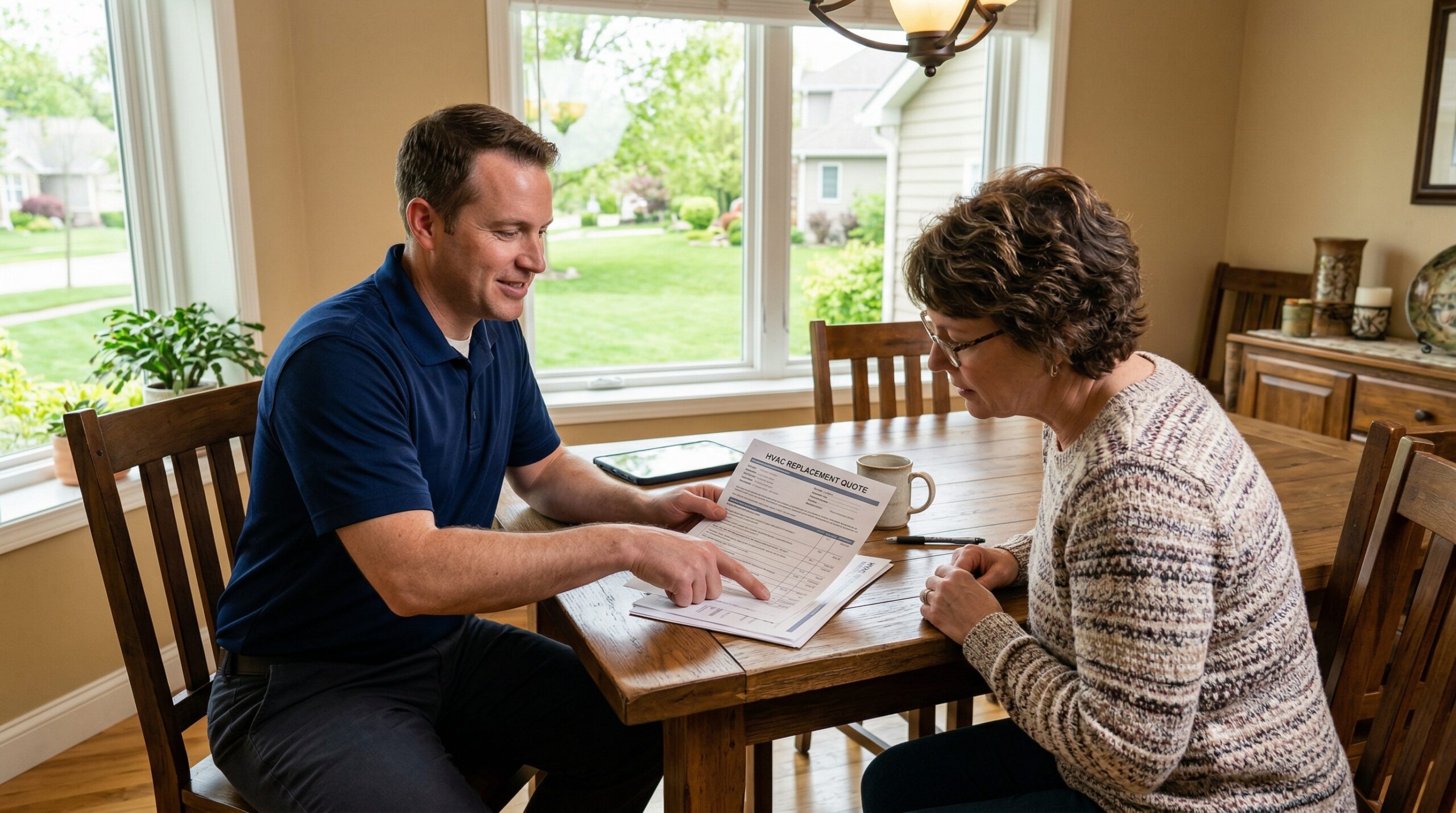
Getting three quotes is the standard advice, but what separates a useful quote from a confusing one is the line-item detail. Ask every contractor to provide a written quote that includes the following before you sign anything.
- Equipment manufacturer, model number, and efficiency rating (AFUE, SEER2, or HSPF2)
- Labor cost listed separately from equipment cost
- Permit fee included (or explicitly excluded with cost stated)
- Warranty terms: equipment manufacturer warranty and contractor labor warranty (minimum 1 year on labor)
- Refrigerant type (R-410A systems are being phased out; R-454B or R-32 is 2025+ standard)
For a full breakdown of what drives HVAC replacement costs, see our national HVAC replacement cost guide. For a step-by-step quote comparison process, see our Lennox HVAC cost guide (Lennox is popular in cold-climate Minnesota markets and the guide covers cold-climate model tiers specifically).
Use our free HVAC cost estimator to get a personalized estimate based on your home size, system type, and Minnesota region before you start collecting contractor bids.
Frequently Asked Questions
What is the average HVAC replacement cost in Minnesota?
The average full HVAC system replacement (central AC plus gas furnace) in Minnesota runs $10,500–$14,000 installed in 2026. A furnace-only replacement averages $5,500–$7,200. A cold-climate heat pump runs $9,000–$13,000 before rebates. Costs are 10–20% above the national average due to higher labor costs and cold-climate equipment requirements.
Does Xcel Energy offer rebates for HVAC replacement?
Yes. Xcel Energy offers rebates on qualifying HVAC equipment in 2026. The most significant rebates are:
- Cold-climate heat pump: up to $1,500
- Central AC (SEER2 16+): up to $500
- High-efficiency furnace (95%+ AFUE): $75–$200
- Smart thermostat (ENERGY STAR): up to $100
Rebates require licensed contractor installation and documentation submitted within 90 days. Verify current amounts at xcelenergy.com before purchase as amounts may change.
Can a heat pump heat a Minnesota home in winter?
Yes, with the right equipment. Cold-climate rated heat pumps (NEEP-listed models from brands like Mitsubishi, Bosch, and Carrier) operate efficiently down to -13°F, which covers the vast majority of Twin Cities winter temperatures. In the northern Minnesota/Duluth area, a dual-fuel configuration (heat pump plus gas backup) is the most reliable approach for sustained cold below -20°F. Modern cold-climate heat pumps provide 2–3x the heating output per dollar of electricity compared to electric resistance heat, making them viable and cost-effective for most Minnesota homeowners.
What size furnace do I need for a Minnesota home?
Furnace sizing in Minnesota depends on home size, insulation quality, window area, and local design temperature. As a general starting point:
- 1,200–1,500 sq ft home: 60,000–80,000 BTU furnace
- 1,500–2,000 sq ft home: 80,000–100,000 BTU furnace
- 2,000–2,800 sq ft home: 100,000–120,000 BTU furnace
- 2,800+ sq ft home: 120,000–140,000 BTU furnace
- Michigan HVAC replacement cost: statewide pricing, DTE and Consumers Energy rebates, city-by-city breakdown for Detroit and Grand Rapids
These are rough guidelines only. A proper Manual J load calculation by your contractor will determine the right size for your specific home. Oversized furnaces cycle on and off rapidly, creating humidity problems and uneven temperatures: this is a common issue in older Minnesota homes where contractors historically oversized equipment “to be safe.”
How much does furnace replacement cost in the Twin Cities?
Furnace replacement in the Minneapolis-St. Paul metro runs $5,800–$8,500 for a high-efficiency model installed, reflecting the Twin Cities labor premium of 8–12% above the state average. A standard 80% AFUE furnace runs $4,200–$6,000 installed in the metro area, but these do not qualify for utility rebates. Most Twin Cities contractors recommend 95%+ AFUE models to take advantage of Xcel Energy and CenterPoint rebates and the longer heating season payback.