
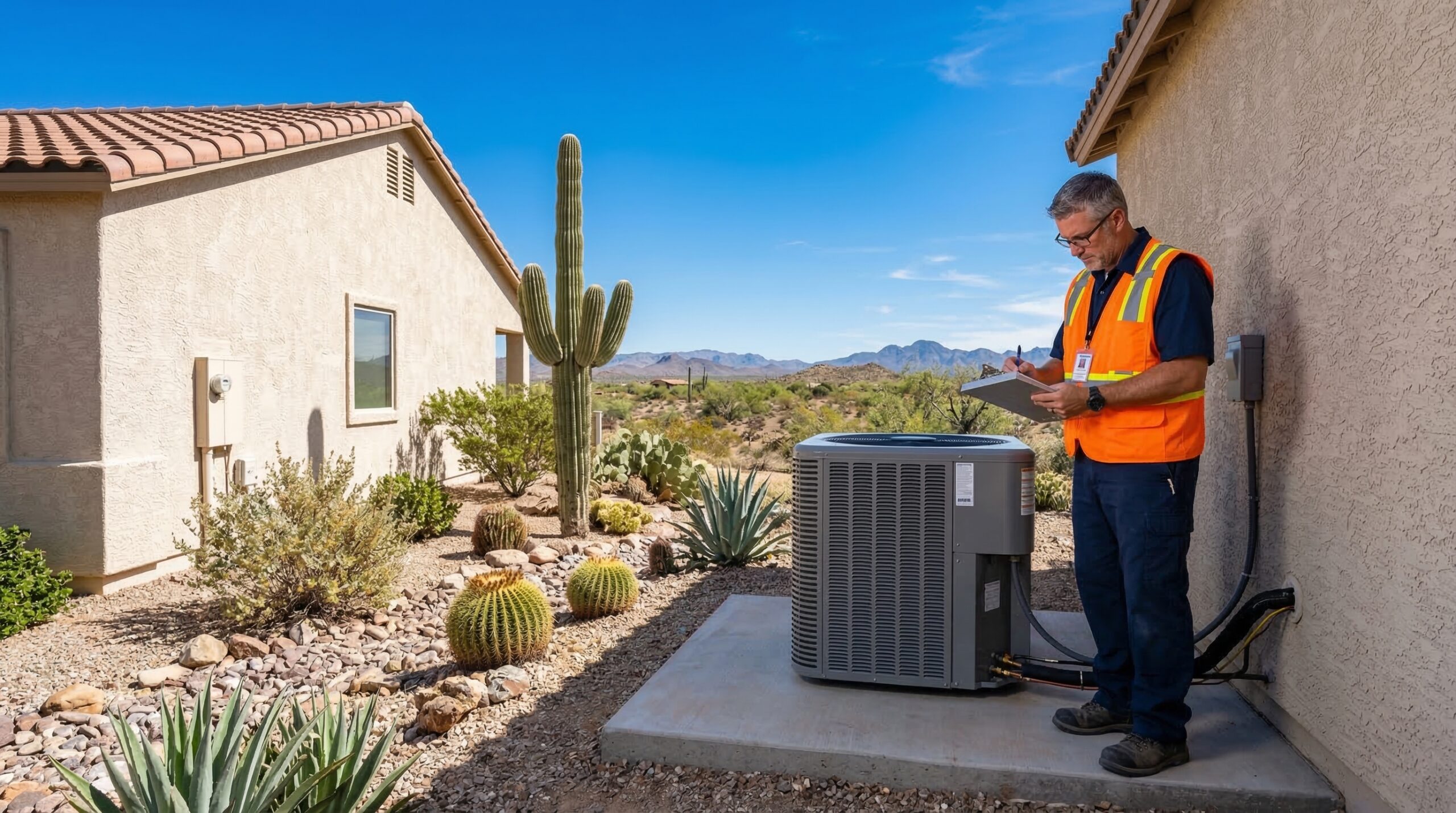
Arizona homeowners pay $5,200 to $14,000 to replace an HVAC system in 2026, above the national average because extreme Sonoran Desert heat demands larger equipment, higher efficiency ratings, and longer cooling seasons than almost anywhere else in the country. This guide covers statewide pricing, APS and SRP utility rebates, SEER2 requirements for IECC Climate Zone 2B, and what to expect in Phoenix, Tucson, and other Arizona markets.
How Much Does HVAC Replacement Cost in Arizona?
The table below shows 2026 replacement cost ranges across the most common system types for Arizona homes. Prices include equipment and installation by a licensed Arizona ROC contractor. See our full HVAC replacement cost guide for national comparisons.
| System Type | Arizona Cost Range | Typical Home Size |
|---|---|---|
| Central AC only (replacement) | $4,800–$9,500 | 1,500–3,000 sq ft |
| Heat pump system | $5,200–$12,000 | 1,500–3,000 sq ft |
| Gas furnace + central AC | $7,500–$16,000 | 1,500–3,500 sq ft |
| Full HVAC replacement (any type) | $5,200–$14,000 | Any size |
| Ductless mini-split (single zone) | $3,500–$7,500 | Single room or addition |
Arizona prices typically run 10 to 15% above the national average. Phoenix metro pricing tracks close to the statewide average. Tucson runs slightly lower (about 5 to 8% below Phoenix). Rural areas in northern Arizona (Flagstaff, Prescott) can run higher due to limited contractor availability and colder winter heating loads.
Why Does HVAC Replacement Cost More in Arizona?
Three factors push Arizona HVAC costs above the national average:
- Larger system sizes: Phoenix averages a 112°F design temperature (the temperature your AC must handle 99.6% of summer days per ASHRAE). Most Arizona homes need 3 to 5 ton systems versus 2 to 3 tons in moderate climates. Larger equipment costs more to buy and install.
- Higher efficiency requirements: Arizona’s energy code requires a minimum of 15 SEER2 for new cooling installations, compared to 14 SEER2 in cooler northern states. Higher-SEER equipment carries a price premium, though it pays back faster given Arizona’s 2,800 to 3,200 cooling hours per year.
- Peak season labor: June through September is Arizona’s busiest HVAC season. Contractor demand spikes, installation backlogs stretch 1 to 3 weeks, and pricing reflects that demand. Off-season replacements in October through February often run 10 to 15% lower.
For detailed AC replacement cost information, including how to calculate the right system size for extreme heat climates, see our dedicated guide.
What Are Arizona’s HVAC Efficiency Requirements?
Arizona falls almost entirely in IECC Climate Zone 2B (Hot-Dry), which covers the Sonoran and Mojave Desert regions. Zone 2B has some of the highest cooling loads in the country, and Arizona’s energy code reflects that:
- Minimum cooling efficiency: 15 SEER2 for split systems (central AC or heat pump)
- Recommended for Arizona: 16 to 20 SEER2, given the extreme cooling season
- Heating efficiency: Less critical in most of Arizona due to short mild winters (Phoenix averages 166 heating degree days vs. over 4,000 for northern cities)
- Northern Arizona exception: Flagstaff at 7,000 feet elevation falls in Climate Zone 5B with colder winters. Heating efficiency matters more in Flagstaff than in Phoenix or Tucson.
For a full breakdown of efficiency ratings and how they affect long-term costs, see our HVAC cost by efficiency rating guide. A SEER2 18 system can save $200 to $500 per year in Phoenix compared to a base 15 SEER2 unit, depending on home size and usage patterns.
What HVAC Rebates Are Available in Arizona?
Arizona does not have a statewide HVAC rebate program, but two major utilities serve most of the state’s population and both offer meaningful equipment incentives.
APS (Arizona Public Service) Rebates
APS serves the Phoenix metro area and most of northern and western Arizona. Their current rebate program includes:
| Equipment Type | APS Rebate | Requirements |
|---|---|---|
| Ductless heat pump (mini-split) | Up to $1,250 | Qualifying efficiency, licensed contractor |
| Central heat pump (up to 5 ton) | Up to $800 | Qualifying efficiency, licensed contractor |
| Smart thermostat | Up to $50 | Qualifying model, APS customer |
APS rebates are submitted by your contractor within 60 days of installation. Verify current amounts and eligibility at aps.com/residential/save-money/rebates before signing a contract, as programs update annually.
SRP (Salt River Project) Rebates
SRP serves the east and southeast Phoenix metro, including Mesa, Chandler, Gilbert, and Tempe. SRP offers efficiency rebates for qualifying HVAC equipment. Amounts vary by SEER2 rating and are updated periodically at savewithsrp.com.
TEP (Tucson Electric Power) Rebates
TEP serves the Tucson area and offers rebates for qualifying cooling and heat pump equipment. Tucson homeowners should check current TEP incentives at tep.com/residential/smart-choices/home-efficiency/rebates.
Federal Tax Credits
Federal Inflation Reduction Act credits stack on top of utility rebates:
- 25C Energy Efficient Home Improvement Credit: Up to $2,000 for a qualifying heat pump system, or up to $600 for qualifying central AC (requires SEER2 16+). Claimed when you file your federal taxes.
- HEAR Program (income-qualified): Up to $8,000 for heat pump installation for households below 80% of area median income, or up to $4,000 for households at 80 to 150% AMI. Administered by the Arizona Department of Housing.
A Phoenix homeowner with APS service installing a qualifying heat pump could realistically combine the APS rebate (up to $800), the federal 25C credit (up to $2,000), and potentially HEAR income-qualified funds, bringing the effective out-of-pocket cost down significantly. Check the full rebates and tax credits guide for current program details.
Are Heat Pumps Practical in Arizona’s Desert Heat?
Traditional heat pumps lose efficiency as outdoor temperatures rise above 95°F, which makes them less ideal for Arizona summers that regularly hit 110°F to 115°F. However, the HVAC industry has developed solutions for hot-climate applications.
Key factors for Arizona homeowners considering a heat pump system:
- High-ambient-temperature models: Some manufacturers now offer heat pumps rated for operation up to 125°F outdoor temperature. These are specifically designed for desert climates and perform reliably in Arizona summers.
- Cooling season benefit: Heat pumps in cooling mode perform similarly to central AC. The efficiency advantage of a heat pump over a standard AC unit is real and meaningful in Arizona’s long cooling season.
- Heating season advantage: Arizona winters are short and mild (Phoenix averages a January low around 44°F). Heat pumps handle mild winter heating very efficiently, eliminating the need for gas service in most Phoenix-area homes.
- Dual-fuel option: Northern Arizona homeowners in colder areas (Prescott, Flagstaff) often use a dual-fuel system: heat pump handles heating above 35°F, gas furnace kicks in below that threshold. This captures both heating efficiency and cooling performance.
For most Phoenix and Tucson homeowners, a high-efficiency central AC with gas or electric heat remains the most common choice. Consult a licensed Arizona HVAC contractor who can run a Manual J load calculation to determine what makes sense for your specific home and location.
Arizona HVAC Permit Requirements
Arizona requires a mechanical permit for HVAC replacement in virtually every jurisdiction. Permits are pulled at the city or county level by your licensed HVAC contractor.
- City of Phoenix: Mechanical permit required for equipment replacement. Permit fees typically range from $75 to $300 depending on the declared value of the project. Inspections are typically required for new ductwork but may be waived for like-for-like equipment replacement.
- City of Tucson: Similar mechanical permit requirements. Most HVAC replacements require a permit and inspection. Fees in the $75 to $250 range.
- Scottsdale, Mesa, Chandler, Gilbert, Tempe: Each municipality has its own permit fee schedule. Fees generally range from $75 to $250 for residential HVAC replacement.
- Contractor license requirement: Arizona requires HVAC contractors to hold a valid ROC (Registrar of Contractors) license. Verify your contractor’s license at azroc.gov before signing. Unlicensed installation can void manufacturer warranties and create insurance issues.
Most reputable Arizona HVAC contractors include permit fees in their quoted price and handle the permit application process. If a contractor offers to skip the permit to save money, that is a red flag. See our HVAC planning guide for more on what to expect during the replacement process.
HVAC Costs by Arizona City
Arizona HVAC costs vary by city primarily based on labor market, contractor density, and local utility territory. Use the city guides below for detailed pricing and local rebate information.
- Phoenix HVAC Replacement Cost: The largest market in the state. Phoenix homeowners typically pay $5,200 to $13,500 for full HVAC replacement. APS or SRP rebates apply depending on your service territory. High contractor density keeps pricing competitive.
- Tucson HVAC Replacement Cost: Tucson runs 5 to 8% below Phoenix metro pricing on average. TEP rebates apply for most Tucson-area customers. Tucson Electric Power’s incentive programs have historically been strong for high-efficiency equipment.
- Scottsdale HVAC Replacement Cost: Scottsdale’s luxury housing market pushes costs 10 to 20% above the Phoenix metro average. SRP Cool Cash Rebate applies for most Scottsdale customers.
- Mesa HVAC Replacement Cost: Mesa is Arizona’s 3rd largest city and sits in SRP service territory. Installed costs typically run $9,500 to $14,500 for most homes, tracking 5 to 10% below Scottsdale. The SRP Cool Cash Rebate offers up to $1,125 on qualifying variable-capacity systems.
For all Arizona city pages and a full map of where each utility’s service territory falls, visit the HVAC cost by city hub.
Frequently Asked Questions About Arizona HVAC Costs
How much does HVAC replacement cost in Arizona?
Arizona homeowners typically pay $5,200 to $14,000 for a full HVAC system replacement in 2026. Central AC-only replacement runs $4,800 to $9,500. Heat pump systems run $5,200 to $12,000. Gas furnace plus central AC configurations run $7,500 to $16,000. Arizona prices run 10 to 15% above the national average due to larger equipment sizes, higher SEER2 minimums, and peak-season labor demand.
What HVAC rebates are available in Arizona?
APS offers rebates up to $1,250 for ductless heat pumps and up to $800 for central heat pumps. SRP offers efficiency rebates in the east Phoenix metro. TEP has rebates for Tucson customers. The federal 25C tax credit adds up to $2,000 for qualifying heat pumps. Income-qualified households may qualify for up to $8,000 under the IRA-funded HEAR program through the Arizona Department of Housing. Utility rebates are handled by your contractor at installation; federal credits are claimed on your tax return.
Do I need a permit for HVAC replacement in Arizona?
Yes. Arizona requires a mechanical permit for HVAC replacement in Phoenix, Tucson, and essentially every city and municipality statewide. Permit fees typically run $75 to $300. Your licensed contractor should pull the permit as part of the job. Arizona requires contractors to hold a valid ROC license, which you can verify at azroc.gov.
Should I get a heat pump in Arizona?
Standard heat pumps can struggle at temperatures above 100°F, so the answer depends on what model you choose. Modern high-ambient-temperature heat pumps rated for 115°F to 125°F outdoor operation are designed for desert climates and perform reliably in Arizona summers. These units also qualify for APS and SRP rebates and the federal 25C tax credit, making them financially attractive. For most Phoenix and Tucson homeowners, a high-SEER2 central AC with gas or electric heat is still the most common choice. A Manual J load calculation from a qualified contractor will tell you which system is right for your home.
Why is HVAC more expensive in Arizona than in other states?
Three factors drive Arizona HVAC costs above the national average. First, extreme summer heat (Phoenix design temperature of 112°F) means most Arizona homes need 3 to 5 ton systems, larger and more expensive than the 2 to 3 ton systems common in moderate climates. Second, Arizona’s energy code requires 15 SEER2 minimum for new cooling equipment. Third, June through September creates intense peak-season demand, which pushes installation prices up 10 to 15% compared to fall or winter replacements.
What SEER2 rating do I need in Arizona?
Arizona’s minimum is 15 SEER2. Most contractors recommend 16 to 20 SEER2 for Arizona homes. With 2,800 to 3,200 cooling hours per year (roughly double the national average), higher-efficiency equipment pays back faster in Arizona than in most other states. A SEER2 18 unit can save $200 to $500 annually versus a base 15 SEER2 system in the Phoenix market, depending on home size and electricity rates.
Ready to see what HVAC replacement would cost for your specific Arizona home? Use our free HVAC cost estimator to get an instant estimate based on your home size, location, and system type.