
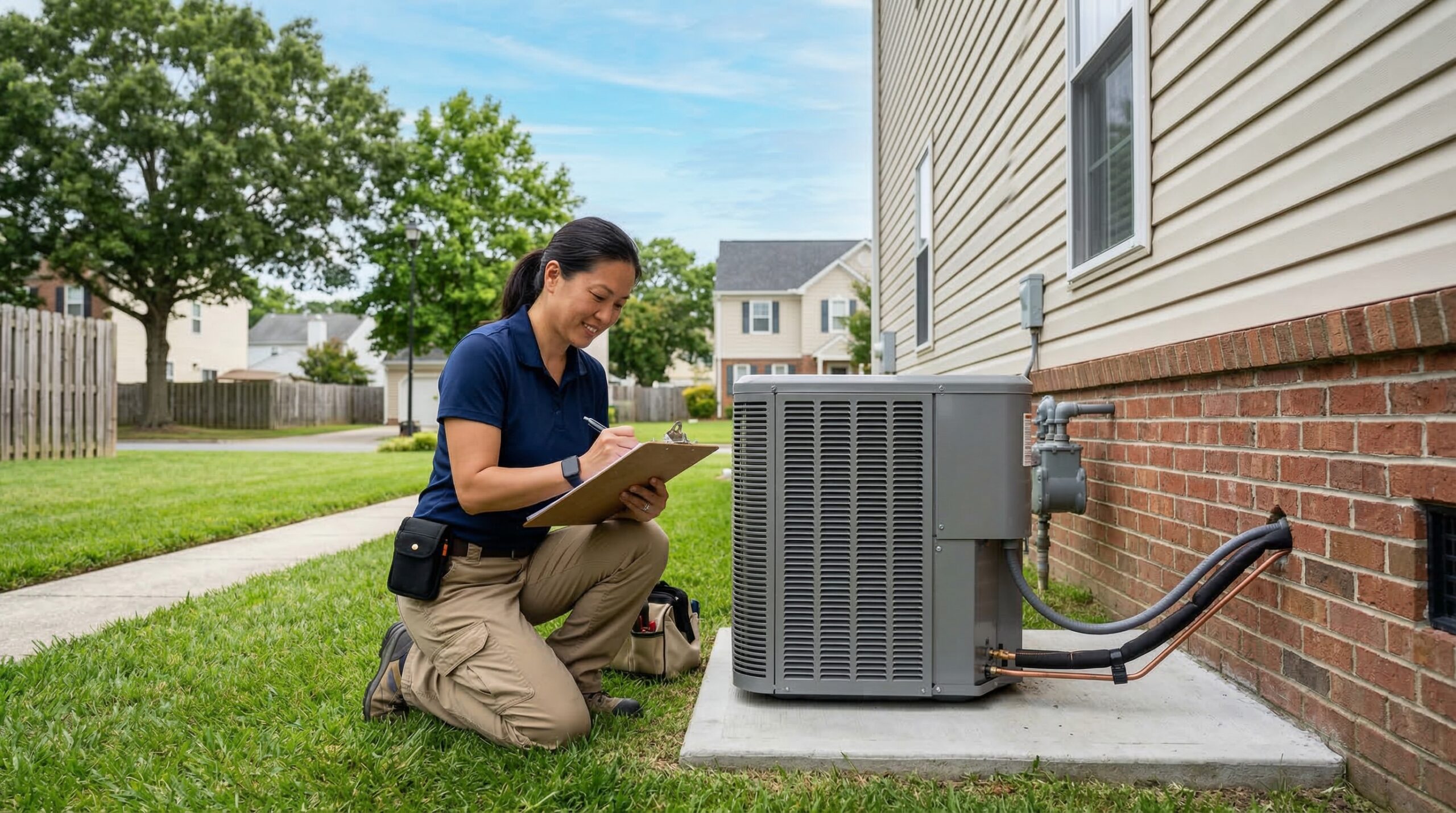
Virginia Beach homeowners replacing an HVAC system face a combination of factors that you won’t find in most coastal cities: a warm humid climate now classified as Zone 3A under the 2021 Virginia building code, salt air from the Atlantic that accelerates outdoor unit corrosion, and one of the largest military populations on the East Coast creating constant housing turnover near NAS Oceana, JEB Little Creek, and Naval Station Norfolk. This guide gives you verified cost ranges, the local rebates Dominion Energy offers, permit requirements from the City of Virginia Beach, and what the coastal environment actually means for your equipment choices.
TL;DR: Virginia Beach HVAC replacement costs range from $4,500 to $14,500 installed, depending on system type and home size. Virginia Beach sits in Climate Zone 3A (warm humid), meaning long hot summers and mild winters. Dominion Energy offers a $50 smart thermostat rebate, and the federal IRA heat pump tax credit covers 30% up to $2,000. A $50 mechanical permit is required from the City of Virginia Beach. Get your personalized estimate.
What Does HVAC Replacement Cost in Virginia Beach?
Virginia Beach labor rates run about 7% below the national average, according to BLS wage data for the Virginia Beach-Norfolk-Newport News MSA (May 2023). That gap pushes equipment costs down modestly compared to markets like Northern Virginia, but the coastal environment and salt air can add complexity to outdoor unit installation and may shorten equipment lifespan near the oceanfront.
| System Type | Typical Range (Installed) | Notes |
|---|---|---|
| Central AC replacement | $4,500–$9,000 | Outdoor unit + indoor coil, standard efficiency |
| Heat pump (full system) | $5,500–$12,000 | Heating + cooling, recommended for Zone 3A |
| Gas furnace replacement | $3,000–$6,500 | Stand-alone furnace, existing ductwork |
| Full split system (AC + furnace) | $7,500–$14,500 | Complete system replacement, average home |
| Ductless mini-split (2-zone) | $5,000–$11,000 | No ductwork required, good for additions |
These ranges cover the full installed cost: equipment, labor, permits, and disposal of the old system. Factors that push prices toward the high end include: homes over 2,500 sq ft, high-efficiency systems (20+ SEER2), difficult attic or crawl space access, ductwork repairs, and coastal corrosion protection upgrades on the outdoor unit.
Why Do Virginia Beach HVAC Costs Differ from the National Average?
Three Virginia Beach-specific factors shape what you pay:
Labor Rates
The Virginia Beach metro area has an average hourly wage 8% below the national mean ($28.86 vs. $31.48 in May 2023, per BLS). HVAC technician wages in the metro track this regional discount, putting local labor at roughly $26–$28/hr versus the national HVAC median of $28.75/hr. This modestly reduces installed cost compared to Northern Virginia or the DC suburbs.
Military PCS and Rental Housing Demand
Virginia Beach is home to NAS Oceana (the Navy’s master jet base for F/A-18 Super Hornets), JEB Little Creek-Fort Story, and Dam Neck Annex. The annual PCS (Permanent Change of Station) cycle drives consistent demand from landlords and new homeowners who need systems replaced before new tenants or owners move in. This high replacement frequency keeps local contractor capacity stretched in spring and summer, and can mean 1–3 week scheduling waits during peak season.
Salt Air Corrosion Near the Oceanfront
Properties within a few miles of the Atlantic Ocean face accelerated condenser corrosion from salt-laden air. Salt particles settle on aluminum fins and copper tubing, triggering electrolytic corrosion that can cut a condenser’s lifespan from the typical 15–20 years down to 10–14 years for oceanfront homes. Replacing a corroded unit at year 12 instead of year 18 effectively increases the per-year ownership cost of the system. See the salt air section below for protective options.
Is a Heat Pump the Right Choice for Virginia Beach?
Virginia Beach’s Zone 3A climate is one of the stronger arguments for heat pump adoption on the East Coast. Here is why:
- Mild winters. Winter design temperature for Virginia Beach is 24°F at the 99th percentile, cold by Florida standards but mild compared to Richmond (18°F). Modern cold-climate heat pumps maintain full heating capacity down to 5°F, and most Virginia Beach winters rarely dip below 25°F for extended periods.
- Long cooling season. With ~2,500 cooling degree days and a summer design dry bulb of 94°F, Virginia Beach runs AC from late April through early October. A heat pump doubles as a high-efficiency cooling system.
- Federal IRA credit. Section 25C covers 30% of heat pump cost, up to $2,000 per year. On a $9,000 heat pump installation, that’s $2,700 back, making heat pumps more competitive than ever against gas-plus-AC setups.
- One system for heating and cooling. Fewer mechanical components to maintain, and no gas line required (relevant for condos and townhomes common near the resort area for condos and townhomes common near the resort area.
Gas furnace plus AC remains a solid choice if you have existing gas infrastructure and prefer the option of a hot air blast during the occasional cold snap. Dual-fuel systems (heat pump + gas furnace backup) offer the best of both, though they carry higher upfront cost.
What Rebates and Incentives Are Available in Virginia Beach?
Virginia Beach homeowners have access to two meaningful incentive stacks : one from Dominion Energy and one from the federal government.
Dominion Energy Virginia Programs
Dominion Energy Virginia serves the Virginia Beach metro. Current programs as of March 2026:
- Smart Thermostat Rebate: $50 instant rebate on eligible smart thermostats (Ecobee, Nest, Honeywell Home, and others) purchased through Dominion’s marketplace at domsavings.com. Stack this with a new heat pump installation for immediate savings at the thermostat.
- Smart Thermostat Rewards: After installation, enroll your thermostat in Dominion’s demand response program to earn ongoing bill credits during high-demand periods, typically summer afternoons.
- Home Energy Evaluation: Dominion coordinates with participating contractors for in-home energy assessments. Rebates on qualifying upgrades are available through this program.
- Income and Age Qualifying (IAQ) Program: For income-qualifying customers, Dominion provides free HVAC tune-ups, duct sealing, and attic insulation at no cost. Call 888-366-8280 to check eligibility.
Note on the Smart Cooling Rewards program: Dominion’s legacy Smart Cooling Rewards program was retired in 2025 and is no longer accepting applications. The Smart Thermostat Rebate and Smart Thermostat Rewards are the current active programs for most homeowners.
Federal IRA Tax Credits
The Inflation Reduction Act’s Section 25C credit applies to Virginia Beach homeowners in the same way it applies nationwide:
- Heat pumps: 30% of installed cost, up to $2,000 per year
- Central AC: 30% of installed cost, up to $600 per year
- Gas furnace: 30% of installed cost, up to $600 per year (efficiency requirements apply)
- Smart thermostat: 30% of cost, up to $150 per year (stackable with Dominion $50 rebate)
The IRA credits are non-refundable, meaning they reduce what you owe in federal taxes but are not paid out as a cash refund. Consult a tax professional to confirm your eligibility. There is no Virginia state HVAC rebate program currently active. DSIRE confirmed no applicable state programs as of March 2026, with Virginia’s state HOMES and HEAR programs still pending federal approval.
Salt Air and Coastal Corrosion: What Virginia Beach Homeowners Need to Know
Coastal salt air is the most distinctly Virginia Beach factor in HVAC ownership costs. Salt particles carried by Atlantic breezes settle on outdoor condenser coils and trigger electrochemical corrosion that degrades aluminum fins and copper tubing faster than inland environments. For properties within a mile or two of the ocean, the practical impact is real:
- Reduced condenser lifespan: Coastal units often show significant coil degradation in 10–14 years versus the 15–20 year expectation inland.
- Higher refrigerant leak rates: Salt-induced pitting on copper tubing can create microscopic holes that lead to refrigerant leaks, expensive to find and repair.
- Reduced efficiency: Corroded fins restrict airflow across the coil, forcing the system to run longer to reach setpoint and increasing energy costs.
If your home is near the oceanfront, Virginia Beach oceanfront resort area, or Chesapeake Bay waterfront, ask your HVAC contractor about:
- Coastal-grade coil coatings: Electrofin, Blygold, or manufacturer-applied epoxy coatings protect aluminum fins. Some manufacturers offer “coastal” models with pre-coated coils and stainless fasteners.
- Annual coil rinse: A simple annual freshwater rinse of the condenser (with power off) removes salt buildup before it pits the fins.
- Equipment location: If your condenser can be placed on the inland side of the house, away from the prevailing ocean breeze, it will experience less salt exposure.
Homes 5+ miles from the beach (western Virginia Beach neighborhoods like Centerville, Kempsville, Princess Anne) experience much less salt exposure and typically see normal equipment lifespans.
Virginia Beach Permit Requirements for HVAC Replacement
A mechanical permit is required for HVAC replacement in Virginia Beach. The City of Virginia Beach Permits and Inspections department issues residential mechanical permits at a base fee of $50. Your licensed HVAC contractor should pull the permit on your behalf before work begins.
Contact: Virginia Beach Permits and Inspections, 2403 Courthouse Drive, (757) 385-4211. Online permit portal and application forms available at VirginiaBeach.gov/TradePermits.
Virginia uses the 2021 Virginia Residential Code, which incorporates the 2021 IECC. For Virginia Beach (now Zone 3A), equipment sizing and insulation requirements follow Zone 3A specifications. Your contractor’s load calculation should reference the updated zone classification. If they quote sizing based on Zone 4A requirements, ask them to confirm they’re using the current 2021 IECC zone map.
Frequently Asked Questions
What utility rebates are available for HVAC replacement in Virginia Beach?
Dominion Energy Virginia offers a $50 instant rebate on eligible smart thermostats through their Smart Thermostat Rebate program at domsavings.com. You can also enroll in Smart Thermostat Rewards to earn ongoing bill credits. For income-qualifying homeowners, Dominion’s IAQ program provides free heat pump tune-ups and duct sealing. On the federal side, the IRA Section 25C credit covers 30% of heat pump installation cost up to $2,000 per year, and 30% up to $600 for high-efficiency AC or furnace. Virginia has no separate state HVAC rebate program currently active (confirmed via DSIRE, March 2026).
Does salt air near the Virginia Beach coast reduce HVAC lifespan?
Yes, for properties near the oceanfront or Chesapeake Bay waterfront. Salt-laden air accelerates corrosion on aluminum condenser fins and copper refrigerant lines, potentially cutting a condenser’s useful life from 15–20 years down to 10–14 years for oceanfront homes. Protective measures include coastal-grade coil coatings (Electrofin, Blygold), annual freshwater rinse of the condenser, and specifying coastal-model equipment with pre-coated coils and stainless hardware. Homes 5+ miles inland in western Virginia Beach neighborhoods face much lower salt exposure and see standard equipment lifespans.
Do Virginia Beach homeowners need a permit to replace HVAC?
Yes. Virginia Beach requires a residential mechanical permit for HVAC replacement. The base fee is $50, and your licensed contractor should pull the permit before work starts. Permits are issued by Virginia Beach Permits and Inspections (757-385-4211, 2403 Courthouse Drive). Completing the replacement without a permit can create complications when you sell the home, since the city inspection confirms the work meets 2021 Virginia Residential Code requirements for Zone 3A.
How does military housing turnover affect HVAC scheduling and pricing in Virginia Beach?
Virginia Beach’s large military population, tied to NAS Oceana, JEB Little Creek, and Dam Neck Annex, creates a distinct spring and summer demand spike for HVAC replacement. The PCS (Permanent Change of Station) cycle runs heavily from March through August, meaning landlords and new homeowners frequently need systems replaced before new occupants arrive. During peak PCS season, scheduling a Virginia Beach HVAC replacement can require 1–3 weeks of lead time. If your system is aging and you have flexibility, booking in January through March typically offers faster scheduling and may come with off-season pricing from contractors looking to fill their schedules.
Is a heat pump the right choice for Virginia Beach’s climate?
For most Virginia Beach homes, yes. Virginia Beach is now classified as ASHRAE Climate Zone 3A (Warm Humid) under the 2021 Virginia building code update. The climate features long hot humid summers (summer design dry bulb 94°F, roughly 2,500 cooling degree days) and relatively mild winters (99th percentile winter design temperature of 24°F). Heat pumps are highly efficient in this climate profile: they handle the heavy cooling load efficiently, and the mild winter means heat pump heating performance remains strong without requiring a backup heat source during most cold snaps. The IRA 30% tax credit up to $2,000 makes the economics even more favorable. Dual-fuel (heat pump plus gas backup) is a good option if you prefer backup gas heating for the occasional January cold spell.
How can I compare Virginia Beach HVAC quotes to make sure I’m getting a fair price?
Get at least three written quotes for any HVAC replacement in Virginia Beach. Each quote should include the equipment model numbers (so you can compare like-for-like), the SEER2 efficiency rating, permit pulling, old system disposal, thermostat, and startup/commissioning. Ask each contractor whether they plan to perform a Manual J load calculation, as proper sizing is critical for both comfort and efficiency in Virginia Beach’s humid climate, where an oversized system will fail to dehumidify properly. Verify the contractor’s Virginia state mechanical license and check that they’ll pull the required mechanical permit. Use our free estimator to see what a reasonable range looks like for your home size before you invite contractors in.
For broader Virginia context, see our Virginia HVAC cost guide. For a neighboring city comparison, see our Richmond, VA HVAC cost guide. To see costs by system type, visit our heat pump replacement cost guide or AC replacement cost guide. For all Virginia city guides and other markets, visit the HVAC cost by city hub.