
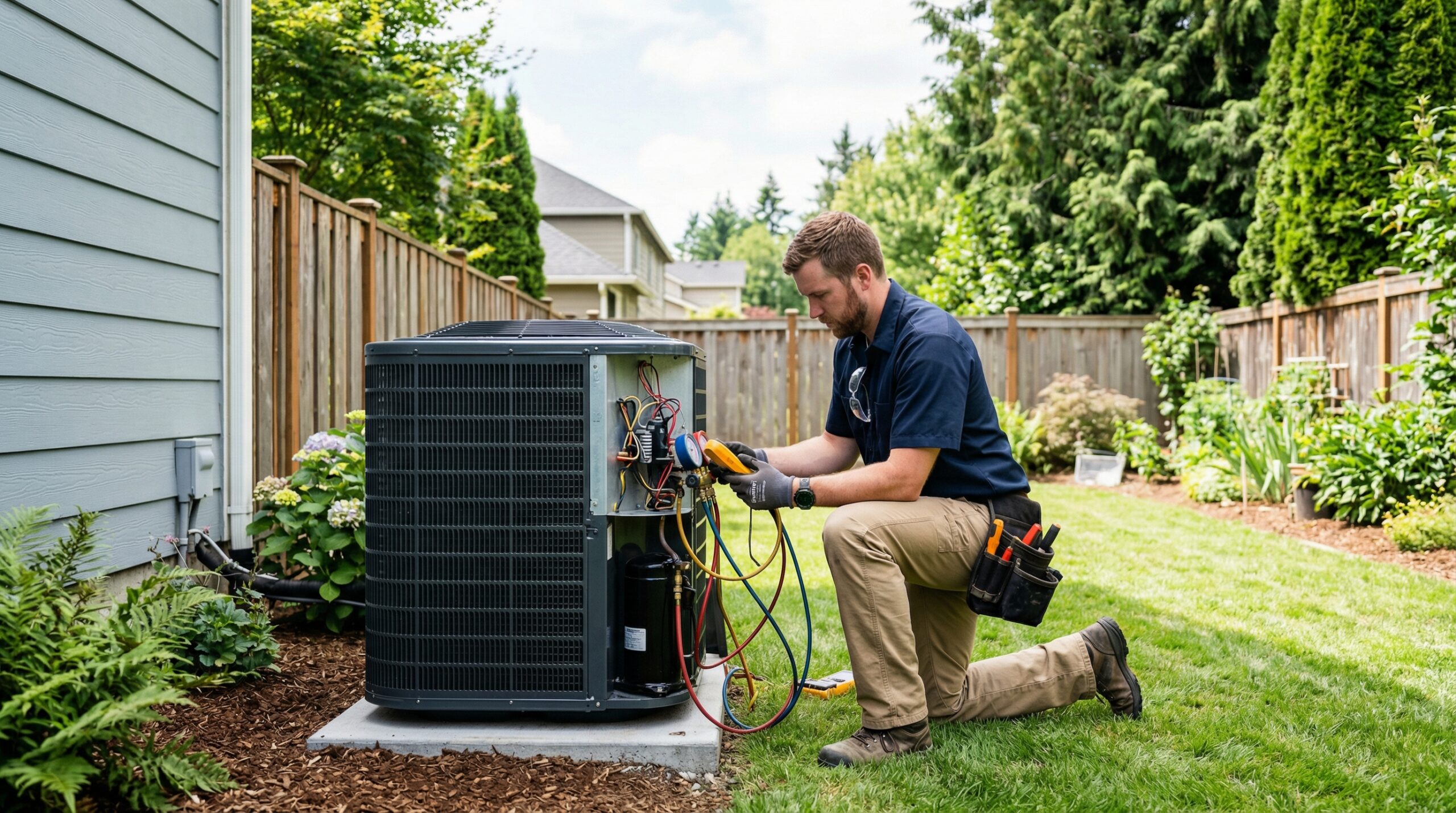
Seattle sits in ASHRAE Climate Zone 4C, a marine classification where mild, wet winters and dry summers make heat pumps the dominant HVAC choice, with adoption rates well above the national average. Labor costs run 26% higher than the US median (BLS 2024), and a stacked set of rebates from Puget Sound Energy, Seattle City Light, and the Washington HEAR program can offset $1,500 to $8,000 of your project cost depending on your income level and current heating source. If your home still runs on oil or electric resistance heat, Seattle has more financial incentive to upgrade right now than almost any other US city.
TL;DR: HVAC replacement in Seattle costs $8,000–$16,000 for a heat pump system (installed), which is 15–25% above the national average due to higher labor rates. Seattle is in Climate Zone 4C (Marine), making heat pumps the standard choice year-round. PSE offers a $1,500 rebate for switching from electric resistance heat to a heat pump, and Seattle City Light provides $400–$600 in instant discounts. A mechanical permit is required through Seattle SDCI or WA L&I (approx. $160–$325). Use our free estimator for a number tailored to your home and system.
How Much Does HVAC Replacement Cost in Seattle?
Seattle HVAC replacement costs run higher than the national average, primarily because of the city’s elevated labor market. HVAC technicians in the Seattle-Tacoma-Bellevue metro earn a median wage of $75,500 per year (BLS 2024), compared to $59,810 nationally. That 26% gap flows directly into contractor bids.
| System Type | Seattle Low | Seattle Mid | Seattle High |
|---|---|---|---|
| Heat Pump (Air-Source Ducted) | $8,000 | $11,500 | $16,000 |
| Ductless Mini-Split Heat Pump | $5,500 | $9,000 | $14,500 |
| Central AC Only | $4,500 | $7,500 | $12,000 |
| Gas Furnace Only | $3,000 | $5,500 | $9,500 |
| Full System (AC + Furnace) | $8,500 | $12,500 | $18,000 |
The mid-range estimate reflects the most common scenario: a standard-efficiency ducted heat pump in a typical Seattle home (1,500–2,000 sq ft), installed by a licensed contractor using existing ductwork. Homes that need ductwork repair or replacement add $2,000–$8,000 to the total.
For a personalized estimate based on your home size, system type, and efficiency tier, try our free HVAC cost estimator. It takes about 60 seconds and never asks for your contact information.
Why Seattle HVAC Costs Run Higher Than the National Average
Three factors drive Seattle’s cost premium over national HVAC averages:
Labor Rates
The Seattle metro is one of the highest-cost labor markets in the country. HVAC technicians here earn a median $75,500 annually, with experienced techs reaching $137,000 at the 90th percentile (BLS 2024). That wage premium translates directly to higher installation bids.
Electrification Demand
Washington State’s aggressive electrification policies and the City of Seattle’s goal to transition all remaining oil-heated homes by 2030 have created high demand for qualified installers. PSE’s Trade Ally requirement (contractors must be enrolled in PSE’s network to process rebates) also concentrates work among a smaller pool of certified contractors, which can affect pricing and scheduling lead times.
Post-Heat Dome Cooling Demand
Before the 2021 Pacific heat dome hit 108°F in Seattle, many older homes had no cooling at all. Since then, demand for heat pumps that provide both heating and cooling has remained elevated. Higher demand and a compressed contractor pool in a city historically underbuilt for AC capacity combine to keep prices above the national average.
What HVAC System Works Best in Seattle’s Climate?
Seattle falls in ASHRAE Climate Zone 4C, described as “Mixed-Marine.” Winters are mild and wet (January average low around 33°F), summers are dry with occasional heat spikes, and the marine airflow keeps temperatures moderate year-round. This climate profile is nearly ideal for air-source heat pumps.
Modern cold-climate heat pumps (rated to operate efficiently at 0°F or below) handle Seattle’s winters without relying heavily on backup resistance heat strips. The mild winters mean the heat pump operates in its high-efficiency range most of the season, not the lower-efficiency range it would see in Minneapolis or Chicago. At the same time, having a heat pump means you also have cooling capacity built in, which matters after the 2021 heat event and the ongoing trend of warmer Pacific Northwest summers.
Gas furnaces remain an option for some Seattle homes, but Washington’s energy code trajectory and the financial incentive stack strongly favor heat pump systems for most replacement projects. See our heat pump replacement cost guide and our Washington state HVAC cost overview for deeper comparisons.
System Recommendations by Home Type
| Home Configuration | Recommended System | Why |
|---|---|---|
| Existing forced-air ductwork (good condition) | Ducted air-source heat pump | Best efficiency, qualifies for PSE rebates, dual heating/cooling |
| No ductwork or poor-condition ducts | Ductless mini-split heat pump | Avoids ductwork cost, zone control, qualifies for rebates |
| Currently on oil heat | Heat pump (any type) | Triggers Seattle Clean Heat $2,000–$6,000 rebate, eliminates oil tank liability |
| Currently on natural gas | Heat pump (income-qualified only for gas-to-heat-pump PSE rebate) | Income-qualified customers can get up to $4,000 PSE rebate for gas-to-heat-pump |
Seattle and PSE Rebates for HVAC Replacement
Seattle homeowners can layer multiple rebate programs to significantly reduce out-of-pocket HVAC costs. The major programs active as of 2026:
Puget Sound Energy (PSE) Rebates
PSE serves most of the Seattle metro outside the city limits (and some areas within). For PSE electric customers:
- Electric resistance to heat pump conversion: $1,500 base rebate. Requires replacing electric baseboard, wall heater, or electric forced-air furnace with a qualifying air-source heat pump (ducted or ductless).
- Efficiency Boost (income-qualified): Up to $2,400 additional rebate for households meeting income guidelines. Stacks with base rebate.
- Heat pump upgrade (existing heat pump to new heat pump): $1,500 rebate for upgrading an older heat pump to a high-efficiency model.
- Contractor requirement: As of April 2, 2026, the heat pump must be installed by a PSE Trade Ally or Recommended Energy Professional (REP) to qualify. Confirm your contractor at pse.com before signing a contract.
PSE rebate source: pse.com/rebates/heating (verified 2026-03-31).
Seattle City Light Rebates
For Seattle City Light customers (within the city limits):
- Heat pump instant discount: $400–$600 on qualifying heat pump models at point of sale.
- Heat pump water heater: $750 rebate (separate from space heating system).
- Clean Heat Program (oil-to-electric conversion): $2,000 instant rebate for switching from oil heat to a qualifying heat pump. An additional $4,000 bonus rebate is available for moderate-income households earning 81–150% of the Area Median Income, bringing the combined potential to $6,000. This program is partnership with Mitsubishi Electric and requires a participating contractor.
Clean Heat source: seattle.gov/environment/clean-heat-program (verified 2026-03-31).
Washington HEAR Program
The Washington Home Electrification and Appliance Rebates (HEAR) program, funded by the federal Inflation Reduction Act and managed by the Washington State Department of Commerce, provides point-of-sale rebates for income-qualified households:
- Heat pump space heating: up to $8,000
- Heat pump water heater: up to $1,750
- Electrical panel upgrade (if required): up to $4,000
- Eligibility: households earning less than 150% of Area Median Income
Note: The federal IRA Section 25C tax credit (formerly worth up to $2,000) expired December 31, 2025. The HEAR rebate program is the primary IRA-funded incentive vehicle for 2026. Check current income limits and program availability through the Washington State Department of Commerce or DSIRE (programs.dsireusa.org/system/program/wa).
How to Stack Seattle Rebates
An income-qualified Seattle homeowner switching from oil heat to a heat pump could potentially stack: Clean Heat ($2,000 base + $4,000 bonus) + PSE Efficiency Boost ($2,400) + HEAR ($8,000) for a total of up to $16,400 in rebates. Not every homeowner will qualify for every program, and some programs cannot be combined. Talk to a PSE Trade Ally contractor, as they are required to process PSE rebates and can often navigate the full stack for you. For more detail, see our HVAC tax credits and rebates guide.
Does Seattle HVAC Replacement Require a Permit?
Yes. HVAC replacement in Seattle and King County requires permits, and the permitting structure is split between two agencies:
Mechanical Permit (Seattle SDCI or WA L&I)
Within Seattle city limits, the Seattle Department of Construction and Inspections (SDCI) issues mechanical permits for HVAC replacement. In King County outside city limits, permits come from the King County Department of Local Services, Permitting Division.
King County’s 2025 fee schedule lists a mechanical installation permit at $160 for inspection. The Seattle 2026 Fee Subtitle governs permit fees within city limits, with mechanical permits starting around $130–$325 depending on the scope of work. Permit fees are typically included in a licensed contractor’s bid.
Electrical Permit (WA L&I)
Washington State Department of Labor and Industries (L&I) issues all electrical permits, even for work inside Seattle city limits. If your heat pump installation requires new wiring, a panel upgrade, or a dedicated circuit, your electrical contractor pulls a separate L&I permit. This is a common point of confusion for homeowners getting quotes.
A licensed HVAC contractor in Seattle will handle both the mechanical permit and coordinate with an electrician for the electrical permit. Always confirm that permits are being pulled before work begins. Unpermitted HVAC work can complicate home sales and void manufacturer warranties.
Seattle HVAC Replacement: What to Expect from Contractors
Seattle’s HVAC contractor market is active but competitive, especially for heat pump work. A few things to know before you start getting quotes:
- PSE Trade Ally enrollment: If you want PSE rebates, the contractor must be enrolled in PSE’s Trade Ally Network. Ask to confirm enrollment before signing. Starting April 2, 2026, this is a hard requirement, not a recommendation.
- Lead times: Heat pump installations can book 2–6 weeks out in Seattle, especially in spring and fall. Start the process early if you have a failing system.
- Manual J load calculation: Washington State Energy Code (2021 WSEC) requires HVAC systems to be sized using an accepted load calculation method (ACCA Manual J). Any contractor who sizes your system by “rule of thumb” (e.g., one ton per 400 sq ft) without a load calc is not meeting code.
- Oil tank decommissioning: If you are switching from oil to electric heat, you will also need to decommission your oil tank per Seattle Fire Department requirements. Budget an additional $1,500–$3,000 for this step if your tank is underground.
- Get three quotes: Seattle’s labor premium means prices vary. A spread of $2,000–$4,000 between quotes on the same system type and size is common.
Frequently Asked Questions About HVAC Replacement in Seattle
Do Seattle homes actually need air conditioning?
Historically, many older Seattle homes were built without cooling because the maritime climate kept temperatures mild through most summers. That calculus changed significantly after the June 2021 Pacific Northwest heat dome, when Seattle reached 108°F. Since then, heat pump installations have surged because they provide both heating and cooling in a single system. If your current system is heating-only, replacing it with a heat pump adds cooling capacity at little incremental cost compared to adding a separate AC system later.
What rebates are available for heat pump installation in Seattle in 2026?
Several programs are active in 2026:
- PSE (Puget Sound Energy): $1,500 base rebate for electric-resistance-to-heat-pump conversions; up to $2,400 for income-qualified customers. Heat pump upgrade rebate also $1,500.
- Seattle City Light: $400–$600 instant discount on qualifying heat pumps; Clean Heat Program offers $2,000 (oil-to-electric) up to $6,000 for moderate-income households.
- Washington HEAR: Up to $8,000 for income-qualified households through the IRA-funded state rebate program.
- Federal 25C tax credit: Expired December 31, 2025. Not available for systems installed in 2026.
Program eligibility varies by utility territory, income level, and current heating source. Confirm with your contractor before assuming you qualify for all programs.
Does HVAC replacement in Seattle require a permit?
Yes. Seattle and King County both require mechanical permits for HVAC replacement. Within the city, the Seattle SDCI issues mechanical permits starting around $130. In unincorporated King County, the permit is $160. Electrical work requires a separate L&I permit in all areas of Washington State. Licensed HVAC contractors handle permit filings as part of the project; always confirm before work begins.
How much more does HVAC replacement cost in Seattle vs. the national average?
Seattle HVAC costs typically run 15–25% above the national average. The main driver is labor: HVAC technicians in the Seattle-Tacoma-Bellevue metro earn a median $75,500 per year vs. $59,810 nationally (BLS 2024). A heat pump that might cost $8,500 mid-range nationally can run $10,000–$12,000 in Seattle. Angi’s 2026 local data puts the average heat pump cost in Seattle at $10,218 (range: $6,667–$13,852). The rebate stack available in Seattle, however, is also significantly better than in most markets, partially offsetting the premium.
Is a heat pump a good choice for Seattle’s climate?
Yes. Seattle’s Zone 4C (Marine) climate is one of the most favorable in the US for heat pump performance. Mild winters mean the heat pump operates in its high-efficiency range most of the season, typically producing 2–3 units of heat for every unit of electricity consumed. Modern cold-climate heat pumps are rated to operate effectively down to -13°F, so Seattle’s rare below-freezing nights do not require backup heat in most cases. Heat pumps also provide the cooling capacity that Seattle homes increasingly need after the 2021 heat event. Washington state’s utility rebate stack makes heat pumps particularly attractive financially.
How long does HVAC replacement take in Seattle?
The physical installation typically takes one to two days for a standard ducted heat pump replacement with existing ductwork. Add a day or more for ductwork repairs. Lead time to schedule the installation is the bigger variable: expect 2–6 weeks, longer during spring and fall demand peaks. If you are switching from oil heat, oil tank decommissioning is a separate project that may take an additional week to schedule with a qualified tank removal company.