
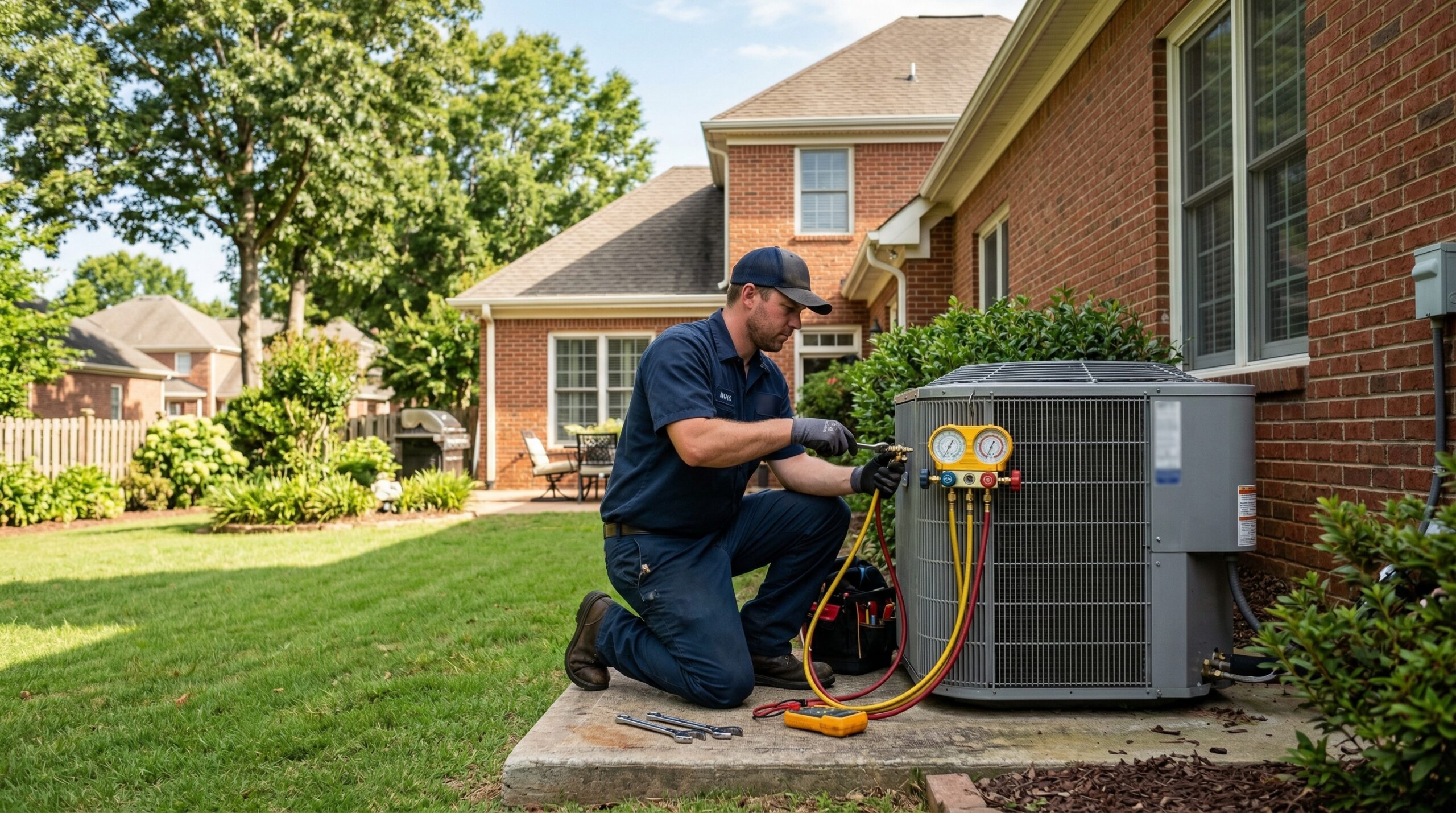
Rock Hill, SC sits 15 miles south of Charlotte in York County, giving homeowners access to one of the Southeast’s most competitive HVAC contractor markets on either side of the state line. Full HVAC system replacement in Rock Hill runs $5,000 to $13,000, with heat pumps dominating new installations in this warm-humid climate zone where summers push into the 90s and winters rarely stay brutal for long.
Rock Hill HVAC Quick Facts: Full system replacement costs $5,000 to $13,000. Climate Zone 3A (warm-humid) favors heat pumps over gas furnaces. Rock Hill Utilities SmartChoice offers a $400 heat pump rebate (14+ SEER, updated October 2025). Duke Energy Carolinas Smart $aver adds up to $500 more. Federal 25C tax credit covers up to $2,000 for qualifying heat pump installations. Permits required from the City of Rock Hill Building Department (803-325-2500). Get a free personalized estimate.
How Much Does HVAC Replacement Cost in Rock Hill, SC?
Rock Hill HVAC replacement pricing tracks the Charlotte metro labor market closely. The city’s position inside the Charlotte-Concord-Gastonia MSA means you can often get quotes from established Charlotte-area contractors who hold South Carolina licenses, which keeps prices competitive. BLS data from May 2024 puts the median HVAC technician wage in the Charlotte MSA at $57,950 per year, putting Rock Hill right in line with major Southeast metro pricing.
| System Type | Rock Hill Cost Range | Typical Home Size |
|---|---|---|
| Central AC only | $4,500 to $8,500 | 1,200 to 2,500 sq ft |
| Heat pump system | $5,200 to $11,000 | 1,200 to 2,500 sq ft |
| Gas furnace plus central AC | $7,500 to $13,500 | 1,500 to 3,500 sq ft |
| Dual-fuel system (HP plus gas backup) | $9,000 to $15,500 | 1,800 to 3,500 sq ft |
| Mini-split (single zone) | $3,500 to $7,500 | 300 to 800 sq ft zone |
Prices include equipment and standard installation labor. Add $2,500 to $5,000 if ductwork needs repair or replacement, and $250 to $400 for the required mechanical permit. Use our free HVAC replacement cost estimator to get a personalized range for your home and zip code.
What Affects HVAC Replacement Cost in Rock Hill?
Several factors specific to Rock Hill and York County push costs up or down from the baseline ranges above.
Charlotte Metro Labor Market
Rock Hill benefits from the Charlotte metro’s deep contractor pool. More competing bids typically translates to sharper pricing. However, during peak summer AC season (June through August), Rock Hill can face the same technician shortage pressure as Charlotte because both markets draw from the same labor base. If your system fails mid-July, expect to pay a premium or wait several days for installation.
Climate Zone 3A and System Sizing
Rock Hill sits in IECC Climate Zone 3A (warm-humid), with approximately 1,809 cooling degree days and 2,043 heating degree days per year based on NOAA normals from Station USW00053871. Summers reach 90°F with high humidity, while January lows average 31°F. This dual-season demand requires a system sized for both summer peaks and occasional winter cold snaps. A properly performed Manual J load calculation is worth requesting from any contractor you hire.
Equipment Efficiency and Tier
Federal minimum efficiency standards (SEER2) took effect in 2023, raising the floor for new equipment. In the Southeast region (which includes South Carolina), the minimum for central AC and heat pumps is 15 SEER2. Systems at the efficiency minimum cost less upfront but may qualify for fewer rebates. Mid-tier systems (16 to 17 SEER2) hit the sweet spot for Rock Hill’s climate, balancing upfront cost with rebate eligibility and long-term operating savings.
Rock Hill HVAC Rebates and Incentives
Rock Hill homeowners have access to two stacking utility rebates plus the federal 25C tax credit, a combination that can reduce out-of-pocket cost by $2,400 or more on qualifying heat pump installations.
Rock Hill Utilities SmartChoice Program
Rock Hill Utilities, the city’s municipal electric provider, offers a $400 rebate for heat pump replacements through its SmartChoice program (verified active as of October 2025 via DSIRE). Requirements: unit must be 14 SEER or greater, and installation must be by a certified heating and A/C contractor. All-electric homes that install a qualifying 16 SEER or higher system can also qualify for the Great Rate discount of up to 4 cents per kWh, adding ongoing bill savings on top of the upfront rebate.
Contact Rock Hill Utilities at 803-325-2640 or visit the SmartChoice page on cityofrockhill.com to confirm current program details and apply.
Duke Energy Carolinas Smart $aver Program
Homeowners served by Duke Energy Carolinas (rather than Rock Hill Utilities) can access the Smart $aver program, which increased rebate amounts on January 1, 2025. Current rebates for residential customers:
- Replacing an existing heat pump: up to $500
- Upgrading strip heat to high-efficiency heat pump (15.2 SEER2 or higher): $600
- Upgrading strip heat to higher-efficiency heat pump (16 SEER2 or higher): $1,000
- Replacing central AC: $300
- Income-qualified households: up to $8,000 for HVAC replacement (raised from $6,000 in 2025)
A home energy check through Duke Energy may be required before rebates are issued. Contact Duke Energy at 800-777-9898 or visit duke-energy.com for current eligibility requirements.
Federal 25C Tax Credit
The Inflation Reduction Act Section 25C credit covers 30% of the cost of qualifying heat pump installations, up to $2,000 per year through 2032. This is a tax credit (not a deduction), meaning it reduces your federal tax bill dollar for dollar. Combined with Rock Hill Utilities’ $400 rebate, a homeowner installing a qualifying $9,000 heat pump could see $2,400 or more in combined incentives. Consult a tax professional to confirm your eligibility based on your specific system and income situation.
South Carolina does not have a state-level HVAC rebate program (confirmed via DSIRE in March 2026).
Heat Pump vs. Gas Furnace for Rock Hill’s Climate
Zone 3A makes Rock Hill ideal heat pump territory. With roughly 1,809 cooling degree days per year, your system will run in cooling mode far more often than heating mode. Heat pumps handle both functions from a single unit, and modern cold-climate models operate efficiently down to 0°F, well below Rock Hill’s typical winter lows.
Gas furnaces make sense in Rock Hill primarily if you already have natural gas service to your home and want maximum heating output during the rare ice storms that occasionally hit York County. A dual-fuel system, pairing a heat pump with a gas furnace backup, is a strong option for homeowners who want heat pump efficiency most of the year with gas backup for the coldest nights. See our furnace replacement cost guide and our mini-split vs. central AC comparison if you are weighing your options.
Sizing matters. Rock Hill’s humidity means an oversized system will cool quickly but not run long enough to dehumidify properly, leaving your home feeling clammy. Request a Manual J load calculation from any contractor before they specify equipment size. See our HVAC sizing guide for how this works.
Do You Need a Permit for HVAC Replacement in Rock Hill?
Yes. A mechanical permit is required for HVAC system replacement anywhere in Rock Hill and York County. Skipping the permit can create problems when you sell your home and the buyer’s inspection uncovers unpermitted mechanical work.
Where to apply:
- City of Rock Hill: Planning and Development Department, 155 Johnston Street, Rock Hill SC 29730 | 803-325-2500 | Appointments M-F 8:30 a.m. to 4 p.m.
- Unincorporated York County: York County Planning and Development Services, 1070 Heckle Blvd Ste 105 | 803-909-7230
In practice, your licensed contractor should pull the permit and schedule the inspection as part of their service. Confirm this is included before you sign the contract. Permit fees typically run $250 to $400 for a standard HVAC replacement in South Carolina.
Hiring an HVAC Contractor in Rock Hill
Rock Hill’s location inside the Charlotte metro means you have access to both Rock Hill-based firms and Charlotte-area companies that hold South Carolina mechanical contractor licenses. This contractor density is a genuine advantage when shopping for quotes.
One important licensing note: North Carolina and South Carolina do not have HVAC or mechanical contractor license reciprocity. A Charlotte-based contractor holding only a North Carolina mechanical license cannot legally work on your Rock Hill home. Always ask for the contractor’s South Carolina Contractor’s Licensing Board license number and verify it at LLR.SC.gov before signing anything.
General best practices for Rock Hill homeowners getting HVAC quotes:
- Get at least three written quotes from licensed SC contractors
- Verify SC mechanical contractor license number on each bid
- Confirm the quote includes pulling the required mechanical permit
- Ask whether the contractor is a Duke Energy Smart $aver Trade Ally if you need that rebate
- Request a Manual J load calculation before accepting any equipment size recommendation
- See our guide to comparing HVAC quotes before you decide
For current HVAC incentive programs by state, see our HVAC rebates by state resource.
Frequently Asked Questions
How much does HVAC replacement cost in Rock Hill, SC?
Rock Hill homeowners typically pay $5,000 to $13,000 for a full HVAC replacement. Central AC only runs $4,500 to $8,500, while heat pump systems range from $5,200 to $11,000 for most homes. Gas furnace plus central AC combinations cost $7,500 to $13,500. Rock Hill pricing tracks the Charlotte, NC metro labor market closely and runs at or slightly below Charlotte rates due to South Carolina’s lower overall cost of living.
What rebates are available for HVAC replacement in Rock Hill?
Rock Hill Utilities offers a $400 heat pump rebate through its SmartChoice program for units rated 14 SEER or greater (updated October 2025). Duke Energy Carolinas customers can receive up to $500 for replacing an existing heat pump or $600 to $1,000 for upgrading strip heat to a heat pump through the Smart $aver program. The federal 25C tax credit adds up to $2,000 for qualifying heat pump installations. Stacking the Rock Hill Utilities rebate with the federal credit can reduce your cost by $2,400 or more.
Do I need a permit for HVAC replacement in Rock Hill, SC?
Yes. A mechanical permit is required for HVAC replacement in the City of Rock Hill and unincorporated York County. Apply through the City of Rock Hill Planning and Development Department at 155 Johnston Street (803-325-2500). Your licensed contractor should pull the permit and schedule the required inspection as part of the installation job. Permit fees are typically $250 to $400 for a standard replacement.
Should I get a heat pump or gas furnace for my Rock Hill home?
Most Rock Hill homes benefit more from a heat pump than a gas furnace. IECC Climate Zone 3A gives Rock Hill about 1,809 cooling degree days versus 2,043 heating degree days annually, making it a balanced but cooling-leaning climate where heat pumps run efficiently year-round. Gas furnaces make sense only if you already have natural gas service and want backup capacity for the occasional cold snap. A dual-fuel system (heat pump plus gas backup) is worth considering if you want the best of both worlds.
Can I hire a Charlotte, NC HVAC contractor for work in Rock Hill?
Yes, but verify they hold a South Carolina Mechanical Contractor license before hiring. North Carolina and South Carolina do not have HVAC license reciprocity, meaning NC-licensed contractors must obtain a separate SC license to legally work in Rock Hill. Many Charlotte-area HVAC companies do hold SC licenses because Rock Hill is a major Charlotte suburb. Always ask for their SC license number and verify it with the South Carolina Contractor’s Licensing Board before signing any contract.
What size HVAC system does a Rock Hill home need?
Most Rock Hill homes in the 1,500 to 2,500 square foot range use a 2.5-ton or 3-ton system, but the correct size depends on your home’s insulation, window area, ceiling height, and orientation, not just square footage. Rock Hill’s high summer humidity makes proper sizing especially important: an oversized system will cool your home quickly without running long enough to remove humidity, leaving it feeling damp and uncomfortable. Ask any contractor for a Manual J load calculation before they recommend a system size. See our HVAC sizing guide for the full process.