
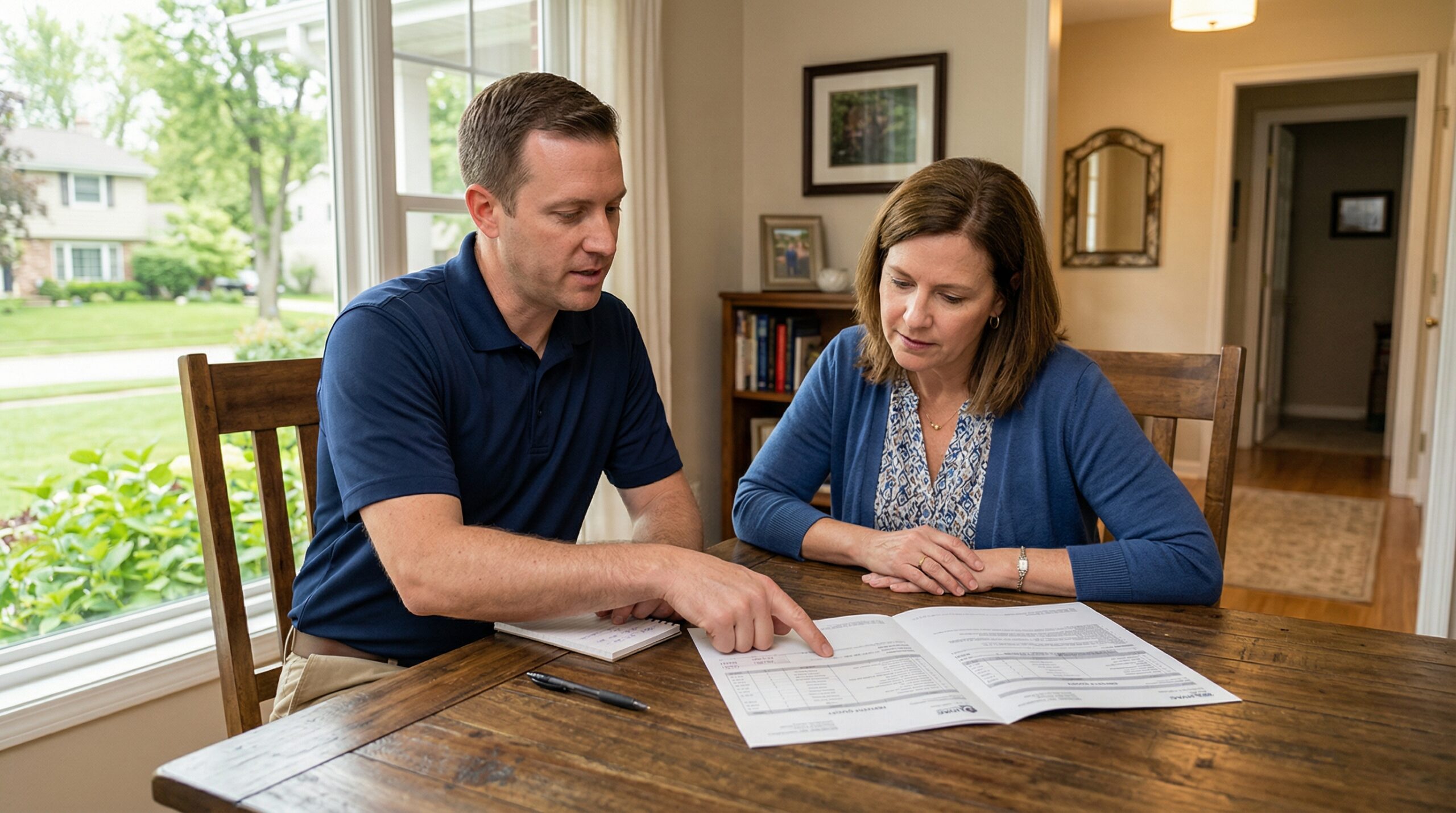
Iowa homeowners face a heating-dominant HVAC environment: Zone 5A winters that regularly drop to 0°F or below in Des Moines and even colder in Sioux City, combined with hot and humid summers that demand real cooling capacity. That climate, plus a farming-economy labor market where rural service routes add cost, shapes Iowa HVAC pricing in ways that differ from neighboring states. This guide covers what HVAC replacement actually costs across Iowa in 2026, which MidAmerican Energy and Alliant Energy rebates you can claim, and how to evaluate the heat pump vs. gas furnace decision for Zone 5A conditions.
What Does HVAC Replacement Cost in Iowa?
HVAC replacement in Iowa runs $3,000 to $13,500 installed, depending on system type, equipment tier, and location. The table below shows 2026 installed cost ranges for the most common replacement scenarios.
| System Type | Low End | High End | Most Common |
|---|---|---|---|
| Gas furnace only | $3,000 | $9,000 | $4,500–$6,500 |
| Central AC only | $3,500 | $8,000 | $4,000–$6,500 |
| Full HVAC system (AC + furnace) | $5,200 | $13,500 | $8,000–$11,000 |
| Cold-climate heat pump | $5,200 | $12,500 | $6,500–$10,500 |
| Mini-split (per zone) | $2,800 | $7,500 | $3,500–$5,500 |
These ranges reflect installed cost including equipment, refrigerant, electrical work, and labor. Permit fees ($75–$200 for most Iowa cities) are not included and should be added to any contractor quote.
Why Does Iowa HVAC Cost What It Does?
Iowa HVAC costs sit close to the national average in metro areas but can run higher in rural regions due to three structural factors.
Climate zone equipment requirements. Zone 5A homes in Iowa require furnaces rated for sustained cold. A 2,000 sq ft home in Des Moines typically needs an 80,000–100,000 BTU furnace. Contractors are increasingly recommending 96%+ AFUE models because Iowa’s ~6,500 heating degree days generate strong payback on efficiency upgrades. High-efficiency equipment costs more upfront but qualifies for utility rebates and federal tax credits that reduce the real cost.
Labor market by region. BLS 2024 data puts HVAC technician wages in the Des Moines-West Des Moines MSA at approximately $52,000 per year (SOC 49-9021). That tracks slightly below the national mean, which holds metro Iowa costs near national average. Rural Iowa often has lower base wages but offset by travel costs built into contractor quotes.
Rural service routes. Iowa’s agricultural geography means contractors in smaller markets often travel 30–60 miles per job. That travel time gets baked into quotes as a surcharge of $50–$150 or higher labor rates in rural areas. Homeowners in smaller communities (outside the Des Moines, Cedar Rapids, and Davenport metro areas) should expect to pay a rural premium of 10–20% compared to metro pricing.
What Does Furnace Replacement Cost in Iowa?
Furnace replacement is the most common HVAC call in Iowa. Most homes in the state run natural gas, and the primary decision is efficiency tier. Iowa’s long heating season makes the upgrade from 80% AFUE to 96%+ AFUE worth examining carefully.
| Furnace Type | AFUE | Installed Cost | Notes |
|---|---|---|---|
| Entry-level single-stage | 80% | $3,000–$4,500 | Lower upfront; not rebate-eligible |
| Mid-range two-stage | 96% | $4,200–$6,500 | Qualifies for MidAmerican/Alliant rebates |
| Premium variable-speed | 97–98% | $6,000–$9,000 | Best humidity control, quietest operation |
In Iowa’s Zone 5A climate, the upgrade from 80% to 96%+ AFUE pays back in 4–7 years for most households. A home burning 800 therms per year at $1.10/therm saves roughly $140–$175 annually with a 96% AFUE furnace compared to an 80% model. MidAmerican Energy and Alliant Energy each offer $50–$100 rebates on qualifying high-efficiency furnace installations, plus the IRA Section 25C federal tax credit adds up to $600 for 96%+ AFUE units (30% of equipment cost).
What Does Central AC Replacement Cost in Iowa?
Central AC replacement in Iowa runs $3,500–$8,000 installed. Iowa’s ~1,300 cooling degree days are significantly lower than Southern states, which affects the payback calculation on premium efficiency equipment. The SEER2 16 tier typically offers the best value for Iowa homeowners: eligible for utility rebates without the price premium of 20 SEER2 equipment.
| AC Tier | SEER2 Rating | Installed Cost | Rebate Eligible? |
|---|---|---|---|
| Standard efficiency | 14–15 SEER2 | $3,500–$5,500 | No |
| High efficiency | 16–17 SEER2 | $4,500–$6,500 | MidAmerican: $50–$150 |
| Premium efficiency | 18–20+ SEER2 | $6,000–$8,000 | Rebates + 25C federal credit |
Iowa summers are humid, making proper AC sizing and refrigerant charge critical for dehumidification performance alongside temperature control. For a full breakdown of efficiency ratings and cost impact, see our SEER rating cost comparison guide.
Heat Pump Cost in Iowa — Is It Worth It?
Cold-climate heat pumps have become a viable option for Iowa homeowners, particularly with MidAmerican Energy rebates and the federal Section 25C credit. Zone 5A Iowa sees extended cold stretches, so equipment selection and configuration matter.
Installed cost for a cold-climate heat pump in Iowa ranges from $5,200 to $12,500, depending on configuration and home size.
| Configuration | Installed Cost | Best For |
|---|---|---|
| Heat pump only (all-electric) | $7,000–$12,500 | Homes with electric backup; southern Iowa |
| Dual-fuel (heat pump + gas backup) | $8,500–$13,500 | Existing gas homes; northern/central Iowa |
| Single-zone mini-split heat pump | $2,800–$7,500 | Additions, sunrooms, supplemental zones |
Rebates make heat pumps financially competitive. MidAmerican Energy offers $150–$400 on qualifying cold-climate heat pumps. The IRA Section 25C federal tax credit adds up to $2,000 per year (30% of combined equipment and installation cost). A $10,000 heat pump installation can attract $1,600–$2,400 in combined incentives, bringing effective cost to $7,600–$8,400 or below.
The Iowa-specific consideration: Des Moines and central Iowa heat pumps work well as primary heat through most of the winter with NEEP-listed cold-climate models rated to -13°F. Sioux City and northwest Iowa see more sustained extreme cold; dual-fuel configurations (heat pump plus gas backup) are the most reliable approach there. For most Iowa homeowners with natural gas already available, a dual-fuel setup captures heat pump efficiency for the majority of the heating season while the gas furnace handles the coldest weeks.
MidAmerican Energy and Alliant Energy Rebates for Iowa Homeowners
Iowa homeowners are served by two primary utilities with active HVAC rebate programs. Which utility serves you depends on your location in the state.
MidAmerican Energy Rebates (2026)
MidAmerican Energy serves central and eastern Iowa, including Des Moines, Davenport, and much of the I-80 corridor. Their rebate program covers the most common residential HVAC upgrades.
| Equipment | Rebate Amount | Requirement |
|---|---|---|
| Cold-climate heat pump | $150–$400 | Qualifying efficiency tier, licensed install |
| Central AC (SEER2 16+) | $50–$150 | SEER2 16+ rating |
| High-efficiency furnace (96%+ AFUE) | $50–$100 | 96%+ AFUE, licensed contractor |
| Smart thermostat | Up to $50 | ENERGY STAR certified |
MidAmerican Energy rebate amounts are set annually and subject to change. Verify current amounts at midamericanenergy.com before committing to equipment selection. Rebates require licensed contractor installation and documentation submitted within 90 days of install.
Alliant Energy Rebates (2026)
Alliant Energy / Interstate Power and Light serves eastern Iowa including Cedar Rapids, Iowa City, and Waterloo/Cedar Falls. Their rebate program mirrors MidAmerican’s structure with comparable amounts.
- Cold-climate heat pump: $100–$350 rebate
- Central AC (high efficiency): $50–$125 rebate
- High-efficiency furnace (96%+ AFUE): $50–$100 rebate
- Verify current amounts at alliantenergy.com before purchase
Federal IRA Tax Credits — Stack on Top of Utility Rebates
The Inflation Reduction Act’s Section 25C residential energy efficiency credits run through 2032 and stack with Iowa utility rebates. Key credits for Iowa homeowners:
- Cold-climate heat pump: 30% of combined equipment and installation cost, up to $2,000 per year
- High-efficiency gas furnace (96%+ AFUE): 30% of equipment cost, up to $600 per year
- Energy audit: 30% of cost, up to $150
An Iowa homeowner installing a cold-climate heat pump can combine MidAmerican’s $150–$400 rebate with the $2,000 federal credit for $2,150–$2,400 in total incentives. That substantially reduces the effective cost on a $9,000–$12,000 system. See Energy Star’s federal tax credit guide for qualifying equipment details. Consult a tax professional; the 25C credit requires IRS Form 5695 at tax time.
Do You Need a Permit for HVAC Replacement in Iowa?
Iowa requires a mechanical permit for all HVAC replacements. Permits are issued by the local Authority Having Jurisdiction, typically the city or county building department. There is no single statewide permit; requirements and fees vary by municipality.
Typical permit costs by Iowa city:
- Des Moines: $75–$200
- Cedar Rapids: $50–$175
- Davenport: $60–$150
- Sioux City: $50–$150
- Iowa City: $75–$175
Iowa requires HVAC contractors to hold a valid mechanical contractor license before pulling permits. Verify your contractor’s license status before signing any contract. Reputable contractors include the permit fee in their quote and handle inspection scheduling. If a contractor tells you a permit is not required for HVAC replacement in Iowa, treat that as a serious warning sign. Unpermitted work creates problems with homeowners insurance claims and real estate transactions.
Iowa City Cost Comparison — Des Moines vs. Cedar Rapids vs. Rural Iowa
HVAC costs vary across Iowa. The Des Moines metro has the most contractor competition and generally the broadest price range. Rural Iowa has lower base labor costs but offset by travel premiums in many areas.
| City/Region | Full System Cost Range | Notes |
|---|---|---|
| Des Moines metro | $8,500–$13,500 | Most competition; MidAmerican rebates available |
| Cedar Rapids | $7,500–$12,000 | Alliant Energy service area; competitive market |
| Davenport / Quad Cities | $7,500–$12,500 | Border market with Illinois; good contractor availability |
| Sioux City | $7,000–$12,000 | Coldest winters; dual-fuel setups more common |
| Iowa City | $7,500–$12,000 | Alliant service area; university market |
| Waterloo/Cedar Falls | $7,000–$11,500 | Industrial market; moderate contractor availability |
| Rural Iowa | $6,500–$12,000 | 10–20% rural premium; propane more common outside gas mains |
Rural Iowa — How Farming Economy Affects HVAC Pricing
Iowa’s agricultural geography creates a distinct rural HVAC market. Outside the major metros, HVAC contractors operate across large service territories. A contractor based in a county seat may serve customers 30–60 miles away, and that travel time is recovered through higher quoted rates or explicit trip charges of $50–$150.
Rural Iowa homeowners face two additional considerations. First, natural gas availability: rural properties outside incorporated areas often rely on propane, which changes both equipment selection and operating costs. Propane furnaces and heat pumps are both options, but propane prices fluctuate more than natural gas and can run $1.50–$3.00 per gallon in Iowa markets. Second, fewer competing bids: rural markets with fewer contractors mean less price competition. Getting at least two quotes is harder but more important in rural areas.
How to Get Accurate Iowa HVAC Quotes
Getting three quotes is standard advice, but what separates a useful quote from a confusing one is line-item detail. Ask every Iowa contractor to provide a written quote that includes the following before you sign anything.
- Equipment manufacturer, model number, and efficiency rating (AFUE, SEER2, or HSPF2)
- Labor cost listed separately from equipment cost
- Permit fee included (or explicitly excluded with cost stated)
- Warranty terms: equipment manufacturer warranty and contractor labor warranty (minimum 1 year on labor)
- Refrigerant type (R-410A systems are being phased out; R-454B or R-32 is 2025+ standard)
- MidAmerican or Alliant rebate paperwork handled by contractor (some contractors manage this; confirm)
Use our free HVAC cost estimator to get a personalized estimate based on your home size, system type, and Iowa region before you start collecting contractor bids. For a full breakdown of what drives replacement costs nationally, see our national HVAC replacement cost guide. If you are timing your replacement to maximize savings, see our best time to replace HVAC guide for seasonal pricing patterns.
Frequently Asked Questions
What is the average HVAC replacement cost in Iowa?
Full HVAC system replacement (central AC plus gas furnace) in Iowa averages $8,000–$11,000 installed in 2026. Furnace-only replacement runs $4,500–$6,500. Central AC only runs $4,000–$6,500. A cold-climate heat pump costs $6,500–$10,500 before rebates. Des Moines metro costs run 5–10% above state average; rural Iowa costs vary based on contractor travel distance.
Does MidAmerican Energy offer rebates for HVAC replacement?
Yes. MidAmerican Energy offers rebates on qualifying HVAC equipment for Iowa customers in 2026. The primary rebate amounts are:
- Cold-climate heat pump: $150–$400
- Central AC (SEER2 16+): $50–$150
- High-efficiency furnace (96%+ AFUE): $50–$100
- Smart thermostat (ENERGY STAR): up to $50
Rebates require licensed contractor installation and documentation submitted within 90 days. Verify current amounts at midamericanenergy.com before purchase as amounts may change annually.
Is a heat pump a good choice for Iowa winters?
Cold-climate rated heat pumps work in Iowa with proper equipment selection. Zone 5A winters in Iowa regularly see temperatures of 0°F to -10°F in central Iowa and colder in the northwest. NEEP-listed cold-climate models from brands like Mitsubishi, Bosch, and Carrier operate efficiently to -13°F. A dual-fuel configuration (heat pump plus gas furnace backup) handles the coldest Iowa stretches while providing heat pump efficiency for most of the heating season. All-electric heat pump setups work in central and southern Iowa with the right equipment; northern Iowa (Sioux City area) benefits most from dual-fuel.
Do I need a permit for HVAC replacement in Iowa?
Yes. Iowa requires mechanical permits for HVAC replacement statewide. Permits are issued by the local jurisdiction (city or county). Fees typically run $75 to $200 in Des Moines and $50 to $175 in Cedar Rapids. An inspection is required after installation. Licensed mechanical contractors must pull the permit. If a contractor tells you no permit is needed for an HVAC replacement in Iowa, that is a red flag.
Why does HVAC cost more in rural Iowa?
Rural Iowa HVAC pricing reflects two factors: contractor travel time and fuel source. Contractors in agricultural regions often travel 30–60 miles per service call, adding $50–$150 in travel costs to installations. In areas without natural gas service, propane furnaces or heat pumps are the primary options. Propane equipment and fuel costs run higher than natural gas, and rural contractors may have less competitive pricing due to smaller local markets.
What efficiency furnace should I buy in Iowa?
Iowa’s Climate Zone 5A and approximately 6,500 heating degree days make a 96%+ AFUE furnace the standard recommendation. The payback period for upgrading from 80% to 96%+ AFUE in Iowa is typically 4–7 years. A household burning 800 therms per year at $1.10 per therm saves roughly $140–$175 annually with a 96% AFUE furnace. High-efficiency furnaces also qualify for MidAmerican Energy and Alliant Energy rebates and the federal Section 25C tax credit of up to $600 (30% of equipment cost).