
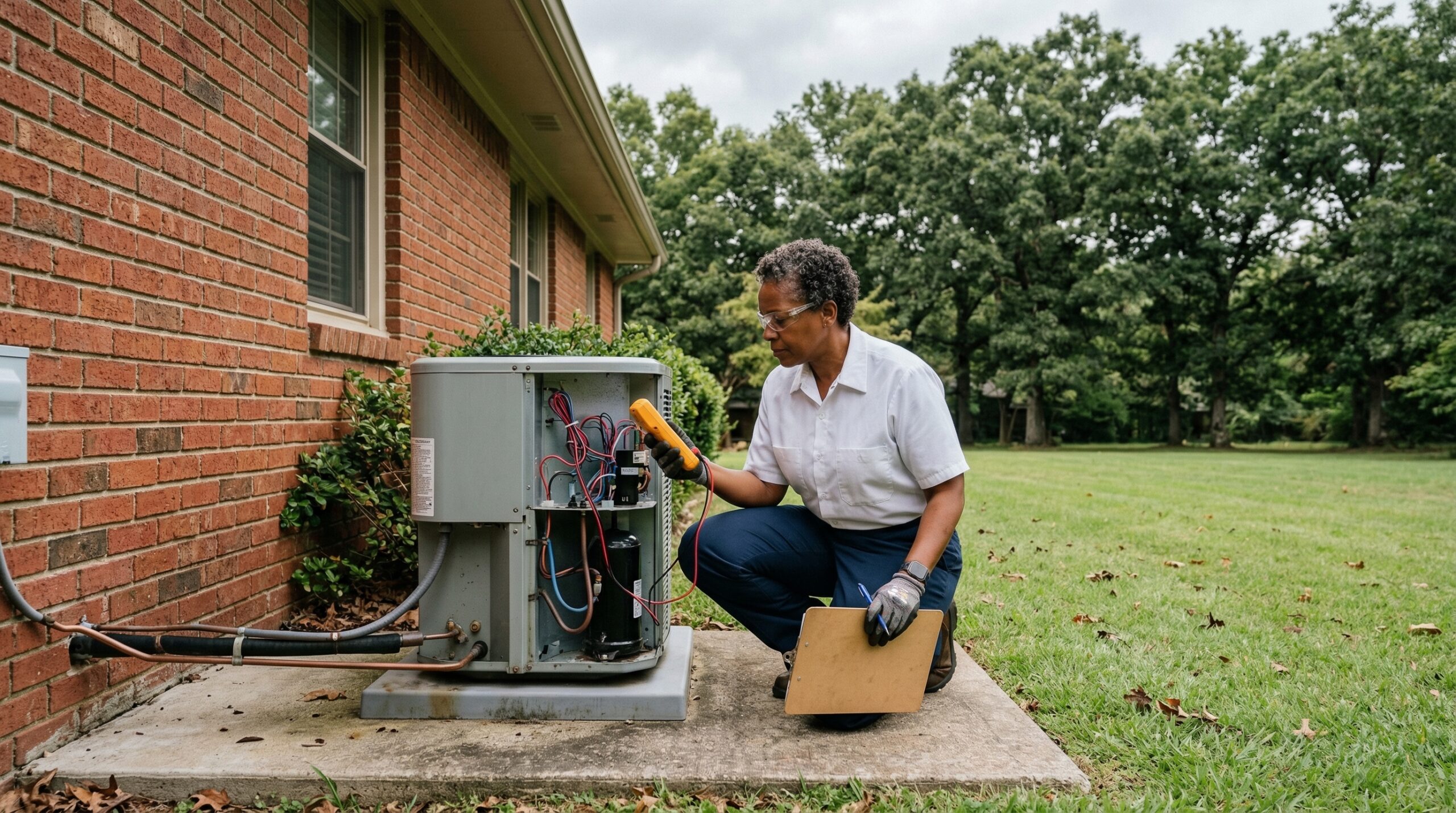
Arkansas homeowners replacing an HVAC system in 2026 face costs shaped by two distinct market forces: labor wages running 15 to 20 percent below the national average in most of the state, and a rapidly tightening labor market in Northwest Arkansas where the construction boom around Bentonville and Fayetteville has pushed prices closer to national norms. Knowing which part of the state you are in, which utility serves you, and which rebates you qualify for can shift your total installed cost by $1,500 or more.
TL;DR: Arkansas HVAC replacement costs range from $4,800 to $13,500 for a full system installed. Most of the state falls in ASHRAE Climate Zone 3A (warm-humid), with Northwest Arkansas in Zone 4A. Entergy Arkansas offers rebates of $300 to $500 on qualifying heat pumps, stackable with the federal IRA 25C tax credit up to $2,000. Most cities require a mechanical permit ($50 to $150). Use our HVAC cost estimator to get a personalized estimate.
What Does HVAC Replacement Cost in Arkansas?
The table below shows typical installed costs by system type for Arkansas homes. Prices include equipment, labor, permits, and basic refrigerant for a standard single-zone system in a 1,500 to 2,500 sq ft home.
| System Type | Arkansas Low | Arkansas Average | Arkansas High |
|---|---|---|---|
| Central AC (split system) | $3,100 | $5,200 | $8,000 |
| Gas furnace replacement | $2,000 | $3,400 | $5,800 |
| Heat pump (air-source) | $4,800 | $7,800 | $12,500 |
| Full AC + furnace combo | $4,800 | $8,500 | $13,500 |
| Ductless mini-split (per zone) | $2,200 | $3,400 | $5,000 |
Summer is peak demand season in Arkansas, particularly June through August when heat indices regularly exceed 105°F. Scheduling installation between November and February typically saves $300 to $700 compared to emergency summer replacements when contractors are fully booked.
How Do HVAC Costs Vary Across Arkansas Regions?
Arkansas is four distinct HVAC markets. Central Arkansas around Little Rock is the state’s benchmark; Northwest Arkansas has become significantly more expensive due to rapid growth; Fort Smith in the west tracks slightly below the state average; and Northeast Arkansas near Jonesboro runs the most affordable in the state due to lower labor costs in the Delta region.
| Region | Central AC Installed | Heat Pump Installed | Full System (AC + Furnace) |
|---|---|---|---|
| Little Rock metro | $4,500–$8,500 | $5,800–$11,500 | $6,500–$10,500 |
| Fayetteville/NW Arkansas | $4,800–$9,500 | $6,200–$12,500 | $7,000–$12,000 |
| Fort Smith metro | $4,200–$8,000 | $5,500–$11,000 | $6,000–$10,000 |
| Jonesboro/NE Arkansas | $4,000–$7,800 | $5,400–$10,500 | $5,800–$9,800 |
Northwest Arkansas has seen HVAC technician wages climb 15 to 20 percent over the past five years as Walmart’s supplier network expansion, Tyson Foods growth, and tech company relocations have driven a regional construction boom. If you are in the Bentonville, Rogers, or Springdale area, expect to pay closer to national average pricing rather than the traditionally lower Arkansas rates. For a deep dive into the Little Rock market, see our Little Rock HVAC replacement cost guide.
What Drives HVAC Costs in Arkansas?
Arkansas HVAC costs run 15 to 20 percent below the national average in most of the state, shaped by these five factors:
- Labor market variation: Most of Arkansas benefits from below-average HVAC labor costs, roughly $19 to $23 per hour statewide according to BLS Occupational Employment data. Northwest Arkansas is the exception, where the construction boom has pushed wages to $22 to $26 per hour, narrowing the cost advantage versus national averages.
- Climate zone and system sizing: Central and south Arkansas homes in Zone 3A typically need a 3-ton or 3.5-ton system to handle the long, hot, humid summers. Northwest Arkansas homes in Zone 4A often need more heating capacity, which increases system size and favors heat pump or dual-fuel configurations.
- Heat pump viability: Arkansas’s climate supports heat pump operation year-round in most of the state. Central and southern Arkansas rarely sees sustained temperatures below 20°F, making standard heat pumps efficient throughout winter. Northwest Arkansas can see colder winters where a cold-climate heat pump or dual-fuel system provides a backup advantage.
- Permit requirements: Arkansas has no uniform statewide permit mandate, but most major cities require mechanical permits for HVAC replacement. Permit fees of $50 to $150 are typically included in contractor quotes. Confirm permit inclusion when comparing bids.
- Ductwork condition: Arkansas’s high summer humidity accelerates duct degradation, particularly in older homes with flex duct in unconditioned attics. Homes with poorly sealed or aging ductwork frequently need duct repairs alongside HVAC replacement, adding $800 to $3,500 to the total project cost. See our guide to ductwork replacement costs.
Which Cities Have Dedicated HVAC Pricing Guides in Arkansas?
These city pages cover local utility rebates, specific permit requirements, and labor market data for each metro area.
| City | Typical Full System Cost | Primary Equipment | Local Detail |
|---|---|---|---|
| Little Rock | $6,500–$10,500 | AC + furnace, heat pump | Entergy Arkansas territory, City of Little Rock permit required, Zone 3A |
Additional city guides for Fayetteville, Fort Smith, Jonesboro, and Conway are in development. For now, use the statewide ranges in the tables above as your planning baseline, and use our HVAC cost estimator for a personalized estimate based on your home’s size and system type.
What Arkansas Utility Rebates and Incentives Are Available?
Arkansas homeowners have access to utility rebates from their electricity provider and federal tax credits through the Inflation Reduction Act. The programs vary by utility, so which one applies to you depends on who serves your address.
Entergy Arkansas Rebates
Entergy Arkansas serves approximately 700,000 residential customers across central, south, and much of northeast Arkansas. Through its Home Energy Solutions program, Entergy Arkansas offers rebates for qualifying high-efficiency HVAC equipment:
- Heat pump rebates: $300 to $500 for qualifying air-source heat pumps (SEER2 at or above 15.2, HSPF2 at or above 7.5)
- Central AC rebates: up to $200 for qualifying units with SEER2 at or above 16
- Applications are submitted after installation through your contractor or directly at Entergy Arkansas Home Energy Solutions program page
- Rebate amounts and program availability can change; always verify current offers before purchasing equipment
SWEPCO (Fort Smith and Western Arkansas)
Southwestern Electric Power Company (SWEPCO) serves Fort Smith and communities in western Arkansas. SWEPCO offers home energy efficiency incentives including HVAC equipment rebates. Amounts vary by efficiency tier. Visit swepco.com and navigate to residential energy efficiency programs for current details and qualifying equipment lists.
IRA 25C Federal Tax Credit
All Arkansas homeowners qualify for the Inflation Reduction Act Section 25C Energy Efficient Home Improvement Credit, regardless of which utility serves them. The credit covers 30 percent of the qualified cost of a heat pump, up to $2,000 per year. Key details:
- Applies to qualifying air-source heat pumps (SEER2 at or above 15.2, HSPF2 at or above 7.5, EER2 at or above 12.5)
- Stackable with Entergy Arkansas or SWEPCO rebates (you can claim both)
- File IRS Form 5695 with your federal return the year of installation
- The $2,000 annual cap is per taxpayer per year; it resets each year
See our full guide to HVAC tax credits and rebates for a complete breakdown of IRA incentives and how to maximize your combined savings.
Which HVAC Equipment Works Best in Arkansas’s Climate Zones?
The right HVAC system for your Arkansas home depends on which climate zone you are in. Arkansas spans two primary ASHRAE zones with meaningfully different heating and cooling demands.
Zone 3A: Central, South, and Northeast Arkansas
Most of Arkansas falls in ASHRAE Zone 3A: warm and humid. Little Rock, Pine Bluff, Fort Smith, Conway, and Jonesboro all sit in this zone. Summers are long and hot, with heat indices above 105°F being common. Winters are mild but include periodic ice storms and cold snaps that require reliable heating. Zone 3A favors:
- Central AC plus gas furnace combos (most common system type for existing homes)
- Air-source heat pumps (efficient year-round; winters rarely cold enough to require auxiliary heat for extended periods)
- Ductless mini-splits for additions or rooms with no existing ductwork
Zone 4A: Northwest Arkansas (Ozark Plateau)
The Fayetteville, Bentonville, Rogers, and Springdale area sits in ASHRAE Zone 4A: mixed-humid. Elevation in the Ozark Plateau produces cooler winters than the rest of Arkansas, with more sustained periods below 30°F. Zone 4A considerations:
- Cold-climate heat pumps (rated to operate efficiently at outdoor temperatures as low as -13°F) are well-suited to Zone 4A
- Dual-fuel systems (heat pump plus gas furnace backup) add $1,500 to $3,000 over a straight AC replacement but provide maximum cold-weather reliability
- Gas furnace demand is higher in NW Arkansas than elsewhere in the state
For a comparison of heat pump versus central AC for Arkansas’s mixed climate, see our heat pump versus AC cost guide.
Do Arkansas Cities Require Permits for HVAC Replacement?
Arkansas has no statewide permit requirement for HVAC replacement, but most cities and counties require a mechanical permit. Here are the requirements for the state’s largest markets:
- Little Rock: Mechanical (HVACR) permit required from City of Little Rock Building Services. Approximate cost $75 to $150. Inspection required after installation.
- Fayetteville: Permit required from City of Fayetteville Development Services. Approximate cost $50 to $125.
- Fort Smith: Permit required from Fort Smith Building Safety department. Approximate cost $50 to $100.
- Jonesboro: Permit required from the City of Jonesboro permits office. Approximate cost $50 to $100.
- Conway: Permit required. Contact City of Conway Building Services for current fees.
- Unincorporated rural areas: Requirements vary by county. Many rural counties do not require permits, but some do. Check with your county building department if you are outside city limits.
Permit fees are typically included in contractor quotes. Always ask for written confirmation that permits are included when comparing bids. Pulling a permit provides a record of the installation and ensures inspections catch any deficiencies in the work.
For neighboring Midwest state pricing, see our Iowa HVAC replacement cost guide, which covers cold-climate Zone 5A systems and MidAmerican Energy rebate programs.
Frequently Asked Questions About Arkansas HVAC Replacement Cost
What is the average HVAC replacement cost in Arkansas?
A full HVAC system replacement (central AC plus furnace) in Arkansas averages $6,500 to $10,500 for most homes, with the statewide range running $4,800 to $13,500 depending on system type, home size, and location. Northwest Arkansas (Fayetteville, Bentonville) runs at the higher end of that range due to the area’s construction-driven labor market. Rural areas and smaller markets in the Delta and River Valley regions tend to fall at the lower end.
Does Entergy Arkansas offer heat pump rebates?
Yes. Entergy Arkansas’s Home Energy Solutions program offers rebates on qualifying heat pump equipment. The current rebate structure includes:
- $300 to $500 for qualifying air-source heat pumps (SEER2 at or above 15.2, HSPF2 at or above 7.5)
- Up to $200 for qualifying central AC units (SEER2 at or above 16)
- Applications processed after installation through the Entergy Arkansas Home Energy Solutions program
Verify current rebate amounts before purchasing, as program terms can change annually.
Do I need a permit to replace HVAC in Arkansas?
It depends on your location. Arkansas has no uniform statewide permit mandate, but most cities and incorporated areas require a mechanical permit for HVAC replacement. Little Rock, Fayetteville, Fort Smith, Jonesboro, and Conway all require permits. Rural and unincorporated areas vary by county. Your contractor should know the local requirements and pull the permit as part of the job. Always confirm permit inclusion in writing when comparing quotes.
Is a heat pump a good choice for Arkansas’s climate?
Yes, for most of Arkansas. Central and south Arkansas (Zone 3A) rarely sees sustained temperatures below 20°F, making a standard air-source heat pump efficient year-round with little or no auxiliary heat needed. Northwest Arkansas (Zone 4A) benefits from a cold-climate heat pump rated for lower temperatures, or a dual-fuel system for maximum cold-weather comfort. Heat pumps are particularly attractive in Arkansas because they qualify for both Entergy Arkansas rebates and the IRA 25C federal tax credit, reducing the upfront cost premium compared to a standard AC plus furnace setup.
How does Arkansas HVAC pricing compare to neighboring states?
Arkansas HVAC costs are below the national average but broadly similar to neighboring states. Compared to the region:
- Tennessee: Similar statewide range ($5,400 to $13,100). Tennessee has stronger TVA EnergyRight rebate infrastructure, while Arkansas relies more on individual utility programs. See the Tennessee HVAC cost guide for comparison.
- Texas: Texas pricing varies more widely (Dallas runs 10 to 15 percent above Little Rock rates; rural East Texas is similar). Texas has no state rebate program beyond utility-level incentives.
- Oklahoma and Missouri: Generally similar cost structure, with labor in those states close to Arkansas averages.
Can I stack Entergy Arkansas rebates with the federal 25C tax credit?
Yes. The IRA Section 25C tax credit is a federal program that does not reduce or exclude state or utility rebates. If your heat pump qualifies for both an Entergy Arkansas rebate ($300 to $500) and the 25C credit (30 percent of equipment cost, up to $2,000), you can claim both. A qualifying heat pump installed for $7,500 could yield $500 in utility rebates plus $2,000 in federal tax credits, bringing the effective cost down to approximately $5,000. Always confirm equipment qualifications with your contractor before purchase.
What size HVAC system does an Arkansas home need?
Most Arkansas homes in the 1,500 to 2,500 sq ft range need a 3-ton to 3.5-ton system. The correct size depends on your specific home’s insulation, window area, orientation, and duct condition. An oversized system short-cycles, causing humidity problems in Arkansas’s moist climate. An undersized system runs continuously without reaching setpoint during July heat waves. Ask your contractor for a Manual J load calculation before committing to equipment size.
When you are ready to compare estimates, use our HVAC replacement cost estimator to build a personalized baseline, then see our guide on how to read HVAC quotes to evaluate contractor bids with confidence.