
Get a quote for adding zones to your HVAC system and you might see anything from $2,000 to $15,000 for what sounds like the same job. The range isn’t a mistake. “Zoning” can mean retrofitting motorized dampers into existing ductwork, installing a brand-new ductless mini-split system, or something in between. Contractors price these very differently, and some homeowners genuinely don’t need zoning at all.
This guide breaks down what zoning actually costs by component, by zone count, and by system type, so you can evaluate quotes with confidence and decide whether the investment makes sense for your home.
TL;DR: Adding zoning to a ducted HVAC system costs $2,000–$5,000 installed, or $350–$500 per additional zone beyond the first. Ductless mini-split zoning runs $4,500–$15,000 depending on zone count. Zoning makes financial sense for 2-story homes, homes with persistent hot or cold spots, or households where family members need different temperatures in different rooms. Use our free HVAC cost estimator to size your full-system budget alongside a zoning upgrade.
How Much Does an HVAC Zoning System Cost?
A ducted HVAC zoning system costs $2,000–$5,000 installed for most homes, according to Air Doctor Tulsa (2025), with Angi’s 2026 data placing the broader range at $1,500–$8,500 and the national average around $3,000. Adding a second zone to an existing system runs $1,700–$2,800, with each additional zone costing $350–$500 beyond that, per HomeGuide (2025).
What drives the wide range? Three factors account for most of the variance:
- Zone count — Each zone adds a motorized damper, thermostat, and wiring. A 2-zone job is straightforward; a 4-zone retrofit in an older home with limited attic access can take two full days.
- Existing ductwork condition — Ductwork that’s already leaking, undersized, or poorly laid out adds $500–$1,500 in prep work before zoning components can even be installed.
- Control board brand — A Honeywell TrueZone panel runs $216–$260; a higher-end multi-zone board from iO HVAC Controls can run $525–$720. The panel cost is a small fraction of total job cost, but it does vary.
The table below shows typical installed costs by zone count for a ducted retrofit on an existing forced-air system in good condition:
| Zone Count | Typical Installed Cost | Best For |
|---|---|---|
| 2 zones | $1,700–$2,800 | 2-story homes, upstairs/downstairs split |
| 3 zones | $2,500–$4,000 | 2-story + finished basement |
| 4 zones | $3,200–$5,500 | Large 2-story or complex floor plan |
| 5+ zones | $4,500–$8,500 | Whole-home custom zoning |
Source: Angi 2026, HomeGuide 2025. Costs assume existing ductwork in good condition and a single forced-air system.
One thing these numbers don’t always include: the bypass duct. More on that in the hidden costs section below, because it’s the item that surprises most homeowners after they’ve already signed a contract.
What Does Each Zoning Component Cost?
Three cost buckets make up a ducted zoning system: motorized dampers ($100–$300 each), a zone control panel ($200–$600), and programmable thermostats ($50–$250 each), per Jacobs Heating (2023). Labor typically adds $500–$1,200 depending on job complexity and local rates.
Here’s what each component does and what it actually costs at the supply house:
Zone Dampers
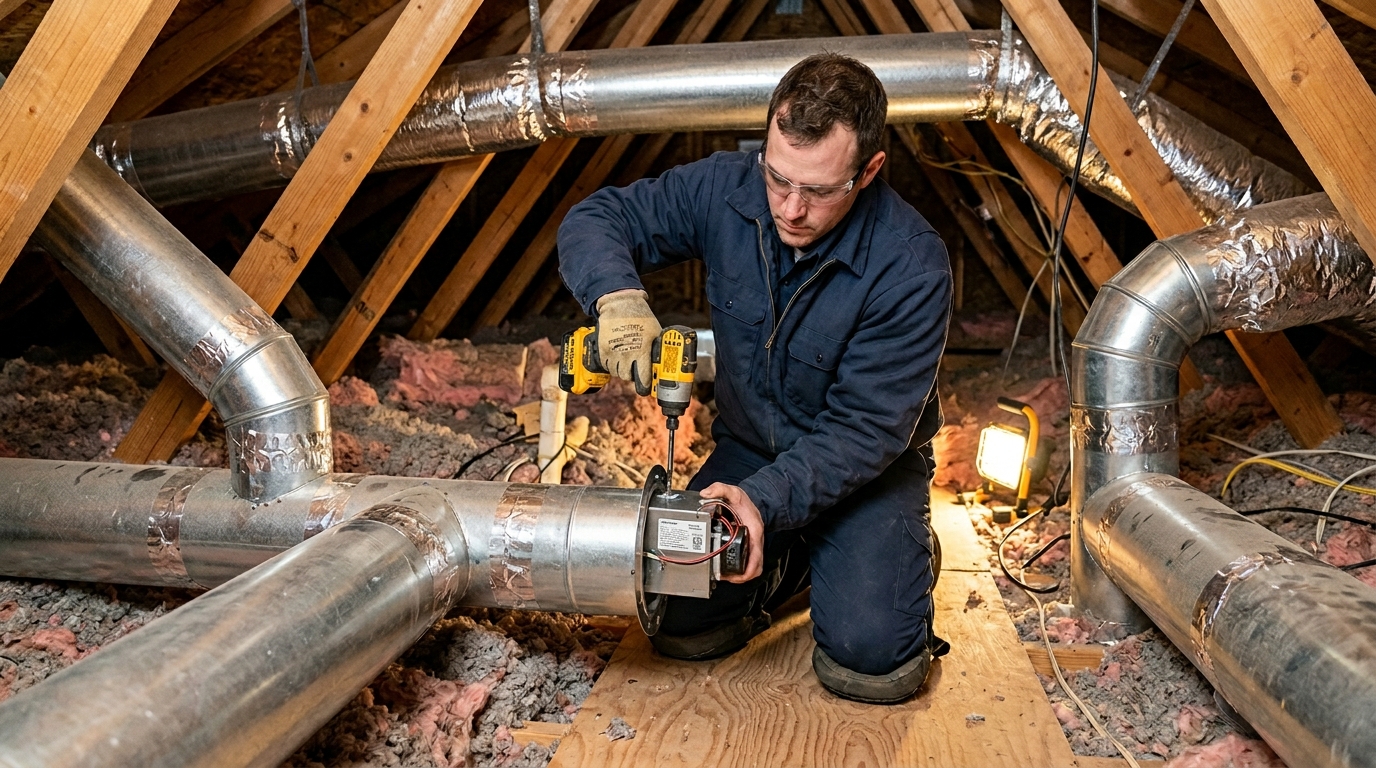
Motorized dampers are metal plates inside your ductwork that open and close based on thermostat demand. A residential round damper runs $80–$180 at supply; rectangular duct dampers for larger trunk lines run $120–$300. Most 2-zone retrofits need 2–4 dampers depending on duct layout. Labor to cut the duct, install, and wire each damper runs $75–$150 per unit.
Zone Control Panel
The control panel is the brain of the system. It receives calls from each zone’s thermostat, coordinates damper positions, and protects the system from running with too many zones closed at once. Common brands include Honeywell TrueZone (2-zone panel: $217; 4-zone: $260) and iO HVAC Controls ZP series ($165–$720 depending on zone count and stage compatibility). For a two-stage or variable-speed system, confirm the panel supports multi-stage operation before purchasing.
Thermostats
Each zone gets its own thermostat. A basic programmable unit runs $50–$100; smart thermostats (Ecobee, Nest) run $150–$250 each. If you have four zones and want smart control in every room, that’s $600–$1,000 in thermostats alone before installation. Wiring runs from each thermostat back to the control panel; in a finished home, fishing new low-voltage wire through walls adds $50–$150 per run.
How Much Does Ductless Zoning (Mini-Split) Cost?
Ductless mini-split zoning costs $4,500–$15,000 depending on the number of zones, per Della Home (2025). A 2-zone system (one outdoor unit, two indoor air handlers) runs $4,500–$7,500 installed; a 4-zone system runs $8,000–$12,000; and a 5-zone system reaches $10,000–$15,000.
Mini-splits are fundamentally different from damper-based zoning. Each indoor head is an independent air handler. Zones don’t interact through ductwork, so there’s no static pressure problem and no bypass duct requirement. That simplicity comes at a higher upfront cost but with meaningful long-term efficiency advantages.
Mini-splits make more sense than ducted zoning when:
- The home has no existing ductwork (new addition, garage conversion, sunroom)
- Existing ductwork is in poor condition and would need replacement anyway
- You want room-level control independent of a central system
- The home is in a climate where a heat pump’s efficiency advantage is significant
For most homes that already have working ductwork, the ducted damper approach costs $3,000–$8,000 less upfront. Whether mini-splits pay back that gap over time depends heavily on your local electricity rates and how many hours per year you’re actually using the system. See our two-stage vs. single-stage HVAC cost guide for pairing mini-split zoning with the right compressor type.
Is HVAC Zoning Worth the Investment?
Zoning is worth it for roughly half of homes that ask the question, and oversold to the other half. The U.S. Department of Energy estimates that targeted HVAC zoning can reduce energy costs by up to 30% compared to a single-zone system running the whole house to one set point. For a home spending $2,000–$2,500 per year on HVAC, that’s $600–$750 in annual savings and a payback period of 4–7 years on a $3,000 zoning install.
Homes that see the clearest return:
- 2-story homes where the upstairs runs 5–10 degrees warmer than downstairs in summer
- Homes with a finished basement or bonus room that only gets used part of the time
- Houses with a room that faces south or west and heats up faster than the rest of the home
- Households where family members keep different schedules and disagree on temperature
Homes where zoning is genuinely unnecessary:
- Well-insulated single-story homes with no comfort complaints
- Small homes under 1,200 square feet where a single zone can maintain comfortable temps throughout
- Homes where the real problem is duct leakage or insufficient insulation (fixing those will cost less and solve more)
If your primary goal is comfort on a 2-story home and you’re already replacing the HVAC system, adding zoning at installation costs $500–$1,000 less than retrofitting later. The contractor is already in the attic, the ductwork is already exposed, and the control wiring runs easily before drywall goes back up. That timing makes it the most cost-effective entry point into zoning. For help sizing the full system, see our guide on what size HVAC you actually need.
What Are the Hidden Costs of HVAC Zoning?
The most common surprise cost in HVAC zoning is the bypass duct, which runs $300–$600 and is required on any single-stage system. When multiple zones close their dampers simultaneously, the blower has nowhere to push air. Without a pressure-relief bypass, static pressure spikes inside the air handler, overheating the heat exchanger, stressing the blower motor, and accelerating system wear.
Most published cost estimates for HVAC zoning don’t include the bypass duct. Most contractors who sell cheap zoning jobs don’t install one either. Ask any contractor you’re evaluating: “Does your quote include a bypass duct or pressure relief damper?” If it doesn’t, add $300–$600 to their price.
Other costs that often aren’t in the headline quote:
- Thermostat wiring — $50–$150 per run in finished walls; more in multi-story homes
- Mechanical permit — Most jurisdictions require one for HVAC modifications; typically $50–$150
- Ductwork sealing or repairs — If your ducts are already leaking 20–30% of conditioned air (per DOE estimates), zoning an imperfect system delivers less than the promised savings
- Damper replacement down the line — Motorized dampers last 10–15 years; budget $100–$300 per damper for eventual replacements
The bypass duct is the one item that separates a correctly installed zoning system from one that will degrade your HVAC over time. It’s not optional on single-stage equipment, regardless of what a contractor tells you.
How Many Zones Does My Home Need?
Most homes need 2–4 zones. The practical rule is one zone per floor, plus additional zones for any space with extreme temperature variance, per NETR Inc.. For square footage guidance:
| Home Size | Recommended Zones | Typical Setup |
|---|---|---|
| 1,000–1,300 sq ft | 2–4 | Main floor + upstairs, or by wing |
| 1,400–1,600 sq ft | 3–5 | Two floors + master suite or basement |
| 1,700–2,000 sq ft | 4–6 | Multiple floors + specialty rooms |
| 2,000–5,000 sq ft | 6–8 | Full whole-home zoning |
Source: NETR Inc., adjusted for ducted systems.
For most 2-story homes in the 1,500–2,500 square foot range, a 2-zone or 3-zone setup handles 90% of the comfort problem at the lowest installed cost. The upstairs and downstairs behave like two separate systems without the expense of a full zone-per-room approach. Attics that are converted to living space and basements used as bedrooms or home offices are the most common reasons to add a third zone.
Adding more zones than your system can efficiently serve creates diminishing returns. A 3-ton single-stage unit wasn’t designed to run one zone at a time. Check with your contractor that the proposed zone count is compatible with your existing equipment’s minimum airflow requirements before committing to a specific plan.
Ducted Zoning vs. Mini-Split: Which Costs Less Over Time?
Ducted zoning is cheaper upfront ($2,000–$5,000 vs. $4,500–$15,000 for mini-splits), but ductwork loses 20–30% of conditioned air through leaks and conduction losses before it reaches the room, per U.S. Department of Energy data. Mini-splits deliver conditioned air directly into the space with no duct loss. That efficiency gap matters most in climates with long summers or winters.
A rough 10-year comparison for a typical 2-story home:
- Ducted zoning retrofit: $3,000 upfront, ~10–15% energy reduction from targeted conditioning, payback in 5–7 years
- 2-zone mini-split: $6,000 upfront, ~25–35% energy reduction from eliminated duct losses + heat pump efficiency, payback in 8–12 years
The gap narrows in homes where existing ductwork is already tight and well-insulated. It widens in homes with older leaky ductwork where mini-splits would avoid the losses entirely. Neither system is the universal winner; the best choice depends on your ductwork condition, climate zone, and how long you plan to stay in the home.
For a full breakdown of what drives HVAC system costs from equipment through labor, see our HVAC replacement cost breakdown. If efficiency ratings are driving your decision between ducted and ductless, our HVAC efficiency ratings cost guide covers the SEER2 and HSPF2 numbers that determine real-world performance.
Frequently Asked Questions
How much does it cost to add a second zone to my existing HVAC?
Adding a second zone to an existing ducted system costs $1,700–$2,800 for a standard retrofit, including motorized dampers, the zone control panel, and one additional thermostat. Labor typically runs $500–$1,000 of that total. If your ductwork needs repairs or a bypass duct isn’t included in the quote, budget an additional $300–$600 on top.
Can any HVAC system be zoned?
Most forced-air ducted systems can be zoned, but compatibility matters. Variable-speed and two-stage systems work best with zoning because they modulate output as zones close. Single-stage systems require a bypass duct to handle static pressure when multiple zones shut simultaneously. Here are the key considerations:
- Variable-speed and two-stage systems: good candidates, modulate output naturally
- Single-stage systems: workable with bypass duct installed; skip the bypass and you risk air handler damage
- Systems older than 15 years: may need ductwork updates before zoning is viable
- Ductless mini-splits: already zoned by design, no retrofit needed
Is HVAC zoning worth it for a 2-story home?
Yes. Two-story homes are the strongest use case for HVAC zoning. Heat rises, so upper floors typically run 5–10 degrees warmer in summer and 5–8 degrees cooler in winter than lower floors. A 2-zone upstairs/downstairs setup costs $2,000–$3,500 installed and can reduce HVAC runtime by 20–30%, with full payback in 4–6 years at average energy rates.
What are the most common HVAC zoning problems?
Three problems account for the majority of zoning failures and complaints:
- No bypass duct installed: When all zones close simultaneously, static pressure spikes and damages the air handler. This is the most preventable and most common installation mistake.
- Damper motor failure: Motorized dampers last 10–15 years. A stuck-open or stuck-closed damper defeats the purpose of zoning and can go unnoticed for months.
- Oversized equipment: An oversized single-stage system short-cycles even without zoning. Add zone restrictions and the problem worsens. Correct HVAC sizing is a prerequisite for zoning to work properly.
How long does HVAC zoning installation take?
A standard 2-zone retrofit on an existing ducted system takes 4–8 hours for an experienced technician working in accessible ductwork. Jobs with 4 or more zones, difficult attic access, or ductwork modifications can stretch to 1–2 days. Installing zoning at the time of a new HVAC replacement cuts labor time by 30–50% compared to retrofitting later, because the system is already disassembled.
Does HVAC zoning require a permit?
Most jurisdictions require a mechanical permit for HVAC zoning work, typically $50–$150. Requirements vary: some counties only require permits when modifying the air handler or adding new ductwork; others require permits for any HVAC modification. Unpermitted work can complicate homeowner’s insurance claims and home resale inspections. Ask your contractor whether their quote includes the permit fee or whether it’s billed separately.
Bottom Line
Ducted HVAC zoning costs $2,000–$5,000 installed for most homes. Mini-split zoning runs $4,500–$15,000 depending on how many zones you need. The single best time to add zoning is during a new HVAC installation, when labor costs $500–$1,000 less than a standalone retrofit.
If you’re getting quotes, verify that each one includes a bypass duct, the zone control panel, thermostats for each zone, and the mechanical permit. That’s the complete scope of a properly installed ducted zoning system. Quotes that omit any of those items aren’t comparable to ones that include them.
Ready to budget the full project? Use our free HVAC cost estimator to get a baseline replacement cost, then add zoning on top. And before you sign with any contractor, get at least three quotes so you can see where the real variance lies in your local market. See our full HVAC replacement cost guide for what the complete system will cost alongside the zoning upgrade.
Missouri homeowners considering zoning upgrades can check the Missouri HVAC replacement cost guide for base replacement pricing in Kansas City and St. Louis before adding zoning costs on top.