
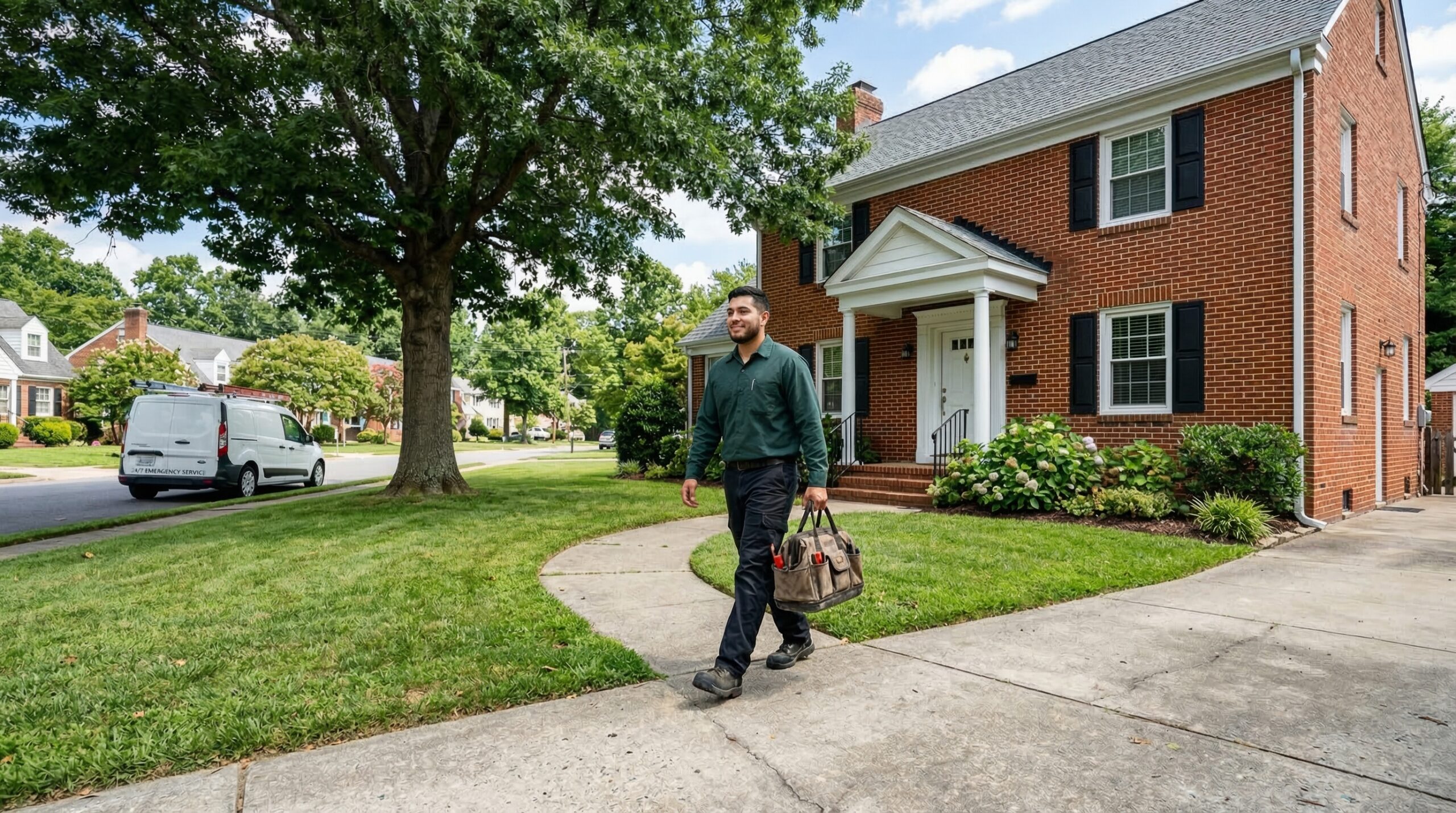
Richmond sits squarely in ASHRAE Climate Zone 4A, a mixed-humid region that demands a full HVAC system for both sweltering July heat (mean highs near 90°F) and cold January nights that can drop below 20°F. The city’s unique blend of century-old Fan District rowhouses and modern Henrico County subdivisions creates a wide range of replacement complexity, from straightforward swaps to full high-velocity retrofits in homes with narrow ductwork. This guide covers real Richmond pricing, Dominion Energy rebate options, permit requirements, and what makes this market different from nearby Charlotte and Raleigh.
TL;DR: Richmond homeowners typically pay $4,800–$14,000 for a full HVAC replacement depending on system type and home complexity. Climate Zone 4A means both heating and cooling capacity matter equally. Dominion Energy Virginia offers a Home Energy Evaluation program and income-qualified HVAC upgrades, while the federal IRA 25C tax credit adds up to $2,000 off a qualifying heat pump. A mechanical permit from the City of Richmond (804-646-4169) is required for all HVAC replacements. Get your personalized Richmond estimate here.
How Much Does HVAC Replacement Cost in Richmond, VA?
Based on current Richmond market data, here are typical installed costs for the most common system types:
| System Type | Low End | High End | Average Installed |
|---|---|---|---|
| Central AC only (3-ton) | $3,800 | $7,500 | $5,600 |
| Gas furnace only | $2,500 | $5,500 | $3,800 |
| Central AC + gas furnace | $6,500 | $14,000 | $9,500 |
| Heat pump (air-source, 3-ton) | $4,500 | $10,500 | $7,000 |
| Ductless mini-split (1 zone) | $2,000 | $5,500 | $3,500 |
| High-velocity system (historic homes) | $8,000 | $18,000 | $12,000 |
These ranges reflect all-in installed costs: equipment, labor, refrigerant, permits, and basic electrical work. They do not include ductwork replacement, which adds $3,000–$8,000 if your existing ducts are failing. Richmond labor rates track close to the Virginia statewide median for HVAC technicians: BLS 2024 data shows Richmond-area HVAC median wages at $59,690/year, nearly identical to the state median of $60,630/year.
What Drives HVAC Cost in Richmond?
Several factors specific to the Richmond market push costs up or down from national averages.
Climate Zone 4A — Balanced Heating and Cooling Demand
Richmond’s ASHRAE Climate Zone 4A designation means the city experiences meaningful heating demand (around 4,000 heating degree days annually) alongside significant cooling demand (roughly 1,400 cooling degree days). Unlike Charlotte, which sits closer to the Zone 3A/4A boundary with milder winters, Richmond’s winters demand a heating system with real capacity. This means most homeowners need a full HVAC system capable of both efficient cooling and cold-weather heating, rather than a cooling-dominant setup.
Home Age and Ductwork
Richmond’s historic neighborhoods (the Fan District, Church Hill, Oregon Hill, and Museum District) contain thousands of homes built before modern HVAC standards. These homes often have undersized ductwork, no central air at all, or systems shoehorned in during mid-century renovations. Replacing a standard system in a 1980s Henrico County ranch might run $7,000–$10,000. That same project in a 1920s Fan District Victorian could reach $14,000–$18,000 if the contractor needs to route ductwork through plaster walls or install a high-velocity system.
System Efficiency Rating
Virginia enforces 2021 IECC energy code, which sets minimum efficiency standards. A 14-SEER2 central air unit might cost $1,500–$2,000 less than a 18-SEER2 unit upfront. But Dominion Energy electricity rates in Richmond are roughly $0.12–$0.13 per kWh, and the efficiency premium often pays back within 5–8 years on a heavily-used Richmond cooling system. For heat pumps, high-efficiency cold-climate models (rated to 5°F or below) add $1,000–$2,500 upfront but eliminate the need for a gas backup in most Richmond winters.
Seasonal Timing
Richmond’s HVAC demand peaks hard in July and August (cooling) and December through February (heating). Scheduling replacement during shoulder seasons (March through May or September through November) typically saves 5–15% on labor because contractors have more availability. Emergency replacements during a July heat wave or a January cold snap will cost more and may involve longer wait times.
What Rebates Are Available for HVAC Replacement in Richmond?
Richmond homeowners have access to several layered incentive programs that can reduce out-of-pocket costs significantly.
Dominion Energy Virginia Programs
Dominion Energy Virginia serves most of the Richmond metro and runs a portfolio of efficiency programs through its domsavings.com portal. Key programs for HVAC replacement:
- Home Energy Evaluation: A free in-home assessment with a participating contractor identifies HVAC upgrades and energy-saving opportunities. This is the starting point for most Dominion rebate programs.
- Income and Age Qualifying (IAQ) Bundle: Qualifying customers (based on income or age) may receive HVAC system improvements at no cost, including heating and cooling upgrades.
- Smart Thermostat Rebate: $50 instant rebate on qualifying smart thermostats (Nest, ecobee, etc.) through Dominion’s marketplace.
- EnergyShare Weatherization: Customers receiving EnergyShare bill assistance are automatically eligible for no-cost home energy upgrades including HVAC improvements.
Call Dominion Energy at 888-366-8280 or visit dominionenergy.com to check current program availability and eligibility. Program terms change periodically. Verify before your installation.
Federal IRA Tax Credits
The Inflation Reduction Act offers two heat pump tax credit pathways for Richmond homeowners:
- Section 25C (Energy Efficient Home Improvement Credit): 30% of the cost of a qualifying air-source heat pump, capped at $2,000 per year. Equipment must meet CEE Tier 2 or ENERGY STAR Most Efficient criteria. This is a tax credit (reduces what you owe), not a rebate; you claim it when filing your federal return.
- Section 25D (Residential Clean Energy Credit): 30% of the cost of a qualifying geothermal heat pump with no annual cap. For Richmond’s geology, geothermal systems are feasible but require significant upfront investment ($20,000–$30,000+) before the credit.
In practice, most Richmond homeowners replacing a standard system with a qualifying heat pump can claim up to $2,000 through the 25C credit. Stack this with Dominion Energy programs and the total savings can exceed $2,500 on an eligible installation. Verify current program status with a licensed tax professional or at energystar.gov before your purchase.
Do You Need a Permit for HVAC Replacement in Richmond?
Yes. The City of Richmond requires a mechanical trade permit for all HVAC replacements, including like-for-like system swaps. The permit is issued through the Department of Planning and Development Review (PDR) at 900 E. Broad Street, Room 108 (phone: 804-646-4169). Most licensed HVAC contractors pull the permit on your behalf as part of the installation.
Richmond enforces the 2021 IECC energy code, which means your contractor must also submit REScheck energy analysis documentation and Manual D duct design calculations for the installation. This compliance paperwork is standard for licensed contractors. Ask to confirm it’s included in your quote. Unpermitted HVAC work can create issues when you sell the home or file an insurance claim.
Outside the city limits, Henrico County and Chesterfield County have their own permit offices but enforce the same Virginia statewide building code. Permit fees in the Richmond area for a typical HVAC replacement typically run $75–$200 depending on project value.
Heat Pump vs. Gas Furnace — What Works in Richmond’s Climate?
Richmond’s Climate Zone 4A sits at the sweet spot where heat pumps perform well for most of the heating season, and the IRA credit makes them significantly more affordable. Here’s how to think through the decision:
Standard Air-Source Heat Pumps
Traditional heat pumps lose efficiency as temperatures drop below 35–40°F. Richmond’s winter design temperature is 18°F (ASHRAE 99% heating), meaning the city does see nights where a standard heat pump alone would struggle. Historically, this made gas furnaces the preferred heating solution in Richmond. That calculus has changed with cold-climate heat pump technology. Modern units from Bosch, Mitsubishi, and Carrier can maintain rated capacity down to 5°F or -13°F, covering Richmond winters without gas backup.
Hybrid Dual-Fuel Systems
A popular solution for Richmond homeowners who already have a gas line: install a heat pump as the primary system and keep a gas furnace as backup for the handful of nights when temperatures drop below the heat pump’s rated range. This hybrid approach captures the IRA tax credit on the heat pump while maintaining gas heating efficiency for the coldest days. Cost: roughly $8,500–$15,000 installed for a full hybrid system.
Gas Furnace + Central AC
The traditional split system remains the most common Richmond installation. Columbia Gas of Virginia natural gas rates are competitive, and gas furnaces provide rapid, reliable heat during cold snaps. If your home already has gas service and you’re replacing a failed furnace mid-winter, a straight gas replacement is usually the fastest and least expensive path.
What About Historic Homes in Richmond?
Richmond’s Fan District, Church Hill, Oregon Hill, and Museum District neighborhoods contain thousands of pre-1950 homes: Victorian rowhouses, Federal-style townhouses, and craftsman bungalows that were never designed for modern central HVAC. These homes present specific challenges and cost premiums that suburban replacements don’t.
High-Velocity Systems
High-velocity systems (brands like Unico) use 2-inch flexible ducts that can be snaked through plaster walls, floor cavities, and attic spaces without major demolition. This preserves the historic character of the home while delivering modern comfort. Cost premium: $4,000–$8,000 over a standard installation. Worth getting multiple bids from contractors experienced with Richmond historic district work.
Ductless Mini-Splits
For smaller Fan District homes or additions, ductless mini-splits eliminate the ductwork problem entirely. A single-zone system serving a living area or bedroom runs $2,000–$5,500 installed. Multi-zone systems covering a whole rowhouse typically run $8,000–$16,000. Mini-splits qualify for the IRA 25C heat pump credit, making them financially attractive alongside the comfort benefit.
How Does Richmond Compare to Nearby Markets?
Richmond HVAC costs sit close to the Mid-Atlantic average. A comparison with nearby markets:
- Charlotte, NC: Similar price range ($5,000–$14,000 full replacement), slightly warmer winters (Zone 3B/4A boundary), Duke Energy rebates instead of Dominion Energy programs
- Raleigh, NC: Comparable to Richmond in cost and climate; both Zone 4A cities with competitive contractor markets and active utility rebate programs
- Washington DC metro: Significantly higher labor costs: HVAC technician wages in the DC market average $72,090 vs. Richmond’s $59,690 median. Expect to pay 15–25% more for comparable work if you cross into Northern Virginia.
Frequently Asked Questions
How much does a new HVAC system cost in Richmond, VA?
Most Richmond homeowners pay $4,800–$14,000 for a full HVAC replacement, depending on system type, home size, and ductwork condition. A standard central AC plus gas furnace replacement in a 2,000 sq ft Henrico County home typically runs $7,500–$11,000 all-in. Historic homes in the Fan District or Church Hill often add $3,000–$6,000 to that range due to ductwork complications.
What Dominion Energy rebates are available for HVAC in Richmond?
Dominion Energy Virginia offers several programs for Richmond-area homeowners. The Home Energy Evaluation provides a free in-home assessment with a participating contractor to identify HVAC efficiency upgrades. The Income and Age Qualifying (IAQ) Bundle provides free HVAC improvements to eligible lower-income or senior customers. A $50 smart thermostat rebate is available through the Dominion marketplace. Stack these with the federal IRA 25C credit (up to $2,000 for qualifying heat pumps) for maximum savings. Visit dominionenergy.com or call 888-366-8280 to check current eligibility.
Is a permit required for HVAC replacement in Richmond?
Yes. Richmond City requires a mechanical trade permit for all HVAC replacements, including like-for-like equipment swaps. Henrico and Chesterfield counties have the same requirement. Your licensed HVAC contractor should pull the permit on your behalf. Unpermitted installations can cause problems during home sales and insurance claims. The City of Richmond PDR can be reached at 804-646-4169.
Is a heat pump a good choice for Richmond’s climate?
Modern cold-climate heat pumps work well in Richmond’s Climate Zone 4A. The city’s winter design temperature of 18°F is within the operational range of current-generation cold-climate models from Mitsubishi, Bosch, and Carrier. For most of Richmond’s heating season (when temps stay above 25°F), a heat pump outperforms a gas furnace in operating efficiency. For the handful of nights with harder freezes, a hybrid dual-fuel setup (heat pump plus gas backup) or a cold-climate model rated to -13°F provides full coverage. The IRA 25C credit adds up to $2,000 in tax savings on qualifying installations, making the math favorable for many Richmond homeowners.
What is the best time of year to replace HVAC in Richmond?
Spring (March through May) and fall (September through November) are the best windows for HVAC replacement in Richmond. Contractor availability is higher during shoulder seasons, which often translates to shorter wait times and occasionally better pricing. Summer (June–August) demand peaks when systems fail during heat waves, and winter (December–February) emergency replacements carry premium pricing. If your system is aging but still functional, plan your replacement for spring or fall to maximize your options and negotiating leverage.
How does an older Richmond home affect HVAC replacement cost?
Significantly. Historic homes in the Fan District, Church Hill, Oregon Hill, and similar neighborhoods often have undersized ductwork or no central duct system at all. Standard replacement equipment may not fit these ducts. Contractors specializing in Richmond historic district work typically recommend one of three approaches:
- High-velocity systems (Unico) that route 2-inch flexible ducts through existing wall cavities without major demolition ($8,000–$18,000 total)
- Ductless mini-splits for individual rooms or zones ($2,000–$5,500 per zone installed)
- Partial duct upgrades where key runs are resized while keeping functioning sections
Get multiple bids from contractors who have experience with Richmond’s pre-WWII housing stock, as approach and cost vary significantly by contractor.
Get Your Richmond HVAC Estimate
Richmond’s four-season climate means your HVAC system works hard year-round. Whether you’re replacing a failed furnace in January or planning an upgrade ahead of summer, understanding your real costs (system type, home age, available rebates) puts you in a stronger position with contractors.
Use our free estimator to get a personalized Richmond cost range based on your home size, system type, and efficiency preferences. No email required, no contractor calls until you’re ready.
Get your free Richmond HVAC estimate now.
Heading to the coast? See how prices and salt-air factors change in our Virginia Beach HVAC cost guide, or return to the full Virginia HVAC cost overview.